
When Rome Burned Books
Ancient Rome did not burn books constantly. But when it did, the flames revealed what certain writings could do: authorize rites, predict the future, wound reputations, preserve memory, or prove dangerous truths.

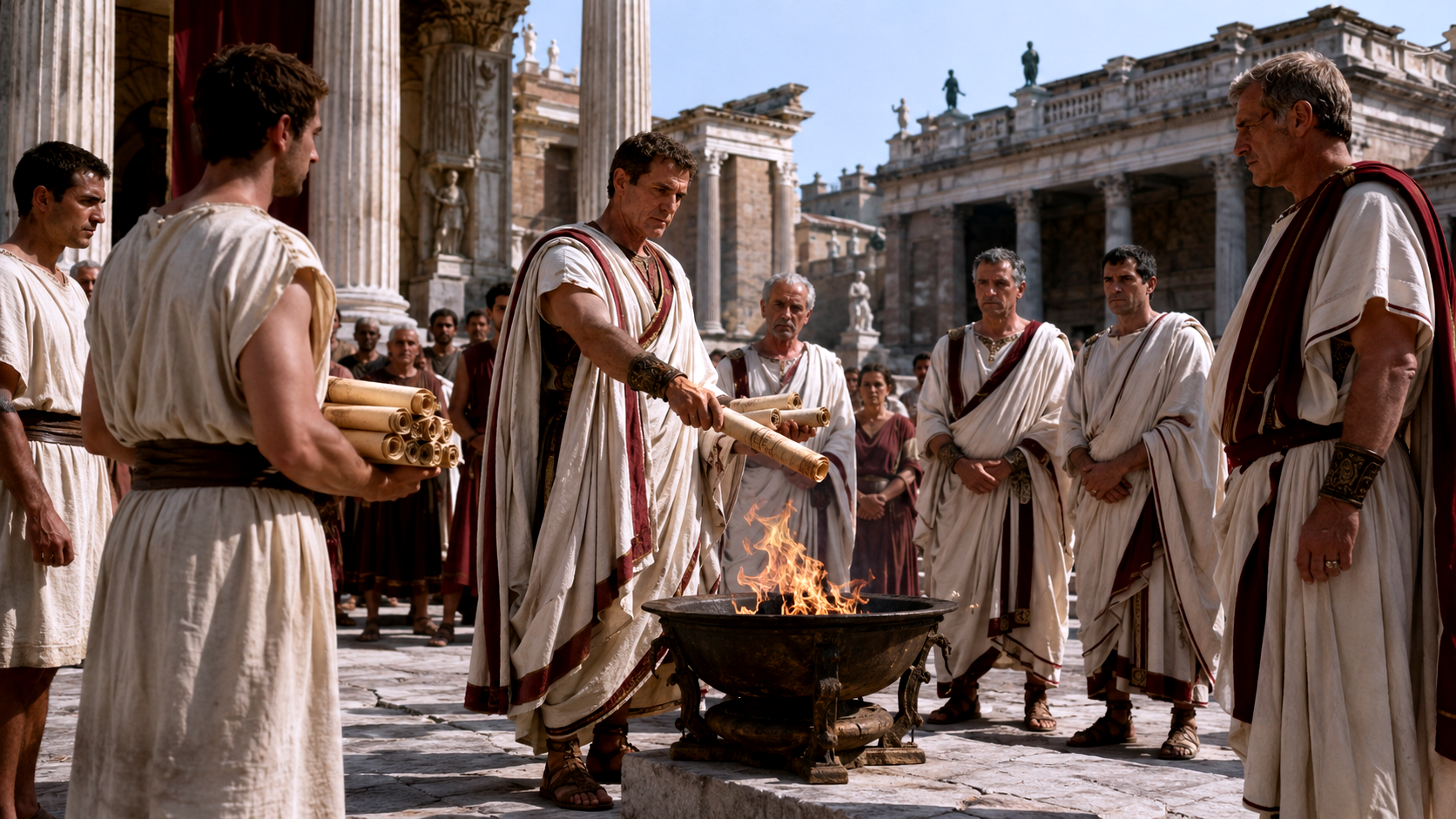
Rome was a world of writing. Laws, wills, contracts, letters, speeches, histories, poems, priestly rules, prophecies, financial accounts, and public records all moved through Roman life in written form. The city stored documents, copied books, preserved archives, and built elite education around reading, memory, and quotation. Writing was not an enemy of Roman power. It was one of its instruments. But not every written object had the same force.
A history could preserve admiration for men a regime wanted treated as traitors. A satire could injure a senator’s reputation. A prophetic book could claim access to a future not controlled by official religion. A ritual text could give private practitioners authority outside public supervision. A letter could implicate a conspirator. A debt record could bind a household. A will could decide an inheritance.
In such cases, writing was not merely writing. It could become memory, evidence, accusation, ritual authority, or political danger. That is why, in certain rare but striking cases, Roman authorities destroyed texts by fire.
The flames did not always work. Literary books could be copied, hidden, remembered, quoted, or made more intriguing because they had been condemned. Documents were different. A burned account, letter, or legal record could remove proof in a way that burning a history or poem often could not.
The Roman concern, then, was not simply with “books” as a single category. It was with what particular written things could do.
Rome Burned Writing, Not Just Books
The phrase “book burning” can mislead. It suggests a single act with a single meaning: a state destroys books because it hates ideas. Roman practice was more complicated.
Romans burned different kinds of writing. Some were literary works: histories, speeches, biographies, satires. Others were documents: letters, financial records, debt accounts, wills, and legal papers. The difference mattered.
A literary work might already have escaped the author’s hand. It could exist in more than one copy. Friends could preserve it. Readers could remember passages. Later writers could quote or summarize it. A decree might make possession dangerous, but it could not guarantee oblivion.
Documents worked differently. A letter, debt tablet, account, or official record could have power because of its physical existence. If that document was destroyed, the consequences could be practical. Evidence could vanish. A debt could be cancelled. A dangerous correspondence could disappear before it was used in court or politics.
So Roman text burning had two faces. Burning a book could be a public attempt to punish memory. Burning a document could be a practical attempt to remove evidence or obligation. That distinction is essential. Rome did not treat all writing alike.
The First Danger Was Religious Knowledge
The earliest Roman anxieties about written material were not mainly literary. They were religious.
In Roman public life, religion was not simply private belief. It was part of civic order. Rituals, sacrifices, vows, priesthoods, and traditional forms of consultation helped maintain the relationship between the community and the gods. A wrong ritual was not merely a mistake. A foreign or unauthorized practice could be seen as a threat to the safety of the state.
During the Second Punic War, with Hannibal in Italy and Rome under enormous strain, Livy describes a city troubled by foreign rites, soothsayers, and private religious practices. The authorities ordered the surrender of books of prophecies, prayers, and written sacrificial instructions.
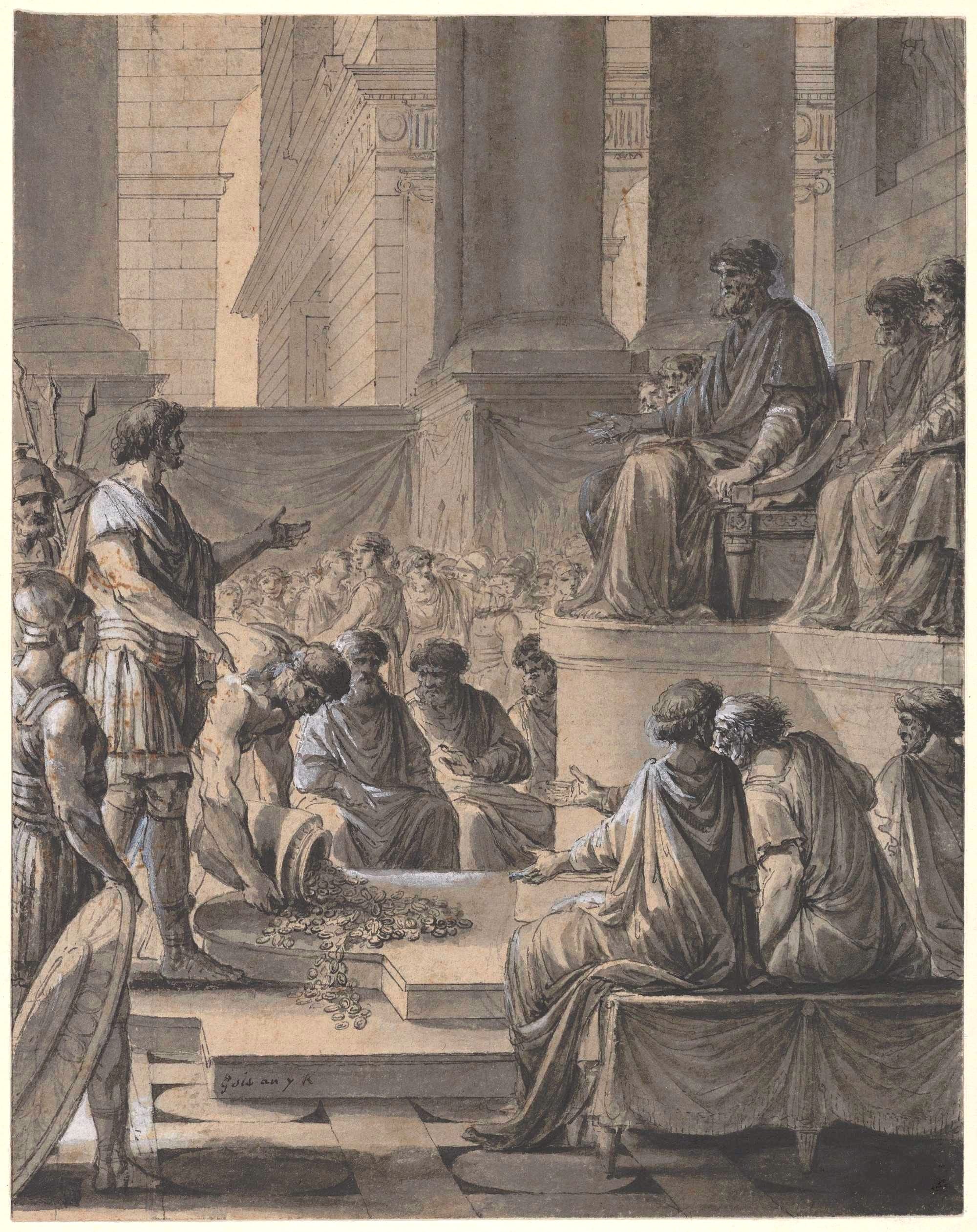
This episode must be handled carefully. It is not a secure case of book burning. The surviving account shows collection and control, not definite destruction by fire. But it shows the anxiety clearly. Written religious knowledge, when it circulated outside official supervision, could become a public problem. A prophecy could feed panic. A ritual formula could authorize a private specialist. A book of prayers or sacrifices could compete with civic religion.
Rome did not object to ritual because it was ritual. It objected when ritual seemed to escape the structures that made it acceptable to the Roman state. A few decades later, that concern produced one of the most famous burnings in Republican memory.
The Strange Books of King Numa
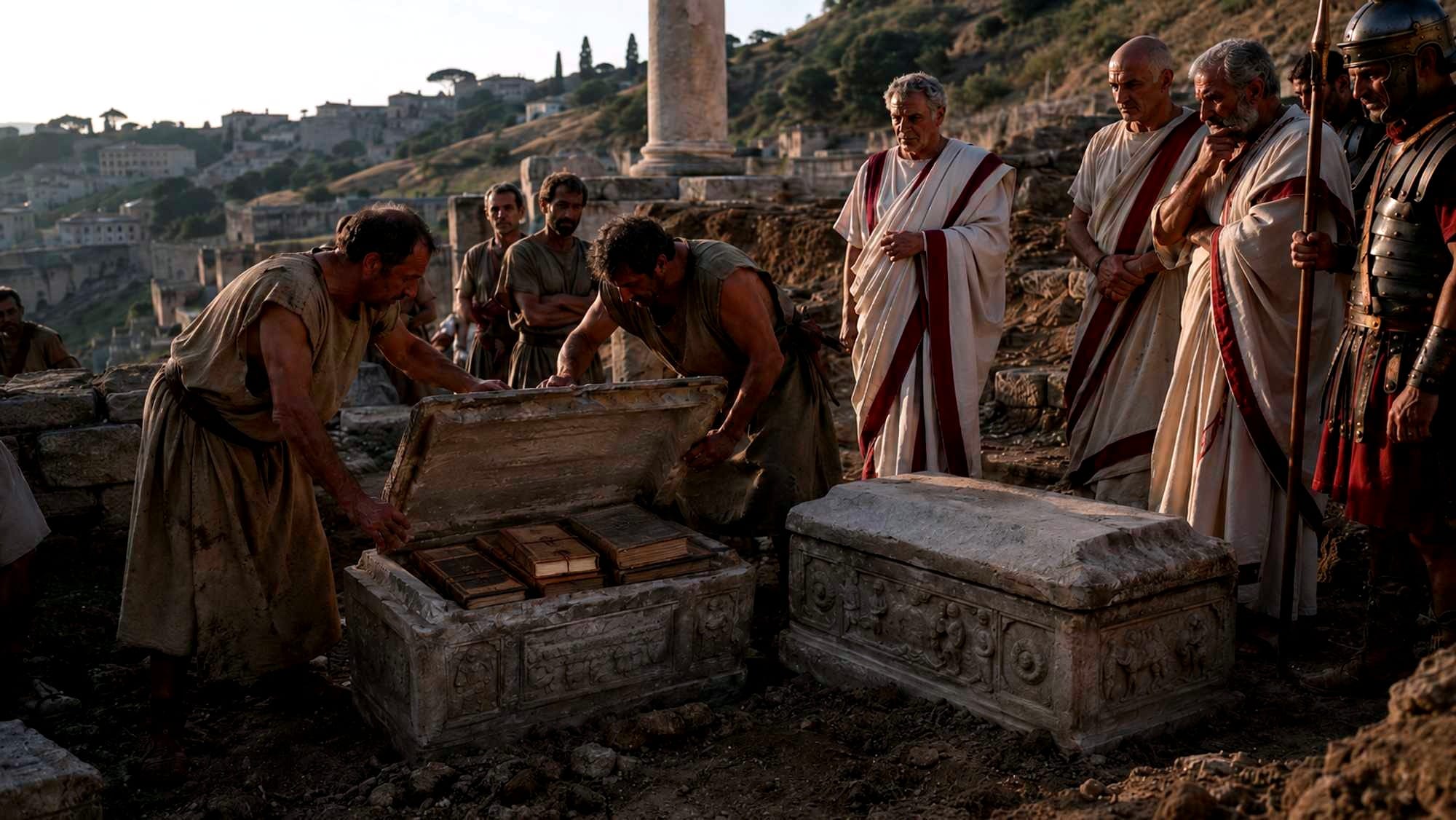
In 181 BC, workmen reportedly discovered two stone chests near the Janiculum. One was said to contain the body of Numa Pompilius, Rome’s legendary second king. The other contained books.
Numa was remembered as a founder of Roman sacred order. Tradition credited him with priesthoods, rites, and institutions that shaped the city’s relationship with the gods. A cache of books under his name should have been a treasure from Rome’s holiest past. Instead, it became dangerous.
Ancient accounts differ in detail, but the main story is clear. The books were examined and judged unsafe. Some were said to concern pontifical law. Others were in Greek and connected in some versions with Pythagorean teaching, although ancient writers knew the chronology was impossible: Numa could not truly have been a pupil of Pythagoras.
The exact contents cannot be recovered. The books were remembered not because later readers knew precisely what doctrines they contained, but because Roman authorities treated them as writings that might disturb established religion while claiming the authority of one of Rome’s sacred founders. The Senate ordered them burned.
They were burned publicly in the comitium, in the political and civic heart of Rome. Some accounts say sacrificial attendants prepared the fire. This was not private disposal. It was a public act, almost ritual in form, declaring that these writings had crossed a religious boundary.
If books could speak in Numa’s name, they could challenge the memory of Numa. They could appear to reveal a hidden version of Roman religion. They could place sacred authority in suspicious texts rather than in the public institutions that claimed to inherit his tradition. The fire protected not only ritual practice, but official sacred memory.
Augustus and the Control of Prophecy
The same problem returned under Augustus, but in a new political world. After decades of civil war, Augustus presented himself as the restorer of Roman order. He rebuilt temples, revived priesthoods, renewed old rituals, and placed religious conservatism at the center of his public image. After he became pontifex maximus, he also acted against unauthorized prophetic books.
Ancient testimony says Augustus collected and burned more than two thousand prophetic writings in Greek and Latin. Yet he did not destroy prophecy as such. He preserved selected Sibylline material and placed it under official control. That distinction is the key.
Rome did not reject prophecy when Rome controlled it. It rejected prophetic authority that circulated outside approved channels. Official prophetic books could be guarded, selected, and consulted by public authority. Unofficial books were different.
They could circulate through private hands. They could feed expectation, panic, or ambition. They could claim to reveal what the gods had decided without passing through the state’s religious mechanisms.
In the age of Augustus, the future was political. Who would rule? Would civil war return? Would the new order last? How long would the princeps live? A prophecy was not harmless curiosity if it touched succession, dynasty, or public fear.
Augustus’ burning of prophetic books was therefore not a rejection of sacred writing. It was an act of selection. Some prophetic material was preserved because it belonged to Rome’s official religious order. Other texts were destroyed because they did not. To control prophecy was to control the public imagination of the future.
When Writing Became Political
Under the early emperors, burning moved from religious and prophetic texts into another field: histories, speeches, satire, reputation, and treason.
One of the earliest important cases was Titus Labienus, an Augustan-era orator and writer, not Caesar’s former lieutenant of the same name. He was known for fierce language and attacks on powerful men. His writings were condemned by senatorial decree and ordered burned. Seneca the Elder later treated this as a new and remarkable punishment: not only a person, but his writings, had been sentenced.
The case should not be reduced to a simple story of emperor versus author. It grew out of a senatorial world where reputation mattered intensely. A hostile text could damage a man’s standing, family memory, and political position. It could circulate after the immediate quarrel had ended. It could turn insult into something permanent.
In that environment, burning books could become a weapon in elite conflict. A senator attacked in writing had an interest in making the written attack disappear. The emperor’s world mattered, but so did rivalry among senators themselves.
That makes the punishment more revealing, not less. Rome’s ruling class understood writing as a form of power. A book could wound. A speech could survive the speaker. A history could shape how later generations judged the living and the dead.
Labienus’ books were burned. But his name was not erased. The condemnation became part of his reputation. A famous reply attributed to Cassius Severus captured the weakness of the punishment: if the authorities wished to destroy Labienus’ books, they would also have to burn those who had learned them by heart. That was the problem with literary fire. Once writing had entered readers, the flames could not fully reach it.
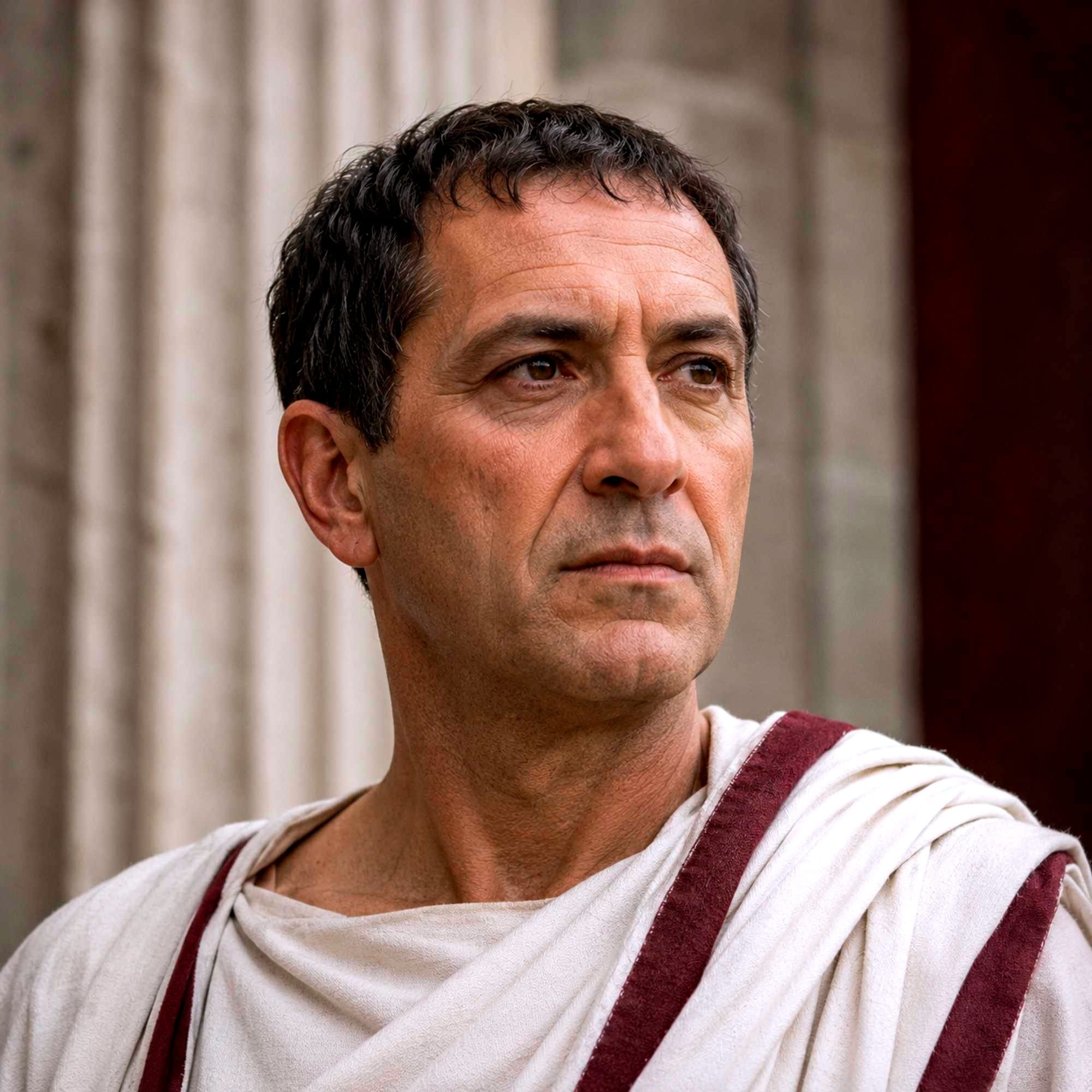
Cassius Severus himself belongs near this story, but cautiously. His defamatory writings brought severe punishment and suppression. Yet the evidence for an actual burning of his works is less secure than in the cases of Labienus or Cremutius Cordus. He shows how dangerous writing could become, but he should not be treated as one of the clearest book-burning cases.
Cremutius Cordus and the Crime of Memory
The most powerful case is Cremutius Cordus. In AD 25, under Tiberius, Cremutius Cordus was accused because of his historical writing. He had praised Brutus and called Cassius “the last of the Romans.” These names were not harmless. Brutus and Cassius were Caesar’s assassins. To praise them under the Principate could sound like praise for resistance to monarchy.
Ancient accounts present the charge as something new and disturbing. A historian had written about dead men. Yet the past was not safe territory. Roman history was full of civil war, tyrannicide, republican virtue, and aristocratic memory. To write about the Republic was never only to write about the past. It could suggest judgments on the present.
The case also belonged to a wider political climate. Cremutius Cordus had enemies. Sejanus, the powerful prefect under Tiberius, appears in the background of the tradition. Other material in Cremutius’ work may also have seemed politically sensitive. It is too simple to say he died only because of one phrase about Cassius. But that phrase mattered because it exposed the danger of historical memory.
The Principate could tolerate the Republic as a completed past. It could honor old names, quote old examples, and preserve the appearance of continuity. But admiration for Caesar’s killers was different. It implied that the men who ended a dictator’s life might be remembered as the last true Romans.
Cremutius Cordus chose death by starvation. His books were ordered burned. The aediles destroyed copies in Rome, and magistrates elsewhere were instructed to do the same where copies could be found. But the destruction was incomplete.
His daughter Marcia and others preserved copies. Later, the work could circulate again. The attempt to erase Cremutius Cordus became part of the reason he survived in Roman memory.
The irony is sharp. The fire did not end his story. It created the form in which later generations remembered it. Rome could burn copies of the work. It could not prevent the work from surviving in memory, quotation, or hidden circulation.
Dangerous Books Could Attract Readers
The failure of literary book burning appears again under Nero. Fabricius Veiento wrote satirical or defamatory works attacking senators and priests. Nero exiled him and ordered his writings burned. Tacitus gives the detail that makes the case unforgettable: while the books were dangerous to possess, people sought them out and read them eagerly. Once permission returned, they fell into oblivion.
That is one of the clearest Roman observations about the paradox of prohibition. Danger created readers. Permission created neglect.
A condemned book could gain value precisely because it was condemned. The decree told readers that the text mattered. It suggested that something inside had frightened powerful people. Even when the contents were not great literature, the danger surrounding them made them interesting. Book burning could punish an author. It could frighten owners. It could stage obedience in public. But it could also advertise the thing it tried to suppress. The flames could become publicity.
Domitian and the Burning of Opposition Memory
Under Domitian, book burning became part of a darker memory of imperial rule. Arulenus Rusticus wrote in praise of Thrasea Paetus. Herennius Senecio wrote in praise of Helvidius Priscus. These were not neutral subjects. Thrasea and Helvidius belonged to the tradition of senatorial opposition, moral resistance, and refusal to flatter imperial power. The authors were executed. Their books were burned in public spaces.
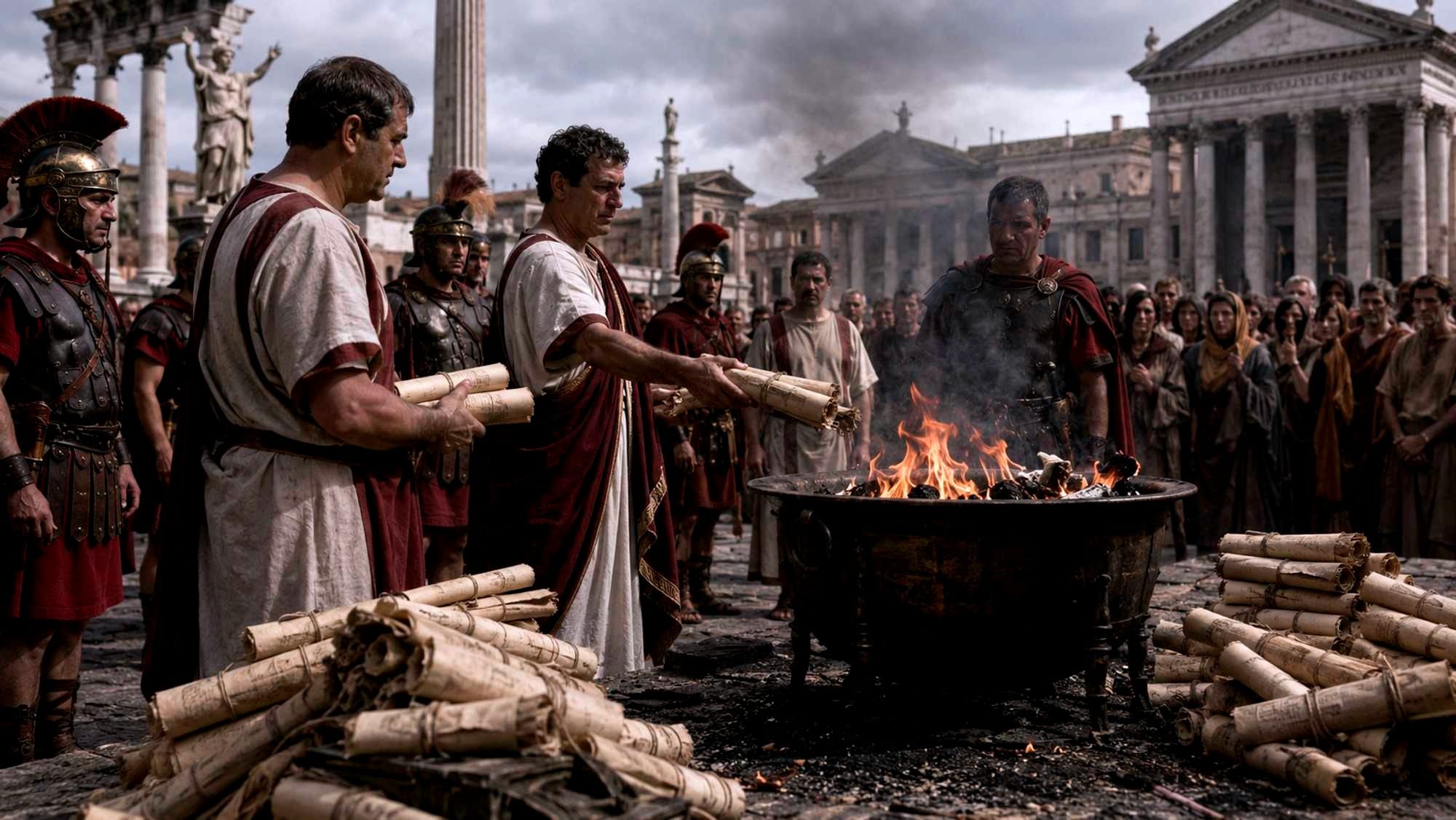
Tacitus later turned this into one of the great images of tyranny. He says the authorities imagined that in those flames they could destroy the voice of the Roman people, the freedom of the Senate, and human conscience. He then adds the crucial thought: memory itself would have been lost, if forgetting had been as easy as silence.
The passage is powerful, but it should be read carefully. Tacitus was writing after Domitian’s death, when attacking the dead emperor had become politically safe. The prosecutions also belonged to a senatorial world of informers, rivals, and accusations. Domitian was not the only actor in that system.
Still, the symbolic meaning is clear. To praise men like Thrasea and Helvidius was to preserve a model of conduct that the regime and its supporters found dangerous. A biography could become a monument. A dead opponent could keep speaking through a book.
Burning such works was therefore an attack on memory. It tried to stop the dead from becoming examples. It failed. Tacitus remembered the burnings. Later readers remember them because he did. The silence imposed by power became evidence against power.
Documents Were Different
Literary burning often failed because books could circulate. Documents were different. Roman public and private life depended on written records: contracts, wills, accounts, letters, debt tablets, lists, and official papers. These writings did not always have many copies. Their power often rested in their status as documents.
To burn them could change reality. A debt record destroyed in public could help announce cancellation. A letter burned unread could suggest clemency, because the names inside would not be used for revenge. A set of incriminating documents destroyed before trial could protect some people and endanger others. A ruler might burn records to present mercy, or claim to have burned them while secretly keeping what could later be useful.
That is why document burning left a different kind of mark. It was not only a symbolic attack on memory. It could be an intervention in evidence, obligation, or accusation.
This also explains why Roman text burning cannot be understood if “book” is the only category. The Romans burned written objects because written objects did different things. A history remembered. A satire wounded. A prophecy predicted. A ritual book authorized. A letter implicated. A debt tablet bound. The fire answered the power of each object differently.
What Rome Really Tried to Control
Rome did not fear all books. It preserved sacred texts, copied Greek literature, taught poetry, collected histories, kept legal records, and built public life around written authority. The Roman elite admired memory, quotation, archive, precedent, and written law. Books were not foreign to Roman power. They were part of it.
But certain writings crossed dangerous boundaries. Religious books could challenge official ritual. Prophetic books could claim private access to the future. Histories could honor the wrong dead men. Satire could injure powerful reputations. Biographies could turn executed opponents into moral examples. Documents could prove what someone wanted forgotten.
The written word was dangerous because it could travel. It could survive its author. It could outlast a trial, a reign, an execution, or a decree. It could turn a private judgment into public memory. That permanence was the problem.
When Roman authorities burned texts, they were not always trying to erase “ideas” in a modern abstract sense. They were trying to control a specific kind of power: ritual authority, prophecy, reputation, evidence, or memory.
The most famous burnings are remembered because they did not fully succeed. The books of Numa became famous because they were judged too dangerous to keep. Augustus’ purge of prophecies shows how carefully the state guarded the future. Labienus’ burned books survived through reputation. Cremutius Cordus lived on through hidden copies and his daughter’s preservation. Veiento’s writings were read because they were forbidden. The victims of Domitian’s literary repression became part of the historical memory that power had tried to suppress.
Rome could burn dangerous texts. It could not always destroy the danger they carried.
Joseph A. Howley, “Book-Burning and the Uses of Writing in Ancient Rome”
Dirk Rohmann, “Book Burning as Conflict Management in the Roman Empire”
Daniel C. Sarefield, “Burning Knowledge”: Studies of Bookburning in Ancient Rome
Frederick H. Cramer, “Bookburning and Censorship in Ancient Rome.”

About the Roman Empire Times
See all the latest news for the Roman Empire, ancient Roman historical facts, anecdotes from Roman Times and stories from the Empire at romanempiretimes.com. Contact our newsroom to report an update or send your story, photos and videos. Follow RET on Google News, Flipboard and subscribe here to our daily email.
Follow the Roman Empire Times on social media: