
How Romans Proved Who They Were
Romans had no single identity document. Names, census records, birth declarations, seals, witnesses and military diplomas could establish identity and legal status.


The surviving evidence does not reveal a single document that every Roman was required to carry as proof of identity. Instead, names, family relationships, place of origin, legal status, census registrations, birth declarations, military diplomas, private tablets, seals, witnesses and official archives could all be used. The evidence required depended on what the person was attempting to establish.
Roman authorities distinguished between citizens, Latins, peregrines, freedpeople and slaves, while individual communities maintained their own civic categories. Status affected taxation, marriage, inheritance, military service, access to public office and protection before the law. Identifying someone could therefore involve more than confirming a name. It could require proof of parentage, citizenship, freedom, membership of a particular community or entitlement to a legal privilege.
A Name Was the Beginning
In Roman literary and legal texts, identification normally begins with a name. A male Roman citizen might be designated by a praenomen and nomen, with a cognomen becoming increasingly common. Public records could add his father’s name and voting tribe. These additions distinguished individuals who shared the same personal and family names while locating them within a recognized citizen family.
The form of a name could indicate legal status. A slave was commonly identified by an individual name together with the name of an owner. After manumission, a freedman generally adopted the praenomen and nomen of his former owner and retained his former slave name as a cognomen. Official formulations could add libertus, identifying him as the freedman of a particular patron. Women’s names could similarly be accompanied by their filiation, marital relationship or connection to a household.
Status and occupation were particularly important when slaves and freedmen acted in commercial affairs. Legal texts describe people as an actor, an agent or manager acting for someone else, or as an institor, a person placed in charge of a business. Such descriptions did more than distinguish one individual from another. They identified the capacity in which the person acted and could affect whether an obligation attached to the agent, an owner or a patron.
The legal compilations do not always preserve the names contained in the original cases. Roman jurists and later compilers frequently substituted conventional names such as Lucius Titius, Gaius Seius and Maevius. Occasionally, an otherwise anonymous case retains an unusual personal name, or an embedded document preserves names different from those used in the surrounding legal discussion. These inconsistencies make it difficult to reconstruct the complete identification formulas of the original transactions.
Registration in the Roman Census
During the Republic, the census was one of the principal means by which the Roman state recorded its citizens. Adult male citizens who were legally independent appeared before the censors and made declarations under oath. These declarations included information about their households, property and legal position. Names, ages, family relationships and voting tribes could be recorded, while wives, children, freedpeople and slaves were included within the broader description of the household.
The census contributed to taxation, military recruitment, voting organization and the classification of citizens according to property. The censors could also alter a citizen’s political or social position. They could transfer him to a less prestigious voting category, cancel his voting rights or expel a senator or equestrian from his order.
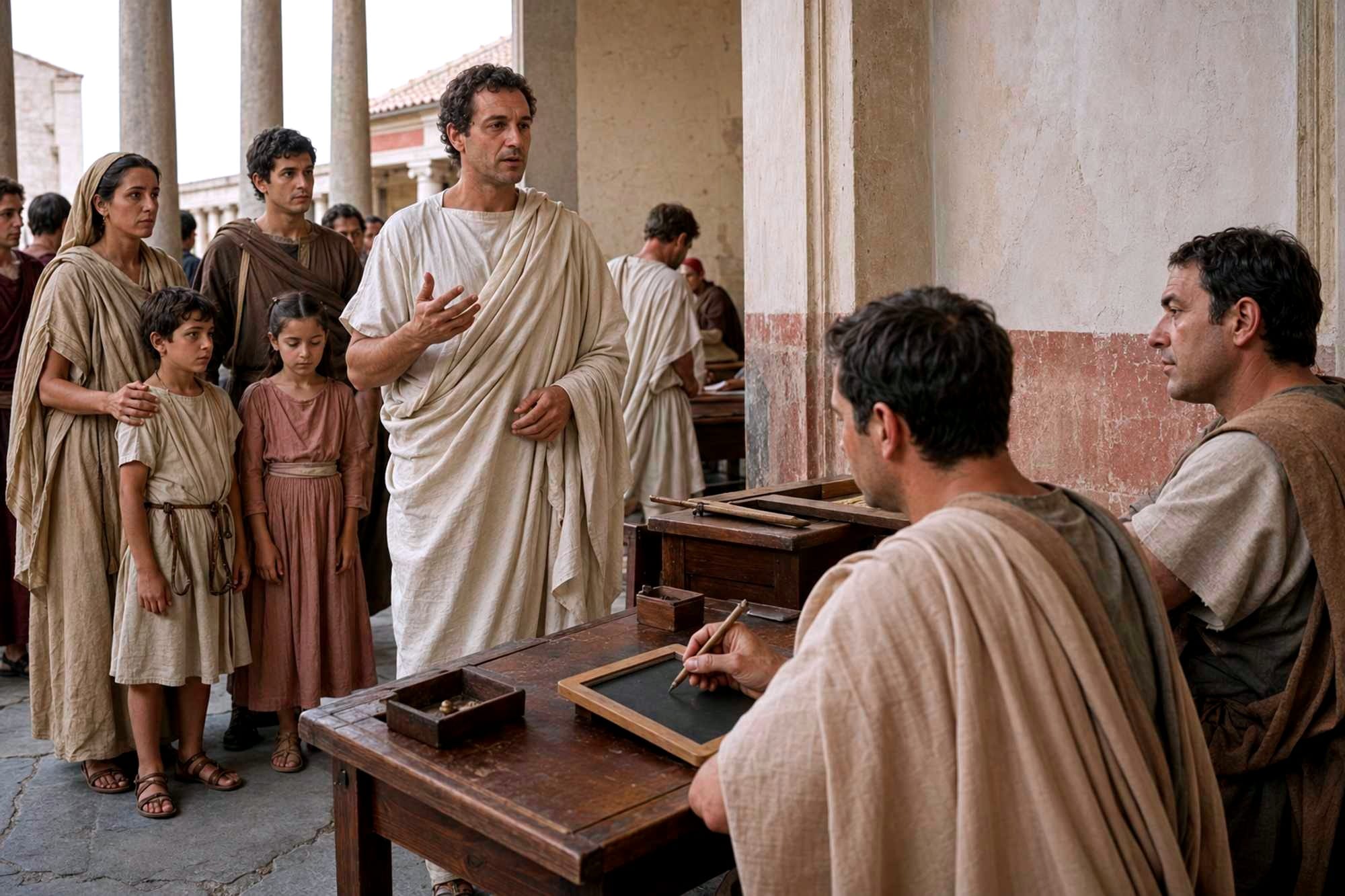
As Roman citizenship expanded throughout Italy, collecting this information solely at Rome became impractical. Municipal communities conducted registrations locally and transmitted copies of their records to Rome. Regulations preserved at Heraclea describe municipal magistrates entering declarations in public records and sending copies to the capital. Officials at Rome could then incorporate the information into the central census records.
Registration was also connected to residence and eligibility for public benefits. Suetonius describes a census conducted under Julius Caesar through the owners of residential buildings:
“He made the enumeration of the people neither in the usual manner nor place, but from street to street aided by the owners of blocks of houses.”
Suetonius connects this procedure with Caesar’s revision of the list of people receiving publicly supplied grain. Registration could therefore establish residence and determine whether a person qualified for a material privilege administered by the state.
Provincial censuses were conducted through local administrative districts. The most extensive surviving evidence comes from Roman Egypt, where household declarations were submitted according to regular census cycles. These declarations identified the occupants of a house by name, age, parentage and legal or civic status. Copies were retained within the administrative system, allowing information gathered locally to reach district and provincial archives.
Egypt cannot automatically be treated as a complete model for every Roman province. Its climate preserved papyri that disappeared elsewhere, and some elements of its administration had earlier Egyptian origins. Evidence from other provinces is considerably less complete.
References to censuses, property declarations and population registers indicate that comparable forms of registration existed elsewhere, but they do not prove that every province followed precisely the same procedures as Egypt.
Birth Declarations and Family Status
Because census registrations were periodic, additional declarations could record changes occurring between them. Birth declarations documented a child’s name, parentage, date of birth and status. Death declarations allowed officials to update tax registers and could support the settlement of an inheritance.
From the Augustan period onward, the registration of legitimate children became increasingly important. In Egypt, surviving declarations show fathers registering children before local officials. Authenticated copies could subsequently be obtained from the archives. These copies reproduced the original declaration and carried the names or seals of the people responsible for verifying the transcription.
A birth declaration could support claims to free birth, legitimate descent and Roman citizenship. It could also protect inheritance rights if a parent died before the next census. The surviving Egyptian evidence is particularly strong for families whose legal or fiscal status was hereditary. Members of such groups had a clear reason to ensure that the next generation was correctly entered in official records.
The precise legal necessity of birth registration remains uncertain. The surviving evidence shows that registered declarations could provide authoritative evidence of birth, descent and status. It also shows that courts and administrative hearings could accept testimony and other records when a birth declaration was unavailable.
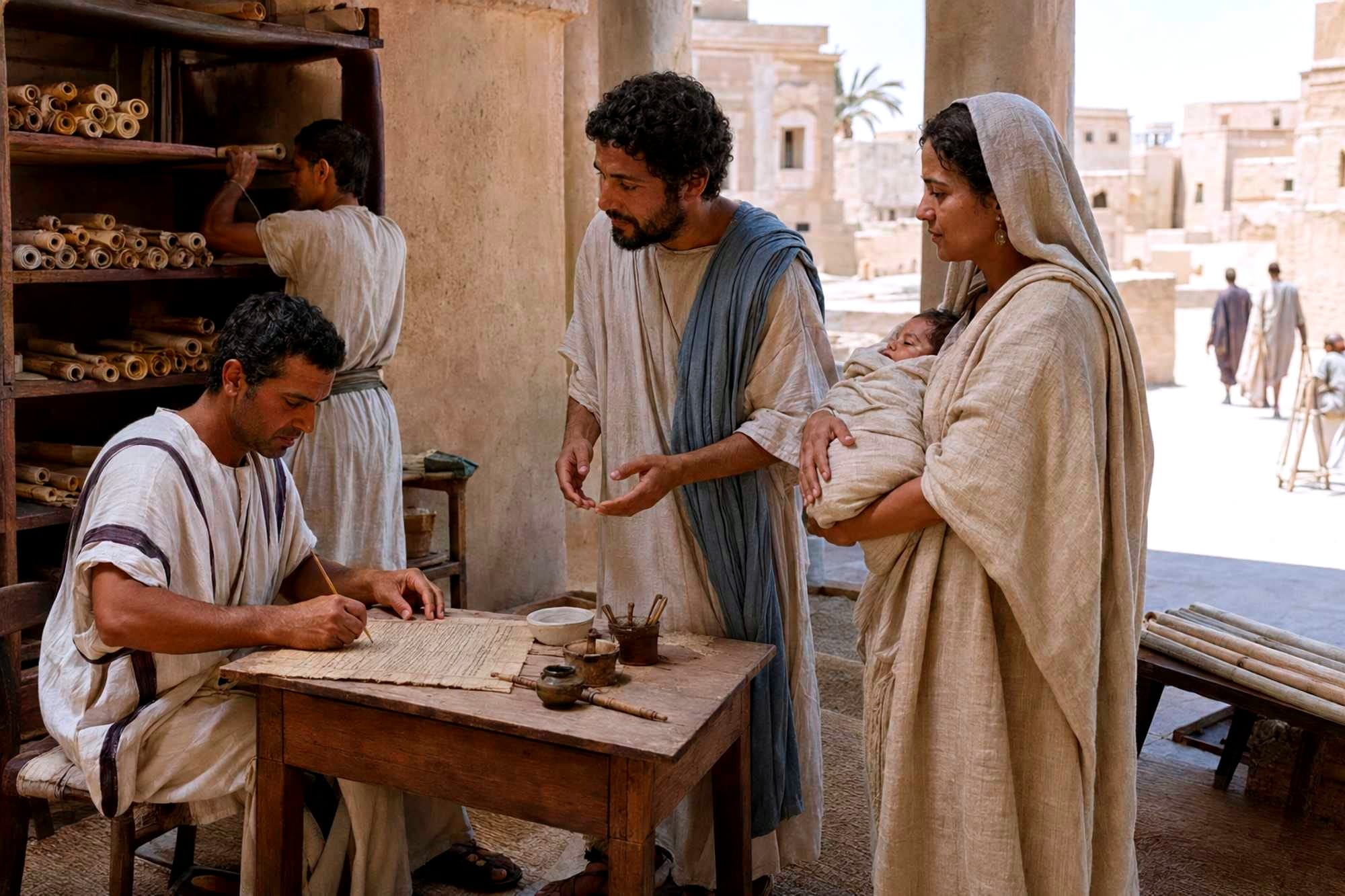
A birth declaration could therefore make a status claim more secure without functioning as an indispensable identity document in every case. Its importance depended on the question being examined, the records preserved in the relevant archive and the availability of witnesses or other documentary evidence.
When Citizenship Was Contested
Cicero’s defence of the poet Archias in 62 BC shows how a claim to Roman citizenship could be assembled from several forms of evidence. Archias claimed citizenship through enrolment at Heraclea, residence in Italy and a declaration made before a Roman praetor under legislation passed after the Social War. The prosecution challenged the supporting records and pointed to his absence from the surviving census lists.
The public registers at Heraclea could not be produced because the archive had been destroyed during the Social War. Cicero responded with the testimony of Lucullus, representatives sent by Heraclea and the surviving record of Archias’s declaration before the praetor Metellus. He contrasted the absence of the destroyed municipal archive with the evidence still available:
“It is ridiculous to say nothing to the proofs which we have, but to ask for proofs which it is impossible for us to have.”
Cicero also argued that appearance in the census did not itself create citizenship. It recorded that an individual had claimed citizen status at the time of registration. Archias had been absent from Rome during successive censuses, while other acts showed that he had behaved as a citizen: he had made wills under Roman law, received inheritances from Roman citizens and appeared in official communications retained in the treasury.
The speech is an advocate’s presentation rather than a neutral description of evidentiary procedure. Its argument nevertheless depends upon forms of evidence that could be presented in a Roman court: municipal enrolment, an official declaration, witnesses, residence, census records, wills, inheritances and archived public correspondence. Cicero does not rely upon only one of them.
The case also shows why archives were valuable without being immune to challenge. Records could be destroyed, carelessly maintained, altered or disputed. Cicero attacked the reliability of some praetorian registers while praising the care with which Metellus maintained his own. The authority of a document depended partly on where and how it had been produced and preserved.
Tablets, Copies, Seals and Witnesses
Roman legal acts were frequently recorded on wooden tablets. The tablet did not necessarily create the transaction by itself. Many Roman contracts were valid because the parties had performed the required legal act or exchanged the appropriate words. The document preserved evidence that the act had occurred and recorded its terms.
Witnesses played an important part in the authentication of tablets. They could confirm that the required procedure had been followed and that the document reflected the transaction. Their seals helped protect the contents against alteration. Over time, sealed tablets became closely connected with the credibility of the witnesses and the reliability of the recorded act.
Authenticated copies could reproduce documents held in official archives. A copy might identify the archive, the original declaration and the officials or witnesses responsible for verifying it. This allowed a person to use evidence taken from an official register without removing the original record. The value of the copy depended on the authority of the record from which it had been made and the procedure used to authenticate it.

Handwriting and signatures supplied further confirmation. A chirographum (Χειρόγραφο) was written in the first person and could acknowledge a debt, receipt or obligation. Its name referred to its handwritten form. In some legal cases, a person’s own handwriting or subscription demonstrated consent to a transaction. A signature by an owner could also confirm an act performed by a slave or agent and make the owner responsible for it.
Seals did not function as portraits or modern biometric identifiers. A distinctive seal could associate a letter or tablet with the person who issued it, provided that the recipient recognized the device and accepted its use. Roman comedy contains stories in which rings, sealed letters and agreed tokens authorize a bearer to collect money or property. The plots also show how a stolen ring or forged letter could allow the wrong person to appear properly authorized.
These comic examples are not administrative records, and several are situated in Greek commercial settings. They cannot establish how frequently Romans used the same procedures in ordinary transactions. They do show that Roman audiences could understand plots based on tokens, recognizable seals and letters used to identify an authorized representative.
Proving a Claim Before a Court
Roman courts did not operate with a single fixed hierarchy of evidence throughout the Republic and Empire. Documents could carry considerable weight, but judges also considered witnesses, admissions, handwriting, seals, account books and the circumstances of the case. Official records became increasingly authoritative, particularly when they preserved acts performed before magistrates or entries made by public administrators.
In Pro Quinto Roscio Comoedo, Cicero asks how an alleged financial obligation could be proved. He refers to payment, an entry in the account books, a verbal promise and the people present when that promise was made:
“You made a stipulation: when? On what day? At what time? In whose presence? Who says that I made a promise? Nobody.”
The questions show the practical combination of records and testimony. An account-book entry could support the claim that money had been transferred. Witnesses could confirm a verbal obligation. Without either, the claimant’s position became more difficult.
Aulus Gellius, (a Roman author and legal antiquarian of the second century AD) describes a case in which a man claimed that he had lent money but possessed neither written records nor witnesses. The claimant had an excellent reputation, while the defendant was known for dishonesty. The defendant nevertheless demanded proof through the customary means: an entry in an account book, banking records, a written acknowledgement, sealed tablets or witnesses.
Gellius found the claimant personally credible but hesitated to decide without the conventional evidence. His account presents a conflict between confidence in a person’s character and proof of a particular transaction. Reputation could be considered, but it did not automatically replace documents or testimony.
Disputes over freedom produced similar problems. In the case of Petronia Justa, preserved in tablets from Herculaneum, the central issue was whether she had been born free or had been born to a slave mother and later manumitted. The relevant documents were apparently unavailable, so the parties relied heavily on witnesses and competing accounts of her mother’s status. The absence of documentary evidence did not itself settle the dispute, but it left the parties dependent on testimony.
Military Diplomas and Official Grants
Roman soldiers could receive particularly formal documentary proof. Military diplomas were bronze copies of imperial constitutions granting privileges to named veterans. Depending on the period and unit, these grants could include Roman citizenship, legal marriage rights and recognition of children.
The text connected an individual recipient with an imperial act. It normally identified the emperor, the units concerned, the commanding officer and the veteran to whom the certified copy had been issued. The diploma’s authority came from the original constitution displayed or deposited at Rome, while the bronze copy allowed the veteran to retain evidence of his inclusion in the grant.
Military diplomas were not general identity documents carried by all Romans. They addressed the specific status and privileges of particular servicemen. Their survival demonstrates how a grant of citizenship or marriage rights could be recorded, copied and authenticated.
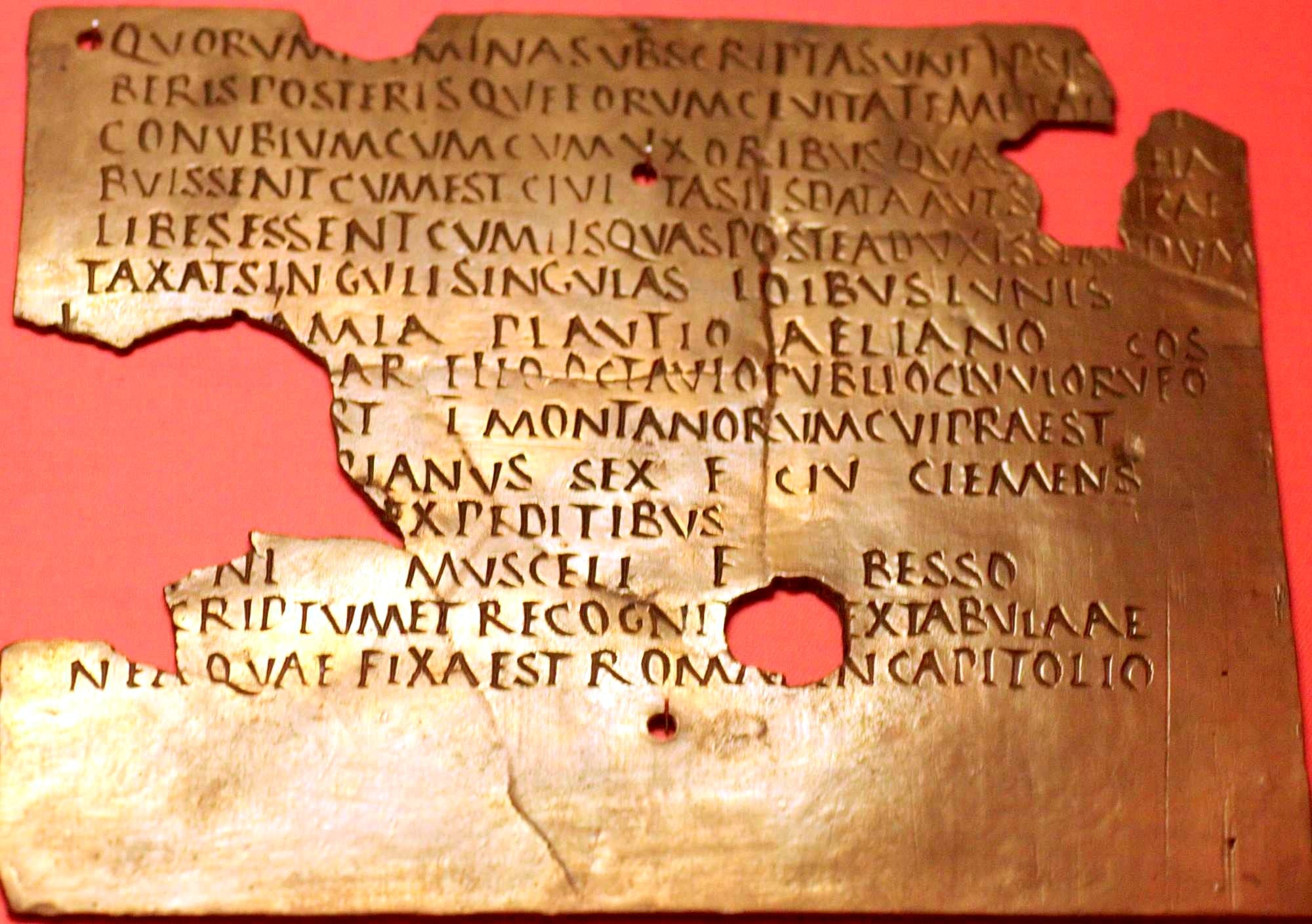
Soldiers and veterans could also be identified through service records, discharge documents and entries held in military archives. During formal examinations of status, military diplomas could be considered alongside birth declarations, manumission records and witness testimony. The purpose was to establish the legal history that gave the individual a particular status.
When a Spoken Claim Was Accepted
Not every assertion of status was accompanied by the immediate production of a document. In Acts, Paul prevents his examination under flogging by telling a centurion that he is a Roman citizen. The commander questions him directly about how he obtained that citizenship:
“And the chief captain answered, With a great sum obtained I this freedom. And Paul said, But I was free born.”
The officials withdraw from the proposed examination and become alarmed because Paul, a citizen, had been bound. In this account, his spoken claim produces an immediate response. The passage does not describe officials consulting an archive or demanding that he present a certificate at that moment.
The episode does not explain whether Paul’s claim was later checked or how a disputed assertion would ordinarily have been investigated. It shows that, in this particular situation, the officers accepted his declaration before proceeding further.
Pliny’s correspondence with Trajan provides a different view of the information required when citizenship was formally granted. After requesting Roman citizenship for his Egyptian doctor Harpocras, Pliny learned that he should first have secured Alexandrian citizenship. He supplied the doctor’s age, financial position and district of origin and asked the emperor to complete the necessary grants.
The exchange records several overlapping statuses. Harpocras was a freedman, an Egyptian, a member of a particular district and a proposed citizen of Alexandria and Rome. Each status followed its own administrative and legal rules. The grant of Roman citizenship did not remove the need to establish the categories under which he had previously been recorded.
Different Questions Required Different Proof
Romans used combinations of evidence to establish identity and status. A name might be sufficient in a familiar private transaction, while a disputed inheritance could require proof of parentage and legitimacy. Citizenship might be supported by municipal enrolment, census information, a birth declaration, an imperial grant, archived correspondence, witnesses or the exercise of rights reserved for citizens.
Documents preserved acts beyond the memory of those present. Archives allowed authorities to retain declarations and issue authenticated copies. Seals, signatures and witnesses supported the reliability of records. Military diplomas connected individual veterans to imperial grants, while account books and written acknowledgements supported private financial claims.
These forms of evidence were neither uniform nor equally preserved across the Roman world. Egyptian papyri provide unusually detailed evidence for household registration, birth declarations and administrative examinations. Evidence from many other provinces survives only in fragments. Courts and officials could consider alternative forms of proof when records were missing, while the production of an appropriate document could make a claim easier to establish.
Cicero, Pro Archia, translated by C. D. Yonge
Cicero, Pro Quinto Roscio Comoedo, translated by J. H. Freese
Suetonius, Life of Julius Caesar, translated by J. C. Rolfe
Aulus Gellius, Attic Nights, Book 14, translated by J. C. Rolfe
Pliny the Younger, Letters, Book 10, translated by J. B. Firth
Acts of the Apostles 22:25–29, King James Version
Anna Dolganov, “Documenting Roman Citizenship”
Jane F. Gardner, “Proofs of Status in the Roman World”
Elizabeth A. Meyer, Legitimacy and Law in the Roman World: Tabulae in Roman Belief and Practice
Philipp Scheibelreiter, “Identifikation von Vertragspartnern in der römischen Literatur”



About the Roman Empire Times
See all the latest news for the Roman Empire, ancient Roman historical facts, anecdotes from Roman Times and stories from the Empire at romanempiretimes.com. Contact our newsroom to report an update or send your story, photos and videos. Follow RET on Google News, Flipboard and subscribe here to our daily email.
Follow the Roman Empire Times on social media: