
The Battle of Pharsalus: The Victory That Changed Rome
At Pharsalus, Caesar faced Pompey at his strongest — and won by turning the battle at the one moment when his own line seemed closest to collapse.

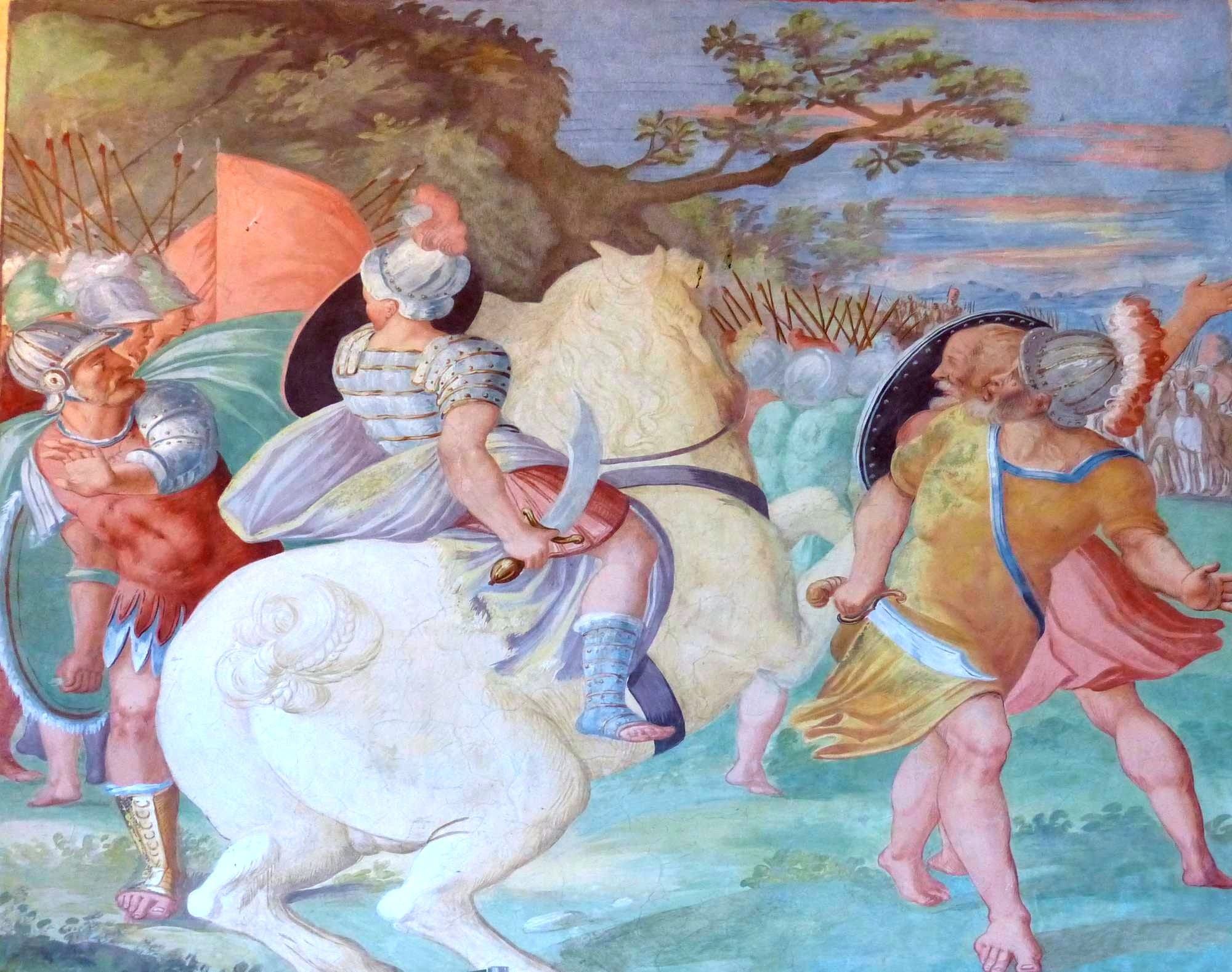
In 48 B.C., on the plains of Thessaly, Rome’s civil war reached the moment from which there was no real return. At Pharsalus, Julius Caesar faced Gnaeus Pompeius Magnus in the battle that would decide not only which commander survived, but which vision of Roman power would endure. What followed was more than a battlefield defeat. Pompey’s army broke, his cause collapsed, and the Republic moved one decisive step closer to its end.
Before Pharsalus (Palaepharsalus): How Caesar and Pompey Reached the Final Clash
By the time Caesar and Pompey faced one another on the plains of Thessaly in 48 B.C., the battle had already been a long time in the making. Pharsalus was not the sudden meeting of two equally placed rivals. It was the result of years of political breakdown, mutual distrust, calculated risk, and a campaign in which both men repeatedly tried to force the war onto terms favorable to themselves.
When the battle finally came, Caesar was not the obvious favorite. He had already suffered a major reverse, had been pushed deep into hostile territory, and was confronting an opponent whose army was larger, better supplied, and joined at last by the eastern forces Pompey had long been assembling.
The roots of the conflict lay in the collapse of the alliance that had once linked Caesar, Pompey, and Crassus. Crassus’ death after Carrhae in 53 B.C. removed the third man who had balanced the relationship. Pompey was the immediate beneficiary. With Caesar still in Gaul, Pompey tightened his hold over Roman politics and rose to a position of exceptional authority in Rome.
Caesar, meanwhile, had done what once seemed unlikely and conquered Gaul, gaining not only military glory but also the loyalty of experienced legions. That left the Republic with two towering figures and no stable arrangement capable of containing them both.
The crisis became acute when Caesar’s Gallic command approached its end. He needed protection, continued standing, and ideally another major command. Pompey had every reason to deny him that future. At that point the political dispute became deadly. Caesar could not safely return as a private citizen. Pompey, for his part, seems to have been content to let the confrontation sharpen until Caesar could be presented as the threat to the Republic.
The Senate’s final decree against Caesar, and Caesar’s decision to cross the Rubicon in 49 B.C., made civil war a fact. Yet even then, the war did not begin with a huge set-piece battle. It began with movement, pressure, and positioning.
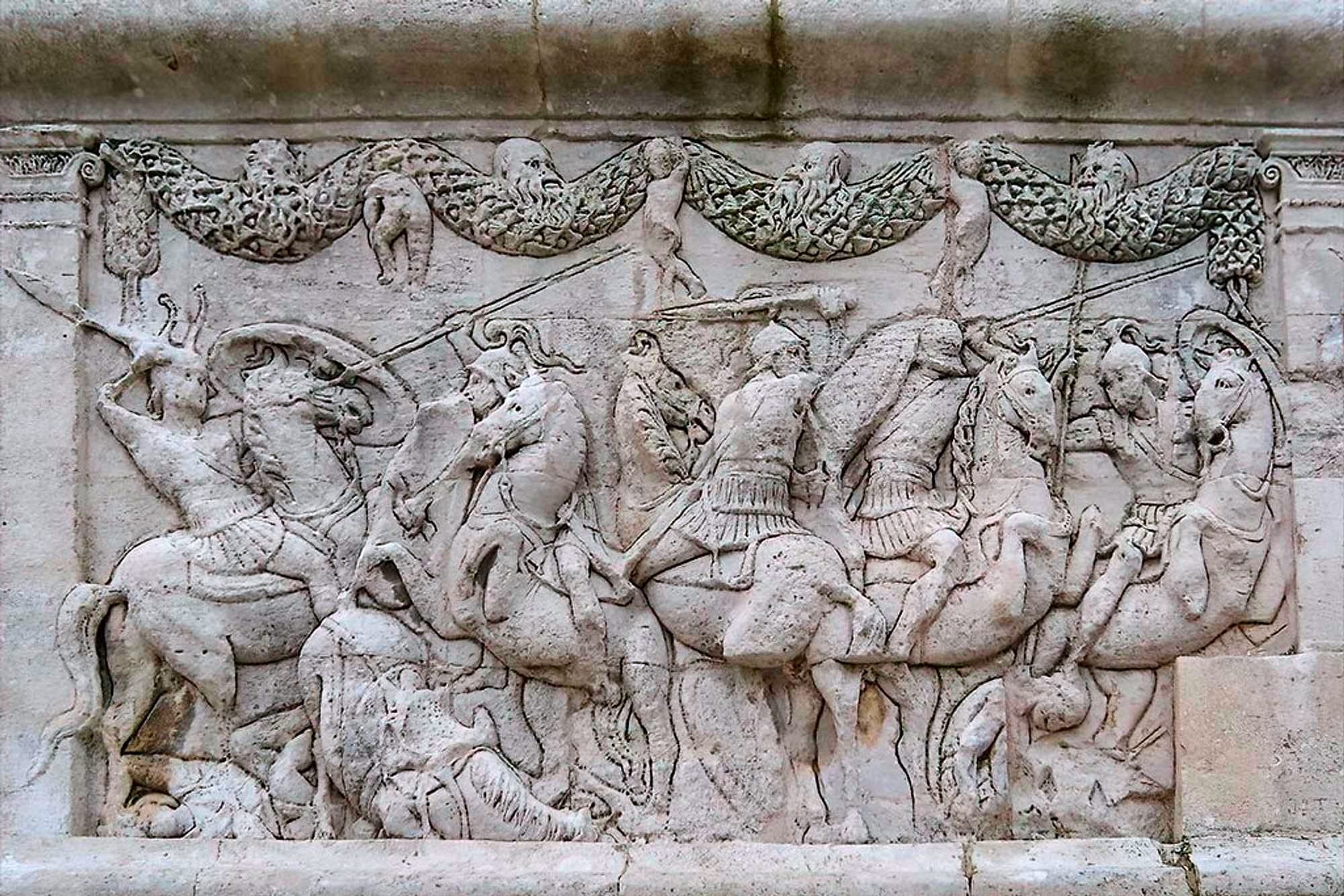
Caesar moved quickly through Italy. Pompey did not try to defend Rome in a decisive stand. Instead, he withdrew southward and then crossed the Adriatic to Greece. That retreat has often been made to look like panic, but the larger pattern suggests calculation. Rome itself was not the true prize. Pompey’s strength lay in time, geography, and resources.
If he could avoid being crushed early, he could draw on the manpower, money, fleets, and client kings of the eastern Mediterranean. Caesar, by contrast, needed speed. He needed to prevent Pompey from turning a political crisis into a vast imperial war. Caesar seized Rome, but that did not end the struggle. It only widened it.
The next phase of the war spread across the western Mediterranean. Caesar moved to secure Sardinia and Sicily, partly to protect Italy and partly to keep Pompey from using those islands to tighten a naval grip on the peninsula. Sardinia fell easily, and Sicily followed when Cato withdrew without a major fight.
North Africa proved more difficult. There the Caesarian advance initially looked promising, but Curio’s campaign ended in disaster at the Bagradas River, where Numidian intervention smashed the Caesarian army. Africa remained firmly in enemy hands. That defeat did not yet decide the war, but it showed that Caesar’s enemies still had strong ground beyond Greece itself.
At the same time, another setback struck in Illyria. Caesar had forces there, and in theory they offered a bridgehead on the eastern side of the Adriatic. Pompey moved decisively to eliminate that threat. The Pompeian fleet controlled the sea, Caesarian naval forces were defeated, and Caesar’s men in the region were trapped and forced into surrender.
This mattered more than it is often allowed to matter. It shut Caesar out of the eastern side of the Adriatic and made any direct move against Pompey much harder. By late 49 B.C., Pompey was not merely in retreat. He was establishing the position from which he wanted to fight the decisive stage of the war.
Caesar then turned west against Pompey’s Spanish commanders. This was a necessary move. So long as Pompeian Spain remained intact, Caesar’s own western power base in Gaul was exposed. The Spanish campaign ended successfully for Caesar, but it also cost time — and time was the resource Pompey needed most.
While Caesar fought in the west, Pompey continued to build strength in the east. By the opening of 48 B.C., the war was moving toward a confrontation in Greece, where Pompey believed he would finally be able to fight on the scale and under the conditions he wanted.
Caesar still tried to prevent that. In a bold winter move, he crossed the Adriatic in January 48 B.C. before Pompey’s preparations were complete. It was a gamble in the purest Caesarian style. He landed in Epirus and tried to bring Pompey to battle before the eastern forces could fully unite. But Pompey refused to give him the kind of quick decision he wanted.
The Pompeian fleet cut Caesar off from Italy, his reinforcements were delayed, and both sides maneuvered across a difficult theatre where supply mattered as much as open combat. Eventually Antony crossed with additional troops, and the war narrowed toward Dyrrhachium.
Dyrrhachium was one of the strangest and most important phases of the whole campaign. Caesar, reversing the normal logic of siege warfare, tried to bottle up Pompey’s larger army with an immense system of fortifications around the bay. Pompey responded by building fortifications of his own.
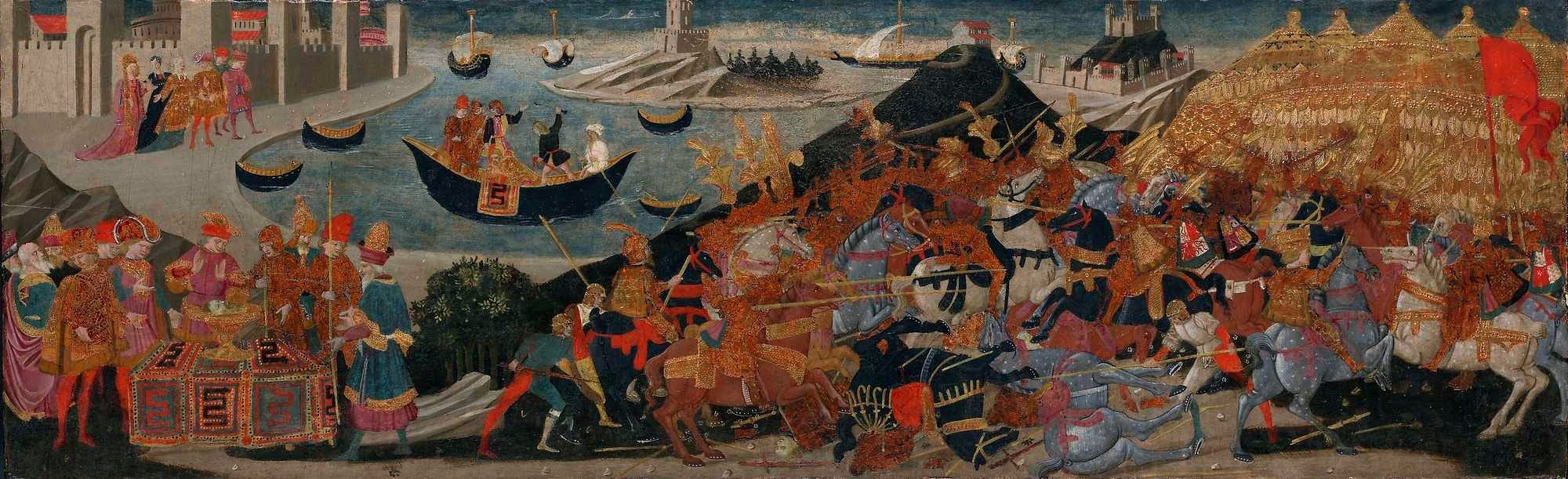
What followed was less a clean battle than a grinding contest of engineering, attrition, shortages, skirmishes, and tactical improvisation. Both armies suffered. Caesar’s men lacked secure supply lines and faced hunger. Pompey had the advantage of sea access but not unlimited freedom. Water became a problem, pack animals died, and the whole operation became a prolonged struggle in which neither side could easily force the other to collapse.
Caesar then tried to break the deadlock by seizing Dyrrhachium itself, apparently hoping for surprise and support from sympathizers inside the city. That failed. Pompey, meanwhile, eventually found a weakness in Caesar’s lines and broke through to the south, improving his access to the sea and worsening Caesar’s position. Caesar had one chance left to reverse the situation quickly.
He launched a major counterattack against a newly forming Pompeian base, hoping to destroy it before it could be consolidated. For a moment, the attack seemed to work. But it was exactly the sort of bold move that left him exposed if it failed to achieve immediate decision. Pompey reacted fast, struck back with superior numbers, and turned Caesar’s attack into a rout.
Dyrrhachium was the greatest battlefield reverse of Caesar’s career up to that point. His army was not destroyed, but it was badly shaken, and the myth of Caesarian invincibility briefly cracked. Pompey had done what he had wanted for a long time: he had beaten Caesar in open campaigning and shown that the rebel general could be checked. Yet Pompey did not finish the war there.
As at other moments in his career, he failed to turn a major success into total destruction of the opposing force. Caesar was allowed to withdraw inland, regroup, and march toward Macedonia and Thessaly, where he still hoped to prevent Pompey from combining fully with Metellus Scipio.
That brought the campaign into its last pre-Pharsalan stage. While Caesar withdrew and recovered, the hidden movement of Metellus Scipio’s army became crucial. One of the difficulties in reconstructing this phase is that the surviving narrative is dominated by Caesar and Pompey, while Metellus Scipio often stands just beyond the center of the stage.
Yet his army mattered enormously. Caesar had earlier sent forces to slow him, and although Metellus seems to have beaten Caesarian detachments in Thessaly, he was delayed. After Dyrrhachium, however, the pressure increased. If Pompey and Metellus united completely while Caesar remained weakened, the odds against Caesar would become overwhelming.
This is what makes the march into Thessaly so important. Caesar was no longer seeking a clean, confident victory from a position of strength. He was trying to keep the war alive on terms that still gave him some chance of success. Pompey, by contrast, was moving toward the type of confrontation he had long expected: a battle after his eastern preparations had matured, after Caesar had been worn down, and after the two Pompeian armies had finally come together. The two sides converged.
Domitius avoided being trapped and brought Caesarian forces together. Metellus marched to Larissa and joined Pompey. Caesar then moved toward the plain of Pharsalus and offered battle.
So before the battle itself began, the larger picture looked grim for Caesar. He had started the war with speed and aggression, but he had failed to keep Pompey from turning it into a vast Mediterranean conflict. He had won in Italy and Spain, but he had lost in Africa and Illyria. He had crossed into Greece boldly, only to be checked and then beaten at Dyrrhachium. He had not prevented the union of Pompey and Metellus Scipio.
By the time the armies drew up near Pharsalus, Pompey’s army nearly outnumbered Caesar’s by two to one. On paper, this was the moment the war should have ended in Pompey’s favor. That it did not is precisely what gives the battle its place in Roman history.
The Two Armies at Pharsalus
After eighteen months of maneuver, retreat, pursuit, and failed attempts to force a final decision, Caesar and Pompey at last committed themselves to battle on 9 August 48 B.C. Before the fighting itself, however, the first thing that mattered was the imbalance between the two armies. On paper, Caesar was badly outnumbered.
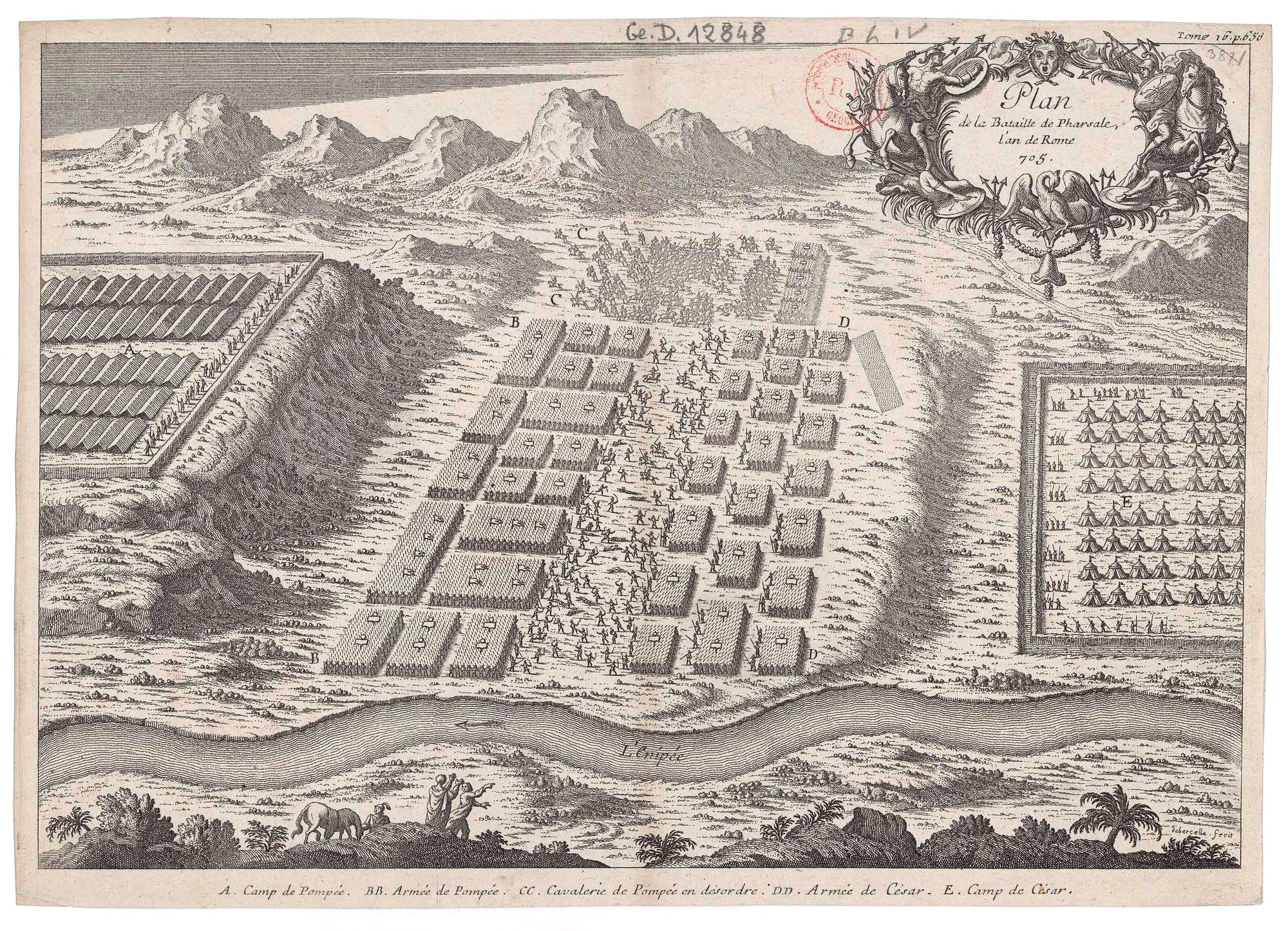
The surviving ancient evidence is not perfectly consistent on the exact totals, but it leaves no doubt about the larger picture. Caesar himself gives his own infantry in the battle line as about 22,000 men, while Pompey’s army is usually placed at around 45,000, with a cavalry arm that overwhelmed Caesar’s. Appian, while noting how widely the ancient figures varied, still preserves the same essential conclusion:
“Pompeius had more than double that number, of whom about 7,000 were cavalry.”
That is the point that matters most. Pompey had achieved what he had wanted for months — a battle fought only after his eastern reinforcements had joined him, and with clear numerical superiority on his side.
Numbers alone, however, do not tell the whole story. The two armies also differed in composition. Caesar’s force was more compact and more heavily dependent on his veteran legionaries, though it also included cavalry from Cisalpine and Transalpine Gaul and some light-armed Greek troops. Pompey’s army was broader and more imperial in character, drawing support from across the Roman world, from Greece and Asia Minor to Syria, Phoenicia, and Crete, with allied kings and princes contributing forces of their own.
What mattered most on the battlefield was not simply that Pompey had more men, but that he had more of the kinds of troops Caesar could least afford to ignore. A substantial portion of Pompey’s army consisted of cavalry, archers, and slingers. That meant his advantage was not only one of mass, but also of reach and mobility. His strongest tactical assets lay on the wings and at a distance. Caesar, by contrast, had far fewer horsemen and could not hope to win a battle of maneuver on equal terms.
That imbalance shaped the logic of the battle before it even began. Pompey’s best chance lay in using his superior cavalry and missile troops to break Caesar’s line apart before the infantry struggle became decisive. Caesar’s best hope was exactly the opposite. He needed to reduce the battle to close fighting, where experience, cohesion, and discipline could matter more than numbers. If Pompey wanted a victory won by range, speed, and pressure on the flanks, Caesar needed a battle fought face to face.
The Field and the Deployment of the Two Armies
Once the armies finally stood opposite one another in Thessaly, the battle was shaped not only by numbers, but by how each commander arranged his men and by the ground on which they had to fight. Caesar gives a first-hand description of both deployments, and from it a broad picture emerges.
Pompey placed his strongest legions across the line, with himself on the left, Metellus Scipio in the center, and other veteran units, including the legions once handed over by Caesar, in key positions. His right flank was protected by difficult ground near the river, and for that reason he concentrated his great cavalry force, together with his archers and slingers, on the opposite wing. Caesar, by contrast, kept to his usual habit of placing the Tenth Legion on the right. His weakened Ninth was reinforced by the Eighth on the left, while Antony commanded the left wing, Sulla the right, and Domitius the center. Caesar himself took position opposite Pompey.
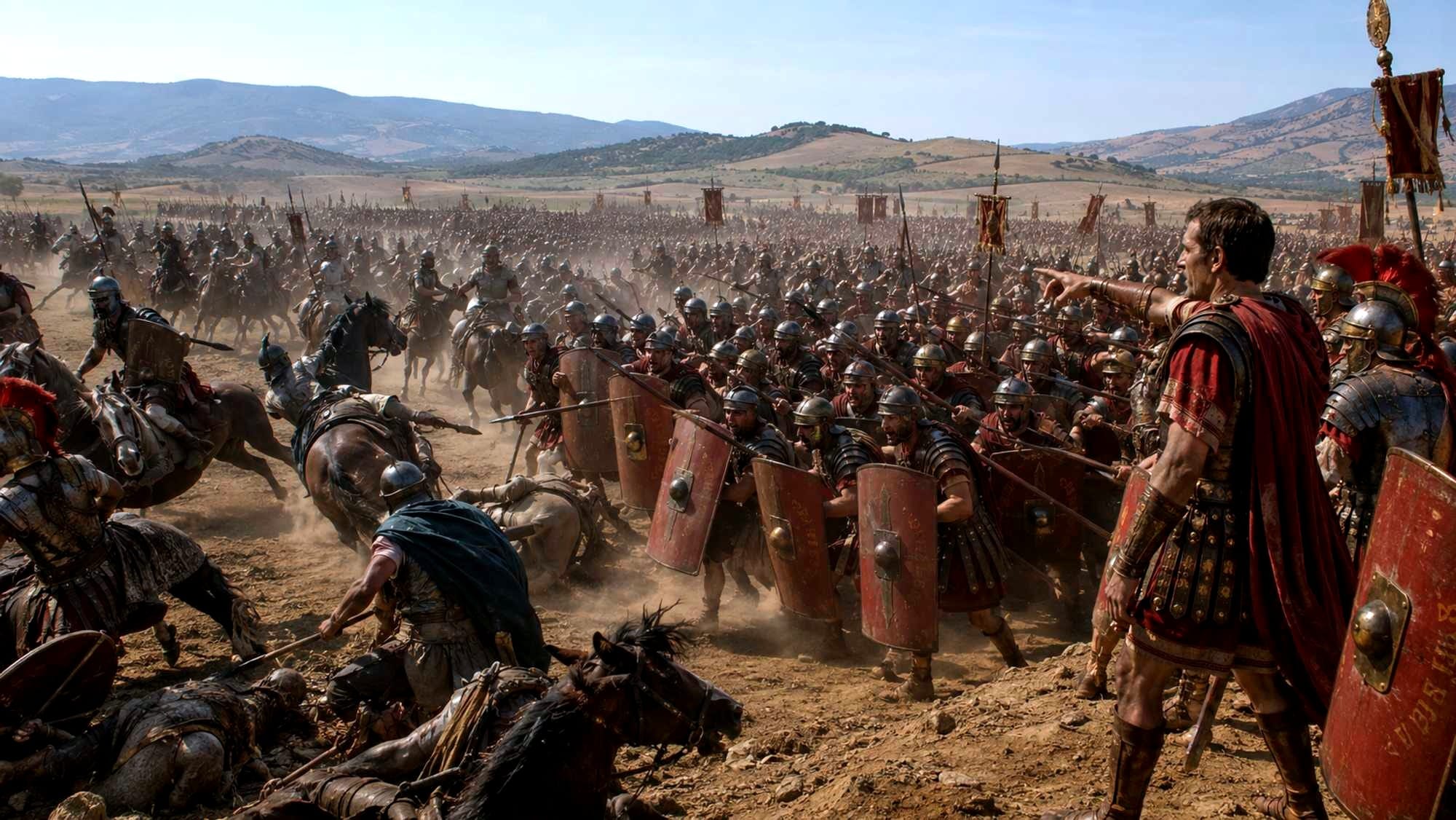
The basic contrast is clear enough. Pompey used his numbers to create a broad and confident front, but his real striking power lay on one wing. The river made his right secure, though also less flexible, so the weight of cavalry and missile troops was shifted to the left, where he hoped to overwhelm Caesar’s exposed flank. Caesar’s own arrangement answered that danger as best it could.
His strongest forces were concentrated where he expected the decision to come, while his weaker legions were placed where the terrain offered some protection. From the outset, then, the battlefield itself pushed the action toward one side. Neither commander had much reason to seek a decisive struggle by the river. The real crisis would develop where Pompey’s left met Caesar’s right.
The most vivid surviving description of the field and the opening deployment comes from Appian:
“Leaving 4,000 of his Italian troops to guard his camp, Pompeius drew up the remainder between the city of Pharsalus and the River Enipeus opposite the place where Caesar was marshalling his forces. Each of them ranged his Italians in front, divided into three lines with a moderate space between them, and placed his cavalry on the wings of each division. Archers and slingers were mingled among all. Thus were the Italian troops disposed, on which each commander placed his chief reliance. The allied forces were marshalled by themselves rather for show than for use.
There was much jargon and confusion of tongues among Pompeius’ auxiliaries. Pompeius stationed the Macedonians, Peloponnesians, Boeotians, and Athenians near the Italian legions, as he approved of their good order and quiet behaviour. The rest, as Caesar had anticipated, he ordered to lie in wait by tribes outside of the line of battle, and when the engagement should become close to surround the enemy, to pursue, to do what damage they could, and to plunder Caesar’s camp, which was without defences.
This account is especially valuable because it captures more than placement alone. It also conveys the mixed character of Pompey’s army — Roman at the core, but surrounded by a mass of auxiliaries from across the wider empire. It suggests order, but also noise and unevenness. The Italian troops remained the backbone of both armies.
The allied contingents, for all their numbers, were secondary, held partly in reserve and expected to exploit success rather than decide the battle head-on. That distinction matters, because it reminds us that the battle would still be settled chiefly by Roman infantry, even if cavalry and missile troops played a decisive part in shaping it.
Yet there is an immediate difficulty. Even the ancient sources do not fully agree on the field itself. Caesar never names either Pharsalus or Palaepharsalus directly in his own account, speaking only of the battle fought in Thessaly. Elsewhere, the tradition divides. The Alexandrine War uses the form Palaepharsalus, and Frontinus is explicit in calling it Old Pharsalus.
Cicero, however, repeatedly uses Pharsalus. That disagreement matters because the exact location affects how the terrain is understood, and especially how the river figured in the deployment. Without a site that commands general agreement, the topography of the battlefield has to be reconstructed from competing texts rather than fixed securely on the ground.
There are also important differences between Caesar’s version and the fuller narrative preserved by Appian. Caesar places Pompey’s cavalry, archers, and slingers heavily on the left wing, with the river securing the right. Appian’s wording gives a broader impression, with cavalry on both wings and missile troops more dispersed.
That may reflect a different underlying source, or a different way of visualizing the field, especially in relation to the Enipeus. Modern discussion has therefore often turned on whether the battle was fought north or south of the river, because that question affects how far the watercourse constrained movement and whether Pompey truly intended his left wing to do the decisive work from the beginning.
Even with those uncertainties, the larger point stands. The battle was not laid out symmetrically. Pompey intended to use the ground and his superiority in cavalry to strike where Caesar was most vulnerable. Caesar recognized that danger and arranged his line accordingly, putting his best troops where he believed the decision would fall.
The ground, the river, and the distribution of cavalry and missile troops all combined to push the coming struggle toward Pompey’s left and Caesar’s right. Once the armies moved, that was where the battle’s fate would be tested first.
Caesar’s Fourth Line and the Battle’s Collapse
By the time the armies had drawn up and the first shock of battle was absorbed, the real crisis of the day was already clear. Pompey had arranged his line so that the decisive action would fall on his left, where his great superiority in cavalry, archers, and slingers could be brought to bear against Caesar’s right.
Caesar knew this before the fighting began, and it was that expectation which led him to make the one tactical adjustment for which Pharsalus is remembered.
Caesar’s answer was the hidden fourth line. Instead of relying only on the conventional three lines of legionaries, he quietly pulled selected cohorts out of his third line and stationed them behind his right wing, where they would be ready to intervene if Pompey’s cavalry attack came in the way everyone expected. He later described the moment with unusual clarity:
“At the same time, having noticed the arrangements mentioned above, fearing lest his right wing should be surrounded by the multitude of cavalry, he hastily withdrew individual cohorts from the third line and out of these constructed a fourth line, stationing it opposite the cavalry, explaining what his object was and reminding them that the day’s victory depended on the valour of these cohorts.”
That decision shows that the battle was not won by accident alone, nor by blind courage alone. Caesar had correctly identified where the danger lay and had prepared a reserve for precisely that point. The battle would still have to be fought, but he had already taken one step to ensure that Pompey’s greatest advantage did not become fatal.
The opening stage of the action seems to have followed Pompey’s plan closely. Pompey remained cautious even after accepting battle. He wanted Caesar to advance first, tire his men in the approach, commit them fully to the infantry struggle, and only then unleash the cavalry attack that would roll up Caesar’s right and turn the entire field. The early fighting did not immediately break either line. Pompey’s front held. Caesar’s attack did not smash through at once. Both men appear to have been waiting for what they knew was coming next: the cavalry assault on Caesar’s right.
One vivid detail survives from the opening clash. A centurion of the Tenth Legion, Gaius Crastinus, charged forward after declaring to Caesar,
“Today, General, I will give you occasion to thank me alive or dead.”
He led the first rush and died in the fighting soon afterward, struck through the face. The story was remembered because it captured the mood of the opening attack — fierce, personal, and immediate — but it did not decide the battle. The true decision still lay elsewhere.
Pompey then committed the blow on which the whole day depended. His cavalry, supported by archers and slingers, moved heavily against Caesar’s right. Caesar’s own horsemen, vastly outnumbered, were unable to hold. They gave ground, just as both commanders had expected.
On a normal reading of the battle, this was the moment when Caesar’s position was most exposed. His own cavalry was hopelessly outnumbered, and once it gave ground, Pompey’s mounted force should have been able to turn inward against Caesar’s right and begin rolling up his line. For a brief moment, that outcome was dangerously close.
At that instant, Caesar released the fourth line.
This was the turning point of Pharsalus. The concealed cohorts surged forward, not as cavalry, but as picked infantry trained and positioned for exactly this emergency. Instead of receiving the cavalry passively, they attacked it at close range. Plutarch preserves the most striking version of Caesar’s instruction:
“When Caesar perceived this movement, he placed 3,000 of his bravest foot-soldiers in ambush and ordered them, when they should see the enemy trying to flank him, to rise, dart forward, and thrust their spears directly in the faces of the men because, as they were fresh and inexperienced and still in the bloom of youth, they would not endure injury to their faces.”
Whether every detail of that instruction is exact or not, the result is plain enough. Pompey’s cavalry, which should have swept Caesar’s flank off the field, recoiled instead. The attack that was meant to decide the battle collapsed into confusion. Once the cavalry gave way, the archers and slingers behind them were exposed.
They could not stand alone against a sudden infantry charge, and the entire Pompeian left began to break apart. Caesar had not merely blocked the danger. He had turned it into the means of victory.
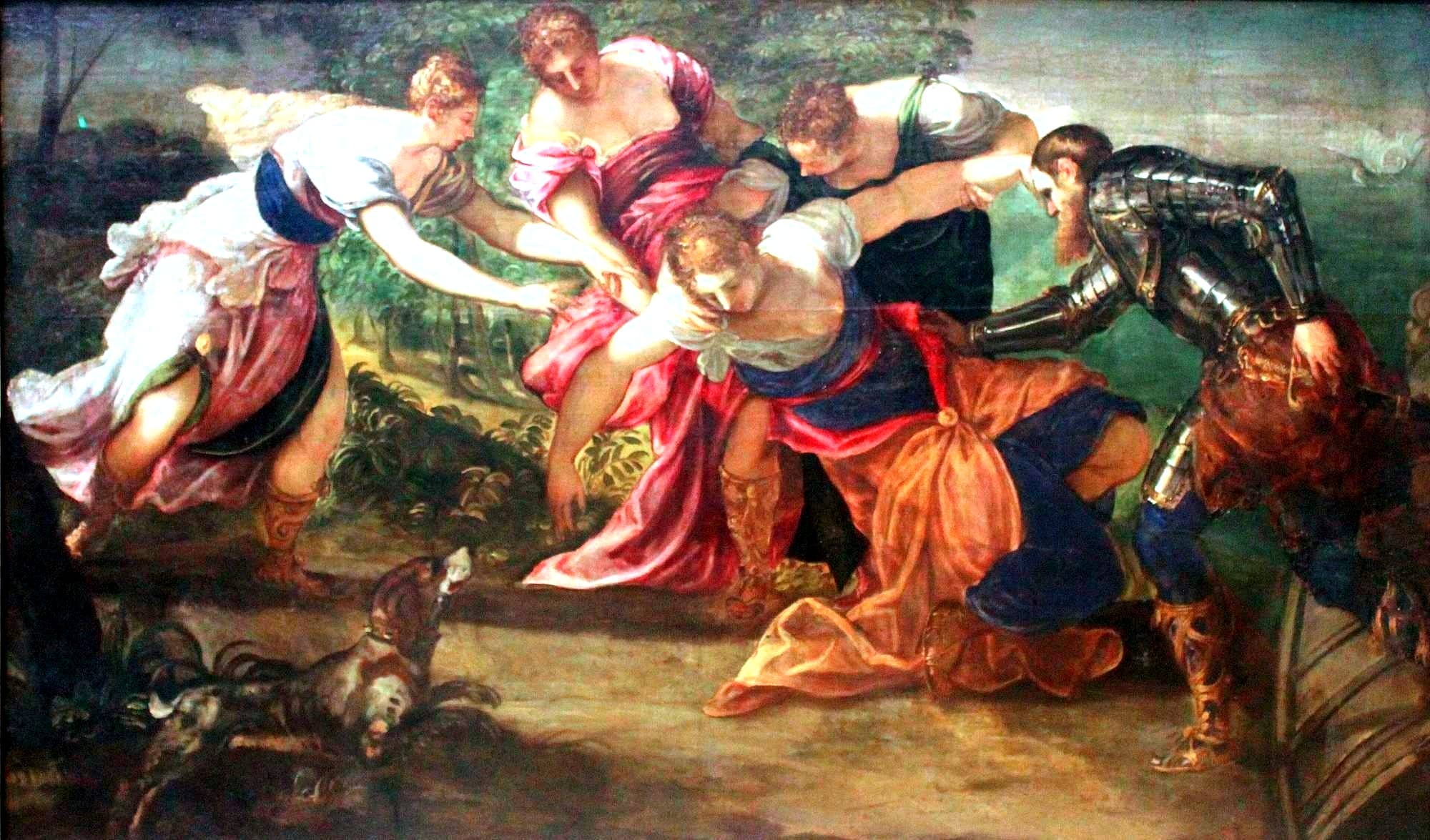
That is the crucial sequence of the battle. Pompey’s strongest arm failed not because cavalry ceased to matter, but because Caesar had anticipated its use and countered it at the exact point where the field was most vulnerable. Once Pompey’s left was thrown back, the balance changed everywhere else.
Caesar was then able to commit the third line he had kept in reserve. The Pompeian left gave way first, but its collapse made the rest of the line increasingly untenable. What had begun as a carefully prepared battle of attrition now turned into a retreat.
Pompey himself seems to have lost his grip on the battle at that moment. The collapse of the left destroyed the logic of his whole deployment. His army had not been annihilated in a single head-on collision, but its best chance had failed, and the defeat spread from the wing inward. The battlefield no longer belonged to the larger army. It belonged to the commander who had survived the critical moment and seized it.
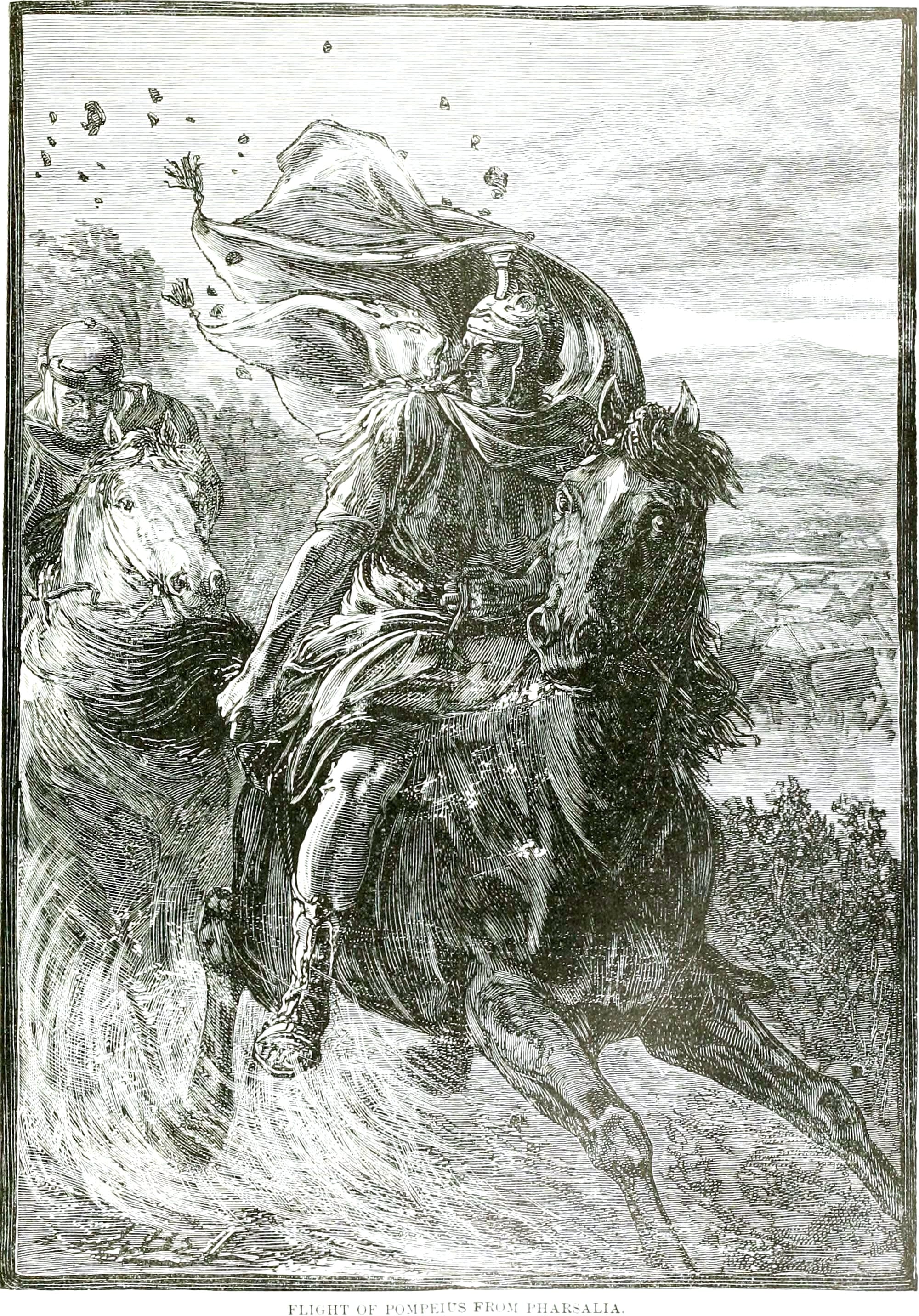
Even then, however, Pharsalus was not quite the clean ending later memory sometimes imagines. A substantial number of Pompey’s men retreated toward their fortified camp, and Caesar still had to complete the victory. Around midday, after the field itself had been won, his men attacked the camp. Caesar’s own account describes a hard defense on the ramparts, with auxiliaries and garrison troops resisting fiercely before the position finally gave way. Yet even this final assault did not deliver the one prize Caesar most needed. Pompey escaped:
“When our men were now circulating within the rampart, Pompeius, procuring a horse and tearing off his insignia as Imperator, flung himself out of the camp by the decuman gate and, putting spurs to his horse, hurried straight off to Larisa.”
That image gives the battle its proper shape. Caesar had won his greatest victory to date, but he had not destroyed the war in a single stroke. Pompey’s army had been beaten, his left shattered, his camp stormed, and his prestige broken. Yet Pompey himself escaped, and with him escaped the possibility of an immediate end.
The casualty figures reinforce the same point. Caesar gives extremely low losses for his own side and very high losses for Pompey’s. Other ancient evidence, especially that associated with Asinius Pollio, offers a lower figure for the Pompeian dead — around 6,000 rather than the much larger totals later tradition liked to repeat. Pharsalus was decisive without being annihilating. Only part of Pompey’s army had been heavily destroyed. Much of the rest, along with most of the leading commanders, got away in good order.
That is why Pharsalus changed Rome without ending everything at once. It shattered the myth of Pompey’s invincibility and transformed Caesar from hunted rebel into master of the battlefield. But it did not end resistance, and it did not close the civil war in a single afternoon.
What it did was far more important in the long run: it broke the one man who could still plausibly stand against Caesar as an equal. After Pharsalus, Pompey could still flee, regroup, and hope. He could no longer command the Roman world in the same way.
The battle had done what years of political struggle and months of campaigning had not — it had made Caesar the dominant figure in the Republic, even if the Republic itself was not yet finished. (“The battle of Pharsalus 48BC. Caesar, Pompey and their final clash in the third Roman civil war” by Gareth C. Sampson)
About the Roman Empire Times
See all the latest news for the Roman Empire, ancient Roman historical facts, anecdotes from Roman Times and stories from the Empire at romanempiretimes.com. Contact our newsroom to report an update or send your story, photos and videos. Follow RET on Google News, Flipboard and subscribe here to our daily email.
Follow the Roman Empire Times on social media: