
The Battle of Pydna: How Rome Broke the Macedonian Phalanx
At Pydna in 168 BC, Aemilius Paullus defeated Perseus after the Macedonian phalanx lost cohesion and Roman troops entered the gaps in its line.

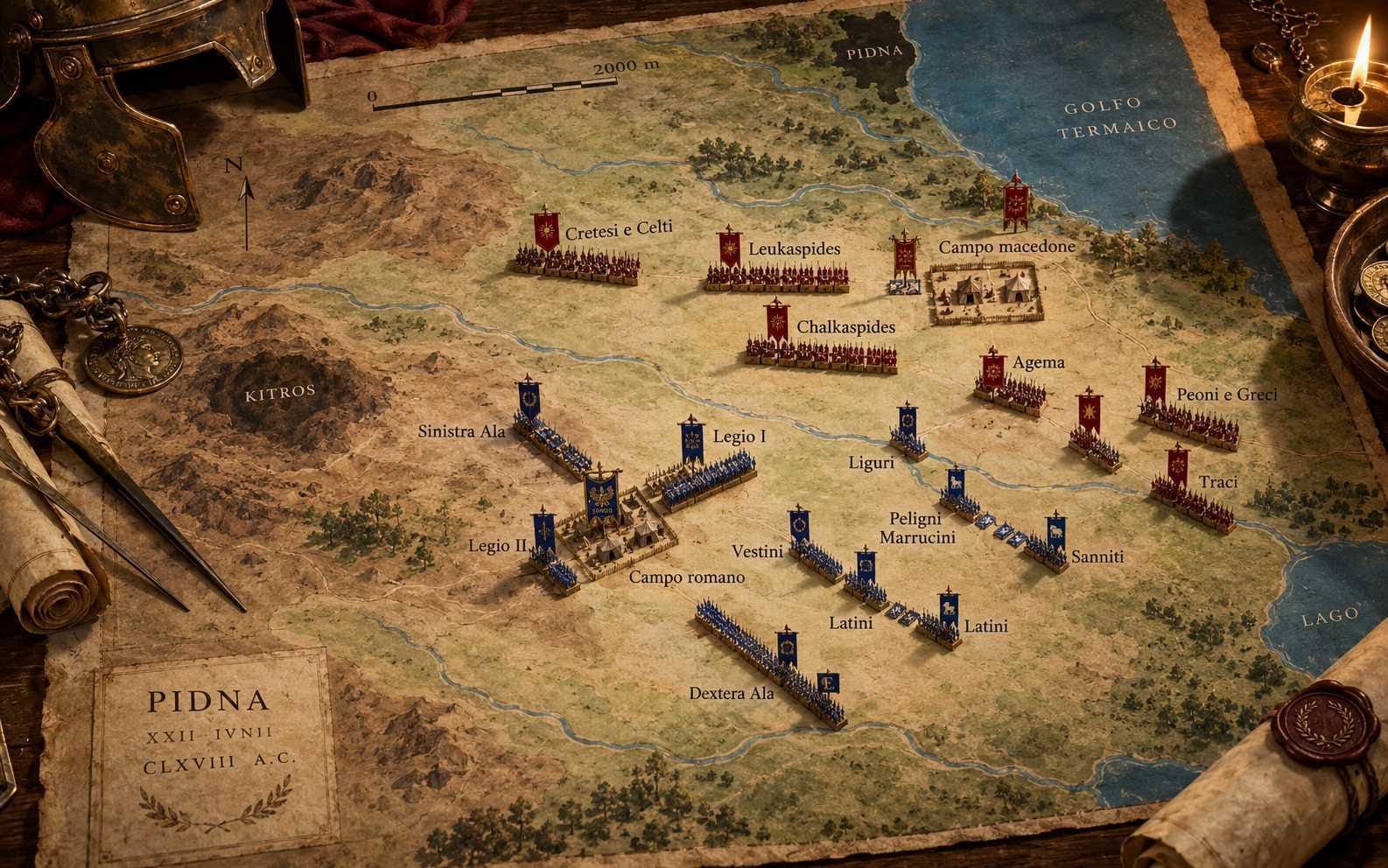
Usually dated to 22 June 168 BC, the Battle of Pydna ended with the defeat of King Perseus by the Roman army commanded by Lucius Aemilius Paullus. The surviving accounts describe an initial infantry struggle in which the Macedonian phalanx proved extremely difficult to approach, followed by a breakdown of the Macedonian line that allowed Roman units to enter gaps between its formations and attack separated bodies of troops. Polybius preserves Paullus's recollection of the fear inspired by the phalanx, while Livy and Plutarch both describe the later fragmentation of the Macedonian formation.
The evidence for the battle is incomplete. Polybius accompanied the Roman army during the Third Macedonian War, and it is possible that he witnessed Pydna, while Scipio Aemilianus, the son of Paullus, fought there as a young cavalryman. Polybius's full narrative of the battle has been lost. Livy preserves the most detailed surviving account, but his text is interrupted by a major lacuna during the deployment and opening of the principal infantry engagement. Plutarch preserves additional traditions, including material associated with Scipio Nasica and Poseidonius, but some of the versions he records disagree with one another.
The Final Campaign of the Third Macedonian War
The Third Macedonian War had begun in 171 BC. Earlier in the conflict Perseus had defeated Roman cavalry and light infantry at Callinicus, while subsequent Roman operations had failed to destroy his main army. By 168 BC command of the Roman forces had passed to Paullus, who found Perseus established behind the River Elpeus near Mount Olympus.
The Macedonian position was strongly defended. Rather than attack it directly, Paullus sent a force commanded by Publius Cornelius Scipio Nasica and Quintus Fabius Maximus through the mountain country. The movement threatened the Macedonian position from another direction, and Perseus withdrew northward. The king retained his field army and established another position near Pydna.
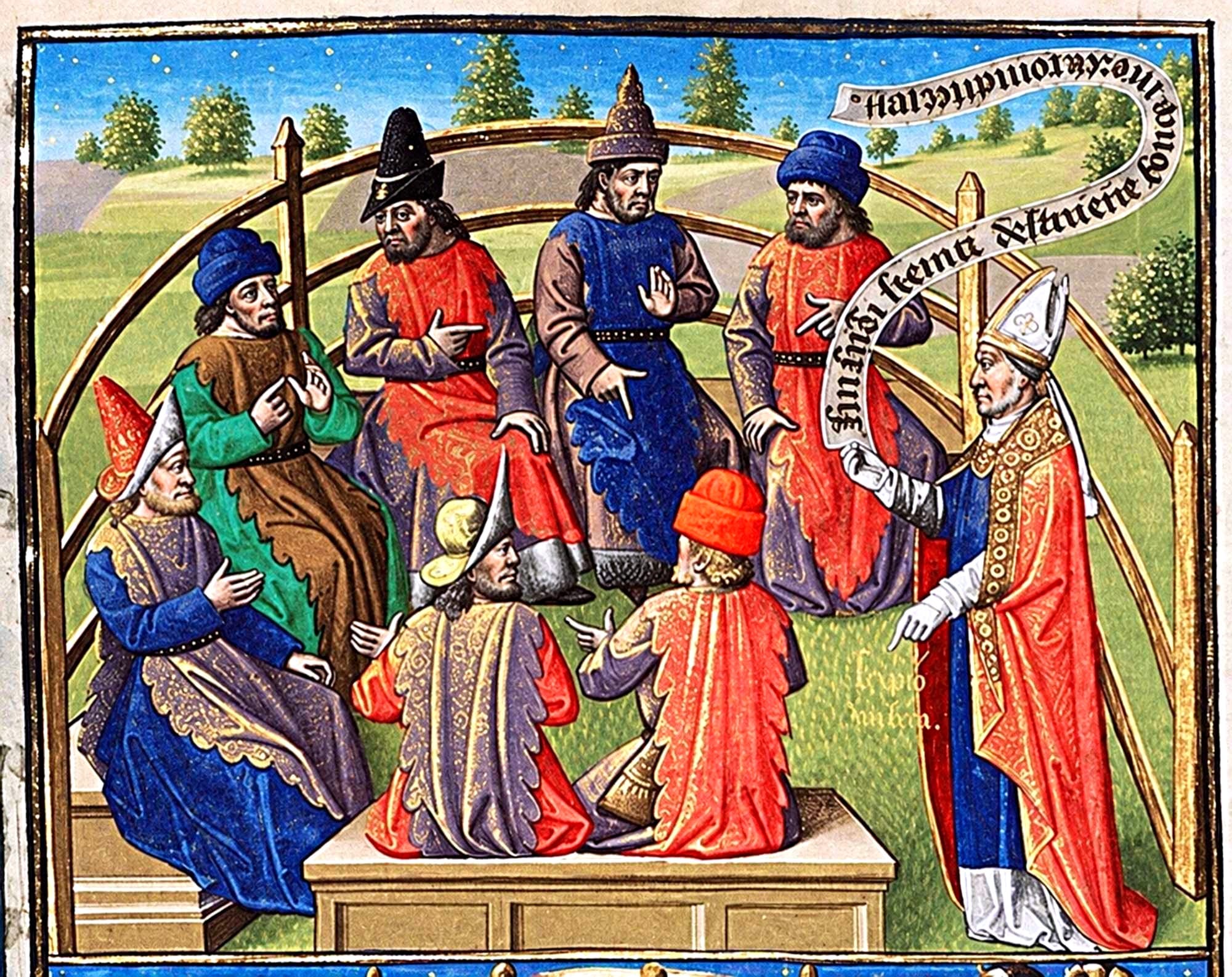
Plutarch describes the new position as combining ground suitable for the phalanx with hills that could be used by lighter troops:
“The place afforded a plain for his phalanx, which required firm standing and smooth ground, and there were hills succeeding one another continuously, which gave his skirmishers and light-armed troops opportunity for retreat and flank attack.”
The ancient descriptions also require shallow watercourses in the battlefield area. Modern attempts to identify these rivers and the precise battlefield have produced different solutions. Earlier reconstructions placed the fighting near Katerini, while later studies favour the plain south of ancient Pydna and east of Kitros. Even within that general area, the proposed identifications of the rivers and the orientation of the two armies differ.
The surviving topographical evidence requires a plain near Pydna, a shallow river, neighbouring low hills, ground in front of the Roman camp that was in some way unsuitable for the phalanx, and sufficient space for both armies to deploy. No direct archaeological evidence has securely identified the battlefield, and the modern reconstructions remain proposals based on the surviving literary and topographical evidence.
Livy gives Perseus approximately 43,000 men when describing the Macedonian forces earlier in the war. The largest component was the phalanx, divided into formations called the Chalkaspides, or Bronze Shields, and the Leukaspides, or White Shields.
The army also included 5,000 peltasts, among them 2,000 members of the agema, 3,000 Macedonian cavalry and another 1,000 Odrysian horsemen under King Cotys. Other contingents included Paeonians, Gauls, Thracians, Cretans and additional allied or mercenary troops.
The figure of around 20,000 pikemen commonly used in modern reconstructions is not stated directly for Pydna. It is derived by subtracting Livy's other enumerated contingents from his larger total. Losses, detachments and movements during the intervening campaigns also mean that the strength of Perseus's army on the day of Pydna cannot be recovered exactly.
Paullus's army contained two Roman legions which Livy says had been strengthened to 6,000 infantry each. Italian allied troops, cavalry, Ligurians, Numidians, other allied contingents and twenty-two elephants increased the Roman force. One modern reconstruction estimates around 25,000 Roman and Italian infantry before auxiliaries are added and considers approximately 35,000 men a reasonable total for Paullus's army, although other estimates differ.
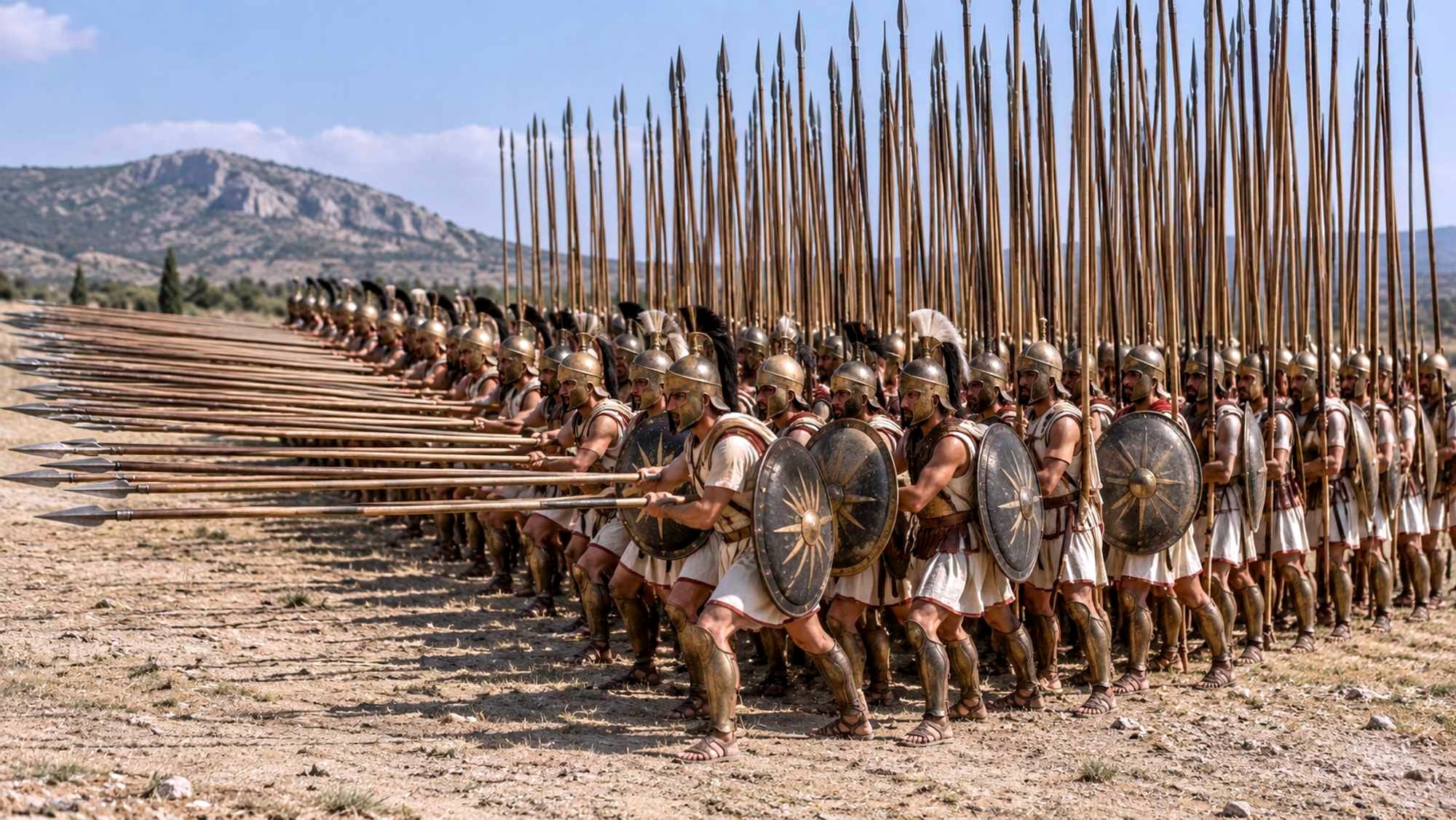
The sarissa phalanx depended on several ranks of long pikes projecting ahead of the foremost Macedonian soldiers. In his earlier discussion following Cynoscephalae, Polybius described the frontal strength created by this arrangement. His discussion was not a surviving account of Pydna, but his description of the phalanx states:
“nothing can withstand the charge of the phalanx as long as it preserves its characteristic formation and force.”
In Plutarch's account of Pydna, the Macedonian formation initially remained intact while Roman and Italian troops struggled to get past the sarissai.
Why Paullus Chose Not to Fight at Once
When Paullus first reached the Macedonian position near Pydna, the Roman soldiers had completed a difficult march while Perseus's troops were already prepared for battle. Livy says some of the younger Roman officers favoured an immediate attack, but Paullus declined to commit the army at once.
Livy's explanation emphasizes the condition of the Roman troops, the need to establish a fortified camp and the danger of engaging an army already drawn up while the Romans were still recovering from their march.
Plutarch also describes Paullus declining battle and establishing his camp. The Roman withdrawal from the initial confrontation was carried out gradually, with units moving back in succession while the remainder continued facing the Macedonian line. Perseus did not attack during this movement.
The sources describe the terrain from different perspectives. Plutarch's account places Perseus on a plain suitable for the phalanx, while Livy indicates that the position in front of the Roman camp was unsuitable for bringing the phalanx forward.
One modern reconstruction interprets these descriptions as referring to different portions of the battlefield and argues that Paullus had positioned his army so that Perseus would have to leave the most favourable ground in order to attack.
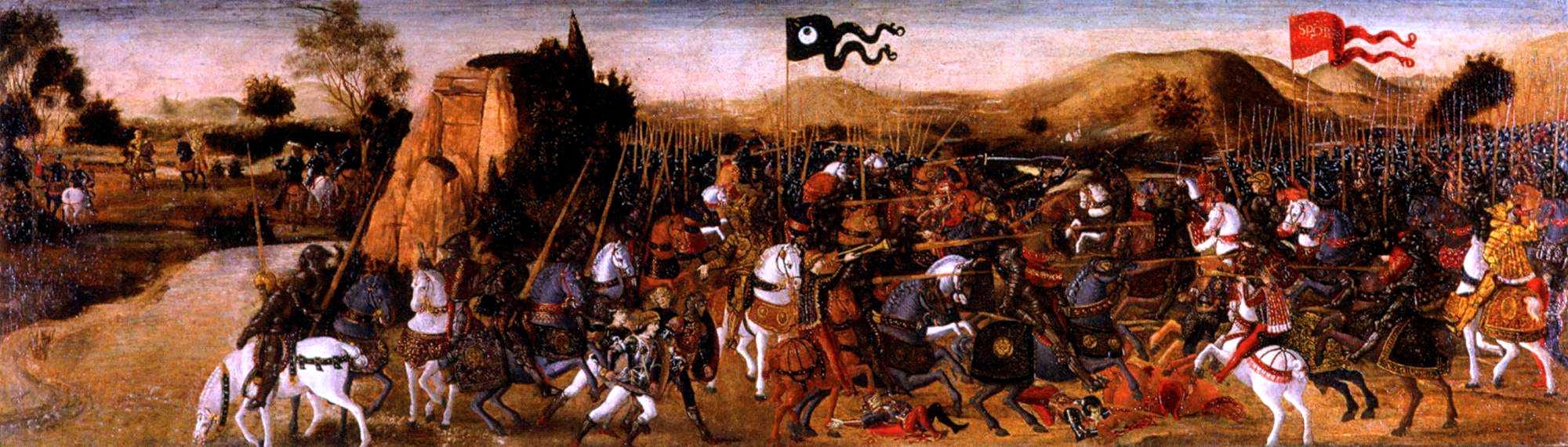
Another reconstruction places less emphasis on deliberate Roman control of the eventual battlefield and more on the rapid development of the fighting on the following day. The surviving evidence therefore supports different reconstructions of what Paullus intended when he refused the first opportunity for battle.
The Lunar Eclipse on the Eve of Battle
A lunar eclipse occurred during the night before the battle. The ancient accounts agree on the occurrence of the eclipse but differ over the actions attributed to Gaius Sulpicius Gallus and over the way the event was presented to the Roman army.
Livy says Gallus predicted the eclipse and explained beforehand that the disappearance of the moon's light would result from a natural and predictable celestial event. Cicero preserves a different version in which Gallus explains the eclipse to the soldiers on the following morning rather than announcing it in advance.
Polybius preserves the tradition that the eclipse was understood as foreshadowing the eclipse of a king and that this encouraged the Romans while discouraging the Macedonians.
Plutarch describes the eclipse itself:
“Now, when night had come, and the soldiers, after supper, were betaking themselves to rest and sleep, on a sudden the moon, which was full and high in the heavens, grew dark, lost its light, took on all sorts of colours in succession, and finally disappeared.”
In Plutarch's account Paullus understood the natural causes of eclipses but nevertheless observed the appropriate religious rites. He sacrificed eleven heifers to the moon and continued sacrificing on the following day:
“And as soon as it was day, he sacrificed as many as twenty oxen to Hercules without getting favourable omens; but with the twenty-first victim the propitious signs appeared and indicated victory if they stood on the defensive.”
Plutarch later says that Paullus delayed the engagement while the sun moved westward, so that the light would no longer be directed into the faces of the Roman troops.
A Skirmish That Became a General Engagement
Livy describes the immediate beginning of the battle as an unintended escalation. Roman and Macedonian detachments drew water from opposite sides of a shallow stream. A Roman pack animal crossed toward the Macedonians, Roman soldiers followed it, fighting developed with Thracian troops and additional men were sent forward from both armies. The local clash then expanded as reinforcements arrived.
Plutarch records two different explanations for the same event:
“Towards evening, Aemilius himself, as some say, devised a scheme for making the enemy begin the attack, and the Romans, pursuing a horse which they had driven forth without a bridle, came into collision with them, and the pursuit of this horse brought on a battle; others say that Thracians, under the command of Alexander, set upon Roman beasts of burden that were bringing in forage, and against these a sharp sally was made by seven hundred Ligurians, whereupon reinforcements were sent to either party, and thus the engagement became general.”
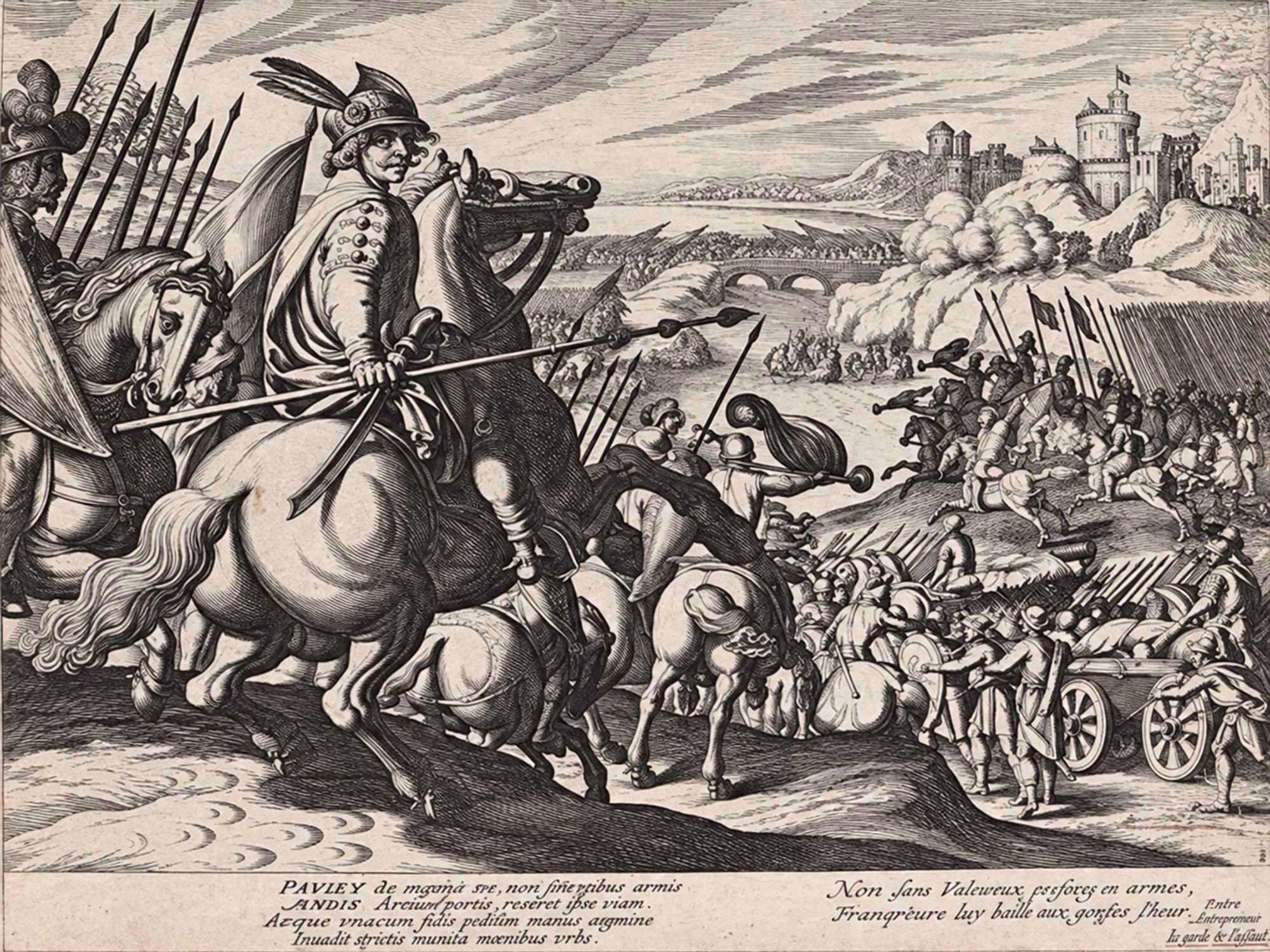
In the first version Paullus deliberately released a horse in order to provoke the enemy. In the second, Thracians attacked Roman animals connected with foraging and Ligurians responded. Plutarch does not resolve the contradiction between the two traditions.
One modern reconstruction treats the battle as an encounter engagement developing while substantial parts of both armies were still leaving their camps and forming for combat. It argues that the rapid movement of units onto the battlefield explains the disorder that later appeared in the Macedonian line and that the Roman legions were able to move from camp into fighting formation more quickly than the large pike formations.
Another reconstruction accepts the possibility that the immediate catalyst was accidental but argues that Paullus had already shaped the circumstances of the engagement through the position of the Roman camp and his refusal to fight on the previous day. A third reconstruction is more sceptical of the accidental interpretation and points to the timing and location of the engagement.
When the Macedonian Phalanx Advanced
As the main Macedonian infantry entered the engagement, the ancient descriptions emphasize the difficulty faced by the Romans. Polybius preserves Paullus's later recollection of his first experience of a Macedonian phalanx:
“Aemilius the consul, who had never seen a phalanx until this occasion in the war with Perseus, often confessed afterwards to certain persons in Rome that he had never seen anything more terrible and dreadful than a Macedonian phalanx, and this although he had witnessed and directed as many battles as any man.”
Plutarch describes the Macedonian pikes already pressing against Roman shields and preventing the Romans from reaching the men carrying them. He gives a similar account of Paullus's reaction:
“And when he saw that the rest of the Macedonian troops also were drawing their targets from their shoulders round in front of them, and with long spears set at one level were withstanding his shield-bearing troops, and saw too the strength of their interlocked shields and the fierceness of their onset, amazement and fear took possession of him, and he felt that he had never seen a sight more fearful.”
The Pelignians and Marrucinians on the Roman side became involved in a direct attack against the Macedonian formation. Plutarch says their commander Salvius threw his standard among the enemy, causing the Pelignians to advance in an attempt to recover it:
“The Romans, when they attacked the Macedonian phalanx, were unable to force a passage, and Salvius, the commander of the Pelignians, snatched the standard of his company and hurled it in among the enemy.”
Plutarch continues by describing the Romans trying to push the long spears aside with their swords and shields or seize them with their hands, while the Macedonians held the sarissai firmly with both hands and drove them forward. He says the pikes pierced the attacking Romans through shields and armour, the first Italian line was cut down, and the men behind it were pushed back toward the height called Olocrus.
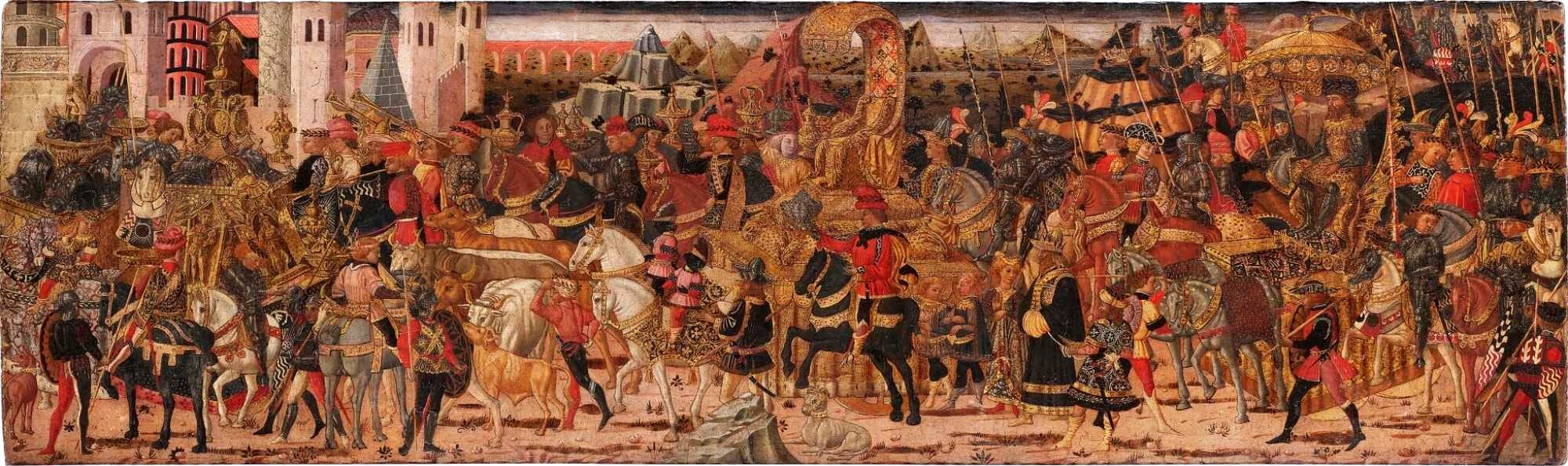
One modern reading of Plutarch emphasizes that the phalanx remained unbroken during this initial fighting, with the sarissai keeping Roman swordsmen beyond effective range. The openings that later became decisive appear only in the next stage of Plutarch's account.
The Moment the Macedonian Front Lost Cohesion
Plutarch describes a subsequent change in the Macedonian formation. Different sections of the line were no longer advancing or fighting in the same way:
“But the ground was uneven, and the line of battle so long that shields could not be kept continuously locked together, and Aemilius therefore saw that the Macedonian phalanx was getting many clefts and intervals in it, as is natural when armies are large and the efforts of the combatants are diversified; portions of it were hard pressed, and other portions were dashing forward.”
Livy's account similarly describes a number of separate engagements disrupting the phalanx during an uneven advance. One modern reconstruction connects this fragmentation with the hurried deployment of the Macedonian formations after the initial skirmish. It argues that the Leukaspides may not have completed their formation before the Romans attacked and estimates that the main Macedonian phalanx divisions collapsed after a relatively short period of heavy fighting.
At the same time, Livy places the Roman elephants and allied infantry on the Roman right, where the Macedonian left first gave ground. The Macedonians had troops and equipment intended to meet the elephants, but Livy's account presents them as ineffective. The allied Roman infantry then followed the elephant attack.
Livy's damaged narrative resumes with Roman troops already exploiting the changing situation. A Roman legion occupied the interval between the caetrati and part of the phalanx, while Lucius Albinus was ordered to lead the second legion against the Leukaspides. The Chalkaspides also appear in the surviving description of the fighting.
The exact arrangement of the Macedonian troops remains disputed. The terminology used for the caetrati and peltastai does not permit every group to be assigned a single uncontested tactical role, while the damaged section of Livy removes part of the deployment narrative. One modern reconstruction interprets some of the caetrati as elite heavy infantry associated with the royal guard while using the same terminology for lighter troops elsewhere in the Macedonian line.
The modern reconstructions also differ over the process by which the openings developed. One gives substantial weight to terrain and Roman positioning, arguing that the Macedonians were induced to advance away from the ground initially selected by Perseus and that troops moving at different speeds became separated.
Another emphasizes the hurried deployment of both armies and the greater difficulty of forming the Macedonian pike units once fighting had already begun. A third gives less weight to terrain and argues that the disruption of the Macedonian left and the separation of supporting troops exposed the side of the phalanx to Roman attack.
How the Romans Fought Inside the Gaps
Plutarch says that Paullus responded to the openings by dividing his troops and directing them into the spaces in the Macedonian line:
“Thereupon he came up swiftly, and dividing up his cohorts, ordered them to plunge quickly into the interstices and empty spaces in the enemy's line and thus come to close quarters, not fighting a single battle against them all, but many separate and successive battles.”
Plutarch continues:
“as soon as they got between the ranks of the enemy and separated them, they attacked some of them in the flank where their armour did not shield them, and cut off others by falling upon their rear, and the strength and general efficiency of the phalanx was lost when it was thus broken up.”
Livy's account also stresses the difficulty faced by the phalanx once units had to respond to attacks from several directions. He attributes the breakup of the formation to numerous separate engagements and describes the long spears as cumbersome when the phalangites were compelled to turn them, especially when attacks came from the flank or rear. Roman troops then entered the gaps that appeared.
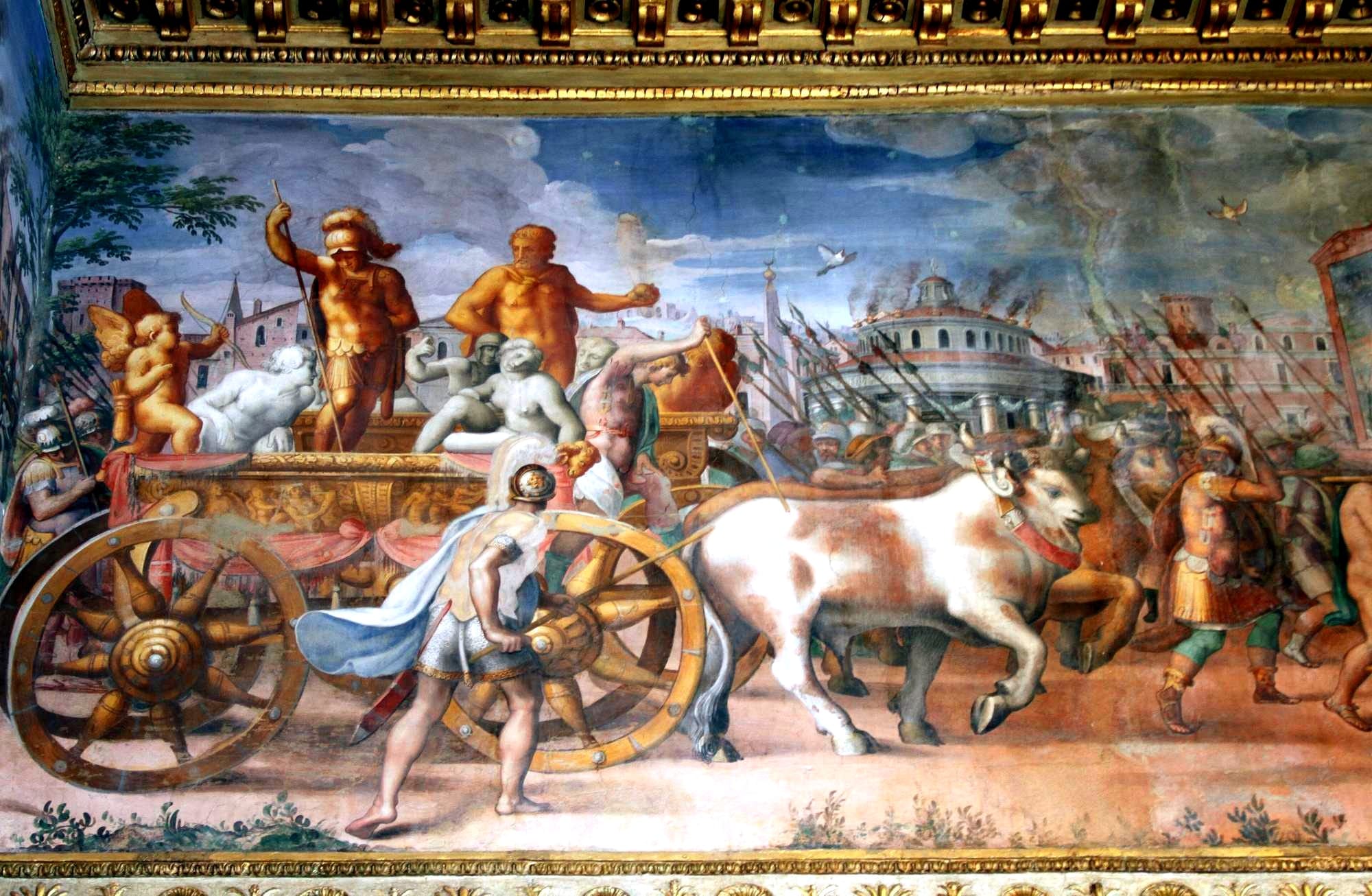
One modern study also compares the equipment available once the fighting had moved to close range. It calculates a substantially larger protective area for the Roman scutum than for the Macedonian shields considered in its reconstruction and notes that the Roman soldier possessed a somewhat longer sword. The same study argues that Roman pila could be used against Macedonian groups and that the spaces between Roman maniples were not equivalent to the gaps that developed in the phalanx, since a Macedonian unit moving into such a space could be exposed to neighbouring Roman formations.
Polybius's earlier Book 18 discussion likewise distinguished between the phalanx's frontal strength and the ability of Roman formations to operate in smaller bodies when circumstances required it. That comparison predates Pydna and is not the lost Polybian account of the battle itself.
The Missing Role of the Macedonian Cavalry
Perseus had fielded substantial cavalry during the war, including approximately 3,000 Macedonian horsemen and another 1,000 Odrysians in the earlier army enumeration. Cavalry and light infantry had been central to the Macedonian success at Callinicus. At Pydna, however, the mounted troops do not appear prominently in the surviving accounts of the decisive infantry fighting.
Livy says that the cavalry left the battlefield with very little loss. Perseus departed with the royal cavalry, Cotys and the Odrysians followed, and the remainder of the Macedonian horse escaped with their formation largely intact while Roman attention remained concentrated on the infantry.
The ancient narrative does not explain why the cavalry had not played a larger role before the infantry collapse. One modern reconstruction explicitly describes the absence of Macedonian cavalry from the decisive fighting as a mystery and considers several possibilities, including that Perseus deliberately held it back, that environmental conditions affected deployment, or that mounted troops may have been present in ways the surviving narrative does not clearly identify.
Another reconstruction places greater emphasis on the rapid and piecemeal development of the battle and proposes that the Macedonian cavalry may not even have completed its deployment before the phalanx began to collapse. It also argues that Perseus should have used cavalry to reinforce the threatened left, but this is part of that author's interpretation rather than information supplied by the ancient narratives.
The same interpretation places Pydna within a broader argument about combined arms. It argues that a sarissa phalanx depended on cavalry and other infantry formations to protect its flanks and that the failure of these supporting arms at Pydna allowed Roman troops to reach the side and rear of the pike formations.
Perseus and the Conflicting Accounts of His Flight
The ancient traditions disagree over Perseus's conduct during the fighting. Plutarch preserves a hostile version attributed to Polybius:
“The king of the Macedonians, on the other hand, according to Polybius, as soon as the battle began, played the coward and rode back to the city, under pretence of sacrificing to Heracles.”
Plutarch also records a different version from Poseidonius. According to this account, Perseus had been injured when a horse kicked his leg before the battle. Poseidonius nevertheless had him mount, enter the fighting without a breastplate and receive a glancing blow from a missile while among the Macedonian troops.
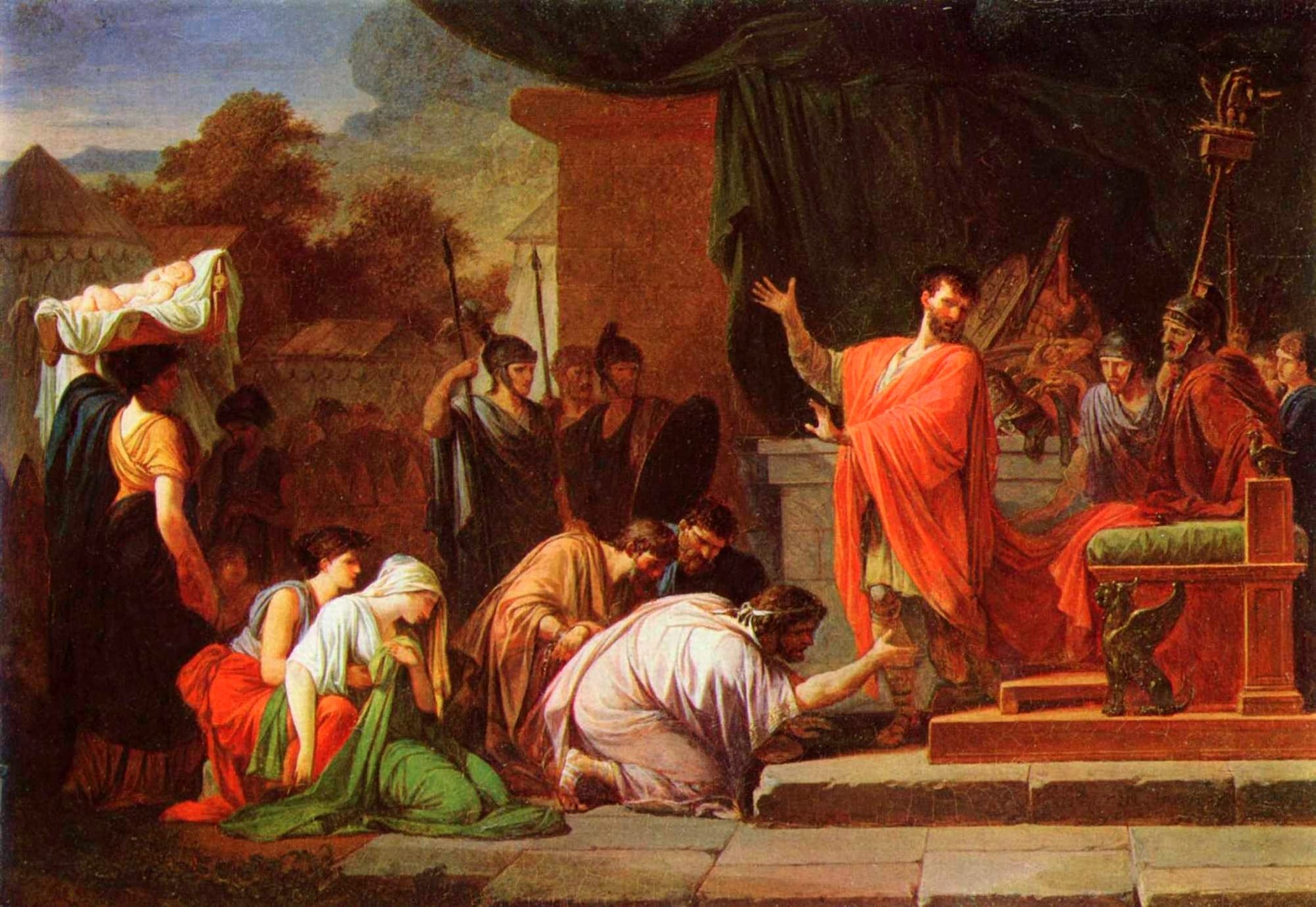
Plutarch presents the Poseidonius version as a defence against the charge that Perseus abandoned the battle through cowardice. The two accounts assign the king very different roles and cannot be combined into a single narrative. The surviving evidence establishes that Perseus eventually left the battlefield with cavalry, while the Poseidonius tradition places him in the fighting before that withdrawal.
The Rout, the Casualties and the End of the Battle
Plutarch describes the decisive fighting as extremely brief:
“And this greatest of all struggles was most speedily decided; for the Romans began fighting at three o'clock in the afternoon, and were victorious within an hour.”
One modern reconstruction estimates that the deployment of both armies may have taken approximately twenty to thirty minutes and that the principal fighting another thirty to forty minutes, while explicitly relating this estimate to Plutarch's statement that the battle lasted less than an hour.
Plutarch says that three thousand picked Macedonian troops remained in order and continued fighting until they were killed. The identification of these men with a specific named formation is disputed. One modern reconstruction regards them as possibly the caetrati rather than the agema, while the surviving ancient wording does not settle the identification.
Elsewhere the Macedonian army broke into flight, with men moving toward Pydna, the coast and other routes away from the battlefield. Livy reports that approximately six thousand Macedonians reached Pydna during the rout, a detail used in modern attempts to constrain the possible location of the battlefield.
Livy gives approximately 20,000 Macedonian dead and 11,000 prisoners. Plutarch gives more than 25,000 Macedonian dead. Livy records not more than one hundred Roman deaths, while Plutarch gives one hundred according to Poseidonius and eighty according to Nasica.
Modern analysis treats the Macedonian death totals with particular caution. One study considers the reported 20,000 or 25,000 dead likely exaggerated and notes that, when Livy's prisoner figure is added, the total killed and captured would account for almost the entirety of the Macedonian force reconstructed for the battle. It suggests that the prisoner figure may be more reliable if captives were formally counted, while still treating the exact totals cautiously.
Pydna and the End of the Antigonid Kingdom
Perseus escaped from the battlefield but was captured shortly afterward. The Romans subsequently abolished the Macedonian monarchy.
Plutarch describes the Roman and Italian troops first struggling to penetrate the intact Macedonian formation. He then describes clefts and intervals developing in the Macedonian line and Paullus ordering his units into them, where the fighting became a series of separate engagements. Livy likewise attributes the disruption of the phalanx to numerous scattered combats and describes Roman troops entering the openings that appeared.
The modern reconstructions differ over how those openings developed. One places greater weight on hurried deployment after the initial skirmish, another on the terrain and the position chosen by Paullus, while another emphasizes the failure of Macedonian flank protection and supporting arms. The ancient accounts do not preserve enough of the deployment and command decisions to resolve that disagreement.
Livy, Ab Urbe Condita, Book 44
Plutarch, Life of Aemilius Paullus
Polybius, Histories, Books 18 and 29
Cicero, De Republica, Book 1
Paul Johstono and Michael J. Taylor, “Reconstructing the Battle of Pydna,” Greek, Roman, and Byzantine Studies 62 (2022), 44–76
Davide Morelli, “La battaglia di Pidna. Aspetti topografici e strategici,” Klio 103.1 (2021), 97–132
Graham Wrightson, The Third Macedonian War and Battle of Pydna: Perseus’ Neglect of Combined-arms Tactics and the Real Reasons for the Roman Victory, Pen & Sword Military, 2023

About the Roman Empire Times
See all the latest news for the Roman Empire, ancient Roman historical facts, anecdotes from Roman Times and stories from the Empire at romanempiretimes.com. Contact our newsroom to report an update or send your story, photos and videos. Follow RET on Google News, Flipboard and subscribe here to our daily email.
Follow the Roman Empire Times on social media: