
No Fridge? No Problem: How Romans Preserved Food
Romans preserved food through drying, salting, smoking, pickling, fermentation and careful storage, using techniques that could keep grain, fruit, cheese, meat and wine usable for months.

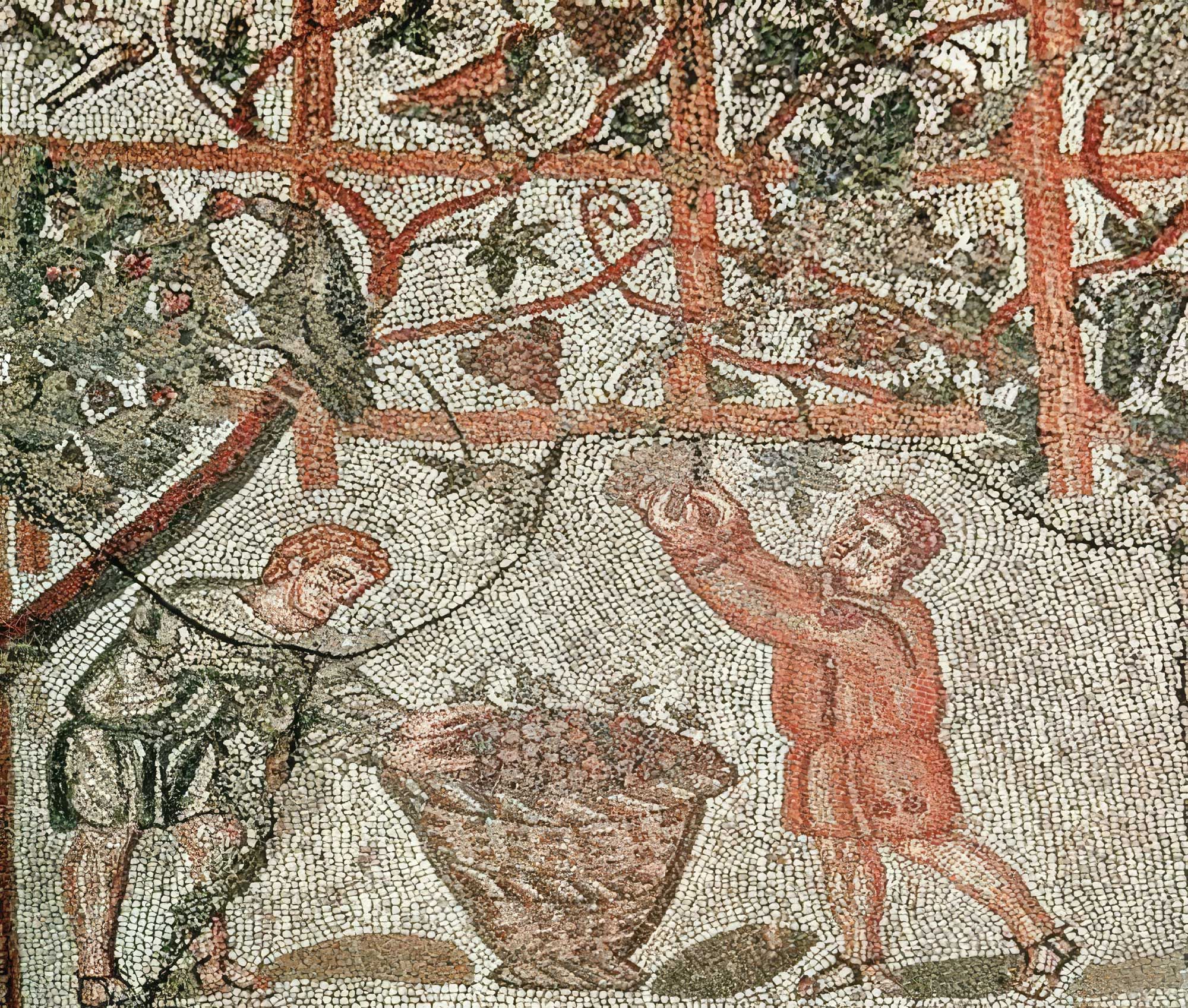
A Roman harvest did not arrive evenly throughout the year. Grain ripened and was cut, grapes came in with the vintage, olives had their season, and many fruits and vegetables were abundant for a limited period. Milk, fresh meat and fish presented a different problem because they deteriorated much more quickly.
A large part of Roman food preparation therefore took place long before a meal was cooked, as households, farms and commercial producers turned seasonal or perishable foods into forms that could be stored, transported and eaten later.
The methods preserved in agricultural texts and recovered archaeologically were remarkably varied. Grain was threshed, winnowed, dried, stored and milled. Grapes became raisins, wine, vinegar, preserved sweet must and concentrated syrups. Olives were soaked and pickled for eating or crushed and pressed for oil.
Fruit was dried, packed in chaff or bran, immersed in water, covered with honey or boiled must, and sometimes enclosed in vessels while still attached to the plant. Milk became cheese; pork was salted, weighted, aired and smoked; vegetables were treated with salt, brine and vinegar. Storage buildings, buried jars and transport amphorae continued the work after the food itself had been processed.
The surviving instructions are often more revealing than a simple list of preserved foods. They tell us how strong brine was tested with an egg or a piece of cheese, how figs were trodden with clean feet and made into seasoned fig loaves, how grape juice could be sealed inside an amphora and submerged in water, how hard cheese could survive transport overseas, and why wine and olive oil were deliberately stored under different conditions. Roman food preservation was not one technique but an entire chain of processing and storage.
From Stored Grain to Bread
Grain was naturally easier to preserve than milk, meat or ripe fruit, but keeping it usable was not automatic. After harvest it first had to be separated from the plant. Threshing loosened the grain, while winnowing allowed the lighter chaff to be carried away. Some cereals required further parching or pounding, and once grain entered storage it had to be protected from damp, rodents and insects.
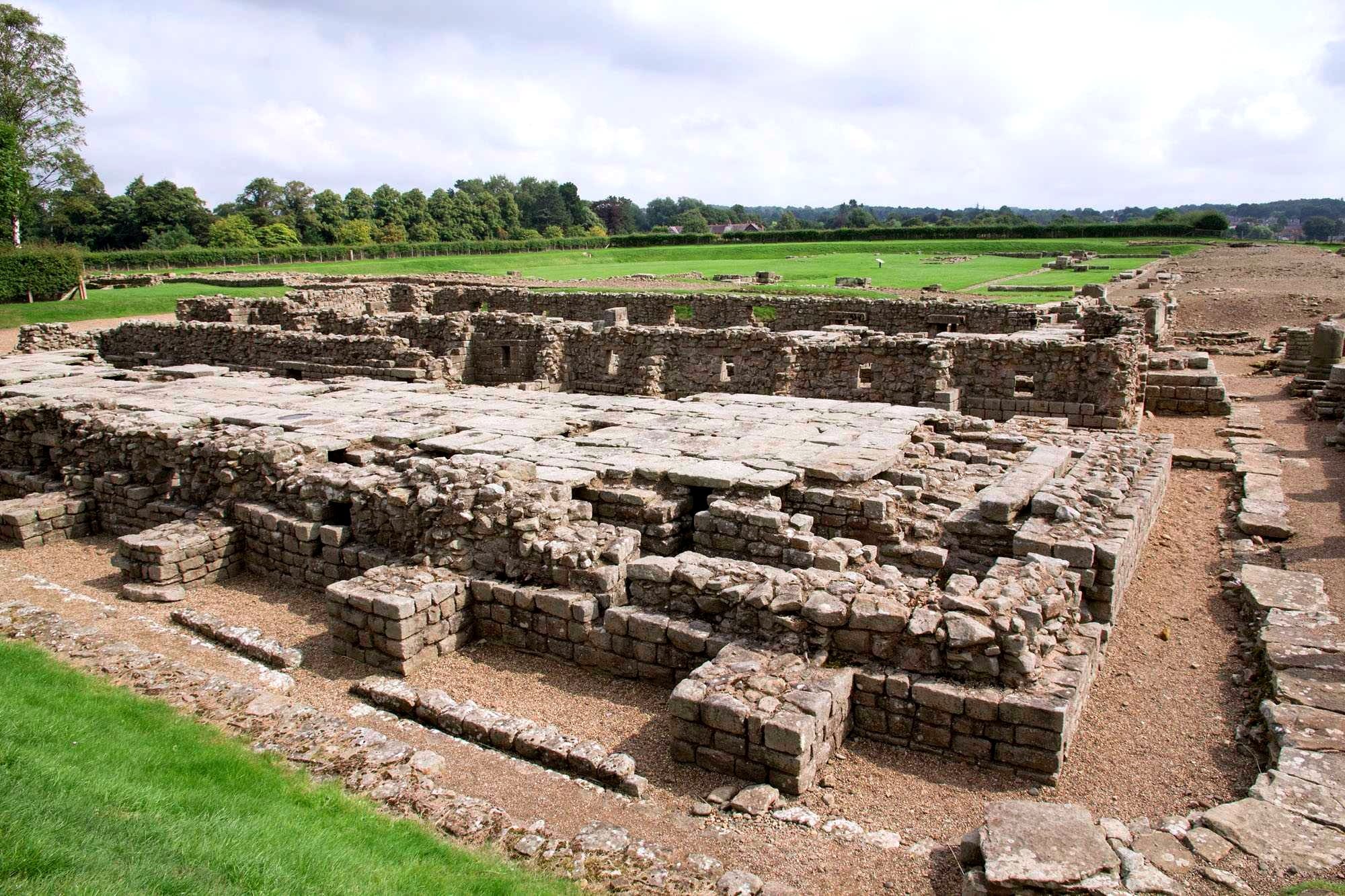
Roman writers describe both underground and above-ground storage. Underground pits could preserve grain for long periods, but Varro records a very practical danger when they were reopened. His warning is worth reading in full:
“Those who keep their grain under ground in the pits which they call sirus should remove the grain some time after the pits are opened, as it is dangerous to enter them immediately, some people having been suffocated while doing so.”— Varro, De Re Rustica 1.63.
Varro therefore advised waiting after the pit had been opened before entering and removing the grain. In the same discussion he describes another storage problem: weevils. Infested grain could be brought into the sun, with vessels of water set nearby so that the insects would gather there and drown. The instructions show that storing a harvest successfully required continued attention long after the grain had left the field.
Above-ground granaries followed a different logic. Columella recommended treating parts of the granary with amurca, the watery residue left from olive-oil processing, before grain was put inside. He describes turning over the earth floor, soaking it with fresh unsalted amurca and compacting it. The material could also be incorporated into floor and wall treatments, and the walls could be sprinkled with amurca before the grain entered storage.
Varro gives another detailed prescription for above-ground grain storage:
“Wheat should be stored in granaries, above ground, open to the draught on the east and north, and not exposed to damp air rising in the vicinity. The walls and floor are to be coated with marble cement, or at least with clay mixed with grain-chaff and amurca, as this both keeps out mice and worms and makes the grain more solid and firm.”— Varro, De Re Rustica 1.57.1.
Raised floors offered another defense. Roman granaries could lift the storage surface above damp ground, while archaeological examples show attention to ventilation and moisture control. At Portus, later warehouses used systems of channels beneath raised floors to help stabilize storage conditions.
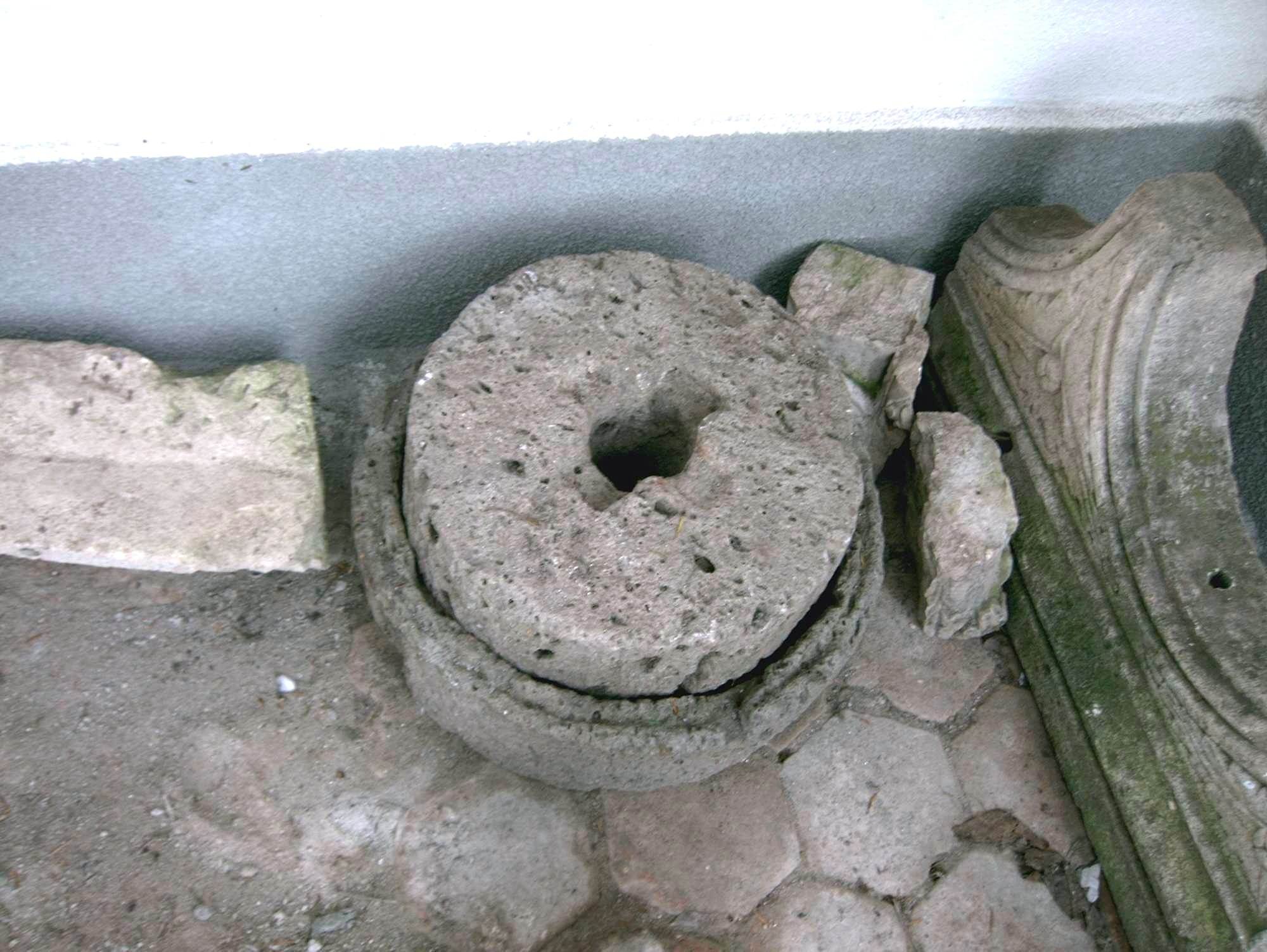
Once grain left storage, milling ranged from household labor to substantial machinery. Mortars, saddle querns and rotary hand mills remained in use. The large animal-driven mills familiar from Pompeii had a fixed lower stone and an hourglass-shaped upper stone, the catillus. The upper stone could be reversed when one grinding surface became worn, allowing another surface to be used instead of immediately discarding the component.
Commercial bakeries could bring several stages together. Flour was sieved, mixed with water, kneaded and baked. Archaeological remains and relief sculpture provide evidence for rotary kneading machines, while large ovens allowed bread to be produced on a scale beyond ordinary household preparation. The reliefs on the tomb of the baker Eurysaces show several parts of this production process, and archaeological evidence confirms mechanical kneading equipment in Roman commercial settings.
Water could replace human or animal power. Vitruvius describes a geared watermill in considerable mechanical detail:
“Water mills are turned on the same principle, and are in all respects similar, except that at one end of the axis they are provided with a drum-wheel, toothed and framed fast to the said axis; this being placed vertically on the edge turns round with the wheel. Corresponding with the drum-wheel a larger horizontal toothed wheel is placed, working on an axis whose upper head is in the form of a dovetail, and is inserted into the mill-stone.” — Vitruvius, De Architectura 10.5.2.
He continues by explaining that the teeth of one wheel engage the other, turning the millstones while a hopper supplies the grain.
The description corresponds with archaeological evidence for Roman water-powered milling. The complex at Barbegal in southern Gaul famously incorporated sixteen mills, while watermills were also used elsewhere in the Roman world. There is no need to attach uncertain theoretical production figures to them. What the evidence demonstrates securely is that hand mills, animal-driven mills and watermills could all coexist rather than representing neat technological stages in which one immediately eliminated the others.
A brief literary glimpse of the labor involved survives in Apuleius, whose fictional account places exhausted enslaved workers and animals inside a bakery operating mills. It should not be treated as a statistical description of Roman bakeries, but it provides a vivid reminder of the human and animal work behind mechanical milling.
Roman cereal processing went beyond ordinary flour. Cato describes making starch from wheat through prolonged soaking and repeated handling:
“Clean hard wheat thoroughly, pour into a trough, and add water twice a day. On the tenth day drain off the water, squeeze thoroughly, mix well in a clean tray until it is of the consistency of wine-dregs. Place some of this in a new linen bag and squeeze out the creamy substance into a new pan or bowl.” — Cato, De Agricultura 87.
Bread itself could be leavened in several ways. Pliny records preparations involving grain and must, the use of beer foam in Gaul and Spain, and the much simpler method of retaining fermented dough from a previous batch.
The surviving evidence therefore ranges from grain pounded or ground in a household to commercial establishments equipped with animal mills, mechanical kneaders and large ovens. Preservation was only the first stage; storage, milling, fermentation and baking transformed a durable agricultural crop into the bread eaten every day.
Olives: From Bitter Fruit to Oil and Pickles
Olives demanded quicker attention. The agricultural writers repeatedly warn against leaving harvested olives lying around for too long. Cato wanted the crop processed promptly, and Columella describes ways of temporarily handling olives if pressing could not begin immediately.
The texts also reveal competing interests during processing. Cato says that the gatherers wanted as many fallen olives as possible, while the press workers preferred the olives to remain on the floor long enough to soften because they were then easier to mill. He rejected the idea that leaving them there increased the quantity of oil, insisting that quicker processing produced more and better oil.
Cato's instructions make the emphasis on speed clear:
“Observe the following directions in making green oil: Pick the olives off the ground as soon as possible, and if they are dirty, wash them and clean off leaves and dung. Mill them a day or two days after they have been gathered.” — Cato, De Agricultura 65.
Oil production began by crushing the fruit. Devices such as the trapetum used heavy stone runners inside a basin, after which the olive paste was transferred to presses. Roman presses employed several mechanisms, including beams, weights, winches and later screws. Older and newer systems could coexist.
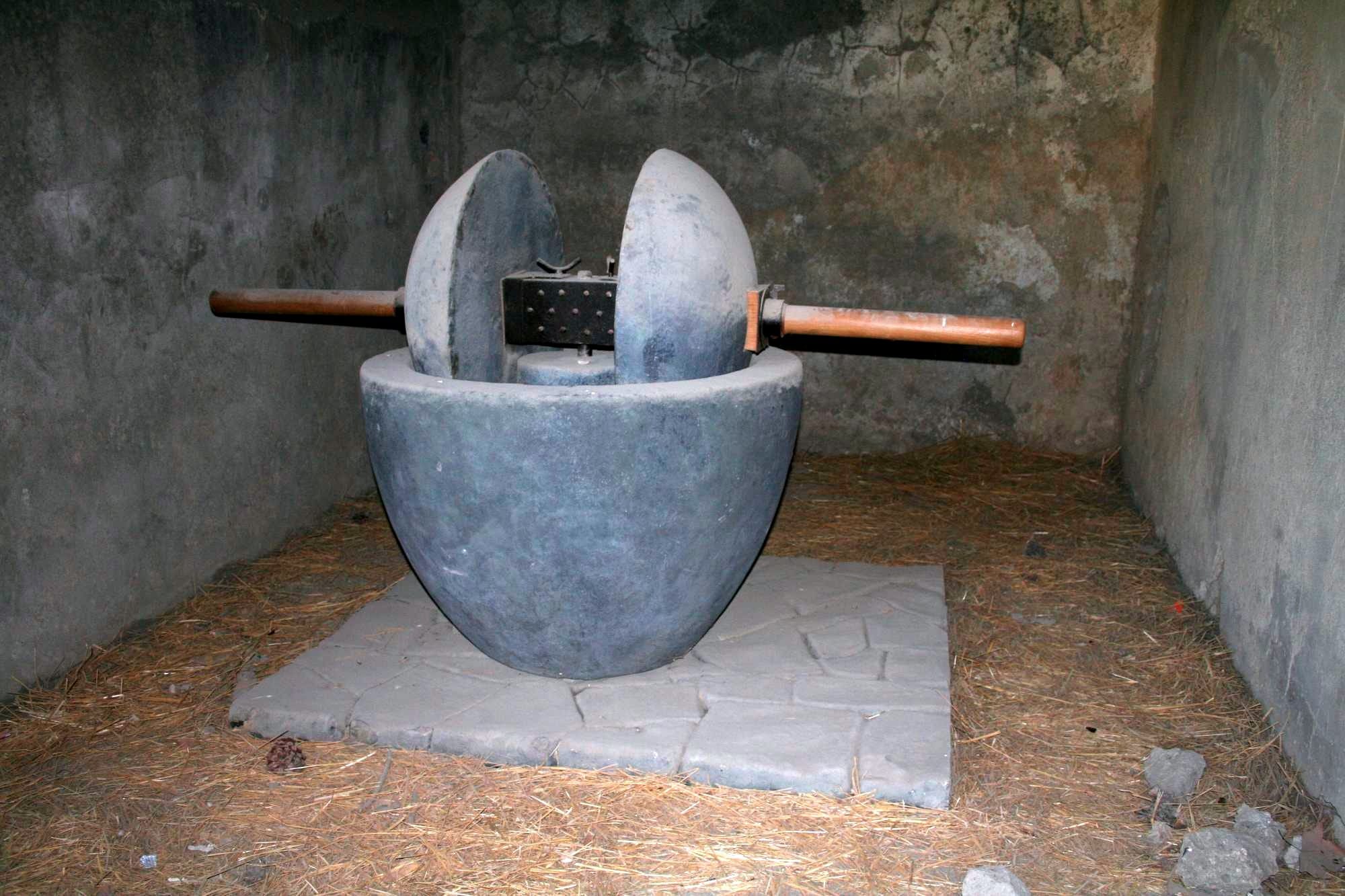
Both Cato and Columella discuss attempts to adjust crushing equipment so that the flesh of the olive was thoroughly broken down while the pit supposedly remained intact. Columella thought crushing the pit could harm the flavor of the oil.
Modern scholarship has questioned whether a trapetum could consistently avoid breaking the olive pits and whether doing so would actually improve the oil. The ancient writers therefore regarded keeping the pits intact as desirable, although modern scholarship does not consider it necessary for producing good oil.
Pressing, however, did not yield finished clear oil. The liquid coming from the press also contained water, solids and amurca. It had to settle and the oil had to be separated from the other material. Cato repeatedly emphasizes cleanliness and prompt handling, while Columella describes cleaning pressing equipment thoroughly between uses.
The by-product amurca was far from useless. It could be kept and employed in treatments for storage vessels, threshing floors, granaries and other parts of an estate. Roman processing repeatedly turned what looked like waste into another usable substance.
Olives intended for eating followed another route. Their bitterness could be reduced through soaking, brining and salting. Green olives might be cracked first so that the preserving liquid penetrated them. Black olives could be salted for weeks and later stored with concentrated grape must and aromatics.
One Columella treatment mixed black olives with mastic seed, fennel seed and toasted salt, packed them into amphorae and rolled the vessels daily. Every few days the amurca was poured off. After forty days the salt was washed away and the olives returned to storage.
Green olives could be treated differently: cracked, softened in hot water, squeezed, mixed with fennel, mastic and salt, and topped with very fresh must. Roman preserved olives could therefore combine saltiness with fennel, resinous aromatics and the sweetness of grape juice.
Cato gives an especially simple test for determining whether brine was strong enough:
“place a small dried fish or an egg in it, and if it floats you have a brine strong enough to pickle meat or cheese or salted fish.”— Cato, De Agricultura 88.
The same principle appears in Columella with fresh cheese. If the cheese sank, more salt was required. When it floated, the brine was considered ready. The floating food therefore provided a practical test of the brine's strength.
Grapes Could Become Much More Than Wine
Few crops demonstrate Roman processing as well as grapes. A grape harvest could become fresh fruit, raisins, preserved bunches, must, wine, vinegar, lora (a weak, secondary wine-like drink made from the grape residue left after pressing) or concentrated grape products. Even the material left after the principal pressing could be reused.
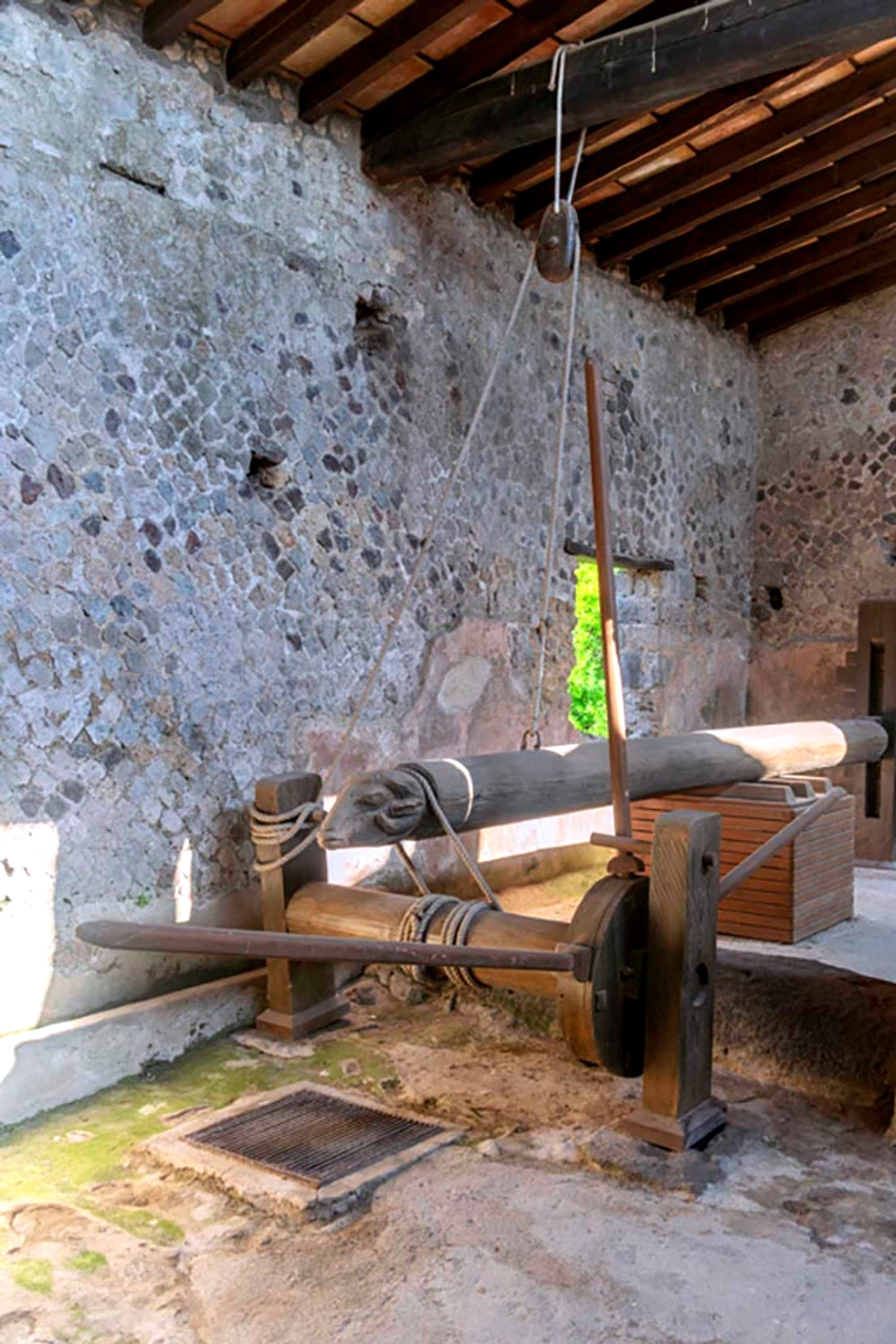
Wine began with treading or crushing. Free-running juice could be collected before the remaining grape mass was pressed. Subsequent pressings recovered more liquid, while exhausted grape skins and stems still had other uses.
Grape marc could be kept for winter livestock fodder. It could also be mixed with water to produce lora, the much weaker drink. What looked like the remains of winemaking was therefore still useful.
Romans also devoted considerable effort to preserving grapes as grapes. Bunches could be hung, packed in dry materials, placed separately into containers or protected within sealed vessels. Varro records pitched vessels and methods involving water, while Columella provides an extraordinary catalogue of procedures.
One of the most striking was to construct tiny pitched vessels around individual bunches while the grapes were still attached to the vine. Their lids were made in two parts so that they could fit around the stem and then be carefully sealed. The storage container was effectively brought to the living fruit rather than waiting for harvest.
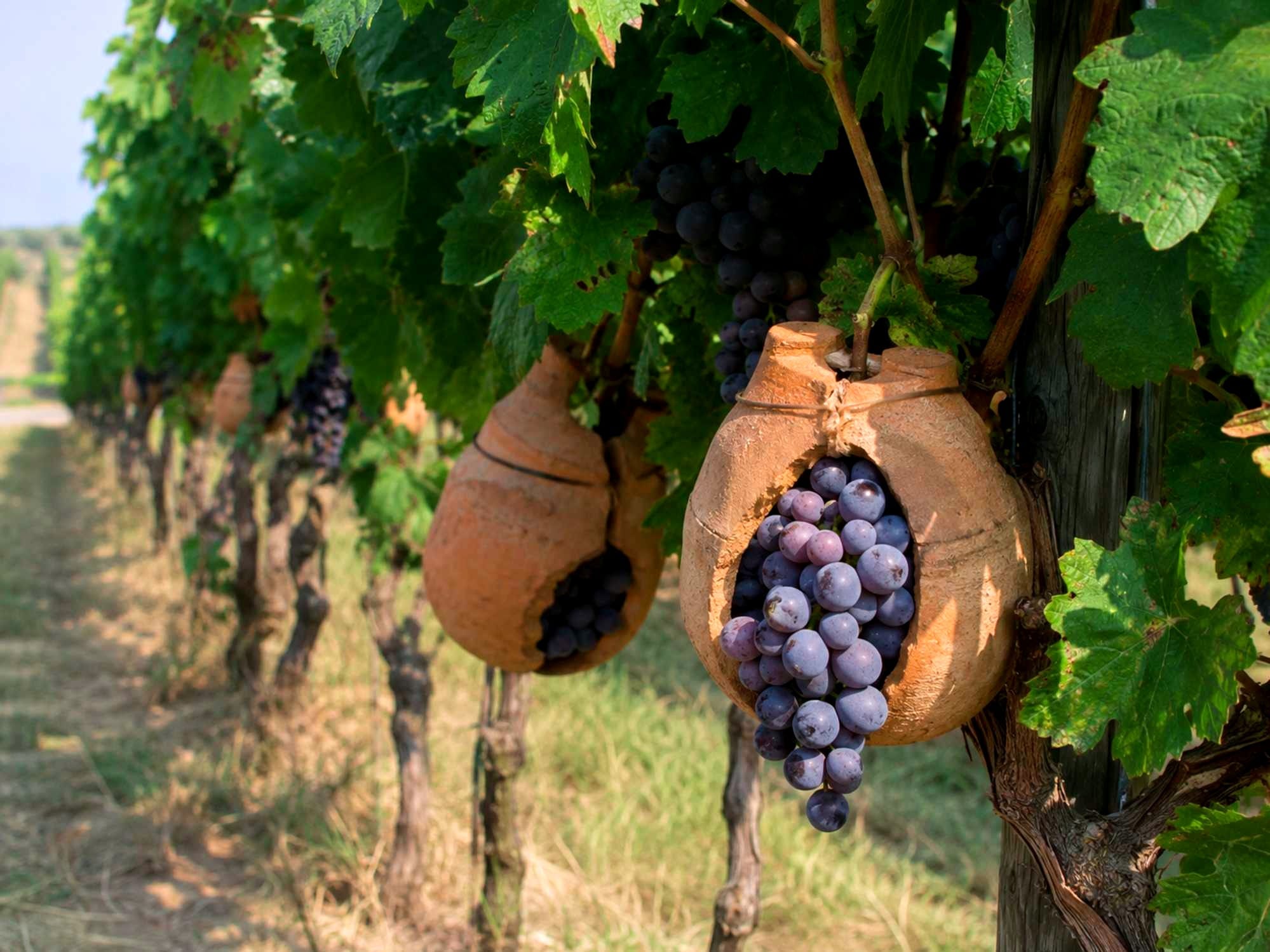
Other grapes could be arranged among completely dry chaff, barley bran or sawdust. Bunches might be carefully spaced so that they did not touch. Some containers were placed inside larger vessels surrounded by wine-press residue, while others were sealed and submerged in cold water.
Columella even describes a system in which defrutum was poured into the bottom of a pitched dolium. A rack was constructed above the liquid and vessels containing grapes were arranged on tiers, or the bunches themselves could be suspended so that they touched neither one another nor the concentrated must below.
Raisins required a different process. Columella describes carefully selected grapes briefly dipped in boiling lye-water, not long enough to cook them, and then arranged on hurdles so they did not touch while drying. Cato records Duracinian and large Aminean grapes dried on hurdles and then smoked in a blacksmith's workshop.
Romans could also try to keep grape juice sweet instead of allowing it to become ordinary wine. Columella gives one of the most memorable preservation instructions in the agricultural literature:
“… and put it into a new amphora, and daub it and pitch it carefully, that no water at all may enter into it; then sink the whole amphora into a pond of cold and sweet water, so that no part of it may stand out of it; then, after forty days, take it out of the pond; thus it will continue sweet for a whole year.”— Columella, De Re Rustica 12.29, 1745 translation.
The claim that it would remain sweet for an entire year belongs to Columella. The method itself is clear enough: fresh must was sealed inside an amphora and completely submerged in cold water for forty days.
Cato gives a related method for preserving must, showing that keeping grape juice sweet rather than allowing it to ferment was a recognized goal.
Boiling Grapes into Sapa and Defrutum
Another important destination for the grape harvest was concentrated must. Roman texts use names including caroenum, defrutum and sapa, but their precise definitions and reduction ratios are not entirely consistent.
Pliny defines defrutum one way and sapa another. Columella gives different proportions, and Palladius gives still another set. It is therefore safest to describe them as different concentrations of boiled grape must rather than impose a single universal Roman formula.
Pliny's old English translation describes the deliberate manufacture of sapa in particularly memorable terms:
“the devise of mans wit, and no worke of Nature”— Pliny, Natural History 14.
Columella's instructions show that concentrated must was not necessarily a minor kitchen preparation. On a substantial estate it could involve a dedicated room, the cortinale, named for the large cauldrons or cortinae in which the must was reduced.
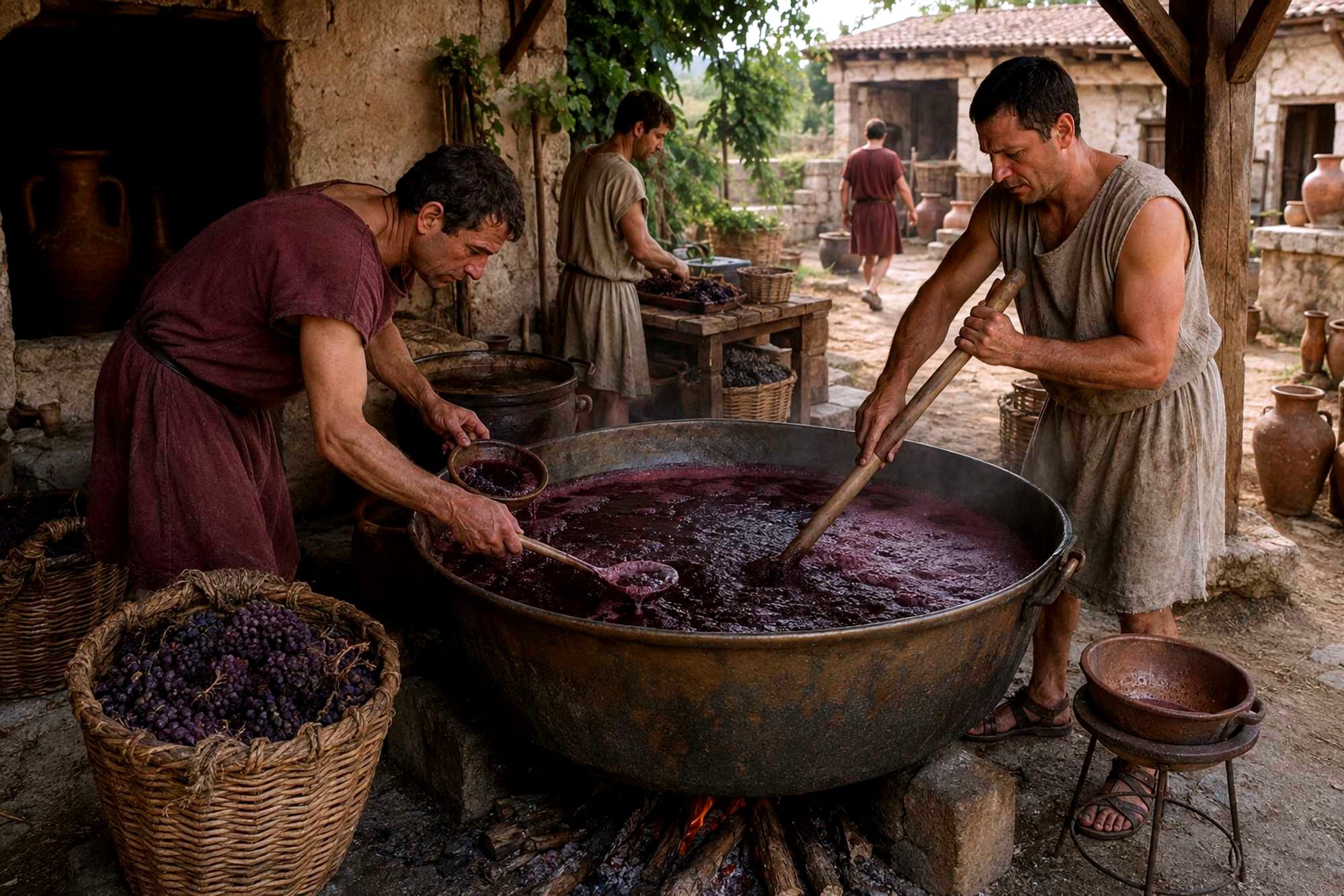
The scale could be considerable. Columella refers to vessels capable of holding around ninety amphorae, more than two thousand liters. The ripest grapes were preferred, and the must was boiled down slowly, stirred and repeatedly skimmed.
These concentrates then appeared throughout Roman food preparation. They could be used to modify wines, accompany preserved olives, sweeten preparations and preserve fruit and vegetables. Concentrated grape must therefore moved between vineyard, winery, storeroom and kitchen.
Columella specifies lead cauldrons for boiling concentrated must and rejects bronze because he believed the copper salts, or aerugo, produced by bronze would spoil the flavor.
Pliny records another curious procedure. Walnuts were sometimes placed into boiling must because they were believed to draw out smoky or unpleasant flavors.
Wine itself required attention after fermentation. It could be racked, clarified and transferred between containers. Various substances appear in ancient attempts to alter or stabilize it, including salt or brine, gypsum, chalk, resin, pitch, spices and other aromatics. Some wines were exposed to heat or smoke.
Strong odors were regarded as especially dangerous. Pliny advised that cellars be kept away from foul-smelling places:
“there be no muckhils nor privies neare: no roots of trees, nor any thing of a strong and stinking savor: for that wine is of this nature, to draw any smell very quickly into it.”
He also warned against crowding the wine vessels:
“they ought to stand a pretie distance one from another: for feare of contagion, for that wine is alwaies most apt to catch infection very soone.”— Pliny, Natural History 14.
Fermentation itself could be physically violent. Varro knew that fermenting wine could damage or burst vessels. Roman wine storage was therefore never merely a matter of filling a jar and forgetting it.
Figs, Vegetables and a Brine Tested with Cheese
Vegetables could be preserved with salt, brine, vinegar and combinations of these. Some were salted and weighted first so that moisture drained from them, then washed or pressed before being transferred into their final preserving mixture. Roman texts preserve methods for turnips, onions, lettuce, garlic, herbs and various shoots.
The brine tests belonged to this practical environment. Cato used a dried fish or egg; Columella records a similar method using fresh cheese. The object had to float before the salinity was considered sufficient.
Fruit generated some of the most inventive preservation methods in the surviving literature. Apples could be separated by variety and carefully arranged in storage. Pomegranates could be enclosed in small ceramic containers while still on the tree. Grapes could be hung, packed, submerged or individually protected.
Figs deserve particular attention because Columella describes both simple drying and something much more elaborate. Figs could be spread on reed hurdles in a sunny location with air circulating beneath them. During the night they were protected from dew and rain, then exposed again during the day.
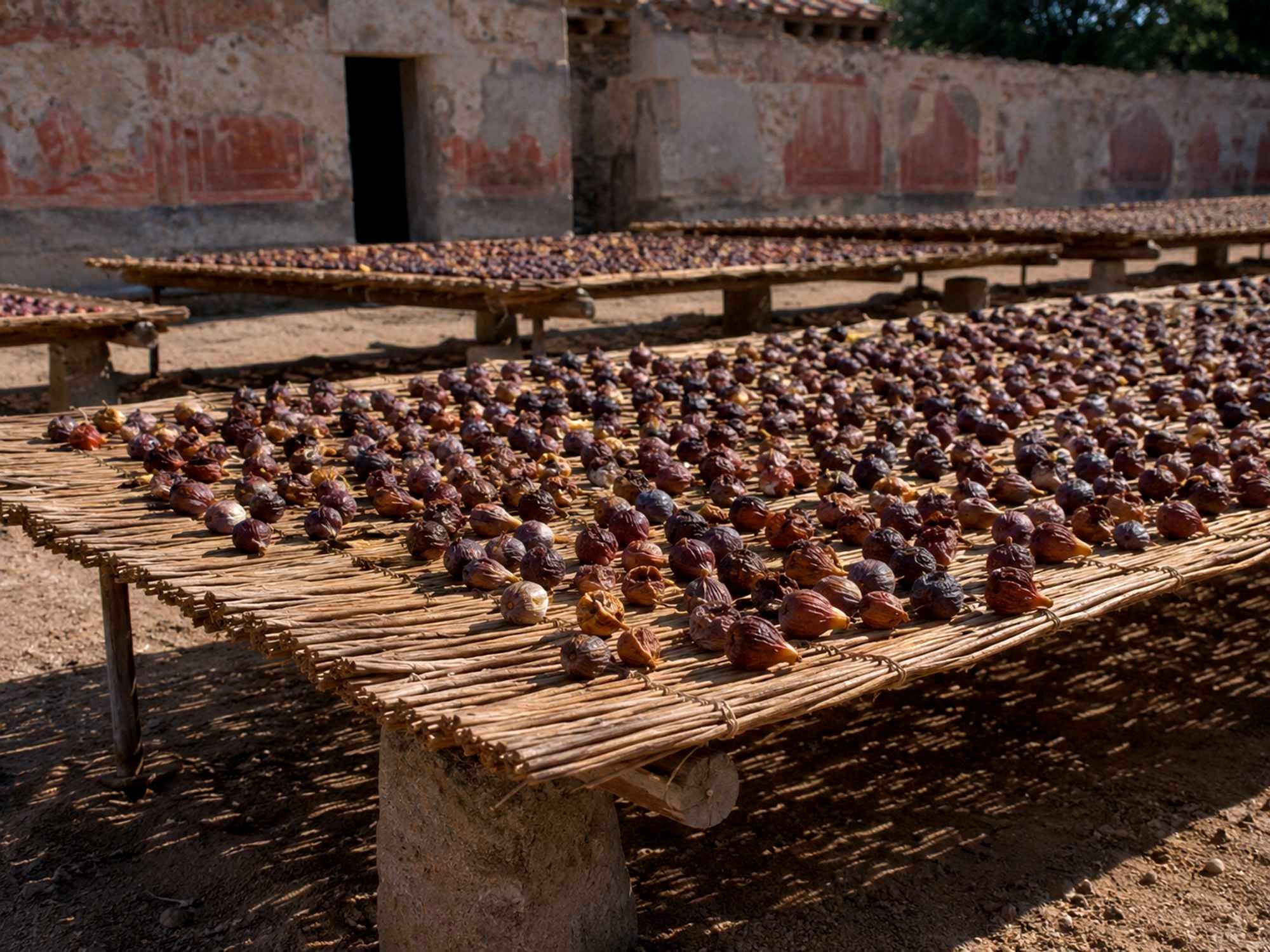
Once partly dried, they could be transformed into an entirely different product. Columella describes them being trodden
“with washed feet, in the manner of flour”,
then mixed with toasted sesame, Egyptian anise, fennel and cumin.
The fig mass was then shaped, wrapped and dried further. Other versions were fashioned into stars, flowers or bread-like loaves. The preserved mass could eventually become so hard that the earthen vessel storing it had to be broken to remove the contents.
These were no longer merely dried figs. The fruit had been dried, crushed, seasoned, shaped and stored as a manufactured preserved food.
Raisins likewise involved more than leaving grapes in the sun. Columella's lye-water treatment was intended to prepare selected bunches for rapid drying, while Cato's smoked grapes show that smoke could enter preservation procedures as well.
Fruit rooms were ideally cool and dry. Apples could be arranged with varieties kept separate and stems positioned carefully. Pomegranates were sometimes protected while still growing. Roman preservation repeatedly begins before the food entered a pantry.
Vinegar offered another solution. Columella records fig vinegar in places where ordinary wine was unavailable. Fully ripe figs could be left to ferment and acidify before the liquid was strained into sweet-smelling pitched vessels.
Other fruit vinegars were made from apples, pears and sorbs. Vinegar then re-entered food processing as a preservative for vegetables, olives and meat.
Cheese, Honey and Pork
Fresh milk deteriorated quickly. Cheesemaking changed both its physical form and how long it could be kept.
Columella gives detailed instructions. Fresh milk was gently warmed and then made to coagulate. Rennet from lambs or kids could be used, but the ancient texts also record alternatives involving fig sap, thistle and other plant materials.
Varro likewise records alternatives to ordinary animal rennet:
“Others use, instead of rennet, the milk from the stem of a fig, and vinegar; they also curdle with various other substances — a thing which, in Greek, is sometimes called ὀπός, and sometimes δάκρυον.”— Varro, De Re Rustica 2.11.
The thickened curd was transferred into wicker forms or baskets so that whey could drain away. Country producers could begin pressing the cheese immediately.
Hard cheese required additional work. It could be pressed repeatedly, salted, washed and dried, while the individual cheeses were kept apart on wickerwork. The procedure produced a much denser and longer-lived food than fresh cheese.
The result could be durable enough for serious transport. The modern study of Roman processing notes that hard ewe's-milk cheese made in this fashion could be shipped overseas.
Columella also describes caseus manu pressus, hand-pressed cheese. Warm curd was broken up and treated with hot water before being shaped by hand or in molds. The technique can be compared cautiously with later stretched-curd processing, but there is no reason to call the Roman product mozzarella.
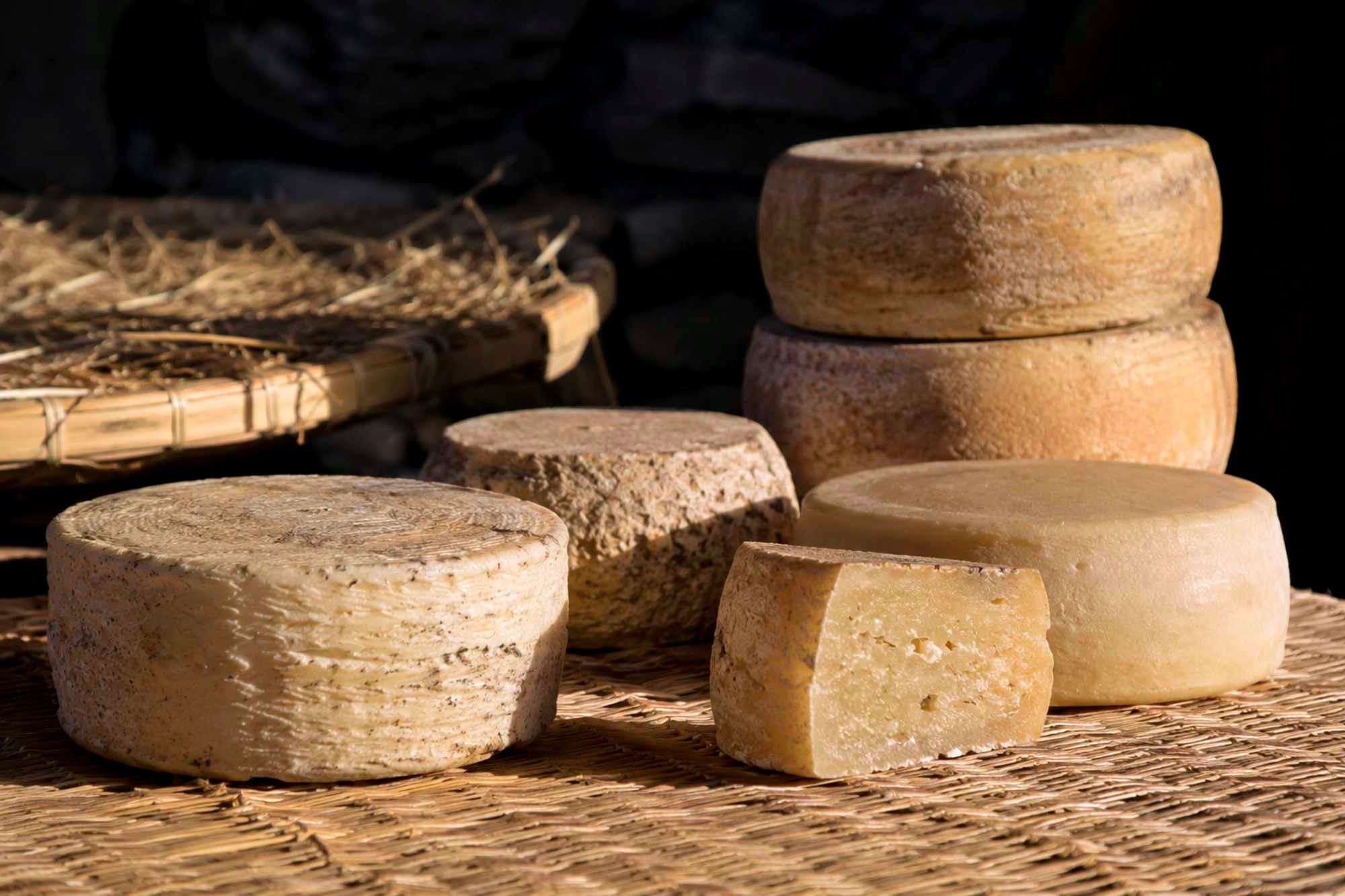
Flavor could be deliberately altered. Pine kernels or thyme might be added, and smoke could be used on finished cheese. Columella even records hard ewe's cheese placed in grape must, bringing dairy production back into contact with the vineyard.
Honey processing also produced several grades and by-products. Columella says the combs should be processed while still warm. Honey flowing freely from the opened comb was considered the better quality. The remaining comb could then be pressed to obtain a second grade, kept separately from the first.
Even the spent comb still had a use. It could be broken up and soaked in spring water or rainwater, pressed again, and the resulting weak honey liquid boiled down to create mella. Columella recommends mella for pickles and preserves.
Pork preservation is documented in unusually practical detail. Cato's ham recipe begins with salt spread in the bottom of a jar or pot:
“Spread salt on the bottom of the jar or pot; then lay a ham, with the skin facing downwards, and cover the whole with salt. Place another ham over it and cover in the same way, taking care that meat does not touch meat. Continue in the same way until all are covered.”
After five days, the hams were removed and rearranged so that those previously on top were placed at the bottom.
Cato then continues:
“Twelve days later take them out finally, brush off all the salt, and hang them for two days in a draught. On the third day clean them thoroughly with a sponge and rub with oil. Hang them in smoke for two days, and the third day take them down, rub with a mixture of oil and vinegar, and hang in the meat-house.”— Cato, De Agricultura 162.
The full procedure shows why it is misleading to describe Roman ham preservation simply as “salting.” The process involved layering, separation, time, rearrangement, airing, oil, smoke and a final vinegar treatment.
Columella provides another pork-curing method. Meat could be deboned, rubbed with coarse salt and pressed under weights to remove liquid. Further salting continued over a number of days before washing, drying and smoking.
He also describes meat packed into vessels in alternate layers with salt, weighted down and preserved in its own liquid in a manner he compares directly with salted fish.
Sausages were another preserved meat product. Lucanica involved seasoned meat packed into casing and smoked.
Eggs presented a smaller household problem. Agricultural texts record storage in materials such as chaff and bran, as well as salt-based methods. The objective remained the same: prolong the useful life of a food that otherwise deteriorated rapidly.
Preserving Fish in the Roman World
Fish preservation relied heavily on salt. Fish could be treated whole or divided into pieces, and Roman terminology distinguishes numerous salted fish products. Large processing establishments used waterproof vats and could operate commercially on a substantial scale.
Garum and related fish sauces formed an important part of Roman fish processing, alongside salted and preserved fish that could be stored and transported over long distances.
The scale of Roman-period fish processing is visible both archaeologically and through amphorae distributed over long distances. Preserved fish entered the same commercial networks as oil, wine, cured pork and hard cheese.
One archaeological detail is particularly interesting. Sheep and cattle bones have been found in fish-salting vats at Kerobestin and Telgruc in Gaul. This has been interpreted as possible evidence that installations built for fish processing were also used to preserve meat during the fishing off-season.
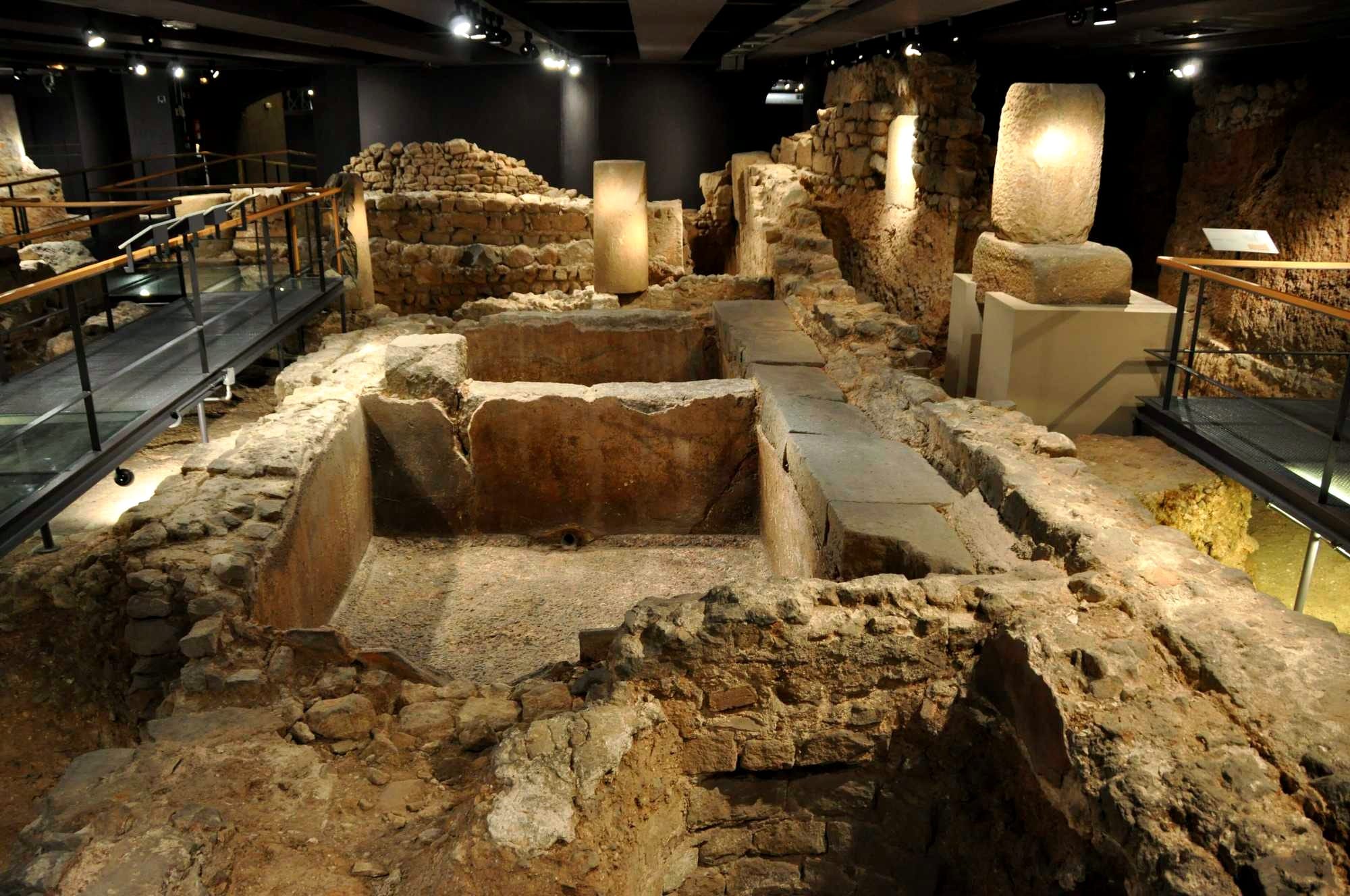
It does not demonstrate that every Roman saltery operated in this way, but it raises the possibility that expensive vats and processing spaces could be used seasonally for more than one product.
The Building Could Preserve the Food Too
Food did not cease to be vulnerable once it had been salted, dried, pressed or fermented. Containers and buildings became another part of preservation.
Amphorae were suited to transport partly because their relatively narrow necks could be stopped and sealed. Archaeological evidence includes closures made from leaves, textiles, papyrus, coiled plant fibers and ceramic pieces. More durable plaster could then be placed over the opening.
At a larger scale stood the dolium. These enormous ceramic vessels could hold several hundred liters and, in some cases, more than 2,000. Many were partly sunk into floors and became effectively permanent elements of a winery or storeroom.
Some dolia used a surprisingly elaborate double-cover system. A flat inner lid, the operculum, fitted directly over the opening and could be sealed with pitch or mastic when wine was stored inside. Above it sat a larger convex tectorium supported on three ceramic feet, leaving an air space between the two lids.
The food therefore sat within several protective layers: liquid inside a thick ceramic vessel, the vessel partly embedded in the floor, two covers above it and the entire installation inside a room whose orientation could itself be selected according to what was being stored.
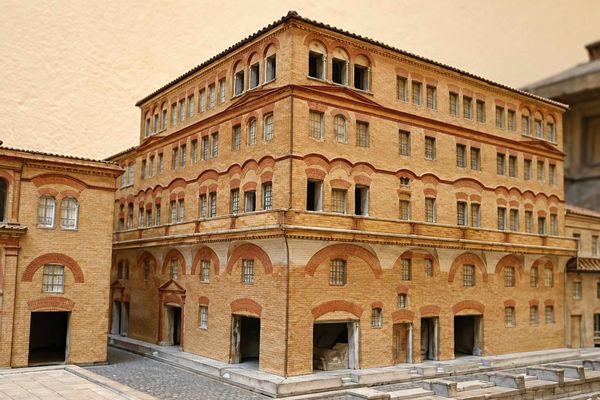
Large warehouses, or horrea, extended this approach to the architecture itself. Storage rooms could have thick walls, high windows and raised floors.
At Portus, individual storage rooms used suspensurae, floors lifted roughly half a meter to a meter above ground level. Channels beneath them were around thirty centimeters wide and fifty to sixty centimeters high. Large bricks supported the floor surface, which was covered by a substantial layer of cocciopesto, a hydraulic lime mortar containing crushed ceramic.
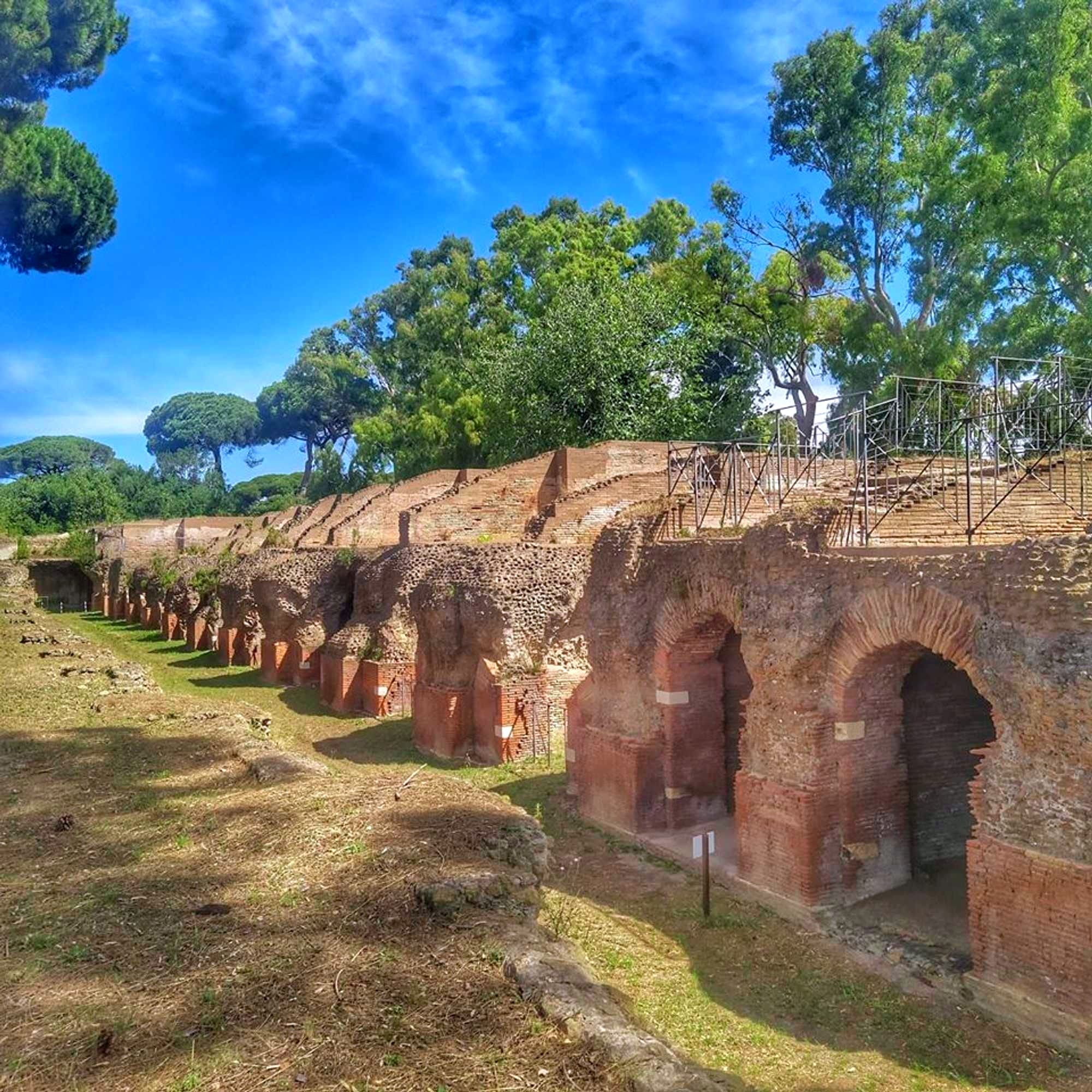
The same material could also be applied to walls. The raised floor and waterproof treatment created an air space, reduced damp and moderated temperature changes.
Modern computer modelling has attempted to estimate the conditions produced inside the Portus warehouses. Under reconstructed July conditions, exterior temperatures could reach 35°C or higher while interiors remained around 21–24°C. These are modern modelling results rather than measurements taken in antiquity, and they depend considerably on assumptions about windows, ventilation and the reconstruction of the building.
The same research suggests that Portus warehouses were probably used mainly for relatively short periods while imported grain was received, documented, organized and then moved onward to Rome and other destinations.
A second-century CE grain shipment recovered near Woerden in the Netherlands contained more than twenty different types of insects and mold-feeders, represented at different stages of their life cycles. The grain had already been harvested, threshed, winnowed and sieved and appears to have remained in storage for at least a year before shipment.
That cargo is an important counterweight to the sophisticated warehouses and storage instructions. Roman farmers and merchants could reduce risks, but they could not eliminate insects, mold or spoilage.
Processing could itself create vulnerability. Grain already threshed and prepared was easier for merchants and consumers to handle but had lost some of its natural protection. The movement toward storing processed grain therefore increased the importance of warehouse conditions and pest management.
Smaller shops possessed their own built-in storage. Masonry counters at Pompeii and Herculaneum incorporated large ceramic jars generally capable of holding around 150–300 liters. Encasing them in masonry gave the vessels additional insulation.
These jars are often popularly imagined as containers for hot food or drink, but archaeological research has suggested that many may instead have held dry products. Because fixed porous vessels were difficult to clean thoroughly, grain, legumes and nuts were more practical contents than liquids that could soak into the ceramic fabric.
Wine Wanted Cool, Oil Wanted Warm
Storage rooms were not interchangeable. Wine and olive oil benefited from different conditions, and Vitruvius says so explicitly.
For wine he recommends a cooler location:
“the cellar, lighted from the north, for if it have any opening through which the heat of the sun can penetrate, the wine affected by the heat becomes vapid.”
For oil the instruction is almost the reverse:
“The oil room is to be lighted from the southern and warmer parts of the heaven, that the oil may not be congealed, but be preserved liquid by means of a gentle heat.”— Vitruvius, De Architectura 6.6.2–3.
The architecture therefore participated directly in storage. Wine was protected from excessive heat; oil was kept warm enough to remain fluid.
Archaeological evidence shows variation rather than a single Roman blueprint, but wine dolia were frequently deeply embedded in floors, while containers associated with olive oil could be less deeply sunk or kept above ground.
Temperature was only one concern. Moisture, ventilation, insects, rodents and odors all appear throughout the evidence. Roman preservation depended on combining several defenses rather than discovering a single solution that worked for every food.
A grape bunch could be enclosed inside a small pitched vessel while still hanging from the vine. An amphora of must could disappear beneath cold water for forty days. Figs could begin on drying hurdles and end as spiced loaves shaped into stars or flowers. Fresh milk could become a hard cheese capable of overseas transport. Pork could spend nearly two weeks in salt before being aired and smoked. Grain could move from threshing floor to granary, mill, kneading machine and bakery. Wine could sit beneath two ceramic lids inside a huge buried jar in a deliberately cool room.
These procedures belonged to the practical management of Roman food. Farms, households, workshops, salteries, bakeries and warehouses all had to deal with the same basic problem: bringing in the harvest was only the beginning. Enough of it also had to survive until people were ready to eat it.
David L. Thurmond, A Handbook of Food Processing in Classical Rome: For Her Bounty No Winter
Robert I. Curtis, Ancient Food Technology
Robert I. Curtis, “Food Processing and Preparation,” in The Oxford Handbook of Engineering and Technology in the Classical World
Geoffrey Kron, “Food Production (Expanded Version)”
Caroline Cheung, “Managing Food Storage in the Roman Empire”
Cato, De Agricultura
Columella, De Re Rustica
Varro, De Re Rustica
Pliny the Elder, Natural History
Vitruvius, De Architectura
Apuleius, Metamorphoses

About the Roman Empire Times
See all the latest news for the Roman Empire, ancient Roman historical facts, anecdotes from Roman Times and stories from the Empire at romanempiretimes.com. Contact our newsroom to report an update or send your story, photos and videos. Follow RET on Google News, Flipboard and subscribe here to our daily email.
Follow the Roman Empire Times on social media: