
Roman Painters Mixed Egyptian Blue Into the Plaster Itself
Wall fragments from a villa at Torre di Pordenone reveal how Roman decorators mixed Egyptian blue into lime plaster to create a pale backdrop for fish and other marine life.

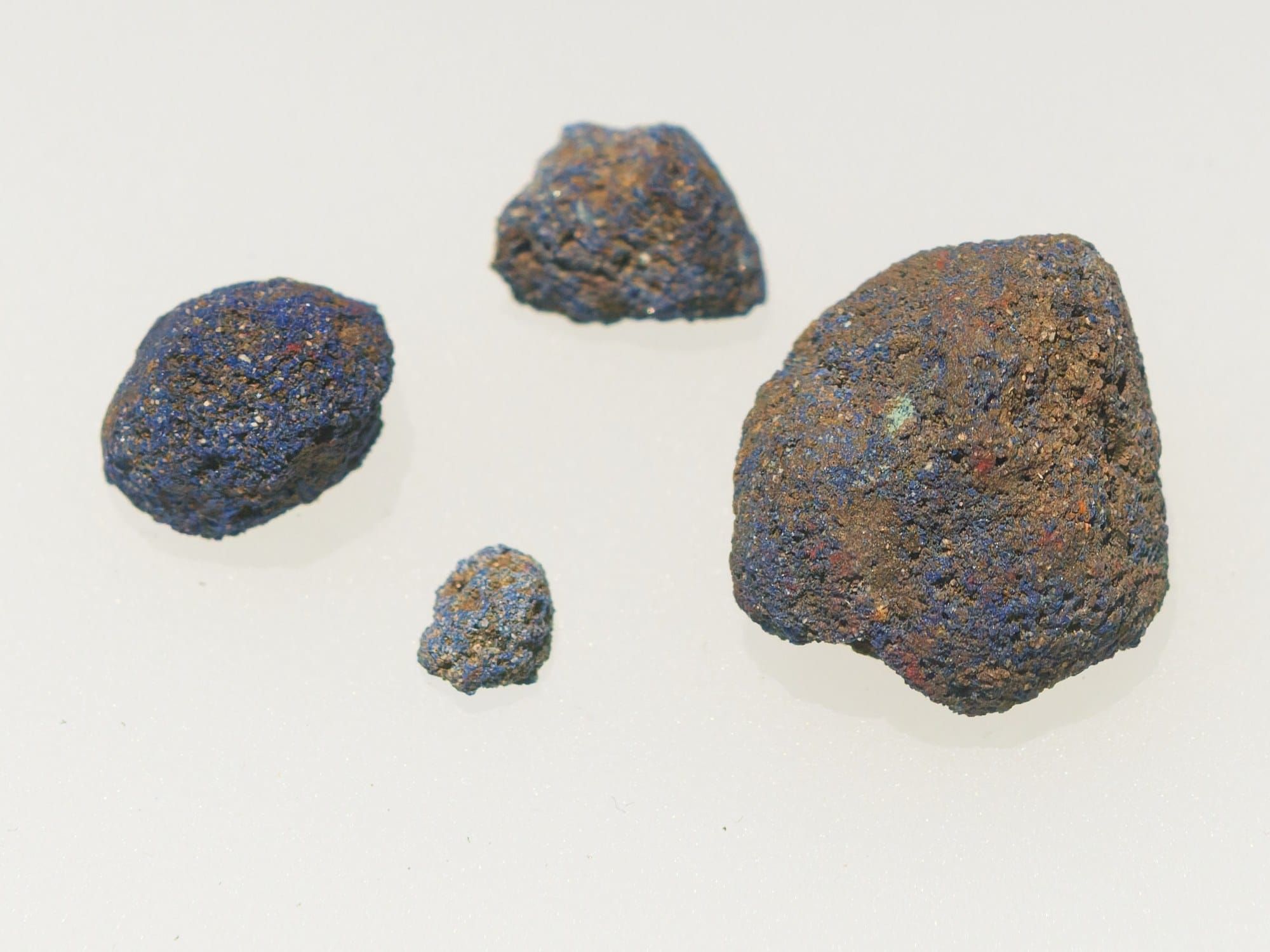
Roman decorators at a villa in northeastern Italy mixed Egyptian blue directly into their finishing plaster, creating a pale-blue background for a scene filled with marine life. Laboratory analysis has traced the pigment beneath the painted surface, showing that colour was incorporated into the material before it was spread across the wall.
The evidence comes from fragments found at Torre di Pordenone, beside the Noncello river in the modern region of Friuli Venezia Giulia. Fish, an octopus and lobsters survive among roughly 50 pieces of decorated plaster. Comparisons with other Roman paintings place the decoration between the late first century and the first half of the second century AD.
Published in Archaeometry on 8 September 2026, the study examined ten fragments to investigate the decoration’s materials and construction. Its contribution concerns a workshop technique preserved inside the plaster. Egyptian blue was already familiar to Roman painters, but incorporating it throughout a finishing mortar is rarely documented.
A painted fishpond beside the river
The villa was excavated in campaigns between the 1950s and 2008, revealing buildings in three separate areas. The marine fragments came from secondary debris in an area interpreted as a riverside belvedere, with curved rooms and niches for fountains. Their original arrangement has been reconstructed from the pieces rather than preserved as a complete wall.
The surviving creatures include mullets, scorpionfish, an octopus and lobsters against blue water. The researchers interpret the composition as a painted fishpond, a subject with parallels at Brescia, Pompeii and Rome. Those comparisons also provide the basis for the proposed date, connecting the fragments with a recognisable Roman decorative tradition.
Such scenes offered a different subject from the Painted City fresco beneath Trajan’s baths, where architecture fills the painted view. At Torre, the marine imagery may have accompanied a fountain. The study links that possibility to the belvedere’s architecture and the ceramic-rich preparatory plaster beneath the decoration.
Three layers supported the blue background
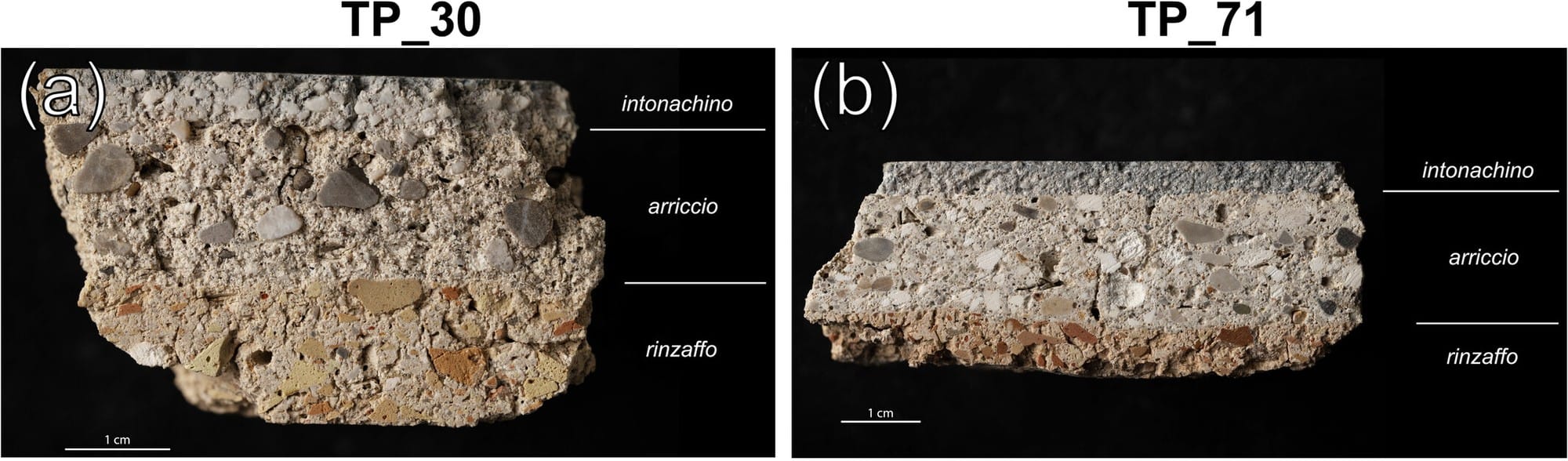
Sections cut through the fragments revealed a consistent sequence of plaster layers, with modest variations between samples. A coarse backing contained ceramic pieces, followed by a thicker preparation containing river sand and gravel. Above them lay the intonachino, the fine finishing plaster that carried the painted decoration.
In one representative fragment, this final layer was uniformly blue and approximately 4 millimetres (0.16 inch) thick. Another representative sample had a paler finishing coat. These two pieces, labelled TP-71 and TP-30, provided detailed examples of the variation within the ten fragments selected for analysis.
The finishing mortar also contained crushed fossil-bearing limestone. The researchers identify nearby carbonate outcrops as its likely source, rather than the crystalline calcite often selected for fine Roman plaster. The combination joined a manufactured pigment to a more readily available aggregate, revealing choices in the wall’s construction as well as its colour.
The pigment continued below the surface
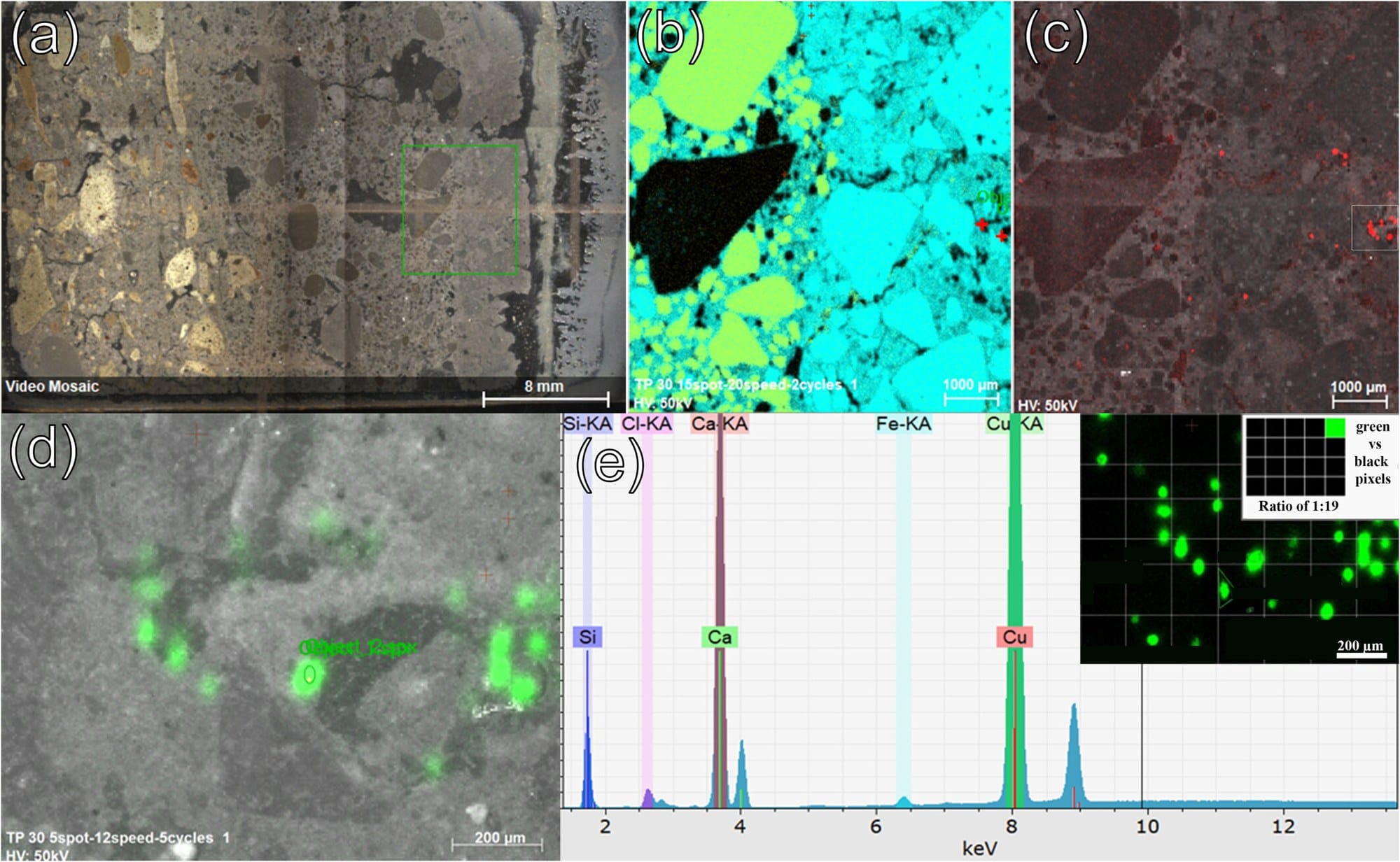
Microscopy established the structure of the plaster, while chemical and mineralogical tests identified the blue particles. The team combined electron microscopy, X-ray analysis and Raman spectroscopy to check their composition. The results identified cuprorivaite, the calcium copper silicate responsible for the colour of Egyptian blue.
The techniques also located the pigment within the finishing coat. Electron microscopy identified grains approximately 1.5 millimetres (0.06 inch) beneath the surface, and Raman analysis confirmed them at about 2 millimetres (0.08 inch). Elemental mapping traced copper-rich clusters to around 3 millimetres (0.12 inch), approaching the boundary with the underlying preparation.
The depth and size of the embedded grains support deliberate mixing into the mortar. In ordinary fresco work, pigments brushed onto wet plaster remain close to its surface as the plaster sets. At Torre, the distribution instead indicates that Egyptian blue entered the lime-and-aggregate mixture before the finishing layer was applied.
Colour was built into the wall
Roman wall painting involved successive stages of plastering, smoothing and painting. A scholarly review of workshop practice describes increasingly fine preparation layers and the coordination needed to decorate a fresh surface. Colour could also be added to the plaster itself, with red earth pigments supplying established examples of this method.
At Torre, mixing blue through the finishing mortar produced a broadly uniform, pale background on which the marine figures could be painted. The researchers suggest that this approach simplified the coordination between plasterers and painters: the background colour arrived with the plaster, reducing the need to paint that whole field during its setting.
Recent wall-painting finds around Smyrna’s agora and theater add to the record of decorated Roman buildings. At Torre, analysis of the surviving plaster reveals the materials and working stages behind the marine scene. Its layered structure preserves the sequence in which the craftsmen assembled the wall covering.
Vitruvius described blue made in a furnace
Egyptian blue was a manufactured material, produced by heating ingredients containing silica, calcium and copper with a flux. Roman makers could supply it beyond Egypt: Vitruvius’s account of architecture and building materials associates production at Puteoli, modern Pozzuoli, with a man named Vestorius.
In On Architecture 7.11.1, Vitruvius describes the preparation of blue pigment. His account moves from grinding and mixing to shaping, drying and firing. The passage preserves a sequence of workshop operations, giving a written counterpart to the manufactured blue particles identified by modern analysis.
“Sand and the flowers of natron are brayed together so finely that the product is like meal, and copper is grated by means of coarse files over the mixture, like sawdust, to form a conglomerate. Then it is made into balls by rolling it in the hands and thus bound together for drying. The dry balls are put in an earthern jar, and the jars in an oven.” — Vitruvius, On Architecture 7.11.1.
The Torre study places the villa’s material within this wider Roman production and distribution network, which included manufacturing centres in Italy. Their account connects the pigment with a workshop process involving both carefully prepared ingredients and controlled heating.
A rare recipe, with more walls to examine
Copper mapping in one sample suggested that Egyptian blue occupied up to about five per cent of the examined plaster section. The estimate came from the area of the fluorescent clusters in the image. Incorporating pigment through a layer of plaster required a different scale of use from applying a thin coat across its surface.
The researchers interpret that consumption as evidence of a dependable supply capable of supporting substantial decoration. Broader analytical research on Roman-period mummy portraits also records Egyptian blue mixed into faces, clothing and backgrounds, and questions a simple equation between the pigment and extreme rarity. Availability and use varied with the task.
At Torre, Roman craftsmen combined marine imagery with blue finishing mortar made from manufactured pigment and likely local stone. The study proposes examining other fishpond, garden and Nile-themed paintings in the same way. Their plaster could establish how widely Roman workshops adopted this technique.


About the Roman Empire Times
See all the latest news for the Roman Empire, ancient Roman historical facts, anecdotes from Roman Times and stories from the Empire at romanempiretimes.com. Contact our newsroom to report an update or send your story, photos and videos. Follow RET on Google News, Flipboard and subscribe here to our daily email.
Follow the Roman Empire Times on social media: