
Did the Romans Really Massacre the Defenders of Maiden Castle?
Maiden Castle became famous as the scene of a supposed Roman massacre. Later archaeology has complicated that picture, revealing repeated episodes of violence and a much longer history behind the cemetery.


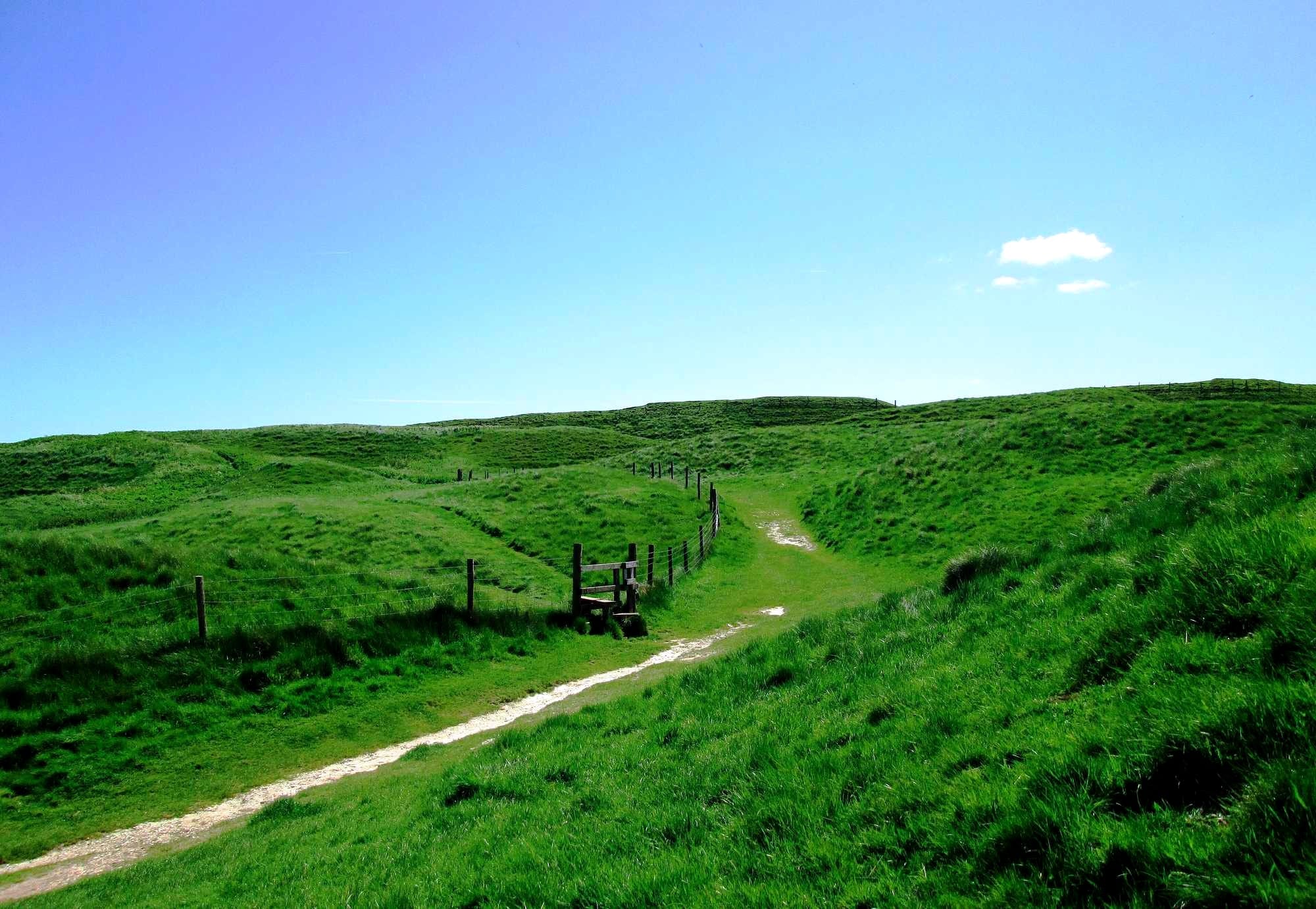
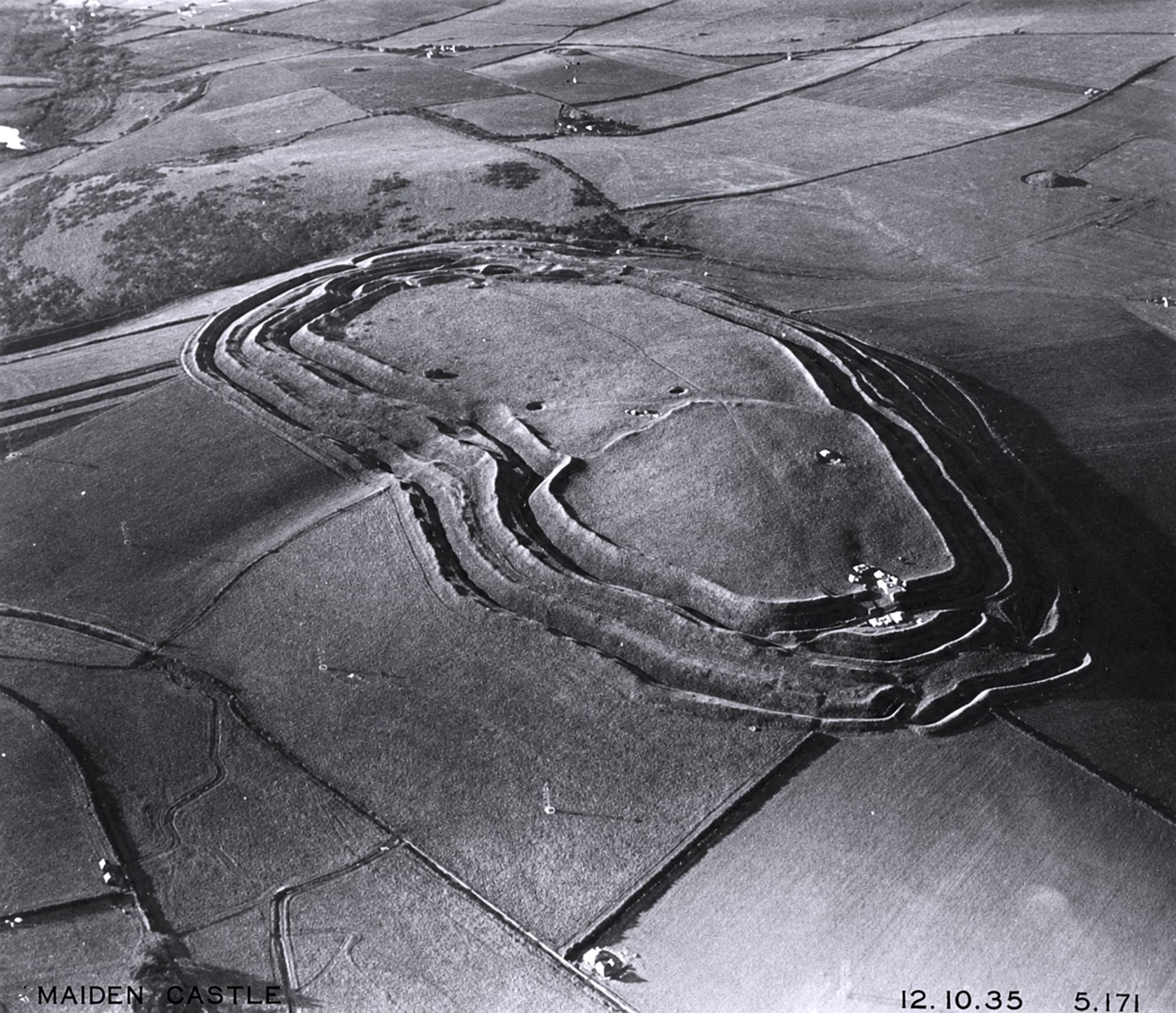
On a chalk ridge outside Dorchester in Dorset stands Maiden Castle, one of the largest Iron Age hillforts in Britain. Its massive banks and ditches surround a site occupied and reshaped over many centuries, long before Roman armies arrived in Britain. Yet Maiden Castle became famous above all for one particular episode: the supposed destruction of the hillfort by Roman troops during the conquest of southern Britain in the first century AD.
That interpretation emerged from the excavations directed by Mortimer Wheeler between 1934 and 1937. Near the eastern entrance, archaeologists uncovered a cemetery containing men and women with severe injuries. One man had an iron projectile embedded in his spine. There was evidence of burning around the entrance, and the graves appeared to Wheeler to belong to the final period of the independent hillfort. He connected these discoveries with the Roman invasion of AD 43 and with the campaigns of the future emperor Vespasian in southern Britain.
Later excavations and re-examinations produced different interpretations of several parts of Wheeler’s reconstruction. They did not remove the evidence for violence at Maiden Castle. Modern examination of the skeletons actually identified substantially more trauma than had originally been recognized. The debate concerns when that violence occurred, how many episodes may be represented, and how securely any particular group of deaths can be associated with the Roman conquest.
The Fortress Above Dorset
Maiden Castle had already existed for centuries before the period that produced the famous burials. During the Iron Age, its fortifications were enlarged repeatedly until the enclosed settlement covered a substantial part of the ridge. Its ramparts and elaborate entrances were accompanied by houses, storage pits, streets, agricultural activity and craft production.
Niall Sharples’s excavations of 1985–86 placed the hillfort within a wider landscape rather than treating it simply as an isolated fortress. His reconstruction presents Maiden Castle as becoming the dominant settlement in part of southern Dorset during the Iron Age. Nearby communities changed as the hillfort expanded, while its enormous defences may increasingly have expressed the status and cohesion of the community as well as serving a defensive function. In the later Iron Age, Sharples regarded Maiden Castle, Hod Hill and South Cadbury as political centres associated with the developing Durotriges.
The character of Maiden Castle was already changing before the Roman conquest. Sharples found that during the last century BC the organized occupation that had filled much of the interior began to break down. Streets ceased to structure the settlement as they had previously, and occupation became more dispersed and increasingly concentrated towards the eastern part of the hillfort.
Changes were also occurring outside its ramparts. Small settlements appeared or reappeared in the surrounding landscape, some of them developing into substantial Late Iron Age and Romano-British farmsteads. Within Maiden Castle itself, continuous occupation across the interior was no longer apparent, although the site retained importance and some of its defences continued to be maintained.
The Maiden Castle of the first century AD was therefore different from the densely organized settlement of several centuries earlier. Domestic occupation had contracted, while the eastern entrance had become an important area for other activities, including metalworking.
The Cemetery at the Eastern Gate
Wheeler’s excavations revealed numerous burials around the eastern entrance. He divided the Iron Age remains according to the archaeological framework then used for British prehistory, including a group that became famous as the “Belgic war cemetery.”
That terminology reflected the chronological and cultural model within which Wheeler worked. Sharples later explained that the old Iron Age A, B and C system interpreted changes in British material culture partly through successive movements or invasions from continental Europe. Wheeler connected these archaeological phases closely with military and historical developments known from Gaul and Roman Britain.
The cemetery appeared particularly dramatic. Wheeler recorded 34 individuals in the group he regarded as the war cemetery, while other Iron Age burials were found in and around the eastern entrance. Some of the dead had suffered unmistakable injuries. The appearance and arrangement of the graves led Wheeler to characterize them as burials carried out in haste and anxiety.
One skeleton appeared especially significant. An iron projectile remained embedded in the lumbar vertebra of an adult male. It was interpreted as a Roman ballista bolt and consequently became one of the most memorable pieces of evidence associated with the proposed Roman attack.
Other discoveries seemed to fit the same reconstruction. Structures near the entrance had been covered by a thick layer containing ash, which Wheeler associated with destruction during a Roman assault. The elaborate eastern gateway therefore became the setting for his reconstruction of the hillfort’s final battle.
Wheeler envisaged Roman artillery being used against the defenders before legionaries moved through the entrance works. He associated the fighting with the Roman campaigns in southern Britain following the invasion of AD 43 and, more specifically, with Vespasian, then commander of the Second Legion.
Vespasian’s Campaign in Britain
The ancient sources establish that Vespasian fought extensively in Britain, although neither surviving account identifies Maiden Castle.
Suetonius records that Vespasian was transferred to Britain during the reign of Claudius, where he:
“fought thirty battles with the enemy. He reduced to subjection two powerful nations, more than twenty towns”
Suetonius continues by adding the island of Vectis, modern Isle of Wight, and says that Vespasian operated partly under Aulus Plautius and partly under Claudius himself.
Cassius Dio also places Vespasian among the commanders involved in the Claudian invasion. In Book 60, Dio describes Aulus Plautius sending Vespasian and his brother Sabinus across a river during fighting against the Britons; they crossed and killed many of the enemy by surprise. Dio then continues with the campaign towards the Thames and Claudius’s later arrival in Britain. He does not identify Maiden Castle.
Wheeler’s identification of Maiden Castle with Vespasian’s campaign was therefore a reconstruction made by bringing the archaeological evidence together with what was known from the literary sources about Vespasian’s operations in Britain. Neither Suetonius nor Cassius Dio specifically records an assault on Maiden Castle.
What the Skeletons Show
Rebecca Redfern returned to Wheeler’s human remains for a major bioarchaeological study published in 2011. She examined the surviving skeletons using clinical, forensic and osteological methods, looking for fractures, projectile wounds, sharp-force injuries and trauma sustained both before and around the time of death.
Her results strengthened the evidence for serious violence. Trauma was identified in 74.2 percent of the individuals available for study, compared with 27.7 percent in the original analysis. Among the group Wheeler had classified as the war cemetery, 87.5 percent showed trauma. The Iron Age C group also produced a high rate, at 75 percent.
The injuries were varied. Some people had suffered blunt-force trauma to the head. Others had been struck or cut with edged weapons or hit by projectiles. Injuries to forearms and hands were interpreted in several cases as defensive wounds. Cuts on ribs and vertebrae indicate penetrating injuries to the torso, while repeated blows to the head show that some individuals were struck several times.
One man from the war-cemetery group had at least five cuts to different parts of his head as well as cranial fractures, projectile wounds and injuries elsewhere on his body. Another had cuts to the arms consistent with attempts to protect himself, together with wounds to the head.
Women were also among the injured. One woman had sharp-force injuries to the lower leg that would have caused severe damage and major blood loss. Other women had cranial wounds, fractures and evidence of projectile injuries. An adolescent of about 15 also suffered severe cranial trauma.
Some injuries had healed before death. Redfern therefore found that several individuals had survived previous violent incidents before eventually dying in later conflict. She also identified repeated and excessive blows in some of the dead and compared the overall pattern with archaeological populations associated with warfare, raiding and massacres.
Redfern did not assign all these deaths to one event. She concluded that the people had died because of conflict, but emphasized that identifying the particular events in which the injuries were sustained remained difficult. She considered the concentration of trauma among burials dating broadly from the first century BC to the first century AD compatible with multiple episodes connected with the violent social and political conditions of the Late Iron Age and early Romano-British period.
At that stage, however, Redfern still accepted the embedded projectile as being of Roman manufacture. She therefore regarded its presence, together with the dating then assigned to the cemetery, as supporting the possibility that part of the sample derived from an encounter with the Roman army.
Sharples and the Cemetery Reconsidered
Sharples had already questioned several aspects of Wheeler’s interpretation in the 1991 excavation report.
The cemetery extended beyond the particular cluster Wheeler had called the war cemetery. Sharples suggested that the apparent division between burials inside and outside the inner hornwork might partly result from the areas that happened to have been excavated. He also noted that, according to the evidence available to him, fewer than half of the burials in the war-cemetery group could demonstrably be shown to have met violent deaths.
The funerary practices also presented a different picture from one of hurried disposal after battle. Bodies were carefully positioned according to recognizable Durotrigian practices. Some graves contained pottery, jewellery, animal remains or other objects. The cemetery included unusually rich graves and a notable number of double burials, but Sharples regarded Wheeler’s description of their “slovenly” character and the supposed haste and anxiety of burial as a subjective impression that fitted his historical interpretation.
Rebecca Redfern and Christine Hamlin examined the funerary evidence again in 2022. They found a mixture of local Durotrigian burial traditions and practices also known from other Iron Age hillforts. After comparing body position, grave goods, multiple burials, possible bindings, animal remains, seasonality and isotope evidence, they concluded that the results strongly suggested that the majority of burials had been undertaken by the Durotrigian community. They allowed for a minority having been buried under stressful circumstances associated with inter-community or ritual violence.
The evidence for burning at the eastern entrance was reconsidered as well. Sharples’s excavations identified substantial ironworking immediately in front of the gates. Layers containing charcoal and slag, together with evidence for welding and forging, demonstrated repeated industrial activity in the area. He consequently suggested that the thick ash over nearby structures, which Wheeler had associated with the Roman attack, could instead derive from this industrial activity.
These findings formed part of Sharples’s reassessment of the archaeological context. They did not amount to an identification of what, if anything, happened militarily at Maiden Castle during the Roman conquest.
The Changing Interpretation of the Projectile
The iron projectile embedded in one man’s vertebra remained an important part of the Roman interpretation for decades. Redfern’s 2011 study still described it as an iron ballista bolt believed to be of Roman manufacture.
Martin Smith, Miles Russell and Paul Cheetham revisited the object in their 2025 reassessment. They identify the supposed ballista bolt as a spear or javelin head, describing native manufacture as the most likely explanation. Elsewhere in the paper they say that the object is more convincingly interpreted as a spear or javelin head than as a Roman artillery projectile.

That interpretation differs directly from the one still followed in Redfern’s 2011 analysis. For Wheeler, and later for Redfern, the object provided a potential connection between one of the violently killed individuals and Roman weaponry. In the 2025 study, Smith, Russell and Cheetham no longer identify it as Roman artillery.
The identity of the projectile does not by itself establish the circumstances in which the man was killed. Its significance lies in the different interpretations given to the same object as the cemetery has been reassessed.
New Dates for the Dead
Smith, Russell and Cheetham also returned to the chronology of the cemetery in 2025 with a new programme of radiocarbon dating. Twenty-two individuals were selected from different burial types and locations and included both sexes and people with and without evidence of weapon trauma.
Their results placed the burials into temporal clusters of lethal violence that they consider capable of spanning multiple generations, with most falling within the early and middle decades of the first century AD. They describe the pattern as suggestive of increasing social stress in the decades leading towards the Roman invasion rather than violence produced by the invasion itself.
The different forms of burial did not form a simple chronological progression. Flexed and extended forms overlapped in time, leading the authors to consider whether differences in burial could instead reflect social status, kinship, personal circumstances or changing cultural practices.
When the dates were considered alongside the evidence for injuries, the authors identified three chronological groupings around the east gate which they suggest could represent relatively brief outbreaks of lethal violence. They consider episodes such as skirmishes or raids among the possibilities and note that the three groupings could have occurred approximately a generation apart.
The double burials are particularly prominent in their discussion. Eleven of the twelve individuals represented in the surviving double burials had weapon injuries. Most were male, although both women represented in this group also showed violence-related injuries.
Smith, Russell and Cheetham discuss several possible explanations for these deaths. Among them are episodic raiding, revenge between groups and internal dynastic struggles involving people who may have been related. They also consider whether selection for burial at Maiden Castle involved high social status and discuss recent genetic evidence for kinship and inheritance patterns among the Durotriges.
The extreme injuries among some of the extended and double burials form another part of their interpretation. They describe combinations of injuries far beyond what would have been required simply to incapacitate or kill and consider whether such repeated violence may have served as a deliberate display connected with social control. They suggest that this pattern adds weight to the possibility of episodic dynastic conflict, while presenting that explanation as an interpretation rather than an identified historical event.
Their radiocarbon programme leads them to explain the unusual cemetery as containing people who died at different times, and possibly from different causes, rather than requiring all the burials to be associated with a single historical event.
Violence Before and During the Roman Conquest
The different studies therefore provide different reconstructions of the deaths discovered around Maiden Castle’s eastern entrance.
Wheeler associated the cemetery with a Roman assault during the conquest and connected it with Vespasian’s campaigns. Sharples questioned several elements used in that reconstruction, including the interpretation of the ash and the characterization of the graves as hurried burials. Redfern’s re-examination confirmed extremely high levels of violence among many of the dead while allowing for multiple episodes of conflict.
Redfern and Hamlin concluded that most of the burials were probably carried out by the Durotrigian community itself. Smith, Russell and Cheetham’s radiocarbon programme placed the burials within several chronological clusters and proposed a variety of possible contexts for the violence.
The ancient literary evidence forms another part of the discussion. Suetonius records Vespasian fighting thirty battles, subduing two peoples and taking more than twenty towns in Britain, while Cassius Dio describes him fighting under Aulus Plautius during the Claudian invasion. Neither author names Maiden Castle.
Sharples also found evidence of activity on the hilltop during the early Roman period. He noted that its character was itself open to interpretation. Continued native settlement had traditionally been proposed, while Roman military occupation had also been suggested, and Sharples cautioned against assuming that the situation necessarily involved a simple choice between the two.
The interpretations have therefore changed substantially since Wheeler published his reconstruction. Wheeler connected the cemetery with the Roman conquest; Redfern identified multiple episodes of serious violence while retaining a possible Roman connection through the projectile; and Smith, Russell and Cheetham now interpret the projectile differently and place the violent deaths within several chronological episodes, which they associate with possible raiding, disputes or dynastic conflict in the period surrounding the end of the Iron Age. The question of a Roman attack on Maiden Castle remains separate from what each of these studies argues about the cemetery itself.
R. E. Mortimer Wheeler, Maiden Castle, Dorset (1943)
N. M. Sharples, Maiden Castle: Excavations and Field Survey 1985–6 (1991)
Rebecca C. Redfern, “A Re-appraisal of the Evidence for Violence in the Late Iron Age Human Remains from Maiden Castle Hillfort, Dorset, England” (2011)
Rebecca C. Redfern and Christine Hamlin, “Burying the Fallen at Maiden Castle Hillfort, Dorset” (2022)
Martin Smith, Miles Russell and Paul Cheetham, “Fraught with High Tragedy: A Contextual and Chronological Reconsideration of the Maiden Castle Iron Age ‘War Cemetery’” (2025)
English Heritage, “History of Maiden Castle”
Suetonius, Vespasian, 4
Cassius Dio, Roman History, Book 60

About the Roman Empire Times
See all the latest news for the Roman Empire, ancient Roman historical facts, anecdotes from Roman Times and stories from the Empire at romanempiretimes.com. Contact our newsroom to report an update or send your story, photos and videos. Follow RET on Google News, Flipboard and subscribe here to our daily email.
Follow the Roman Empire Times on social media: