
The Roman Rudis: The Award That Ended a Gladiator’s Service
The rudis marked a gladiator’s release from compulsory service in the arena, but it did not always mean legal freedom. From training weapon to retirement award and referee’s staff, its meaning reveals much about gladiatorial careers, status and life after combat.


The rudis appears in Roman gladiatorial life in two connected but distinct contexts. Wooden or blunted weapons were used for training, while the same term was associated with a gladiator’s permanent release from further compulsory service in the arena. A man who received that release could be called a rudiarius or rudarius. The surviving evidence, however, does not support the simple idea that every recipient of the rudis thereby became legally free.
Suetonius provides one of the clearest ancient references to the award. During games given by the emperor Claudius, four sons appealed for the discharge of a gladiator fighting as an essedarius:
“when he had granted the wooden sword to an essedarius, for whose discharge four sons begged”
The rudis here accompanies release from gladiatorial service. Yet gladiators entered the arena under very different legal conditions. Some were enslaved, some were condemned criminals, and others were free men who voluntarily contracted to fight. The consequences of receiving the rudis therefore depended partly upon the recipient’s existing legal status.
The Rudis Began as a Training Weapon
The rudis was associated with weapons training long before some of the better-known evidence concerning gladiatorial retirement. After the capture of Carthago Nova during the Second Punic War, Scipio Africanus remained there for several days and subjected his land and naval forces to a repeated programme of military exercises. Both Polybius and Livy describe mock combat with wooden or blunted weapons.
Livy describes the third day of Scipio’s programme:
“the third day they engaged in regular battle practice with single-sticks and darts, the points of which were muffled with balls of cork or lead”
Livy’s rudes were practice weapons used in combat exercises intended to reproduce real fighting without the same danger posed by sharpened swords. Polybius describes wooden swords in the corresponding exercise and adds that they were fitted with leather and protective “buttons.”
The exact construction indicated by his wording has been interpreted differently. One reading understands the wooden swords as covered with leather and fitted with buttons, while another takes the leather to refer principally to the protective feature attached to the tip.
The second interpretation addresses an obvious danger created by realistic practice. A wooden sword could still cause serious injury if driven hard into the chest or abdomen. Roman swordsmanship included thrusting as well as cutting, and military training needed to reproduce the movements used in actual fighting. A protective button on the point would therefore reduce the danger of a thrust without preventing the soldier from practising the technique itself.
The important characteristic of the rudis in these contexts was its bluntness and suitability for practice. Roman authors could use the word more broadly for harmless or practice weapons rather than for one precisely defined wooden sword. The contrast was between the weapon used for training and the sharpened weapon used when the fighting was real.
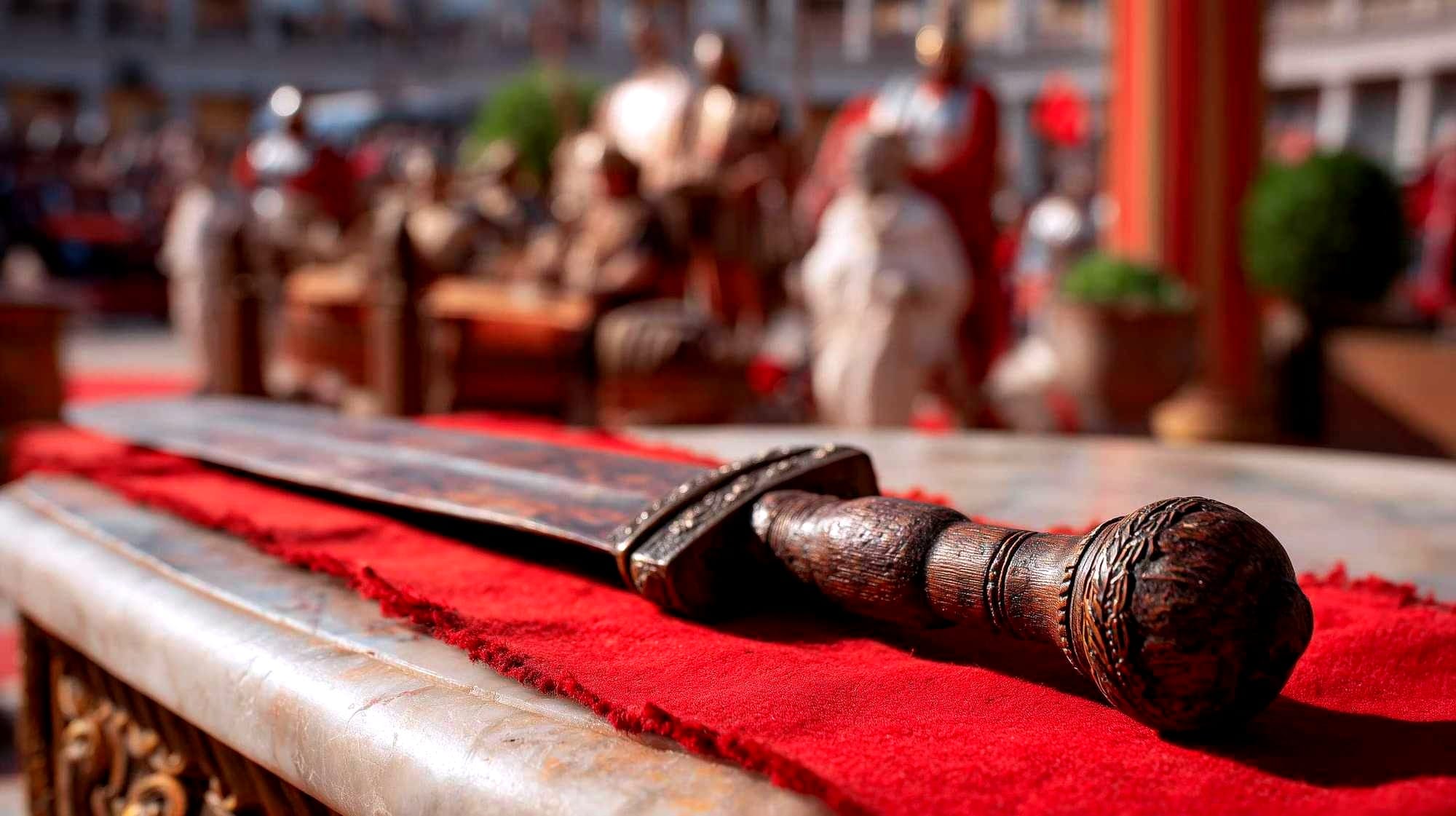
Scipio’s exercises are also important when considering the relationship between military and gladiatorial training. Gladiatorial instructors were employed in Roman military training at a later date, but wooden practice swords were already being used by soldiers during the Second Punic War. The rudis therefore cannot simply be described as an invention of the gladiatorial school that was subsequently adopted by the Roman army.
Training With the Rudis in the Ludus
Wooden weapons formed part of the normal training conducted inside the gladiatorial ludus. Gladiators were organized according to their fighting types and trained in the particular weapons, armour and techniques appropriate to those classifications. Specialist instructors are attested for categories including secutores and murmillones, while the gladiators themselves were ranked within systems connected with the palus.
The palus was the wooden post against which a gladiator could practise attacks repeatedly. Training involved not only striking with the weapon but coordinating attacks with movements of the shield. Juvenal’s description of a woman practising gladiatorial techniques has her repeatedly striking the palus with rudes and attacking the post with her shield. Such exercises allowed movements to be repeated against a fixed target until the fighter became accustomed to using his equipment together.
The ranking terminology of gladiators was itself connected with the palus. References survive to positions such as primus palus and secundus palus, including ranks attached to particular fighting categories. Training and status within the school were therefore closely connected with the techniques demanded by a gladiator’s specific armament.
Experienced gladiators could also become instructors. Martial describes Hermes as both an active gladiator and a magister, while epigraphic evidence records another man who combined the position of doctor, or instructor, with a senior gladiatorial rank. The organization of the ludus allowed experienced fighters to transmit the techniques they had acquired even while they remained active gladiators.
People outside the professional gladiatorial population could also seek such expertise. Apuleius, attacking the behaviour of the young Sicinius Pudens, complains that he frequented a gladiatorial school:
“He is frequently seen in the gladiatorial school and there ... he learns from the keeper of the school the names of the gladiators.”
Apuleius goes on to associate Pudens’ interest with knowledge of the gladiators’ fights and wounds and with instruction from the lanista. The accusation was intended to portray his behaviour as unsuitable for a young man of respectable social position. At the same time, the passage shows that a gladiatorial school could be approached as a place in which knowledge of fighting and weapons could be acquired.
Other evidence connects men associated with gladiatorial combat with groups of Roman iuvenes, or young men. The precise nature of those relationships cannot always be determined, but they have been connected with the possibility that young Romans sought weapons instruction from people who possessed professional knowledge of gladiatorial combat.
Was the Award a Wooden Sword or a Wooden Rod?
The physical form of the rudis presented when a gladiator was discharged is not entirely certain.
In one interpretation, the retirement award was a wooden sword. The same object associated with practice and training thus acquired a second meaning when presented to a gladiator who was released from the obligation to continue fighting. The symbolism would have been appropriate: a weapon that could not be used for lethal combat marked the end of compulsory service in the arena.
There is, however, another interpretation. The wooden practice sword is frequently represented by the plural rudes, while the singular rudis associated with gladiatorial release has been identified instead as a wooden rod or staff. On this reading, describing the retirement award simply as a “wooden sword” combines two related but physically distinct objects represented by the same Latin term.
The disagreement concerns the object itself rather than the essential function of the award. The evidence associates the rudis given to a gladiator with permanent discharge from his obligation to continue serving as a professional fighter. The recipient could thereafter be described as a rudiarius or rudarius.
The terminology attached to gladiatorial referees adds another complication. An official known as the summa rudis is represented not with an object resembling a wooden sword but with a stick or switch appropriate to someone supervising a fight. The word rudis could therefore operate within the gladiatorial world in ways that cannot always be reduced to a single physical object.
Missio Was Not Permanent Discharge
The rudis must also be distinguished from missio. A defeated gladiator could receive missio and leave an individual contest alive without being released permanently from gladiatorial service. He remained a gladiator and could fight again.
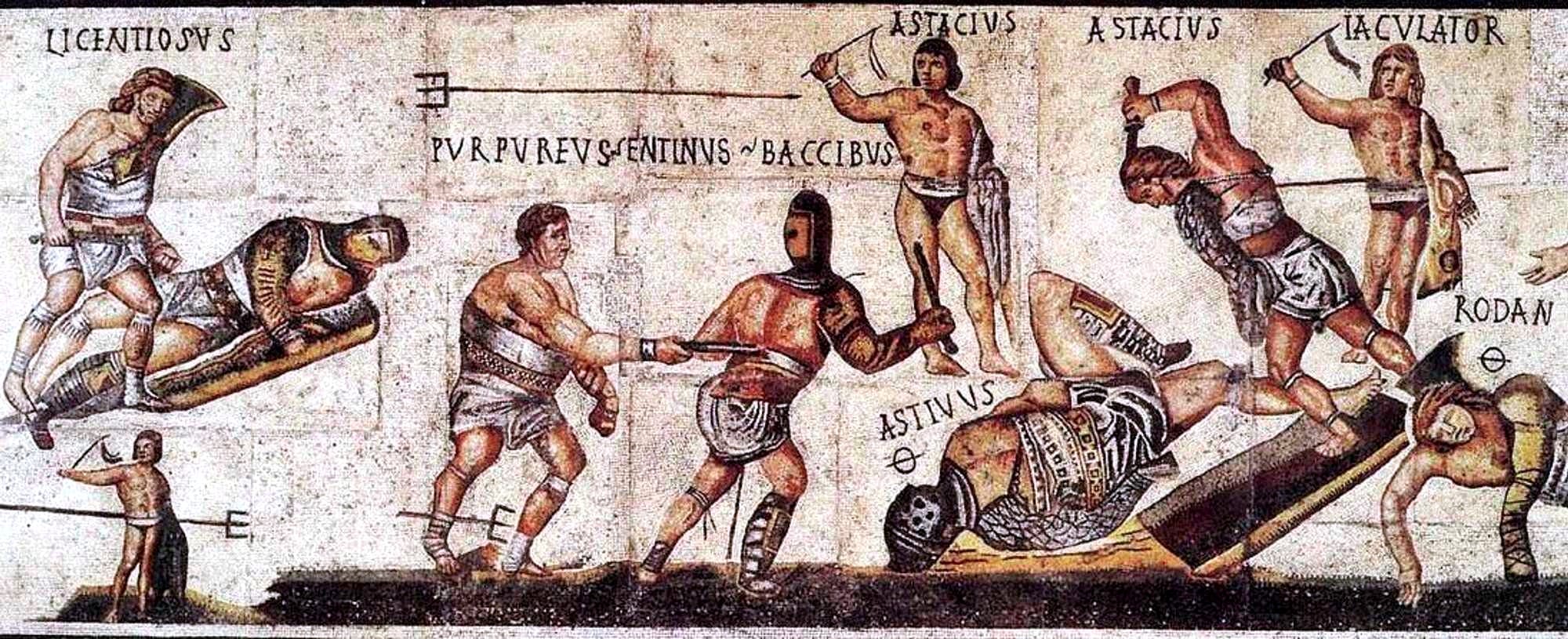
The evidence preserves different terminology for such outcomes. A gladiator might be described as stans missus, indicating release while still standing. The plural expression stantes missi could be applied when two opponents were both released after a contest in which neither had established a decisive superiority. These expressions recorded the result of a particular fight rather than retirement from the profession.
The career record of the gladiator Flamma demonstrates how repeated missio could form part of a long career. He fought more than thirty contests before dying at the age of thirty. His inscription records numerous victories as well as occasions on which he survived without winning. Being released from a particular contest allowed him to continue his career rather than ending it.
An exceptional combination of the two forms of release occurred during the inaugural spectacles of the Colosseum. Martial describes the famous contest between Priscus and Verus. The two men remained evenly matched for so long that neither could establish superiority. Both ultimately received the rudis:
“Caesar sent wands to each, to each the meed of victory.”
Martial explains the rudes as signs of their discharge from further gladiatorial service. In their case, the resolution of an individual contest and permanent release from future compulsory service occurred together.
There was no universal rule requiring every gladiator to complete a fixed number of contests before receiving the rudis. Surviving records of rudiarii show careers of different lengths, while the frequency with which individual gladiators entered the arena could also vary considerably. The number of fights alone therefore cannot be converted into a standard Roman timetable for retirement.
The Rudis Did Not Always Mean Legal Freedom
The distinction between release from gladiatorial service and legal freedom is crucial. Gladiators entered the profession from different legal positions, and the rudis did not have an identical effect upon all of them.
A free man who voluntarily entered gladiatorial service as an auctoratus had not ceased to be legally free simply by becoming a gladiator, although the profession carried serious social and legal disabilities and his service was governed by the contract he had undertaken. Release ended the obligation to continue fighting under that arrangement.

The situation was different for an enslaved gladiator. Receiving permanent discharge from gladiatorial combat did not by itself manumit a slave. The rudis could remove the obligation to fight while leaving the recipient’s underlying status unchanged. Manumission and release from gladiatorial service were therefore separate acts, even though they could sometimes occur together.
The distinction is particularly visible in legislation concerning criminals condemned to a gladiatorial school. Under a provision associated with Hadrian, a man convicted of cattle rustling and sentenced ad ludum gladiatorium had to serve in the arena for at least three years before becoming eligible for the rudis. Even after receiving it, his sentence was not necessarily complete. Legal freedom could follow only after the fifth year.
An official giving the games could exceptionally grant freedom together with the rudis, but the surviving provision treats the two outcomes separately. The interval also demonstrates that a man could be permanently removed from gladiatorial fighting while remaining subject to further obligations.
What happened during the intervening period is not directly documented. It has been suggested that such men could have remained attached to the ludus and performed other duties, perhaps including assistance with training, but the evidence does not establish their precise activities. Nor can the three-year period associated with cattle rustling be turned into a general rule for all gladiators or for every category of condemned criminal.
Rudiarii Could Return to the Arena
Permanent discharge did not prevent a rudiarius from choosing to fight again. A retired gladiator with an established reputation could be particularly attractive to an organizer because spectators already knew his name and abilities.
Suetonius records that Tiberius persuaded retired gladiators to return during games commemorating members of his family:
“inducing some retired gladiators to appear with the rest by the payment of a hundred thousand sesterces to each.”
The size of the payment shows the value that experienced former gladiators could possess when an organizer wanted them back in the arena. Their previous release did not prevent them from entering another agreement to fight voluntarily.
Regulations intended to control the costs of gladiatorial spectacles under Marcus Aurelius and Commodus likewise refer to a free fighter who, after obtaining release, returned to the dangerous profession. His valuation was not to exceed 12,000 sesterces. Release was therefore compatible with a later voluntary return under a new arrangement.
Experience gained in the arena could also be useful without another professional fight. Former gladiators possessed detailed knowledge of weapons, fighting styles and arena conventions, making them obvious candidates for some of the instructional and supervisory roles found around gladiatorial institutions. The evidence supports such movement between fighting and other roles, although it does not justify assuming that every instructor or referee had necessarily been a professional gladiator.
The Summa Rudis and Secunda Rudis
The summa rudis was an official who supervised or refereed gladiatorial contests, apparently sometimes accompanied by a junior official known as the secunda rudis. In surviving representations, such a referee can appear close to the combatants wearing a tunic marked by broad stripes and carrying a stick or switch with which he could intervene or signal during the fight.
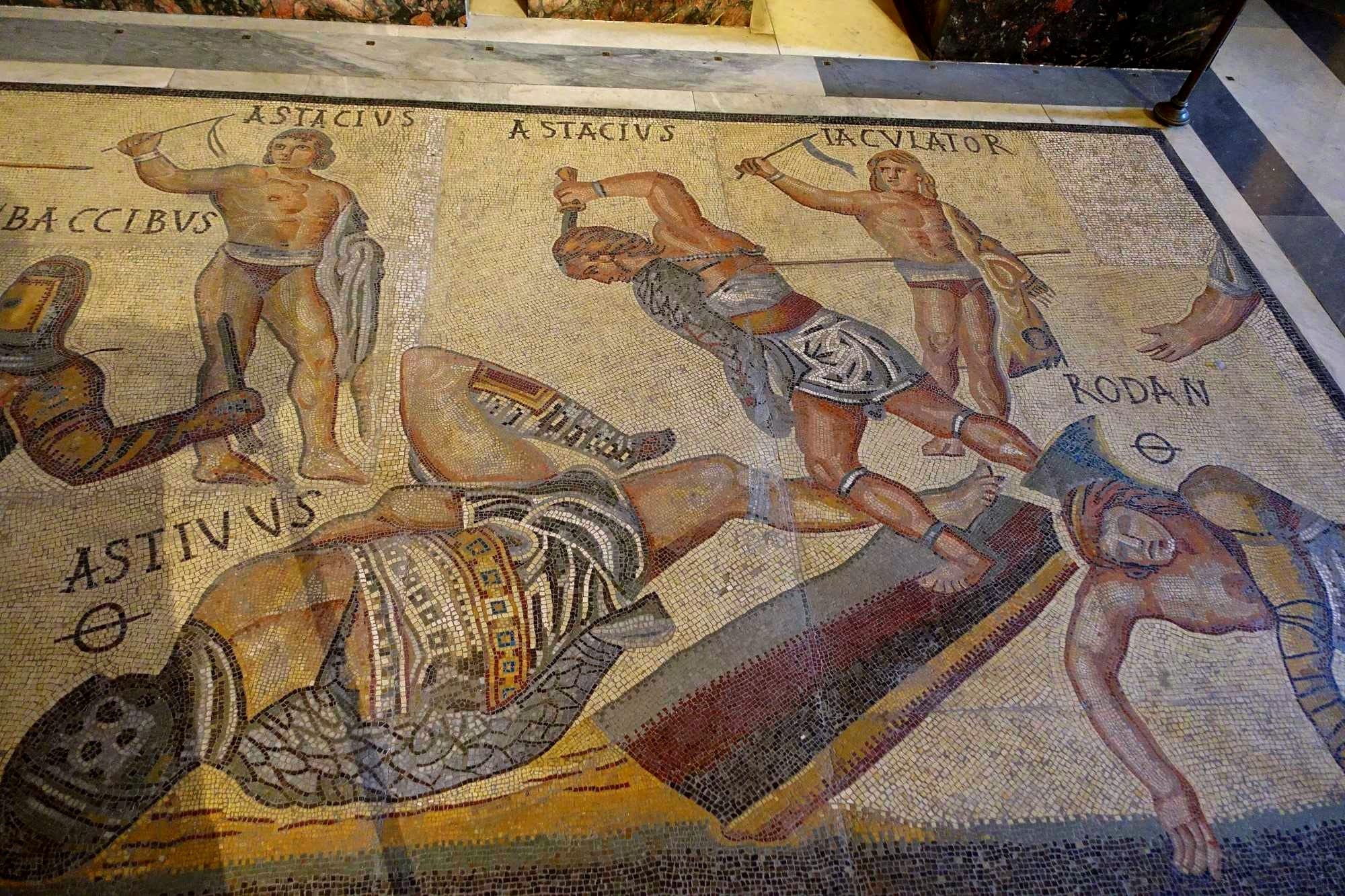
A Pompeian notice advertising games given by Nigidius Maius contains praise for a man named Telephus, identified as a summa rudis. Inscriptions elsewhere connect holders of the title with groups of iuvenes. Their expertise in gladiatorial combat makes weapons instruction one possible explanation for such associations, although the evidence does not exclude other civic or religious functions.
The origins of the men holding the titles summa rudis and secunda rudis have been disputed. One interpretation identifies them as distinguished former gladiators who had been released after successful careers and later used their expertise as instructors or referees. The titles could, on that reading, represent further stages in a professional life that began inside the arena.
Other evidence has made that identification less straightforward. Several known holders of these offices achieved substantial standing in their communities. P. Aelius, a summa rudis, received citizenship in several cities of the Greek East. Another holder of the title made a religious dedication, while Lucius Vettonius Alexander at Mylasa erected a statue of Zeus Labraundos from his own resources on behalf of the town elders. At Hierapolis, the tomb of a secunda rudis named Apollonius received annual honours from the local gerousia.
Such evidence led to doubts that all these men could have emerged from the socially degraded profession of gladiator. Yet successful gladiators could earn considerable sums, and release from the arena did not necessarily prevent a former fighter from later obtaining local prominence. One former gladiator achieved sufficient standing in his community to be selected for an embassy, although his gladiatorial past prevented the mission from succeeding once it became known to the emperor.
A funerary inscription from Beroia supplies another connection between the refereeing offices and the personnel surrounding gladiatorial combat. It commemorates a summa rudis named Publius. Those honouring him included another summa rudis, a secunda rudis, ten additional men, a herald and a trumpeter. The exact identification of the group remains disputed, but it has been interpreted as personnel belonging to a gladiatorial familia or establishment.
A possible professional progression has consequently been reconstructed in which a man could move from recruit to ranked gladiator, from experienced fighter to instructor, then receive the rudis and continue as an instructor before perhaps becoming a secunda rudis or summa rudis. An experienced man might eventually even become a lanista. The evidence does not establish such a sequence as a standard career system, but it shows how the skills acquired in gladiatorial training and combat could continue to have value after a fighter’s compulsory appearances in the arena had ended.
Michael J. Carter, “Buttons and Wooden Swords: Polybius 10.20.3, Livy 26.51, and the *Rudis*,” *Classical Philology* 101.2 (2006), 153–160.
Michael Carter, “Armorum Studium: Gladiatorial Training and the Gladiatorial Ludus,” *Bulletin of the Institute of Classical Studies* 61.1 (2018), 119–131.
Roger Dunkle, *Gladiators: Violence and Spectacle in Ancient Rome* (2008).
James H. Oliver, review of Louis Robert, *Les gladiateurs dans l’Orient grec*, *American Journal of Archaeology* 50.2 (1946), 322–323.
Apuleius, *Apologia* 98
Livy, *History of Rome* 26.51.
Martial, *Book of Spectacles* 29.
Suetonius, *Tiberius* 7.
Suetonius, *Claudius* 21.



About the Roman Empire Times
See all the latest news for the Roman Empire, ancient Roman historical facts, anecdotes from Roman Times and stories from the Empire at romanempiretimes.com. Contact our newsroom to report an update or send your story, photos and videos. Follow RET on Google News, Flipboard and subscribe here to our daily email.
Follow the Roman Empire Times on social media: