
Priscus Attalus: The Roman Emperor Who Was Raised to the Throne Twice; and Lost It Twice
Twice raised to the Roman imperial throne with Visigothic support, Priscus Attalus challenged Honorius, defied his Gothic patrons, and suffered an extraordinary downfall.

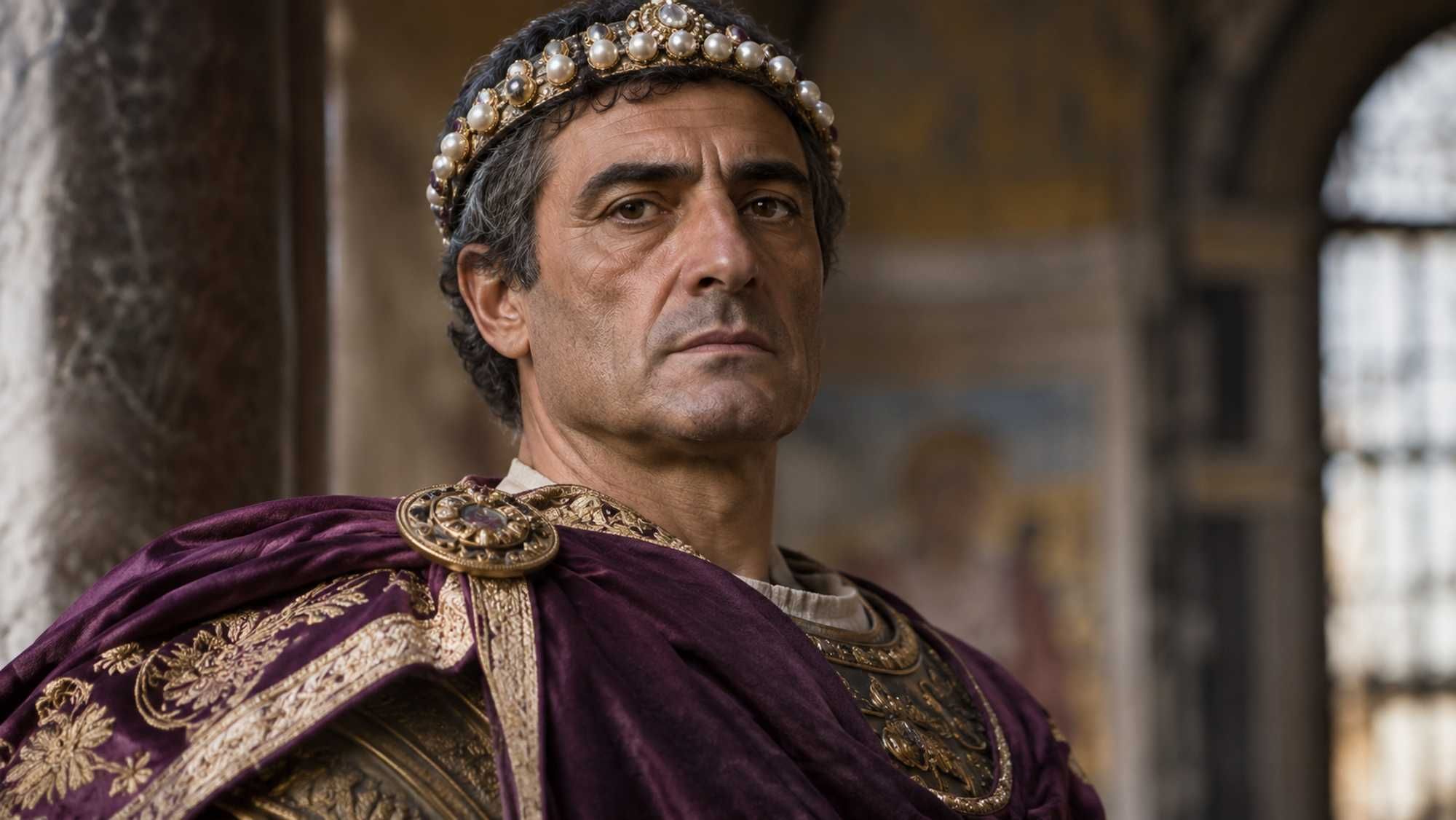
In the closing months of AD 409, a Roman senator named Priscus Attalus was raised to the imperial throne while the Visigothic army of Alaric threatened Rome. He received the purple robes and diadem of an emperor, occupied the imperial palace, and announced ambitions that extended far beyond Italy. Within months, the Gothic leader who had supported his elevation stripped him of his imperial authority.
It would not be the last time Attalus wore the purple. Several years later, another Visigothic king made him emperor again, this time in Gaul, where his new government proved even less secure than the first. His extraordinary career ended in the hands of the emperor he had twice attempted to displace, with public humiliation, mutilation and exile to an island off the coast of Sicily.
Before the Purple: A Senator Among Rome's Aristocracy
Long before becoming emperor, Priscus Attalus belonged to the educated and politically influential circles of the Roman aristocracy. His family appears to have originated in the eastern provinces of the Empire, and he was probably the son of Publius Ampelius, a high-ranking official from Antioch who had served as prefect of Rome in 371–372. Attalus's own birth is generally placed before the middle of the fourth century, although the precise year is unknown.
His education was consistent with the expectations of a prosperous senatorial family. He was familiar with Greek and Latin literature and cultivated the kind of learning that brought distinction among Rome's aristocrats. His association with Quintus Aurelius Symmachus, one of the most prominent senators and letter-writers of his generation, provides unusually personal evidence of his life before he entered the struggles for imperial power.
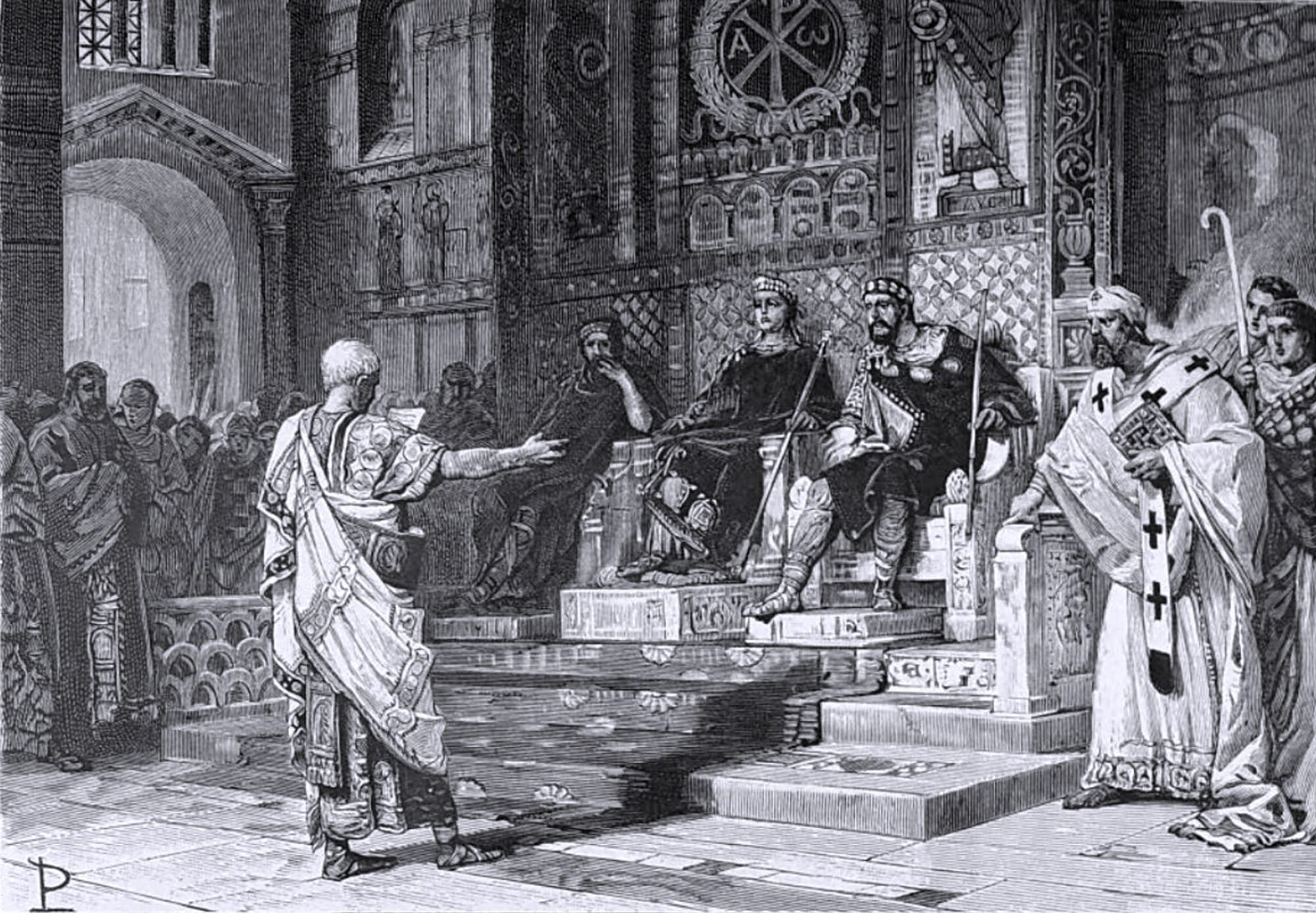
Eleven letters addressed to Attalus survive in the seventh book of Symmachus's correspondence. They show a friendship sustained by literary interests, social obligations and the familiar exchanges of educated Roman gentlemen. In the late 390s, the two men discussed residences, invitations, writing and the ordinary concerns of aristocratic life.
Attalus owned a house in Rome and acquired a country residence near Tibur, modern Tivoli. Symmachus wrote appreciatively about the property and its surroundings, encouraging his friend to improve its buildings. Their correspondence also includes an amusing discussion of the heating arrangements of a bath at the villa, which supposedly required remarkably little fuel to produce sufficient warmth.
These were the concerns of a man whose life appeared comfortably established within the Roman elite. Attalus entertained friends, maintained correspondence and took an interest in literature, but he was not detached from public affairs. His letters also reveal an interest in the activities of the Senate, and he had already begun undertaking political responsibilities on its behalf.
In 398, Attalus participated in an embassy sent to the imperial court to represent senatorial interests concerning the demands placed upon landowners for military recruits. The mission formed part of the continuing negotiations between the Roman aristocracy and the government of Stilicho, the powerful general who directed much of the western administration during the early reign of Honorius.
By the time the Goths threatened Rome, Attalus was therefore no political newcomer. He had experience of senatorial diplomacy, understood the workings of the imperial court and enjoyed connections among the leading families of the capital. Those qualifications would eventually make him a suitable candidate for an imperial elevation under exceptionally difficult circumstances.
From Diplomatic Missions to a Besieged Capital
The crisis that brought Attalus to the throne developed after the execution of Stilicho in August 408. His removal disrupted the political arrangements that had governed relations between the western court and Alaric, whose Gothic forces had repeatedly entered Roman territory and sought an agreement with the imperial government.
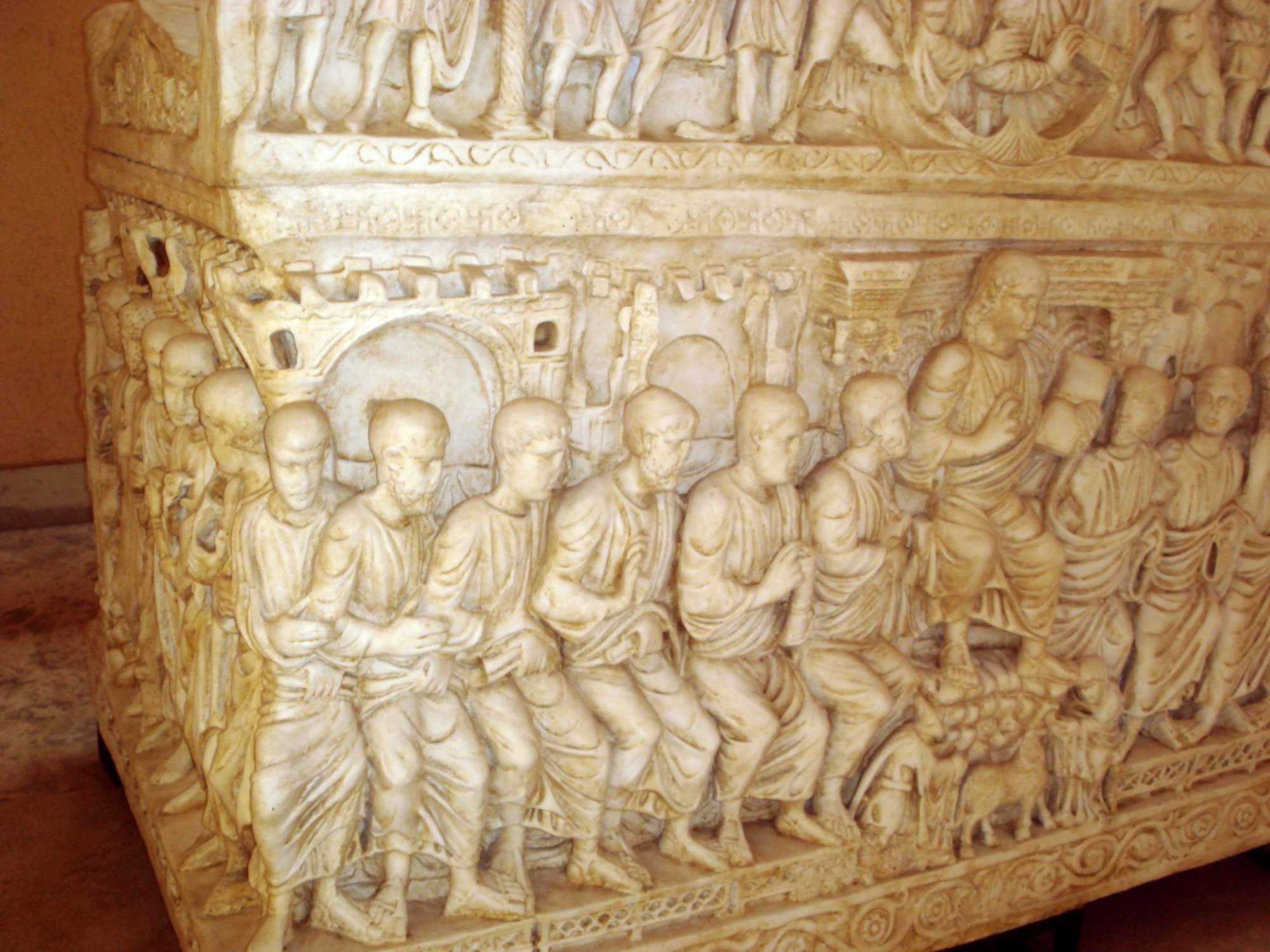
Honorius ruled from Ravenna, a fortified city on the Adriatic coast, while Rome remained the traditional centre of senatorial society and the symbolic heart of the Empire. The emperor's government was increasingly unable to protect the old capital from Alaric's movements through Italy. The resulting negotiations placed the Roman Senate in a position of unusual political importance.
During the first Gothic siege of Rome in 408, food supplies dwindled and the inhabitants faced severe hardship. Alaric demanded substantial payments and sought recognition of his position within the Roman military system. The senators attempted to negotiate a settlement, but the agreement required the approval of Honorius, whose court remained reluctant to concede the terms sought by the Gothic leader.
Attalus participated in the embassies that travelled between Rome and Ravenna during this crisis. In early 409, he received the appointment of comes sacrarum largitionum, placing him in charge of an important branch of imperial finance.
His diplomatic activities also brought him close to military danger. Attalus was travelling with reinforcements from Dalmatia when Gothic forces intercepted the Roman detachment and inflicted a severe defeat. He survived the episode and continued his political career.
His advancement soon continued with his appointment as prefect of Rome. He succeeded Gabinius Barbarus Pompeianus, who had died during disturbances associated with the city's desperate food shortages. The appointment placed Attalus at the head of the capital's civilian administration at a moment when its relationship with the imperial court was rapidly deteriorating.
Meanwhile, further attempts to settle the Gothic question failed. Alaric demanded provisions, territory and a recognised military position, while Honorius rejected proposals that might have provided a lasting agreement. The Gothic army eventually returned to Rome, and the city's vulnerability once again became the decisive factor.
A New Augustus in the City of Rome
Late in 409, Alaric seized Portus, the harbour complex through which much of Rome's imported grain and other supplies reached the city. With access to essential provisions threatened, the senators faced the possibility of another disastrous siege. Alaric now proposed a more dramatic solution to his conflict with Honorius: the creation of a rival emperor in Rome itself.
Attalus, already prefect of the city, became the chosen candidate. The Senate participated in his elevation, although the circumstances were dominated by Alaric's military power. The decision united, for a short time, the interests of a Gothic commander seeking recognition and a Roman aristocracy increasingly dissatisfied with the government at Ravenna.
The ceremony followed established imperial traditions. Attalus received the purple mantle and diadem, the visible insignia of an Augustus, before proceeding to the imperial palace. His transformation from a senior official of Honorius into a rival claimant to the throne was formally complete.
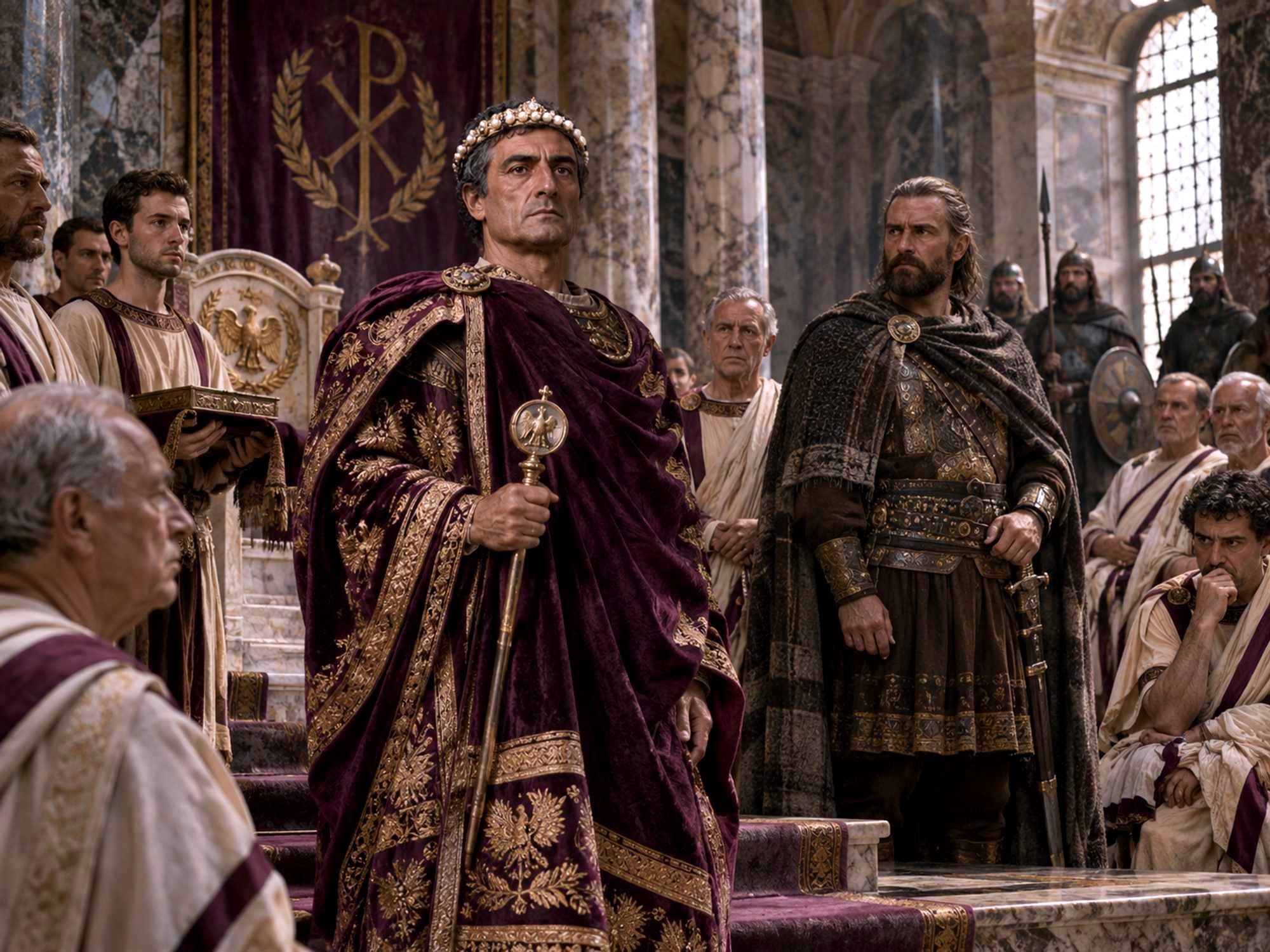
The following day, he summoned the Senate and delivered an ambitious speech. Sozomen records that Attalus promised to protect its traditional privileges and announced that he intended to bring Egypt and the eastern provinces under the authority of Italy. The declaration represented a remarkable claim for a ruler whose immediate power depended upon a Gothic army and whose authority was scarcely established beyond parts of Italy.
For the senators, however, the new emperor offered something that Honorius did not. Attalus belonged to their own social world, had served in their diplomatic missions and was prepared to present himself as a defender of the political importance of Rome. His accession restored an imperial presence to a city whose resident aristocracy had long watched the emperors conduct their government elsewhere.
The appointments made under Attalus reflected the unusual alliance that had brought him to power. Alaric received the senior Roman military command, while Athaulf, another prominent Gothic leader, became commander of the domestic cavalry. Roman officials occupied important civilian positions, including Marcianus as prefect of Rome and Postumius Lampadius as praetorian prefect.
Attalus also appointed Tertullus as consul for 410, an appointment welcomed among sections of the Roman aristocracy. The new court thus possessed the familiar framework of an imperial administration, with consular honours, senior ministers and military commanders. But the authority of these officials depended upon whether the territories and armies of the Empire would recognise Attalus rather than Honorius.
An Emperor Who Promised to Restore Rome's Greatness
Attalus's imperial coinage carried messages suited to his position as an emperor ruling from the old capital. Coins struck in his name displayed the traditional symbols of Roman authority, while several issues celebrated the city through the legend INVICTA ROMA AETERNA – Unconquered Eternal Rome.
One type depicted the goddess Roma seated and crowned by Victory. Other issues referred to the restoration of the Roman state, presenting Attalus's government as an attempt to renew the prestige of Rome and its institutions. The messages were particularly appropriate for an emperor whose principal political support lay among the capital's senators.
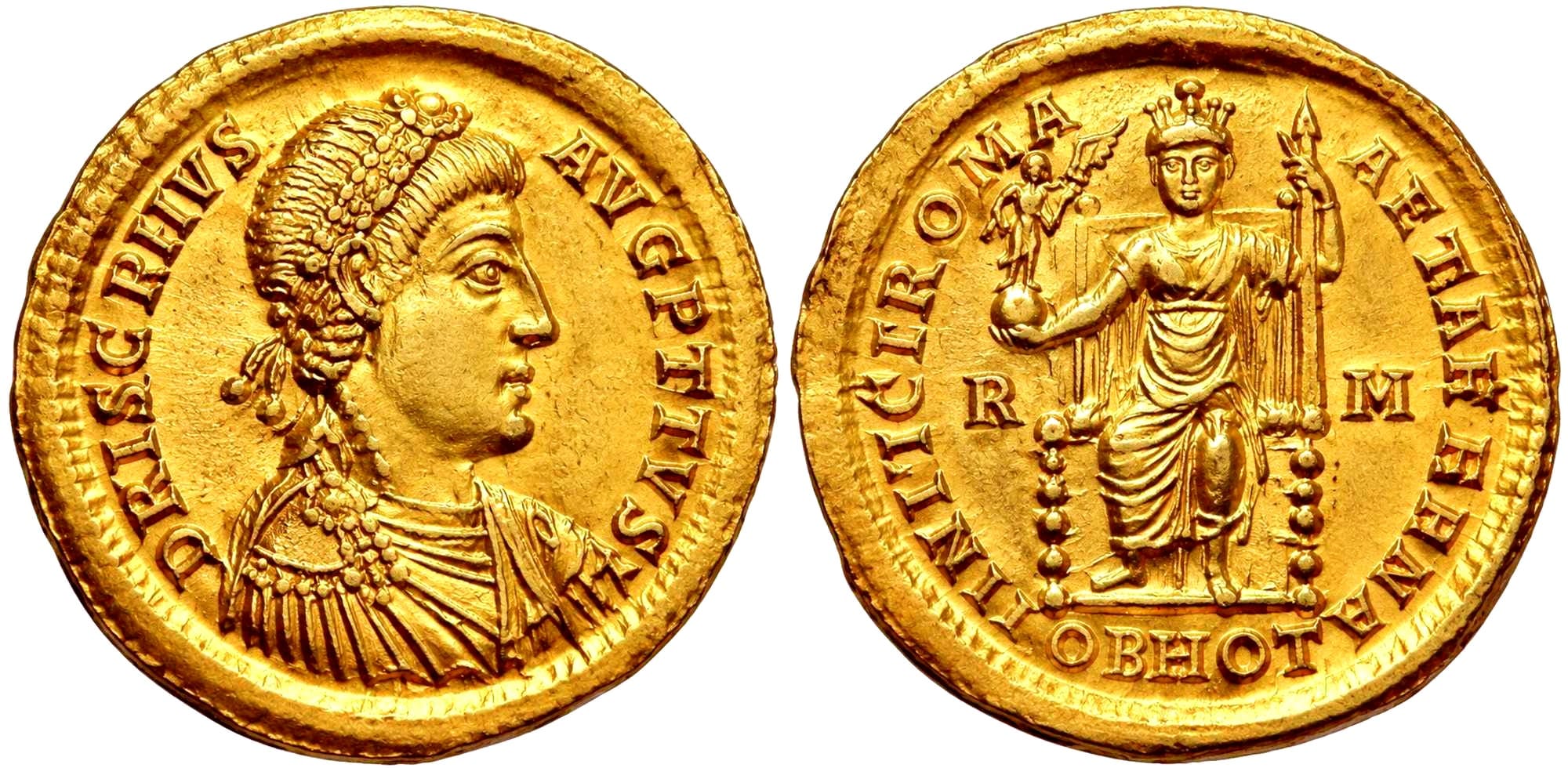
His coinage also contained an unusual feature: the omission of the customary abbreviation D.N., standing for Dominus Noster, or Our Lord. The choice distinguished Attalus from the conventional titulature of contemporary emperors and suited the traditional conception of an emperor closely associated with the Senate rather than elevated above it.
The religious character of his government was equally distinctive. Attalus had been associated with traditional pagan culture and with aristocratic circles in which older Roman religious practices remained important. Yet Sozomen records that he received baptism from Sigesarius, the bishop associated with the Goths, whose Christianity was regarded as Arian by the Catholic Church.
The religious expectations surrounding his accession were varied. Sozomen reports that pagans hoped Attalus would restore traditional temples, sacrifices and festivals, while Arian Christians expected favourable treatment for their communities. The emperor's actual religious policies are much less clearly documented than these hopes.
His government included men from different religious backgrounds, while his surviving coinage principally emphasised Roman political symbols. The new Augustus sought support from constituencies whose political dissatisfaction with Honorius did not necessarily erase their religious differences.
Whatever his intentions, Attalus was attempting to exercise a power extending far beyond the ceremonial authority conferred upon him in Rome. His survival would depend on defeating Honorius or compelling the emperor to recognise his position.
Honorius Is Offered Exile Instead of a Throne
Attalus and Alaric soon advanced towards Ravenna, accompanied by an army that included Roman as well as Gothic soldiers. The movement threatened the centre of Honorius's government and forced the emperor to consider negotiations with the rival Augustus.
Honorius's position appeared precarious. His military forces had been weakened by successive conflicts, and his own officials were divided over the most effective response to Alaric. As the opposing army approached, he sent representatives to Attalus with an offer to share imperial authority.
Attalus rejected the proposal. Rather than accept a position alongside Honorius, he demanded that his rival relinquish the throne and choose a place of exile. The response reversed their previous relationship: the former prefect who had received appointments from Honorius now presumed to determine where the emperor might live after surrendering his authority.
The negotiations became more threatening when Jovius, a senior official whose allegiance had shifted between the competing governments, conveyed an additional proposal that Honorius should suffer mutilation before his exile. Olympiodorus's account indicates that Attalus criticised Jovius for introducing this demand.
Honorius nevertheless had reason to fear that his situation was becoming desperate. He reportedly prepared ships for a possible departure to the Eastern Empire, where his nephew Theodosius II ruled from Constantinople.
The arrival of reinforcements from the East changed his prospects. The soldiers provided a more reliable garrison for Ravenna and allowed Honorius to remain in the city while the conflict continued. His survival now depended partly upon events far from the Italian battlefield.
Africa, the province from which Rome received essential food supplies, had remained under the control of officials loyal to Honorius. Its refusal to recognise Attalus would soon prove more damaging to the new emperor than the resistance of Ravenna itself.
The African Disaster That Destroyed His First Reign
The loss of access to Africa presented Attalus with an immediate practical problem. The province was essential to Rome's food supply, and its governor, Heraclianus, refused to transfer his allegiance from Honorius to the new imperial government.
Attalus needed to remove Heraclianus or secure the province by negotiation. Alaric favoured military intervention and proposed sending Gothic forces to Africa, but Attalus was reluctant to place such a strategically important region under the control of Gothic soldiers.
Instead, a Roman officer named Constans was dispatched to establish Attalus's authority. The expedition failed, and Constans was defeated and killed. Heraclianus retained control of the province and prevented ships carrying provisions from reaching Rome.
The consequences were severe. Food shortages intensified, and the population of the city faced another period of hunger. According to Sozomen, conditions became so desperate that chestnuts were consumed as a substitute for grain, while suspicions circulated that some inhabitants had resorted to eating human flesh.
The failure created further disagreements between Attalus and Alaric. During the worsening crisis, Jovius urged another military intervention in Africa. Later, Attalus returned to Rome and consulted the Senate over the proposal to send Roman and Gothic troops under the command of Drumas.
Zosimus reports that most senators supported the proposal, while Attalus and a few others remained opposed to placing a Roman army under a Gothic commander. Sozomen gives a somewhat different account, presenting the Senate as sharing Attalus's objections.
The dispute was not simply a disagreement over military tactics. Attalus's position depended upon the support of Roman aristocrats who had extensive interests in Africa and were reluctant to see the province occupied by Gothic forces. Alaric, by contrast, needed a government capable of supplying his followers and applying effective pressure upon Honorius.
Attalus's refusal demonstrated that he did not automatically obey his Gothic patron. Yet his ability to pursue an independent policy was limited by his lack of reliable military resources and the worsening conditions in Rome.
Alaric eventually concluded that the emperor he had supported could no longer serve his purposes. The alliance that had elevated Attalus was breaking down, and the Gothic leader began seeking another agreement with Honorius.
The First Emperor to Lose His Purple
During the summer of 410, Attalus was brought before an assembly near Ariminum, modern Rimini. There, in the presence of those gathered, Alaric stripped him of the imperial insignia he had received only months earlier.
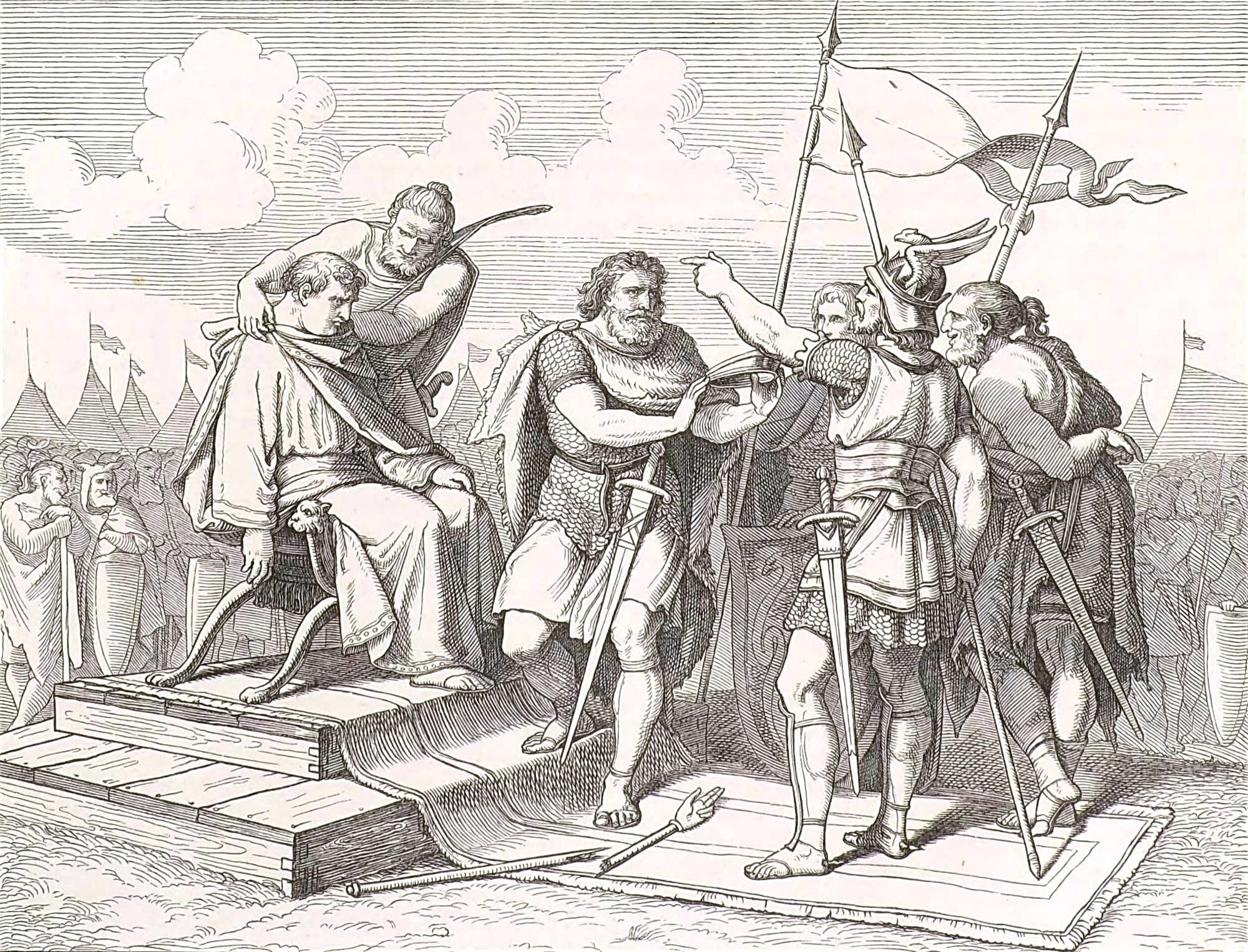
Attalus surrendered his diadem and purple robe. The symbols of his authority were sent to Honorius, providing a visible indication that Alaric no longer supported his rival's claim to the throne.
The officials appointed under Attalus also relinquished the insignia of their positions, while arrangements were made to pardon those who had participated in the failed government. Attalus himself was not killed or immediately handed over to Honorius.
Instead, he remained with Alaric, accompanied by his son Ampelius. His continued place among the Goths may partly have reflected fears for his safety if he returned to Roman territory, but the association eventually developed into a more enduring political relationship.
The timing of his removal was extraordinary. Only weeks later, on 24 August 410, Alaric's forces entered and sacked Rome after another breakdown in negotiations with Honorius. Attalus had briefly ruled the city from its imperial palace, yet he was no longer emperor when the Gothic army captured the capital.
The former Augustus now travelled in the company of the people whose military strength had placed him on the throne. His political career, however, had not ended.
A Former Emperor in the Company of Gothic Kings
Alaric died later in 410, and leadership of the Goths passed to Athaulf. Attalus remained with the Gothic court as its followers moved through Italy and eventually into Gaul, where new opportunities for political negotiation emerged.
His presence was more than that of an insignificant captive. Attalus possessed experience of Roman institutions, understood the political divisions among imperial officials and retained knowledge of aristocratic networks through which support might be obtained. His continued political involvement is documented in the negotiations pursued during Athaulf's leadership.
Among the potential allies was Jovinus, a claimant who had acquired imperial authority in Gaul with support from regional aristocrats and Burgundian forces. Attalus encouraged Athaulf to establish an understanding with him, but the attempt failed.
Relations between the Gothic leader and the Gallic usurper deteriorated, and Athaulf eventually sought alternative arrangements with Honorius's government. Throughout these shifting alliances, Attalus remained a familiar figure within the Gothic leadership.
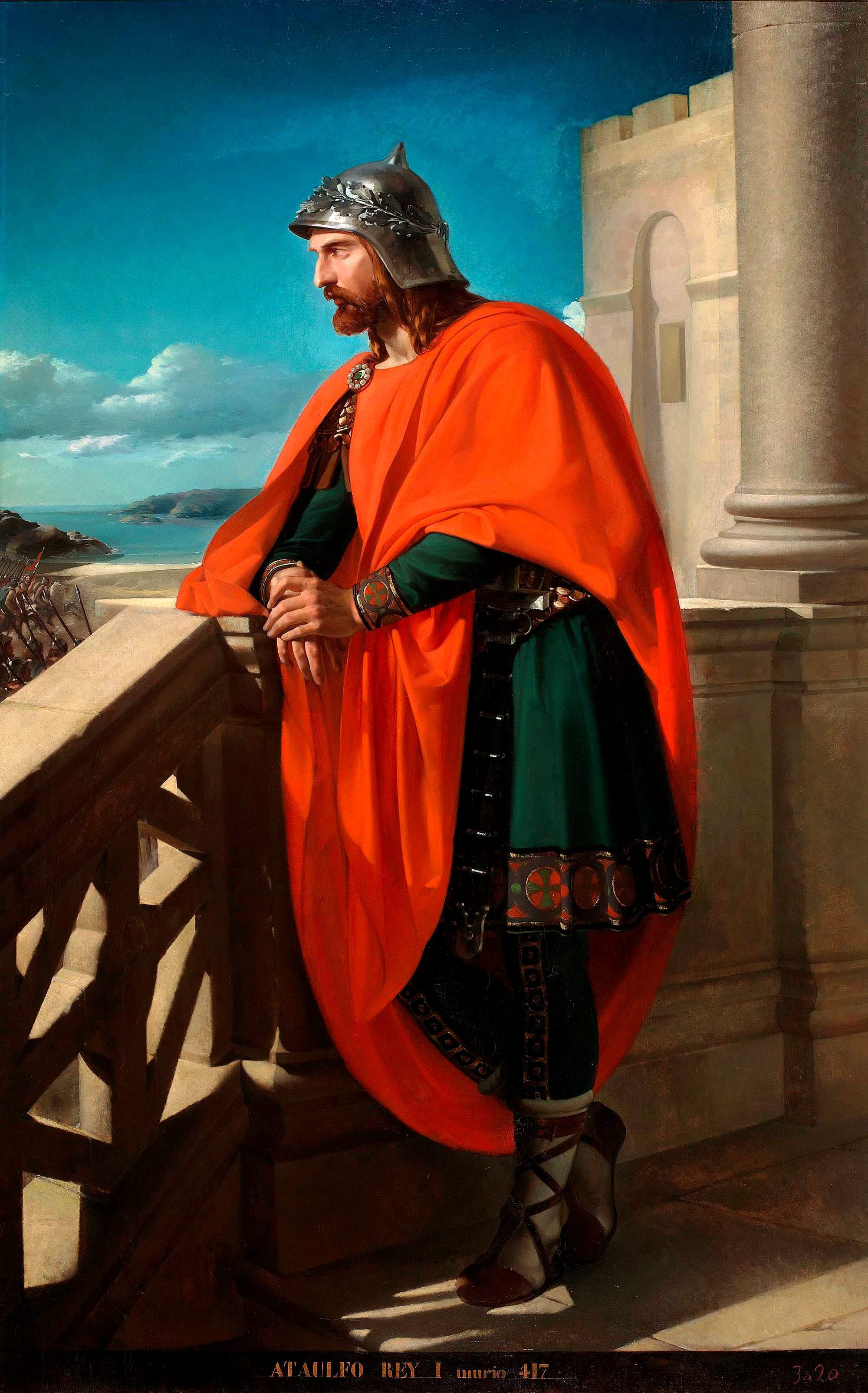
His fortunes were now closely connected to Athaulf, who had become one of the central participants in the struggle over the future of Roman authority in Gaul.
The association also brought Attalus into proximity with Galla Placidia, the half-sister of Honorius, who had been taken into Gothic custody after the sack of Rome. Her presence offered Athaulf a potential connection with the ruling Theodosian dynasty, and that connection became particularly significant when the Gothic king decided to marry her.
The Emperor Who Performed at a Gothic King's Wedding
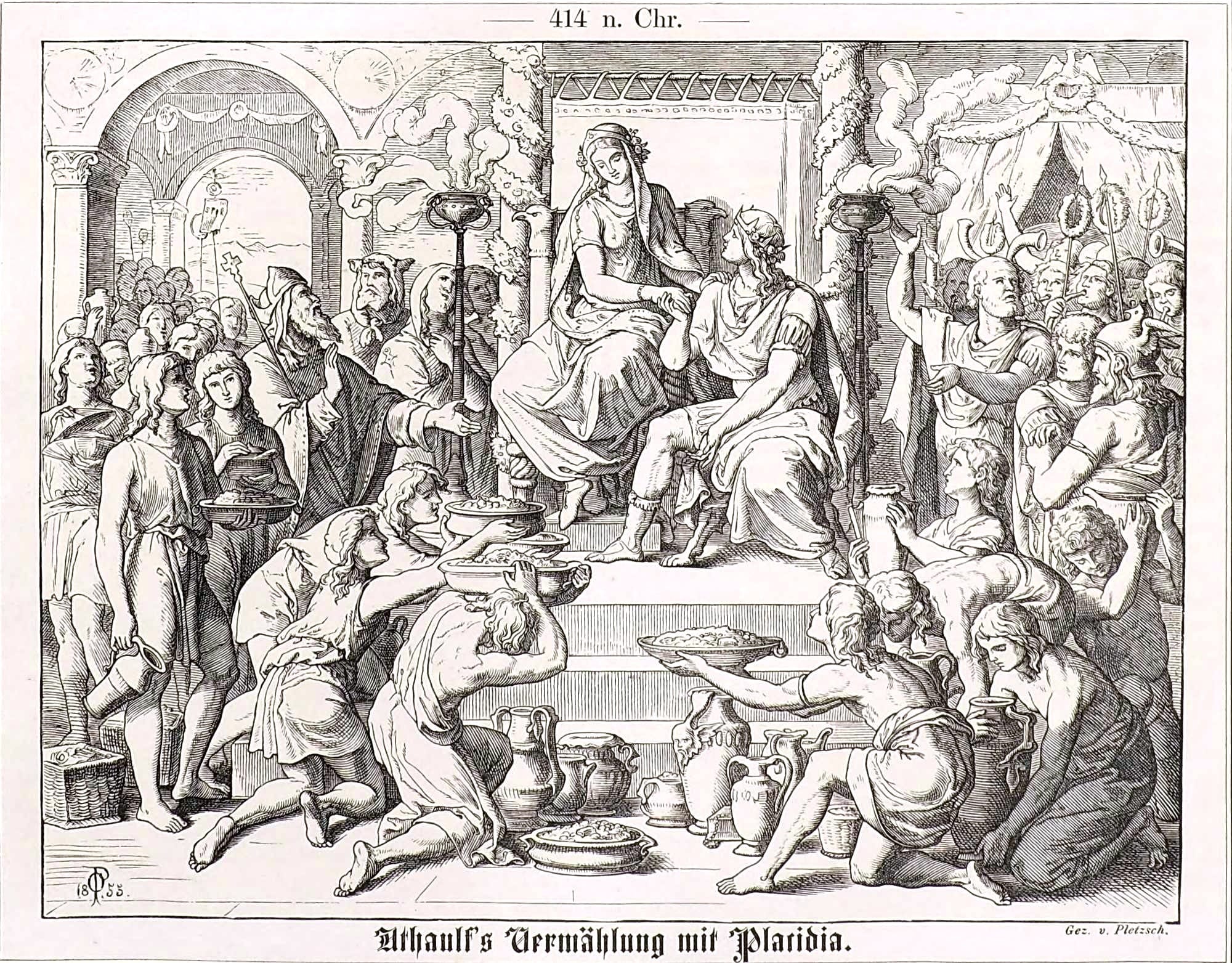
In January 414, Athaulf married Galla Placidia at Narbonne, in southern Gaul. The ceremony took place in the house of Ingenuus, a prominent resident of the city, and brought together Roman aristocratic customs with the political ambitions of the Gothic leadership.
Olympiodorus preserves a detailed account of the occasion. Placidia appeared in imperial dress within a room arranged according to Roman custom, while Athaulf sat beside her wearing a woollen tunic and other Roman clothing.
The wedding gifts were remarkable. Fifty young men dressed in silk carried two large dishes each, one filled with gold and the other with precious stones. Olympiodorus identifies the valuables as spoils taken from Rome during the Gothic sack four years earlier. Among the performers who provided entertainment was Priscus Attalus.
The former emperor led the performance of wedding songs, followed by Rusticius and Phoebadius, two other distinguished participants. The celebration included games and expressions of joy among the Romans and Goths present
It was an extraordinary episode in Attalus's life. He had once challenged Honorius for the imperial throne and had been stripped of his authority by Alaric. Now he was performing at the marriage of Honorius's sister to Alaric's successor, surrounded by a gathering that brought Roman and Gothic participants together.
The marriage did not bring lasting peace with Ravenna. Relations between Athaulf and Honorius deteriorated again, and the Gothic king soon found himself facing renewed pressure from the imperial army. Once more, Attalus would be offered the purple.
A Second Throne, This Time in Gaul
During 414–415, Athaulf supported Attalus's second elevation as emperor. Unlike his first proclamation in Rome, this attempt took place in Gaul, where the Gothic forces were struggling to maintain their position against the army of Honorius.
The exact circumstances of the elevation are not entirely clear. Ancient and modern reconstructions differ over its precise date and location, while agreeing that Attalus resumed the title of Augustus under Athaulf's protection.
This second reign lacked many of the advantages he had enjoyed in 409. There was no election by the Roman Senate, no possession of the ancient capital and no comparable opportunity to present himself as the chosen emperor of Rome's aristocracy.
Athaulf could still provide soldiers, but his military position had weakened. Constantius, the general acting for Honorius, was applying pressure to the Goths and restricting the supplies upon which they depended.
Attalus nevertheless attempted to establish another imperial administration. Officials received appointments in his name, and coins were struck under his authority at western mints. Some continued the earlier message of restoring the Roman state, maintaining the appearance of a government committed to the preservation of imperial institutions.
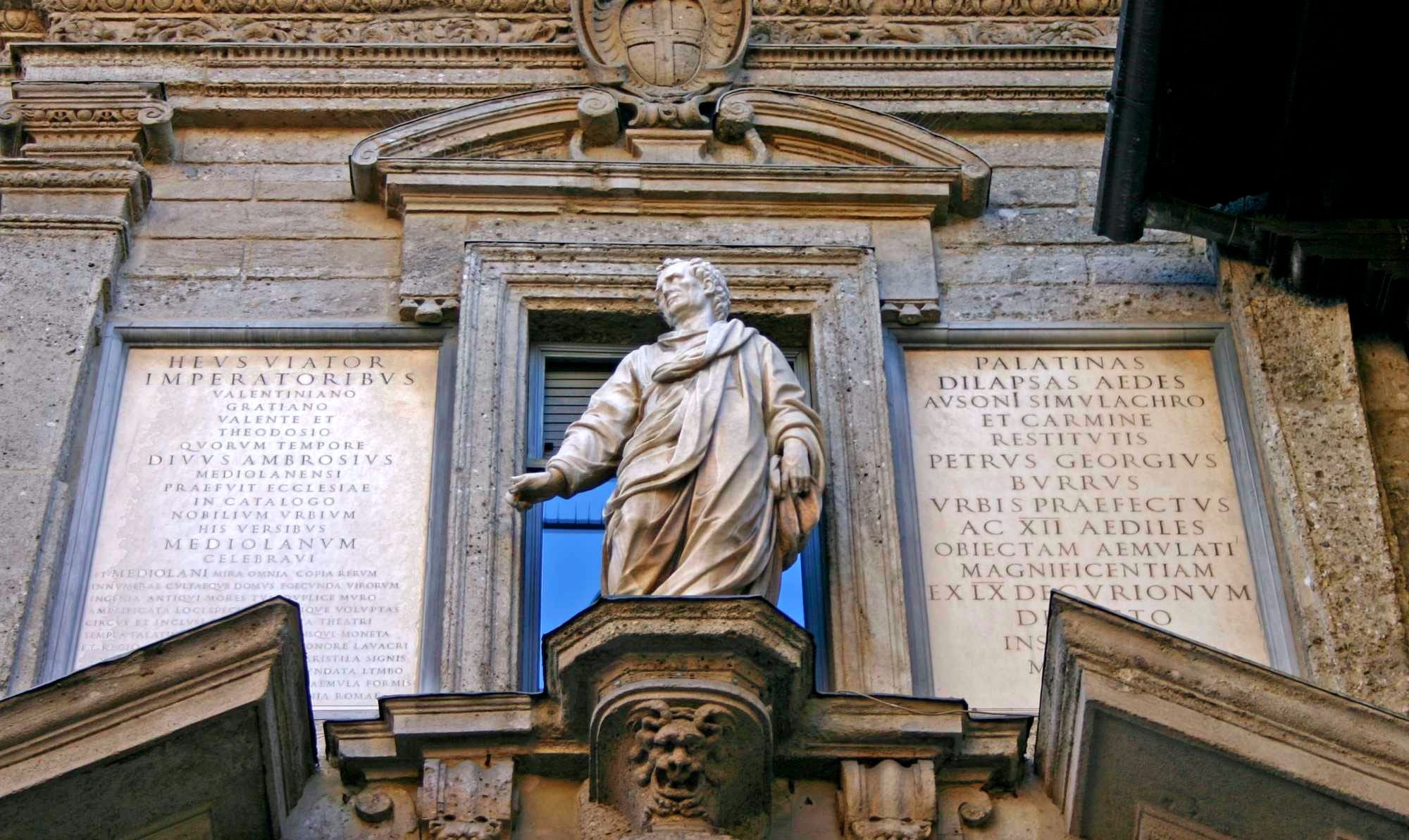
Among the men appointed to serve this government was Paulinus of Pella, the grandson of the celebrated poet Ausonius. Paulinus belonged to the wealthy Gallo-Roman aristocracy and possessed estates in the region affected by the Gothic occupation.
His recollection of the appointment provides one of the most revealing accounts of Attalus's second reign.
An Imperial Appointment That Came with an Empty Treasury
Paulinus received the title comes privatae largitionis, Count of Private Largesses, an office associated with imperial financial administration. The honour might have been substantial under a government possessing secure territory, revenue and a functioning treasury.
Attalus, however, could offer the title without the financial resources normally associated with it. Paulinus later recalled that the appointment had been made while he was absent and had brought him considerable difficulties.
Writing years later in his autobiographical Eucharisticus, Paulinus described it as:
"an empty title of distinction"
He explained that the office lacked the revenue required to sustain it. Attalus himself, in Paulinus's account, depended upon the Goths for protection and possessed neither sufficient independent resources nor a reliable army of his own.
Paulinus's criticism was shaped by his difficult experiences during the Gothic occupation. He had suffered the destruction of property and displacement from his home, and he later insisted that his efforts had been directed towards obtaining peace with the Goths rather than supporting the ambitions of Attalus.
His account nevertheless reveals the practical weaknesses of the second imperial government. Attalus could confer titles, appoint officials and issue coins, but he lacked many of the resources necessary to turn those formal claims into effective administration.
The contrast with his first reign was substantial. In Rome, Attalus had commanded the support of a significant part of the Senate and occupied the imperial palace. In Gaul, his authority depended upon a Gothic ruler whose military position was deteriorating.
As the conflict with Constantius continued, the Goths were forced to retreat towards the Iberian Peninsula. Attalus was approaching the second and final collapse of his imperial career.
Abandoned by the Goths and Captured at Sea
In 415, the position of the Gothic leadership deteriorated further. Athaulf was assassinated, and the struggles that followed his death weakened the political arrangements upon which Attalus depended.
The former emperor was eventually left without the protection that had sustained his second reign. Prosper of Aquitaine records that Attalus was abandoned as the Goths moved towards Spain and was captured when he no longer possessed sufficient military support.
Orosius gives a more detailed version of his final attempt to escape. According to his account, Attalus departed by ship and was captured at sea before being delivered to Constantius.
The accounts differ in some circumstances, but agree on the essential outcome. Attalus fell into the hands of the government he had twice opposed and was brought under the authority of Honorius, whose position had changed greatly since the crisis of 409–410.
Attalus had once received an offer to share the Empire with Honorius and had refused it, believing that his own position was sufficiently strong to demand the emperor's retirement. Now Honorius possessed the means to decide the fate of his former rival.
The defeated Augustus was spared immediate execution, but his punishment would publicly demonstrate the destruction of his imperial authority.
Honorius's Triumph and the Mutilation of Attalus
Attalus's final public humiliation took place during a celebration of Honorius's victory in Rome, probably in 417. The precise chronology has been debated, but the ancient accounts establish that the defeated claimant was displayed before the emperor and subjected to a punishment that permanently marked his failure.
Philostorgius describes Honorius ascending a tribunal and ordering Attalus to stand at its lowest step. The contrast between the emperor above and his defeated rival below was accompanied by an act of physical mutilation.
According to Philostorgius, the thumb and forefinger of Attalus's right hand were cut off. Orosius gives a less precise account, referring to the mutilation of his hand, while other surviving testimony preserves variations in the description of the punishment.
His life was nevertheless spared. Philostorgius records that Attalus was exiled to Lipari, one of the Aeolian Islands north of Sicily, and provided with the necessities required for his maintenance.
Attalus was not the only imperial rival whose fortunes had ended through defeat during the reign of Honorius. Yet his survival distinguished him from several other claimants who had been executed after their capture. On Lipari, the former Augustus disappeared from political life; the ancient accounts do not establish when he died, and there is no secure record of his return to Rome.
Giovanni Alberto Cecconi, “Gruppi di potere, indirizzi politici, rapporti tra Goti e Romani: la vicenda di Prisco Attalo,” in Potere e politica nell'età della famiglia teodosiana (395–455) (2013).
Martijn Icks, “Three Usurpers in Rome: The Urbs Aeterna in the Representation of Maxentius, Nepotian, and Priscus Attalus,” Studies in Late Antiquity 4, no. 1 (2020).
John Matthews, Western Aristocracies and Imperial Court, A.D. 364–425 (1975).
Stefano Bruni, “An AE3 Mule of Priscus Attalus: New Light on Dating the Urbs Roma Felix Series,” in Proceedings of the XV International Numismatic Congress.
Zosimus, New History, Books V–VI.
Zosimus, New History, Books V–VI.
Olympiodorus of Thebes, surviving historical fragments
Orosius, History Against the Pagans, Book VII.
Philostorgius, Ecclesiastical History, Book XII.
Quintus Aurelius Symmachus, Letters, Book VII.
Paulinus of Pella, Eucharisticus.
Prosper of Aquitaine, Chronicle.

About the Roman Empire Times
See all the latest news for the Roman Empire, ancient Roman historical facts, anecdotes from Roman Times and stories from the Empire at romanempiretimes.com. Contact our newsroom to report an update or send your story, photos and videos. Follow RET on Google News, Flipboard and subscribe here to our daily email.
Follow the Roman Empire Times on social media: