
The Mechanics of Civilization: Machines in the Greco-Roman World
From cranes and catapults to mills, pumps, and presses, the Greco-Roman world used machines in far more sophisticated and varied ways than older views once allowed.

The Greco-Roman world is often remembered for its armies, monuments, literature, and law, but it was also a civilization of machines. From cranes that raised stone high above a building site to pumps that moved water, presses that extracted oil and wine, mills driven by flowing streams, and artillery that multiplied force beyond the strength of the human arm, mechanical thinking shaped daily life in ways that were both practical and surprisingly sophisticated. These devices did not form a separate world of technical curiosities. They belonged to the ordinary business of building, feeding, healing, transporting, measuring, entertaining, and defending an empire.
What a Machine Was in Antiquity
In the Greco-Roman world, a machine was any device that made work easier, stronger, more regular, or more precise. Some machines multiplied force, allowing people to lift, press, or move far more than muscle alone could manage. Others redirected force, so that a difficult action became easier to perform. Others turned repeated movements into a continuous process, and in some cases into something approaching automation.
Ancient mechanical thought recognized a group of simple machines that stood at the root of more complex devices: the wheel and axle, lever, pulley, winch, wedge, screw, inclined plane, and gear wheel. Most were known very early. The screw and gear wheel, however, belonged to a later phase of development associated especially with the Hellenistic world. More advanced machines were created by combining these principles and refining them through additions such as cams, cranks, and rack-and-pinion systems.
The power behind these machines could come from many sources. Human effort remained fundamental, and animals supplied traction for larger tasks. But machines could also be driven by water, wind, and heat. In practice, Greek and Roman machines were used chiefly in construction, mining, water-lifting, warfare, and the processing of agricultural produce.
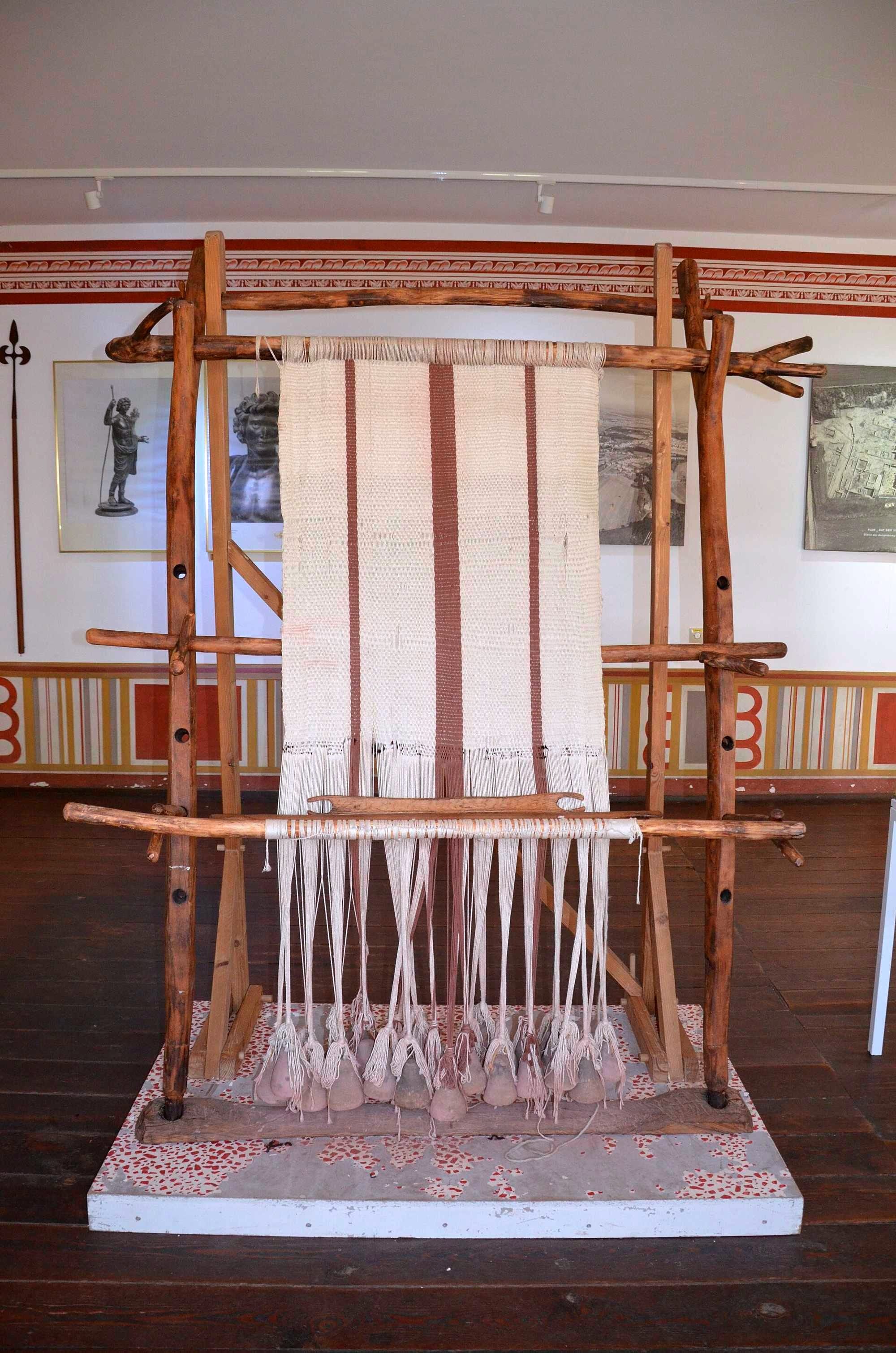
Their role in manufacturing was more limited, though not absent. The loom, for example, mechanized complex weaving operations, and by the Roman and late Roman periods water power was being applied to a wider range of productive tasks than was once thought.
The evidence is uneven. Machines were often made of mixed materials such as wood, rope, sinew, and metal, and these rarely survive together. In many cases only fragments remain, or else masonry that once anchored a mechanism. Technical images can be misleading, and written descriptions are incomplete.
Many works on mechanics have been lost altogether, while others survive only in later translations, especially into Arabic. Even so, enough survives to reveal a long and sophisticated mechanical tradition.
A major turning point came in the early Hellenistic period, especially at Alexandria. The Museum, founded around 305 B.C., gathered scholars working in mathematics, engineering, and natural science under royal patronage. In that environment, mechanical theory and practice advanced quickly. Thinkers associated with this world explored the lever, circular motion, pneumatics, pumps, artillery, automata, and gearing.
Archimedes, Ctesibius, Philo of Byzantium, Apollonius of Perge, Vitruvius, Hero, and later Pappus stand among the key names tied to the surviving tradition. What emerges is not a handful of isolated curiosities, but an evolving body of practical and theoretical knowledge.
The Principles Behind Ancient Machines
The central idea behind many machines was mechanical advantage. A small force could be turned into a larger one, but only by applying it over a greater distance. In theory, the gain in force matched the increase in distance; in practice, friction reduced efficiency. Machines could also be used the other way around, trading force for speed.
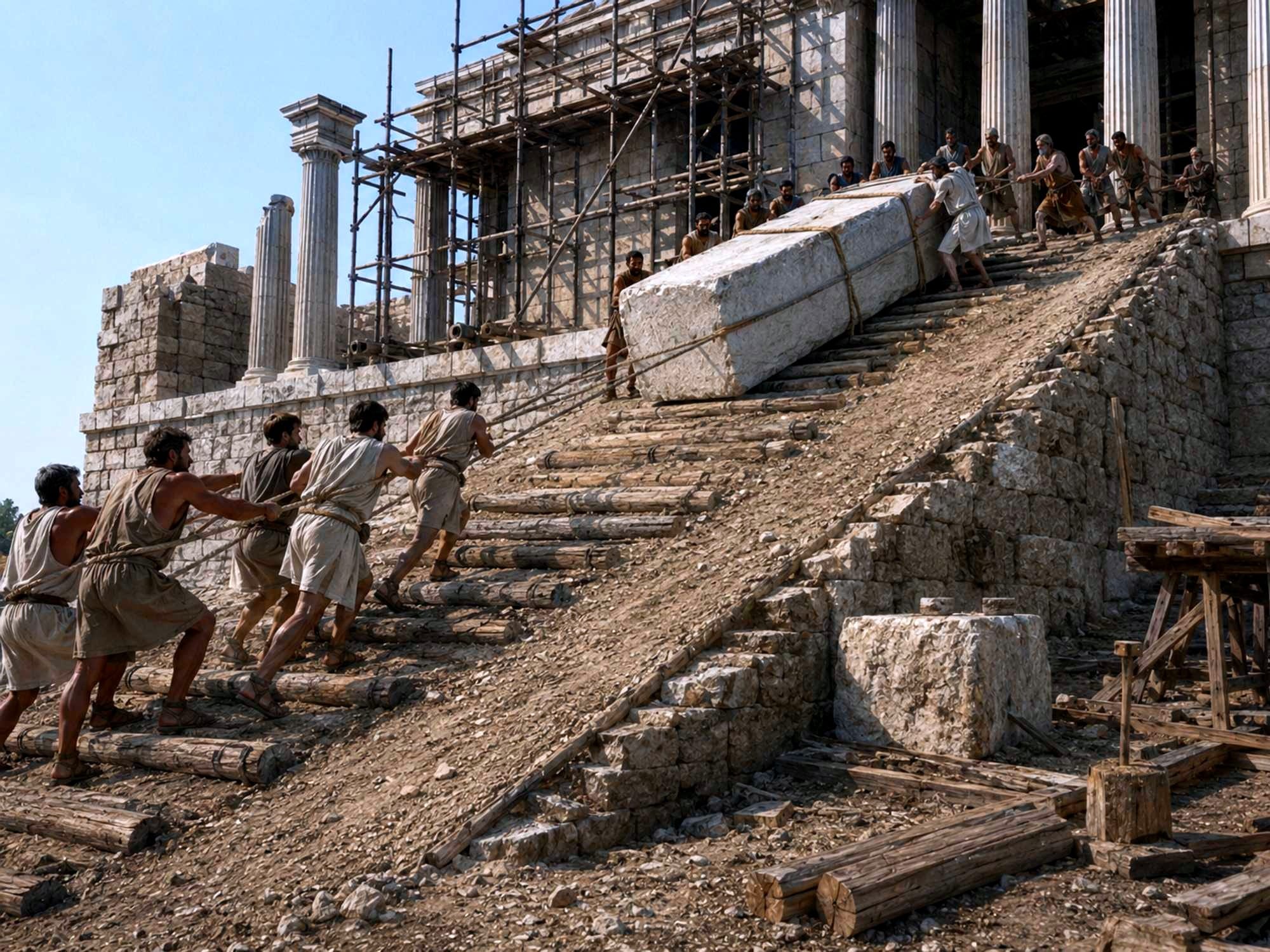
The inclined plane was the simplest case. A heavy load was easier to drag or roll up a slope than to lift vertically. Before cranes became common, this was the main way of raising architectural blocks to height. The lever was equally basic. By arranging the fulcrum so that the effort acted at a greater distance than the load, force could be multiplied. Levers appeared in construction, balances, forceps, and many ordinary tools.
The pulley did not automatically increase force, but it changed direction, allowing workers to pull downward rather than upward. Once pulleys were combined, they could produce major gains in lifting power. The winch and capstan translated effort into circular motion, increasing force through the relation between lever arm and drum. These machines were important in transport, lifting, medicine, and construction.
Gearing was one of the great Hellenistic advances. By linking wheels of different sizes, engineers could multiply force, increase speed, reverse direction, or shift movement from one plane to another. Much of the practical power of mills, clocks, and later devices depended on this.
Most working gears were wooden, but fine instruments used bronze gears with carefully cut teeth, as in the Antikythera Mechanism. The screw added another vital principle, translating the inclined plane into rotary pressure. It was especially useful in presses and precision instruments. The same world that built large lifting machines also understood how to create controlled, delicate movement.
Cranes and the Transformation of Building
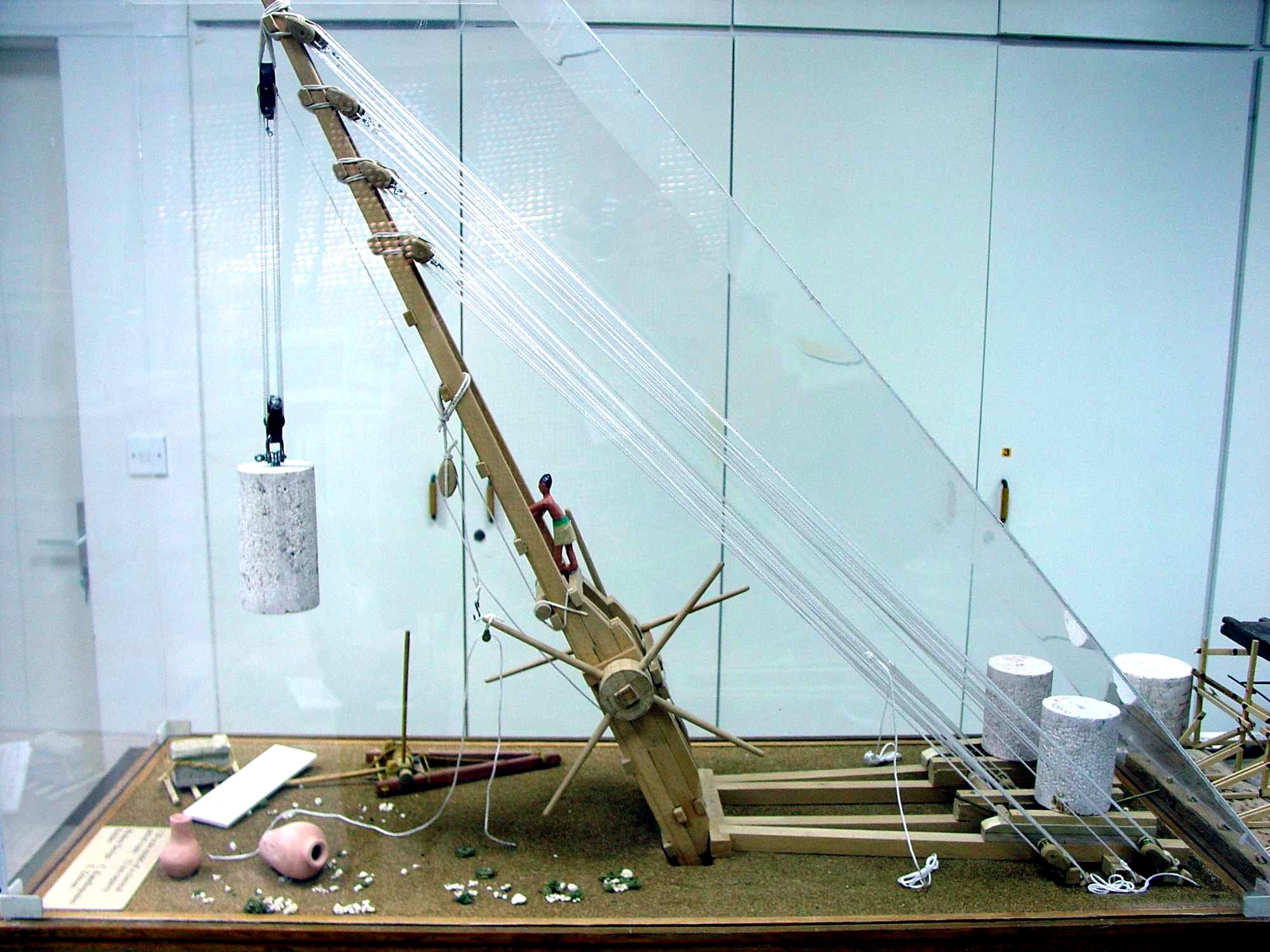
The earliest complex machines in the Greco-Roman world were cranes. These combined pulleys with windlasses and, in stronger forms, compound pulleys and geared systems. In larger versions, men walking inside treadwheels could provide the power.
Before cranes, heavy blocks had to be moved up earthen ramps. The introduction of cranes changed architecture profoundly. It removed the need to build and then dismantle huge ramps during construction, and it allowed heavy materials to be lifted more flexibly and more often.
The earliest Greek cranes are suggested by lifting holes and metal lifting devices that begin to appear in the late sixth century B.C. Their simplest form may have used a single upright pole with a pulley at the top, stabilized by stays. More secure designs used two poles in an inverted V, while later frames with three or four uprights offered much greater control.
Even before compound pulleys, early cranes could achieve useful lifting power through a single pulley combined with a windlass or capstan. Later improvements made them much stronger. Ancient tradition often credited Archimedes with extraordinary feats of lifting and hauling, including the launching of a massive ship. The details are difficult to reconstruct, but the broader point is clear: by the Hellenistic period, engineers were experimenting with increasingly powerful systems of pulleys, gears, and screws.
A related machine was the pile driver, which used pulleys to raise a heavy weight and then release it suddenly onto a timber pile. This was crucial in wet foundations and bridge building. Machines of this kind show that ancient lifting technology was not just about placing stone. It was about controlling force, direction, and impact in a wide variety of settings.
Medicine and the Mechanical Body
Ancient mechanics was not confined to building sites and battlefields. It also entered medicine. One important witness is Oribasius, a fourth-century Greek medical writer and court physician to the emperor Julian, whose compilations preserve much earlier material. He describes several traction machines for resetting broken limbs, some going back to the fifth century B.C.
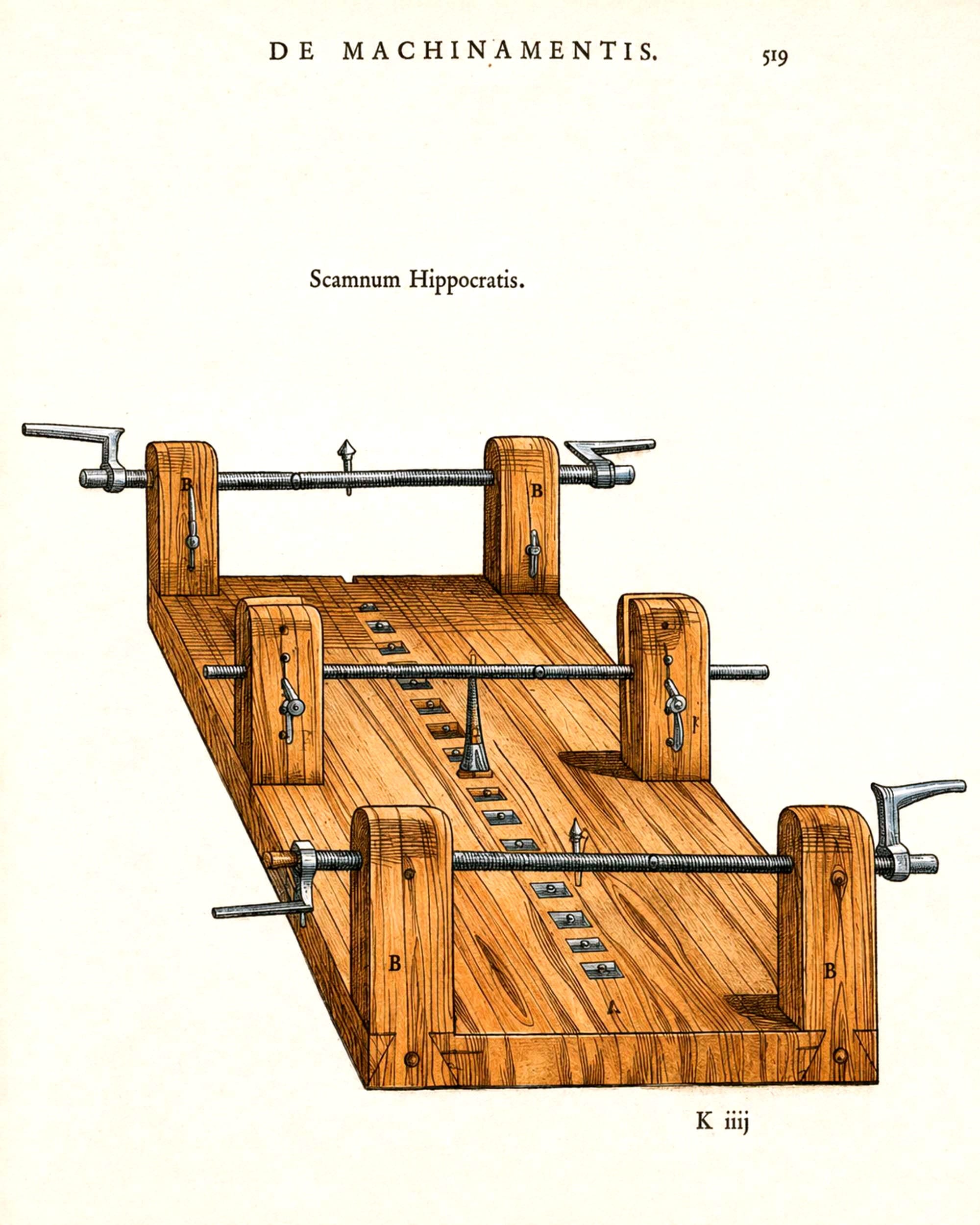
The earliest of these was the bench associated with Hippocrates, essentially a rack with simple winches at either end. Later versions used handspikes, screws, pulleys, or geared winches to increase control and force. Some were more portable, others more compact. In one device associated with Galen, ropes were arranged around pulleys and windlass axles to apply carefully balanced traction.
These machines show that the same mechanical principles used to lift stone or haul ships could be applied to the injured body. The goal here was controlled extension rather than construction or war. Yet the kinship of principle remained obvious, and later torture devices would draw on the same logic.
Artillery and the Engineering of War
The ordinary bow had clear limits. Its power depended on human strength, and its range was restricted by the draw length of the archer’s arms. If armies wanted much greater force, they needed machines. That was the path that led to artillery.
A key moment came at Syracuse in 399 B.C., when Dionysius assembled craftsmen from across the Mediterranean to prepare for war against Carthage. The earliest artillery weapon was probably the gastraphetes, or belly-shooter, a large crossbow-like device braced against the user’s body and spanned by leaning it against the ground or a wall. Larger versions soon followed, mounted on stands and drawn back with windlasses.
The real breakthrough came with torsion artillery. Instead of a single bow, these machines used two arms inserted into tightly twisted bundles of sinew or hair. The resulting catapults could be made much more powerful than ordinary bows. Some were optimized for bolts, others for stones. Engineers at Alexandria developed mathematical rules for the proportions of these machines, tying the size of the springs to the projectile they were meant to fire. This was systematic applied research in a military setting.
More elaborate devices followed, including repeating catapults that fed bolts automatically from a magazine and synchronized the loading, spanning, and firing cycle through gears and linked motion. Not all such inventions were widely adopted, but they show remarkable ambition. Later refinements made catapults lighter, smaller, and more mobile, and Roman armies used artillery extensively in siege warfare and in the field.
One important late type was the onager, a one-armed stone-thrower that hurled its shot from a sling. Simpler than the older two-armed stone-throwers, it became more prominent in late antiquity and survived into the medieval period.
Taken together, ancient artillery demonstrates how far Greek and Roman mechanics could go when backed by organized experimentation, mathematical design, and military demand.
Water-Lifting and the Control of Supply
Water-lifting was another major field of mechanical development. The simplest device was the shaduf, a counterweighted lever with a bucket on one end. It did not multiply force, but it made the action of raising water less exhausting by allowing the user to pull downward. Windlasses and pulleys also served to raise water from depth, though only in small quantities.
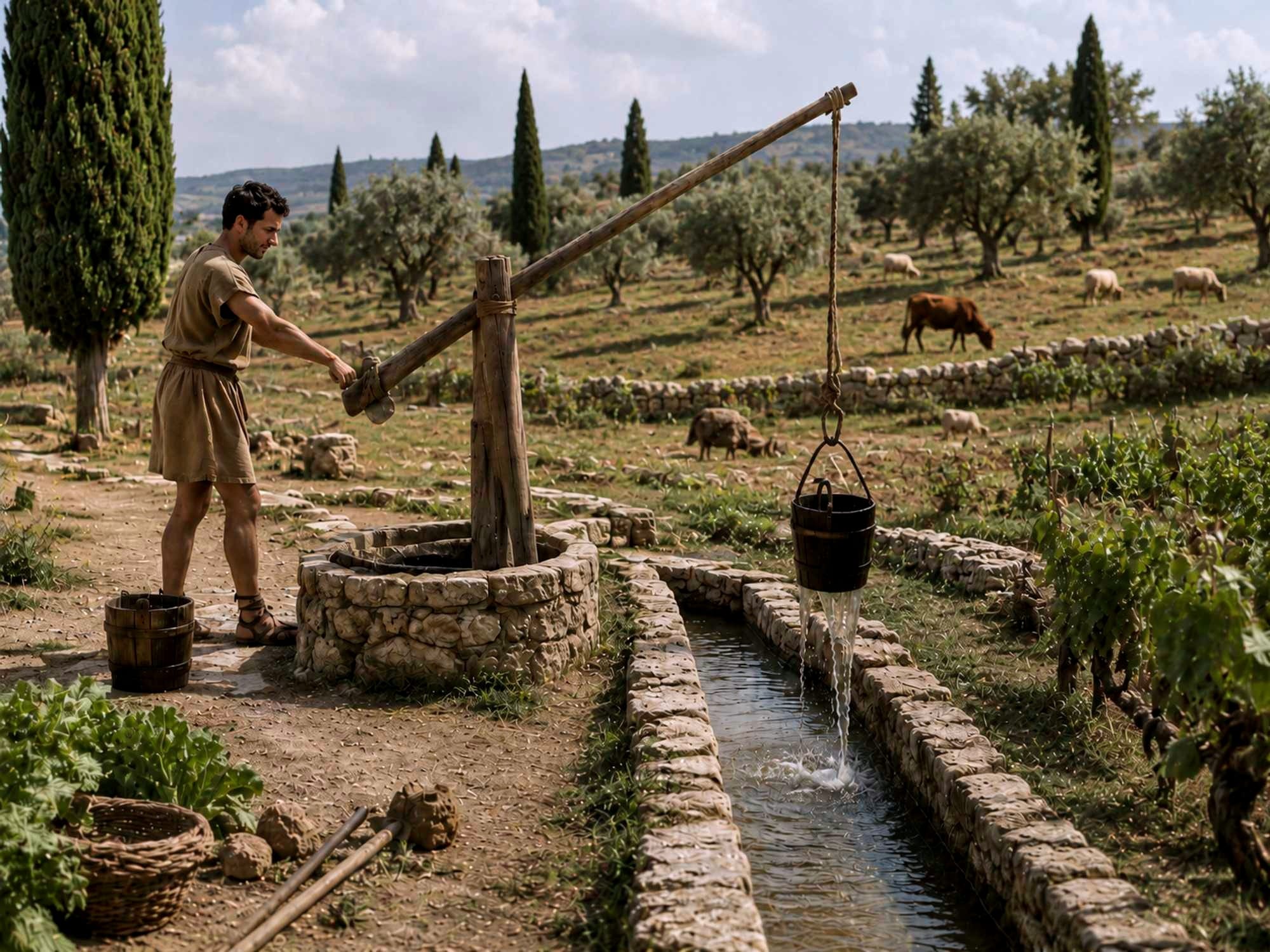
The Hellenistic period brought a new generation of rotary water-lifting machines. Compartmented wheels, rim wheels, bucket chains, the saqiya, and the noria all allowed more continuous operation. Some were powered by human tread, others by animals through gearing, and some by water itself. These machines spread widely, above all in Egypt but also across much of the Roman world, including Italy, North Africa, Britain, and probably Spain.
Design changes helped broaden their use. Wooden buckets could be replaced by terracotta pots, making some devices cheaper and better suited to regions where wood was scarce. State policy may also have played a role. In late Roman Egypt, tax relief on irrigated land may have encouraged investment in irrigation machinery.
Two especially famous devices were the water-lifting screw and the force pump. The screw, traditionally linked to Archimedes, could raise large volumes of water through a limited height and was important in irrigation and mine drainage. The force pump, associated with Ctesibius, was much more complex.
In bronze form it used paired pistons and one-way valves to force water upward through a delivery pipe. It was used in firefighting, public display, and perhaps mine work. In the first century A.D., it was redesigned in wood, making it cheaper and more common on farms and villas, where it served chiefly to draw water from wells.
The chain pump, especially suited to ships, used disks attached to a chain or rope moving through a tube to lift bilge water. It handled silty water well and functioned even in unstable conditions at sea. These devices made possible more ambitious irrigation, more effective drainage, and better control over water in agriculture, shipping, mining, and urban life.
Mills and the Expansion of Water Power
The rotary hand quern was an early improvement in grinding technology. The animal mill expanded that principle by harnessing traction. But the water-mill was the real breakthrough. By using flowing water to automate rotary motion, it became one of the earliest successful applications of natural power to regular productive labor.
Current evidence suggests that both vertical and horizontal water-mills were invented in the mid-third century B.C. By the first century A.D., water-mills were widespread across the Roman world, and by the late second century several vertical-wheel types were in use. Vertical mills required right-angled gearing to transfer motion from the wheel axle to the millstone spindle. Horizontal mills avoided this by directing water straight onto a horizontal wheel attached directly to the spindle. This made them particularly useful where water flow was small or slow.
Some of the earliest surviving horizontal mills already show sophisticated turbine-like designs, suggesting a long prior history of experimentation. Whatever the type, ancient millstones required careful adjustment, and engineers developed mechanisms to regulate the gap between the stones and control the fineness of the flour.
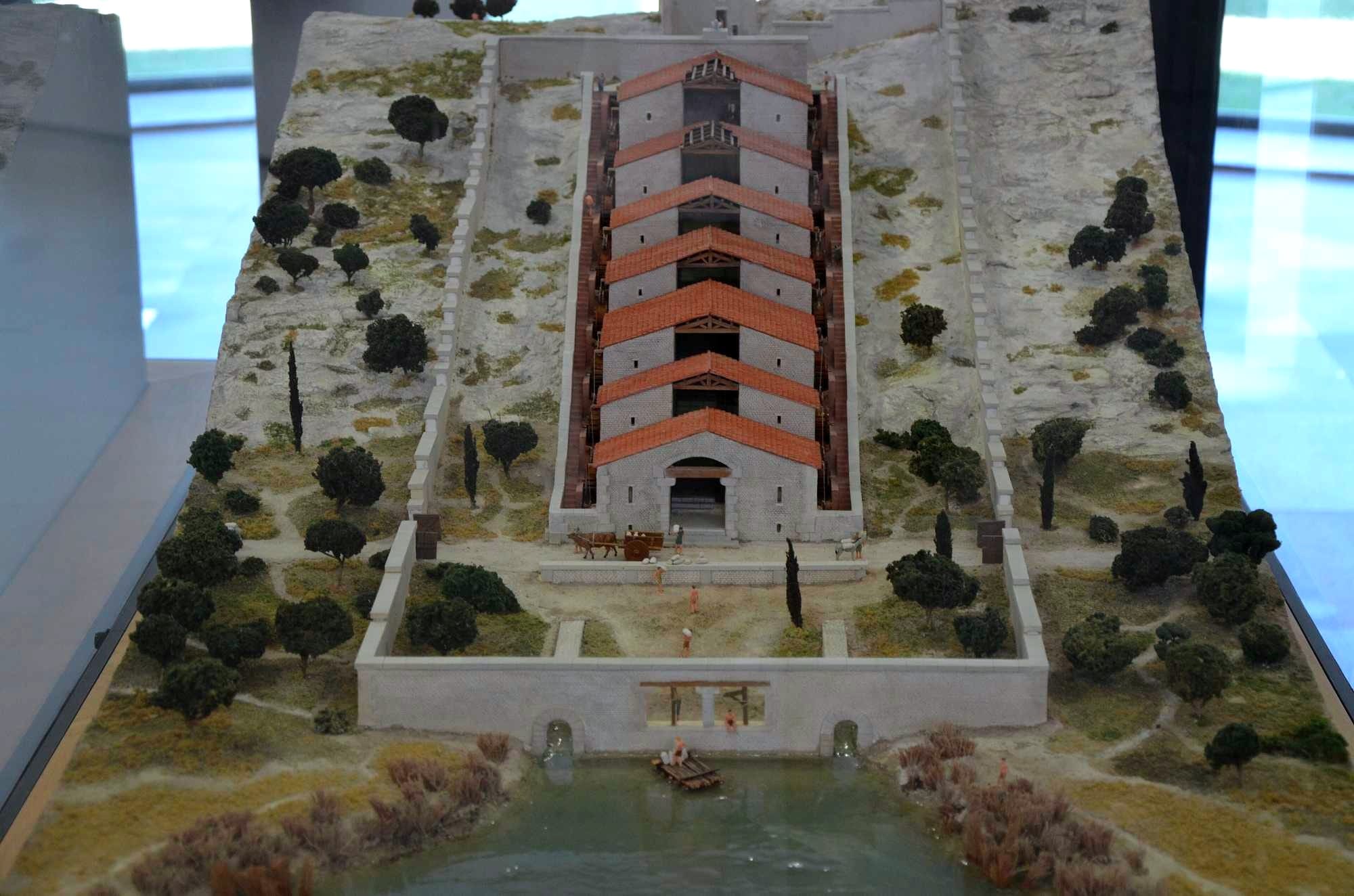
The surviving evidence for mills usually comes not from the machines themselves but from their channels, wheel-pits, and structural remains. In some regions, especially north of the Alps, timber engineering played a larger role than once assumed. The floating mill, mounted on a boat so that the wheel rose and fell with river level, was another ingenious response to local conditions. Whether or not the later tradition connecting it to Belisarius is exact, the design clearly spread in late antiquity.
Milling was not a marginal use of machinery. It was one of the clearest demonstrations that the Greco-Roman world could apply sustained outside power to a basic and necessary form of production.
Machines Beyond the Mill
Water power was also used for much more than grinding grain. It could be applied to sawmills, pestles, ore stamps, fulling, bellows, and dough-mixing. A relief from Pammukale in Turkey is especially important because it shows a water-powered stone saw using a crank and connecting rod to transform rotary motion into reciprocal motion. That is a major piece of evidence for advanced mechanical conversion.
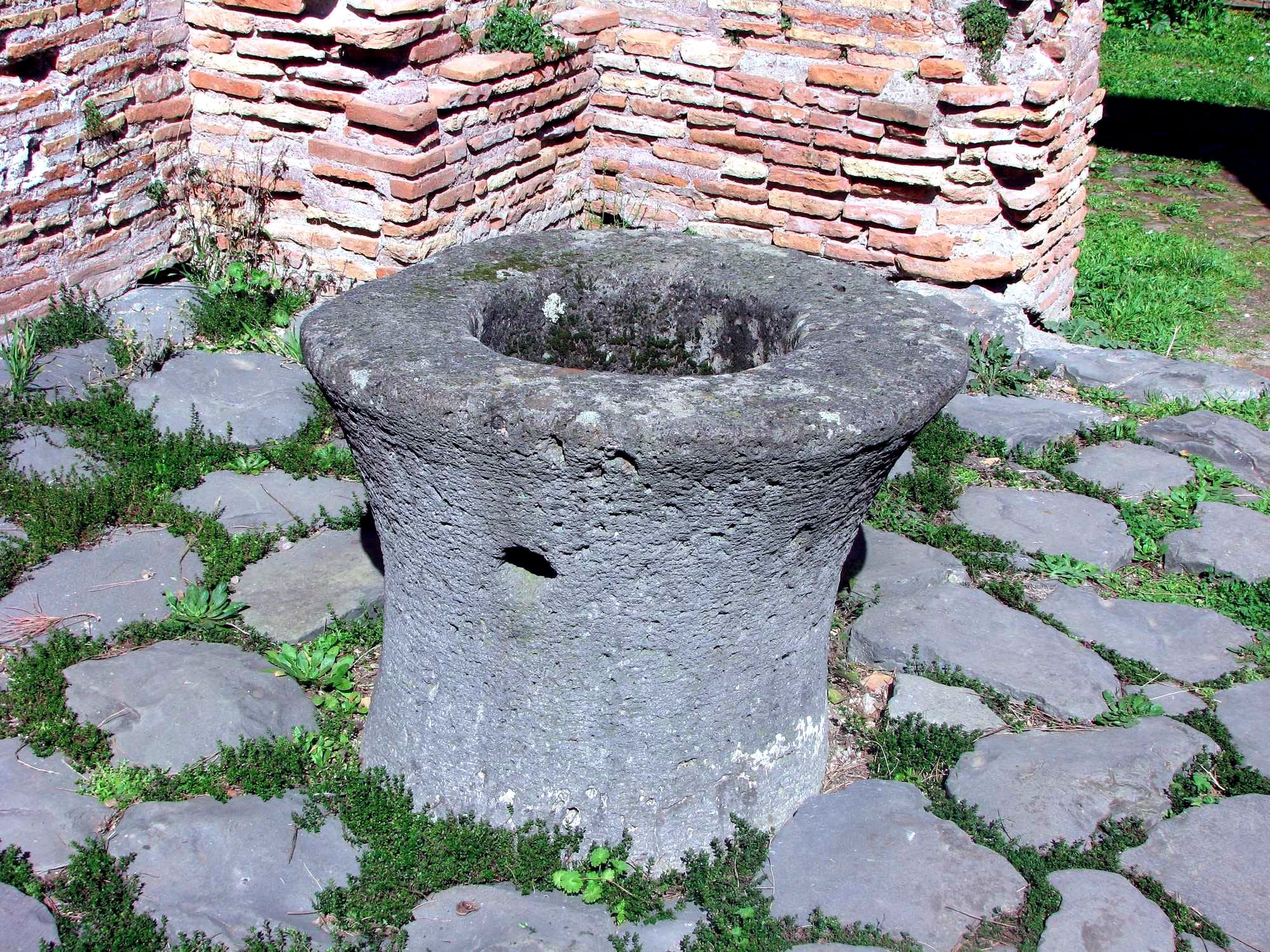
Roman dough-kneaders are another revealing example. These consisted of a cylindrical tub with a rotating spindle carrying paddles that worked dough against fixed rods in the side. The spindle could be turned by a person or an animal, and Vitruvius also refers to water-powered dough mixing. These machines show that the same basic principles used in mills could be adapted to other forms of food production.
Measuring, Pressing, and Performing
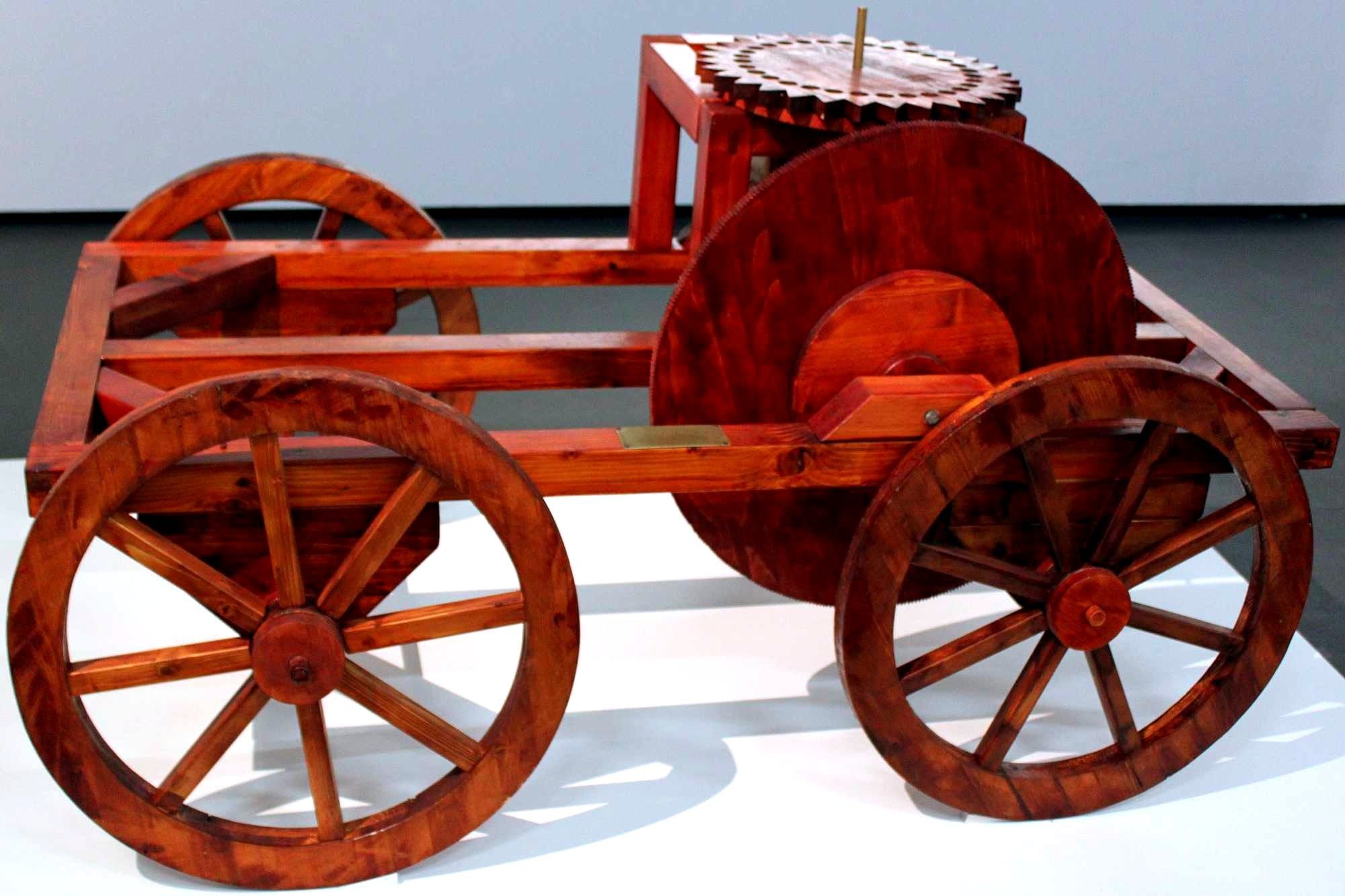
The Greco-Roman machine was not limited to labor and war. It also entered measurement, agriculture, music, and entertainment. The hodometer, described by Vitruvius and Hero, used gears connected to a wagon axle so that a stone dropped into a container after a fixed distance. A similar principle was applied to ships through a paddle wheel moving in the water. Whether or not these were used in practice on a large scale, they show a striking effort to turn motion into measured quantity.
Presses for oil and wine were another major category. The earliest forms used weighted lever beams. Later versions introduced windlasses, screws, and wedges to increase pressure or reduce space requirements. The direct screw press was especially compact and useful in urban settings. The wedge press seems to have been particularly important to perfume makers, who needed fine-quality oil.
Mechanics also shaped public entertainment. The hydraulis, the earliest known keyboard instrument, used water pressure to maintain a steady air supply to organ pipes controlled by keys. More elaborate devices automated musical performance. Theaters used cranes and winches to produce the famous deus ex machina effect.
Circuses used mechanisms to release starting gates simultaneously, probably with spring-like force derived from twisted rope or sinew. Amphitheaters used lifts to bring animals and scenery suddenly into the arena. Even the revolving platforms found on Caligula’s barges suggest a taste for engineered spectacle and controlled motion in elite display.
Machines and the Ancient Economy
For a long time, ancient machines were underestimated. Older views claimed that slavery made mechanical innovation unnecessary, or that religious attitudes discouraged the exploitation of natural power. Those arguments have become difficult to sustain. Mechanical devices were not marginal curiosities, and automata were not merely toys. They helped develop and demonstrate important principles such as feedback control, programmed sequence, and self-propelled motion.
Royal patronage mattered enormously. Syracuse under Dionysius and Alexandria under the Ptolemies were especially important settings for invention. In the Roman world, too, there was at least an expectation that emperors might reward useful ingenuity.
How widespread were machines? For some categories, the answer is clear. Cranes became common across the Greek, Hellenistic, and Roman worlds. Oil and wine presses were abundant. Water-mills and millstones appear in substantial numbers. In some fields, ancient machine use may have been more widespread than in western Europe for many centuries afterward.
Greek and Roman societies did not merely preserve a few simple devices inherited from the ancient Near East. They developed complex machines, adapted them to different uses, and spread them geographically and socially, sometimes by redesigning them in cheaper materials.
That has important consequences for how ancient technology is understood. The old contrast between supposedly stagnant antiquity and a dynamic medieval world now looks too simple. In some areas, such as artillery and pressing, Roman machine use may even have surpassed that of the early Middle Ages.
In others, such as the diversification of water power, the gap is much smaller than once imagined. The machine was not marginal to Greco-Roman civilization. It belonged to a larger world of work, experiment, production, measurement, medicine, and spectacle.
What emerges from this mechanical landscape is not a stagnant world content with inherited tools, but one that understood how to combine force, motion, and design with remarkable intelligence. Greek and Roman engineers did not invent machinery in a single burst, nor did they apply it everywhere equally.
But across centuries they developed, refined, and spread a wide range of devices that made labor more efficient, extended the reach of human effort, and opened new possibilities in war, agriculture, construction, and production. The ancient machine was never peripheral to civilization. It was one of the instruments through which civilization worked. (“Machines in Greek and Roman technology” by Andrew I. Wilson. In The Oxford Handbook of Engineering and Technology in the Classical World)

About the Roman Empire Times
See all the latest news for the Roman Empire, ancient Roman historical facts, anecdotes from Roman Times and stories from the Empire at romanempiretimes.com. Contact our newsroom to report an update or send your story, photos and videos. Follow RET on Google News, Flipboard and subscribe here to our daily email.
Follow the Roman Empire Times on social media: