
Claudian: The Last Great Poet of the Western Roman Court
Claudian turned late Roman politics into poetry, shaping a world of heroes, monsters, fragile power, and Rome’s last western court.

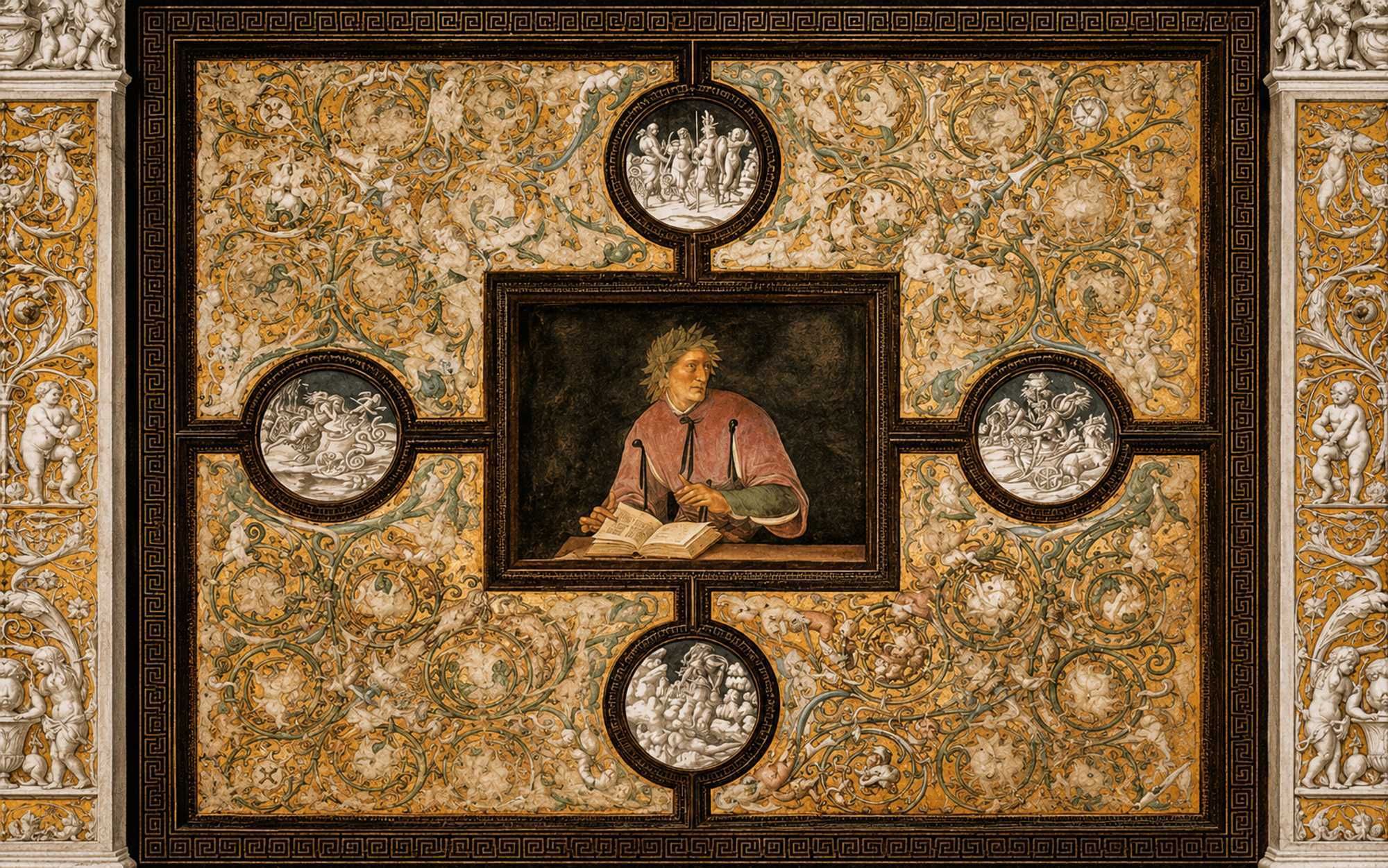
In the final years of the fourth century, when the Western Roman court still spoke the language of empire but already felt the pressure of crisis, Claudian gave Rome one of its last great poetic voices. He was not simply a flatterer of power or a convenient source for historians. He was a poet who turned the politics of his age into mythic drama, filling the world of Honorius and the western court with heroes, monsters, cosmic order, and the fear that Rome’s ancient harmony might not hold forever.
An Alexandrian Poet in Latin Rome
Claudius Claudianus, known simply as Claudian, stands near the end of one of Rome’s longest literary traditions: the use of poetry to praise power, shape public memory, and turn political events into something larger than ordinary history. He wrote in the years around A.D. 395 to 404, when the Western Roman Empire still possessed emperors, courts, ceremonies, aristocrats, armies, and the immense prestige of Roman tradition, but was already living under pressure.
Very little is known about Claudian’s early life, but the evidence points strongly to Alexandria in Egypt as his place of origin. That alone makes his career remarkable. Alexandria belonged to the Greek-speaking intellectual world, yet Claudian became one of the most accomplished Latin poets of late antiquity.
His success reveals a late Roman culture in which elite education could still move across languages, regions, and traditions. If he was indeed Alexandrian, then his poetry shows how deeply the Latin literary canon could be mastered outside the old Latin-speaking heartlands of the West.
He seems to have arrived in Rome shortly before 395. His earliest major Latin poem for a Roman audience celebrated the consulship of the brothers Probinus and Olybrius, members of the great Anician family. From there, he moved into the world of the western court, where his poetry became attached to the political needs, ceremonies, fears, and ambitions of the age of Honorius.
Claudian was honoured in his own lifetime with unusual distinction. A statue was erected for him in the Forum of Trajan, and its inscription praised him not as a mere court servant, but as a poet of exceptional glory. The Greek couplet on the monument offered one of the highest compliments possible in the ancient literary world:
“In one man, the mind of Virgil and the Muse of Homer.”
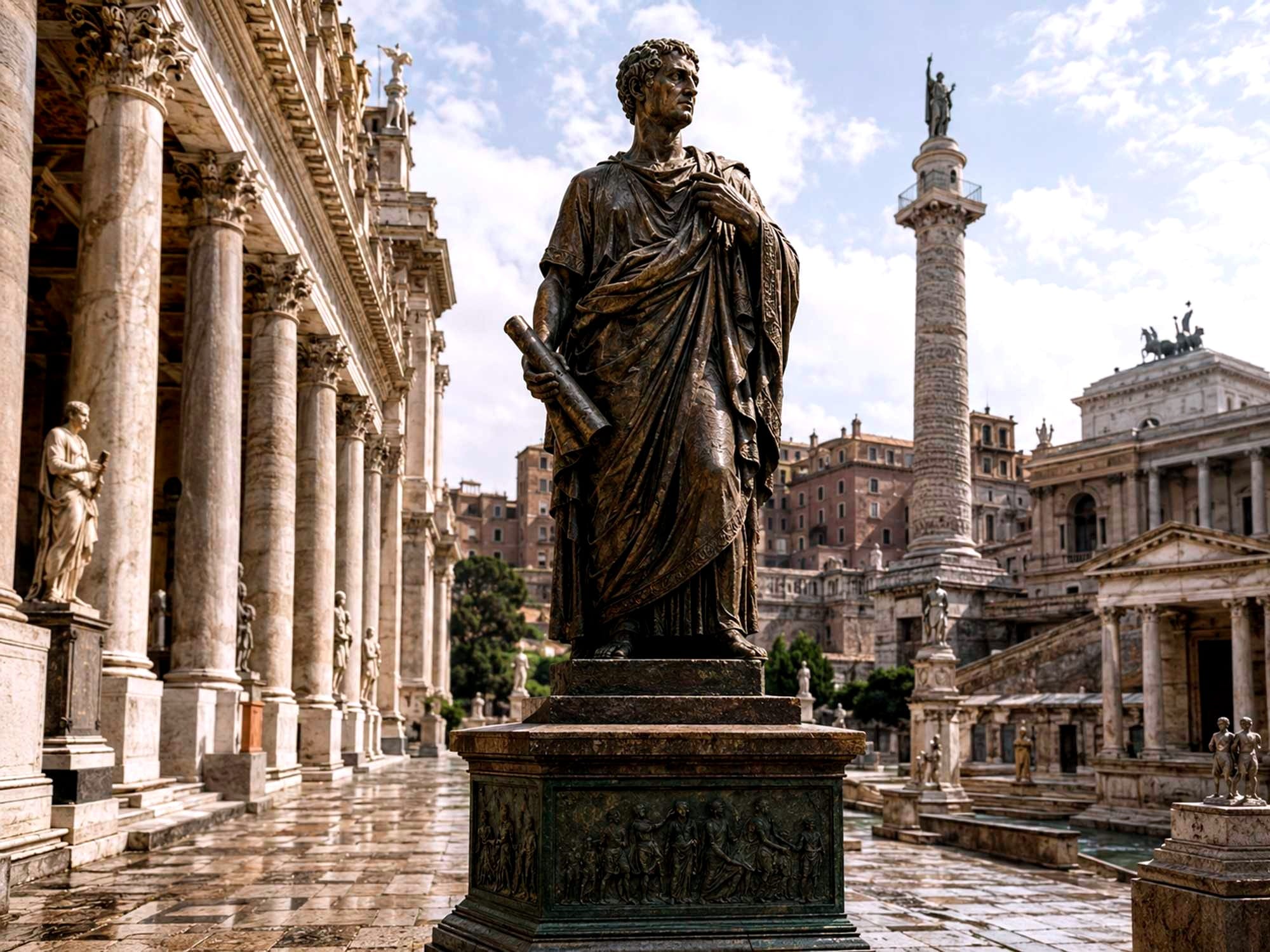
The praise is extraordinary, and it explains how Claudian could be remembered by those who celebrated him. He was not only a political voice. He was a poet whose art mattered in itself. To read him only as a source for the age of Stilicho, Honorius, Alaric, Rufinus, and Eutropius is to miss much of what makes him important. His poetry does not simply record late Roman politics. It reimagines politics through myth, spectacle, symbolism, and performance.
Poetry as Performance and Power
Claudian wrote for occasions. His major poems celebrated consulships, marriages, victories, and political enemies brought low. Some praised emperors or powerful patrons. Others attacked rivals. Their settings were ceremonial and elite. They were written for audiences trained in the classical tradition, people who could recognize the weight of Virgil, Homer, Ovid, mythological comparison, epic language, and rhetorical display.
Claudian’s poetry works through recognition. His audience did not need simple explanations. They could hear a mythological image and understand its political force. A reference to Achilles, Bacchus, Python, the Giants, Mars, Venus, or the underworld was never just decorative. It carried cultural memory with it. Claudian could use that memory to make contemporary politics feel ancient, cosmic, and inevitable.
His style belongs fully to late antiquity. It is visual, ornate, elaborate, rich in set scenes, descriptions, speeches, and shimmering images. Older criticism sometimes treated this style as excessive, as if Claudian’s poetry lost narrative force because it loved description too much. But his descriptions are not empty ornaments. They are the way the poem thinks. They gather symbols until the political message becomes visible.
A robe, a cave, a garden, a monster, a procession, a god, a piece of armour, or a mythical comparison can carry the meaning of the whole poem. Claudian builds through accumulation. The poem’s power does not always lie in a straightforward plot. It lies in the way images repeat, echo, and bind together into a world.
That world is the key to his poetry.
A Story-World of Order and Chaos
Claudian’s political poetry creates a story-world where Rome is more than a state. It becomes the centre of a moral and cosmic order. The universe should be harmonious. Its elements should remain in their proper places. Boundaries should hold. Gods, cities, emperors, soldiers, and seasons all belong to a larger structure of meaning.
But that structure is always under threat. Chaos presses against its borders. Evil figures break boundaries. Monsters emerge. Giants rise. Underworld forces move upward. Barbarian enemies become something more than human opponents. Court rivals become figures of corruption and disorder. In Claudian’s imagination, political danger is translated into cosmic disturbance.
This is one reason his poetry could be so persuasive in performance. The late western court did not merely face administrative problems. It faced fear: fear of barbarian invasion, court betrayal, eastern rivalry, weak authority, and the possibility that Roman order itself might fail. Claudian gave those fears a mythological shape. He turned anxiety into poetry.
The result is not fiction in the simple sense. It is a poetic version of reality. Real people and events remain visible, but they are lifted into a symbolic universe. A minister is not just a minister. A general is not just a general. A barbarian leader is not just a military opponent. Each becomes a figure in a drama about whether the world will remain ordered or fall into chaos.
This is why Claudian’s mythological imagination is so important. It is not a retreat from politics. It is politics intensified.
The Cave of Time and the Poetry of Eternity
One of Claudian’s most striking qualities is his ability to create symbolic spaces. These are not merely beautiful passages inserted into political poems. They give the poems a deeper structure.

The Cave of Time is one of the clearest examples. In Claudian’s poetic universe, time itself becomes a place, mysterious and ancient. The cave is described as a kind of mother of the years, one that sends time out and calls it back again:
“who provides and calls back the times from her immense breast.”
The image is strange and powerful. Time is not an abstract concept. It becomes a living, cavernous, maternal force. Around the cave, Claudian imagines a serpent encircling it, its tail bent back into its mouth:
“A snake encircles the cave,
which consumes everything with calm authority,
and shines eternal green from its scales, and devours its tail
bent back to its mouth, with silent gliding retracing its beginnings.”
This is the ouroboros, the serpent of eternity and return. Claudian uses it to make time feel cyclic, sacred, and endless. Such imagery gives political celebration a cosmic scale. A consulship is no longer just an office held for a year. It becomes a chosen moment within the great movement of time.
This is how Claudian’s poetry works. It takes the temporary and makes it feel eternal. A ceremony becomes part of cosmic order. A political claim becomes woven into the structure of the universe.
Heroes, Monsters, and Giants
Claudian’s universe needs figures who either preserve order or threaten it. His enemies often appear as monsters. His heroes appear as those who restore harmony. This opposition is one of the strongest patterns in his political poetry.
In the invectives against Rufinus and Eutropius, political rivalry is transformed into moral and mythic drama. These men are not treated simply as officials or opponents. They are associated with disorder, corruption, inversion, and boundary-breaking. Rufinus, especially, is given the force of a monster.
The imagery around him evokes Python, the serpent destroyed by Apollo, as well as the Furies and the underworld. His fall can therefore be imagined not merely as a political death, but as the removal of something unnatural from the world.
The barbarian threat is often shaped through the image of giants. This draws on the myth of the Gigantomachy, the war in which the Giants challenged the gods. In Claudian’s hands, the image becomes politically charged. The barbarian enemy is not only dangerous because he attacks Roman territory. He is dangerous because he threatens the order of the universe.
This is why the giant matters. A giant is excessive. He crosses limits. He belongs to an older, violent, unstable world. He is both familiar and alien, recognizably human in shape but monstrous in scale and nature. Such a figure is ideal for Claudian’s treatment of the enemy. It allows him to magnify political danger while connecting that danger to myths his audience already understood.
This does not mean Claudian simply invents fear. He works with anxieties his audience already possessed. Barbarian armies, divided courts, and insecure frontiers were real concerns. Claudian turns them into visible shapes. The monster gives fear a body. The hero gives hope a body too.
The Hero Who Holds the World Together
Claudian’s poetry often moves between danger and restoration. Monsters, giants, corrupt ministers, and barbarian enemies threaten the order of the Roman world; heroic figures are made to restore that order. In the political poems, Stilicho often fills this role.
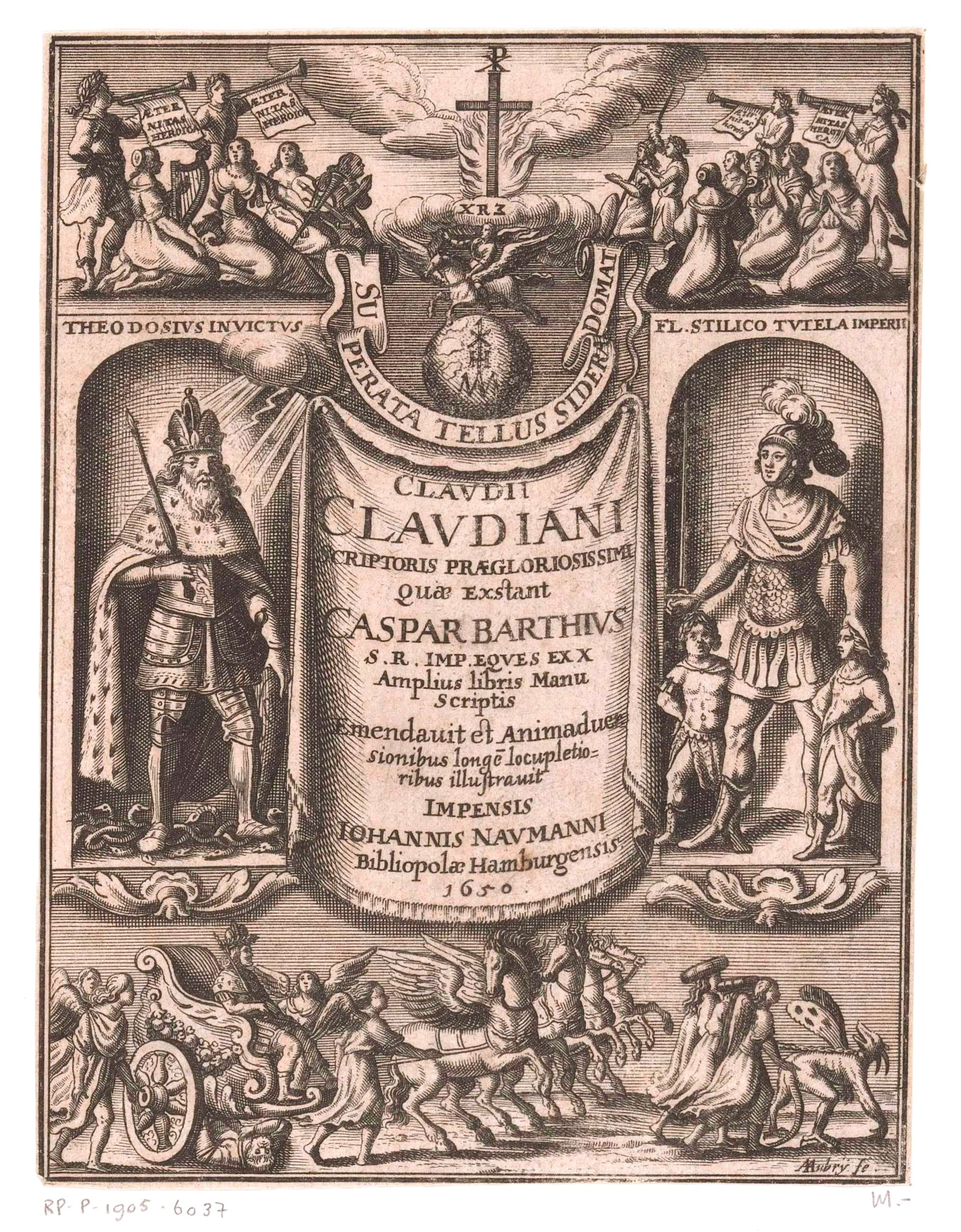
Claudian presents him not simply as a general, but as the figure who calms disorder, protects boundaries, and allows Roman harmony to return. The result is not biography in verse, but a poetic image of power: Rome survives because someone is still able to steer it through danger.
He is not simply praised as brave. He is made into the one who restores boundaries, calms disorder, and permits harmony to return. Claudian’s language often draws him into heroic and divine associations, but carefully. He is not made emperor. He is made protector, guide, helmsman, and restorer.
One of the most revealing images compares him to Tiphys, the helmsman of the Argo. The comparison matters because Tiphys is not the king of the Argonauts. He is the man who knows how to steer. In Claudian’s poetic world, the empire becomes like a ship passing through danger, and the hero is the one with the skill to guide it through.
This is more subtle than simple flattery. It allows Claudian to present power as service. The hero is not a usurper. He is the necessary pilot. Through this kind of imagery, Claudian can defend the political arrangement of the western court without saying it bluntly.
He also uses images of renewal. The phoenix, paradise, gold, light, peace, and the Golden Age all appear as part of the language of restored order. The hero does not merely defeat enemies. He makes the world fertile again. War leads back to ceremony. The sword makes possible the robe. The battlefield makes possible the city.
This is Claudian’s political imagination at its richest. He turns the work of power into the restoration of beauty.
Honorius and the Problem of Youth
Claudian’s treatment of Honorius is one of the most delicate parts of his poetry. Honorius had to be praised. He was the legitimate emperor, the son of Theodosius, and the centre of western imperial ceremony. Yet the political reality of the court required something more complex. Honorius was young. He could be celebrated as emperor, but not presented as fully independent.
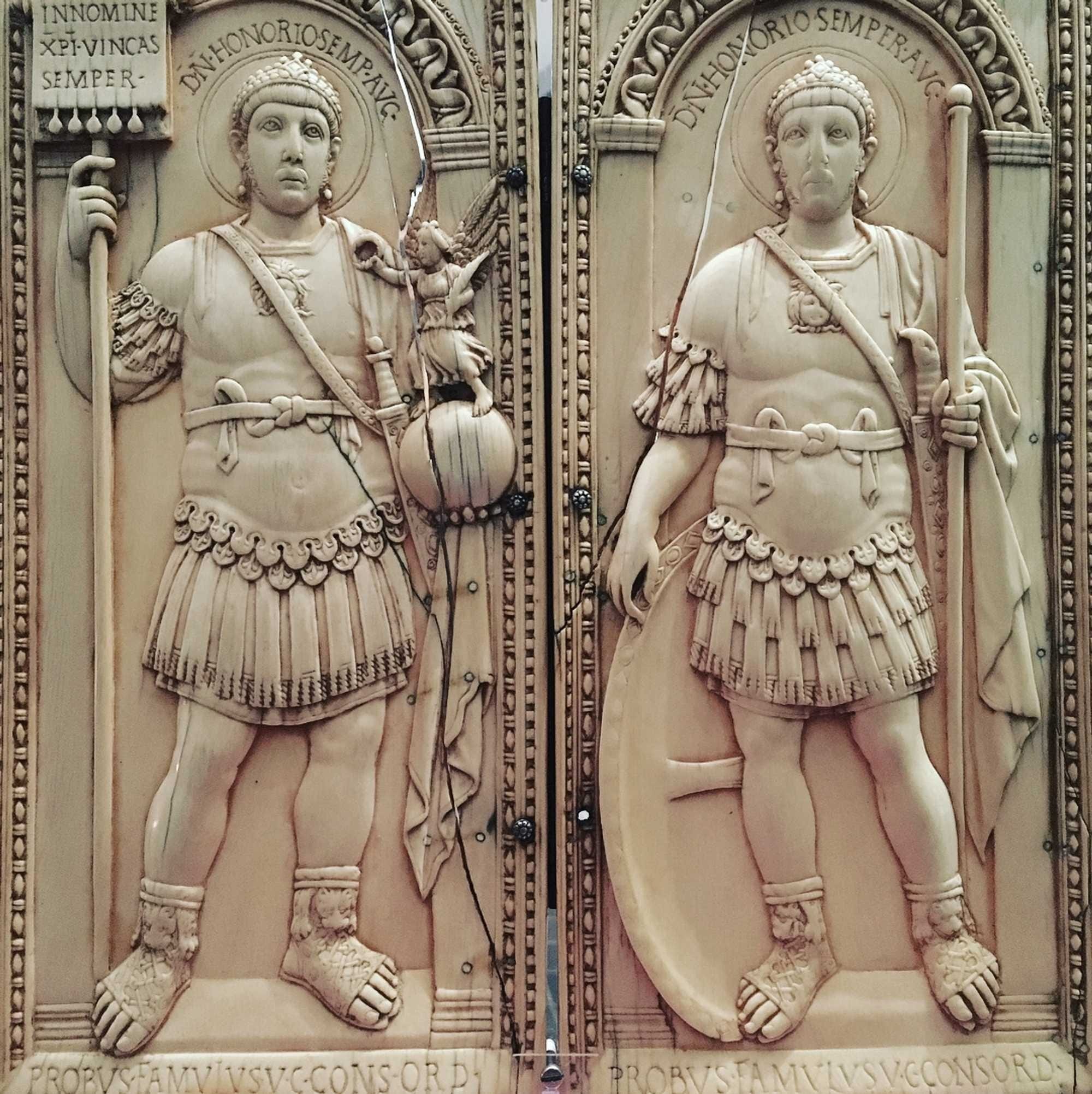
Claudian solves this through myth. Honorius appears splendid, radiant, and promising, but often as a figure not yet fully complete. He is compared with youthful divine or heroic figures whose greatness is still emerging. The result is praise that also explains dependence.
In the poem for Honorius’ fourth consulship, the young emperor is associated with Bacchus. The image is flattering, full of ceremony and magnificence. But there is a quiet contrast. Bacchus can drive his own chariot; Honorius is carried. Claudian’s phrase
“sidereum gestaret onus” – “they carried their heavenly burden”
– captures the tension perfectly. Honorius is heavenly, but he is still borne by others.
The wedding poems also use a delicate mythological language. Honorius can be linked with Achilles, but not the mature Achilles of Troy. The image points toward the young Achilles on Scyros, before the full revelation of his heroic identity. This is playful and suitable for a marriage poem, but it also preserves a political message. The emperor has promise. He has splendour. He has legitimacy. But he is not yet the figure who acts alone.
This is not an attack on Honorius. It is controlled praise. Claudian honours the emperor while leaving space for another guiding figure in the political world of the poem. His skill lies in making that arrangement seem natural.
The Poet Who Shows the Veil
Claudian is especially fascinating because he does not pretend that his poetry is plain truth. He repeatedly presents himself as a poet, performer, singer, and maker of poetic illusion. His prefaces often draw attention to the act of performance itself.
In the preface to the poem for Honorius’ sixth consulship, Claudian imagines himself in a dream, standing in the starry height of heaven and bringing his songs before Jupiter:
“For I seemed to be at the central height of the starry sky,
bringing my songs before the feet of highest Jupiter;
as sleep favours us, the gods applauded my words
and the sacred circle gathered around.”
The scene is a heavenly version of his earthly performance. The gods become the audience. The poet is not merely reporting events; he is staging his own poetic authority. Then the boundary between dream, performance, and reality begins to blur.
This is part of Claudian’s power. His audience knew they were hearing poetry. They knew panegyric could flatter and distort. Claudian does not hide this completely. Instead, he uses that awareness. He lets the audience see the veil, then draws them through it.
The result is a kind of double effect. The audience enjoys the artistry while absorbing the political vision. They recognize the myth, the exaggeration, the performance, and the literary craft. Yet the poem still shapes how events feel. It makes one version of the world memorable.
Claudian’s artifice is therefore not a weakness. It is the mechanism of persuasion.
The Last Vision of Rome in Verse
Claudian probably died around A.D. 404. He did not live to see the execution of Stilicho in 408 or the sack of Rome by Alaric in 410. That makes his poetry feel suspended at a dramatic moment in Roman history. He wrote while the western court could still imagine itself defended, ceremonial, legitimate, and capable of renewal. The disaster that later came had not yet fully arrived, but the anxiety behind it was already present.
His poems are filled with splendour: gods, giants, robes, processions, gardens, caves, golden years, serpents, heroes, and monsters. Yet behind that splendour stands a tense political world. The empire was divided. The young emperor needed guidance. Court rivals competed for influence. Barbarians pressed against Roman order. The old language of Roman greatness still existed, but it had to work harder than ever.
Claudian’s achievement was to make that language shine again. He did not simply imitate the classical past. He used it for a late Roman present. He took myth, epic, panegyric, invective, and ceremonial performance and fused them into a poetry capable of speaking to crisis.
For historians, he remains indispensable but dangerous. His poetry preserves precious evidence for the age of Honorius and the western court, but it also reshapes that age according to poetic design. To read him only for facts is to miss the artistry. To read him only as art is to miss the politics.
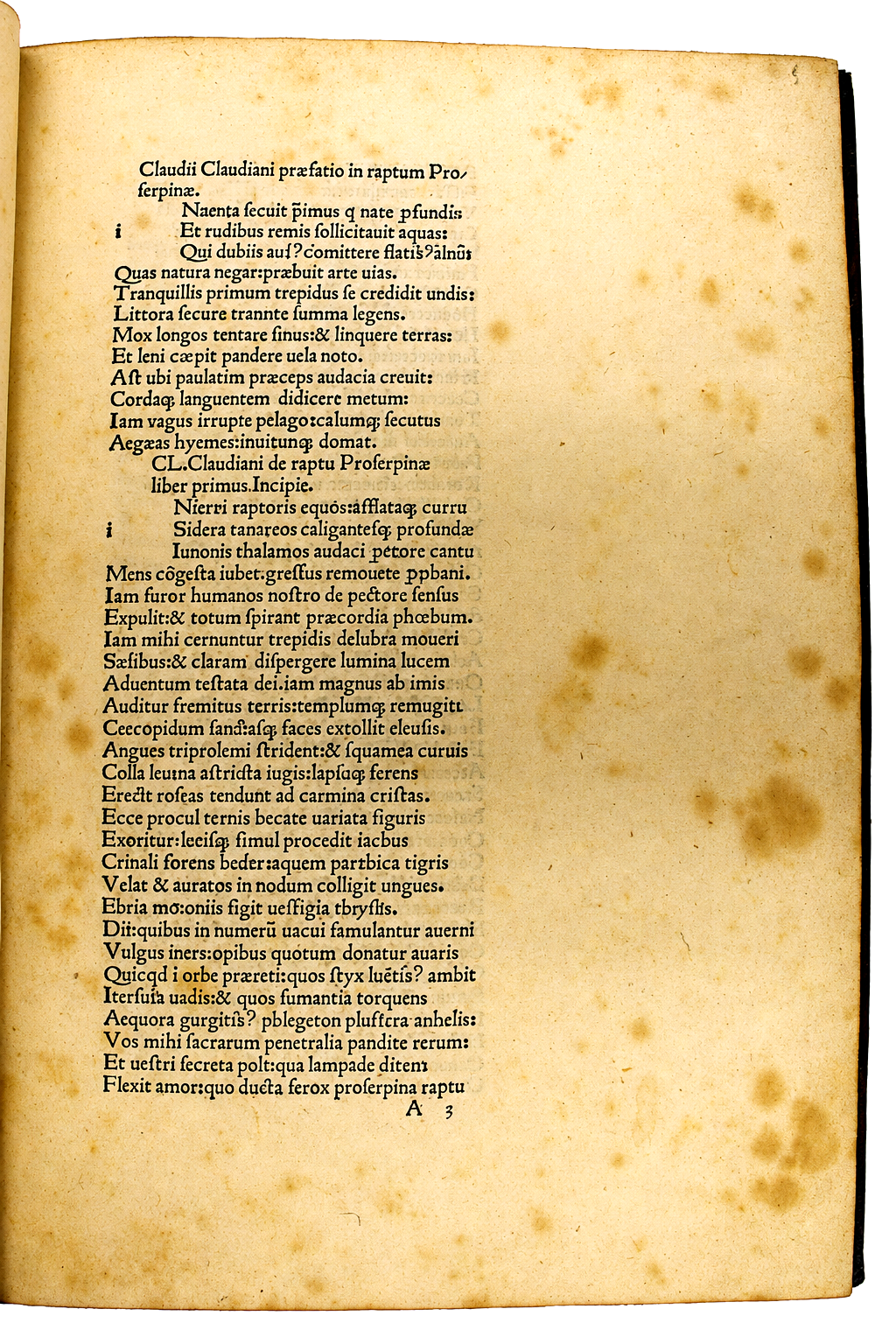
Claudian was not the final Latin poet, but he was one of the last great poets of the Western Roman court. He wrote at the edge of a world that still believed Rome could be imagined as eternal. In his verse, political enemies became monsters, imperial ceremonies became cosmic moments, and poetry itself became one of the last grand instruments through which the western empire could see itself as ordered, defended, and still magnificent. (“Claudian The Poet” by Clare Coombe)
About the Roman Empire Times
See all the latest news for the Roman Empire, ancient Roman historical facts, anecdotes from Roman Times and stories from the Empire at romanempiretimes.com. Contact our newsroom to report an update or send your story, photos and videos. Follow RET on Google News, Flipboard and subscribe here to our daily email.
Follow the Roman Empire Times on social media: