
Gaius Verres: The Roman Governor Accused of Plundering Sicily
Stolen masterpieces, corrupt officials and a passion for art that allegedly cost him his life. Gaius Verres plundered Sicily for three years before facing Cicero in one of the most extraordinary trials of the Roman Republic.

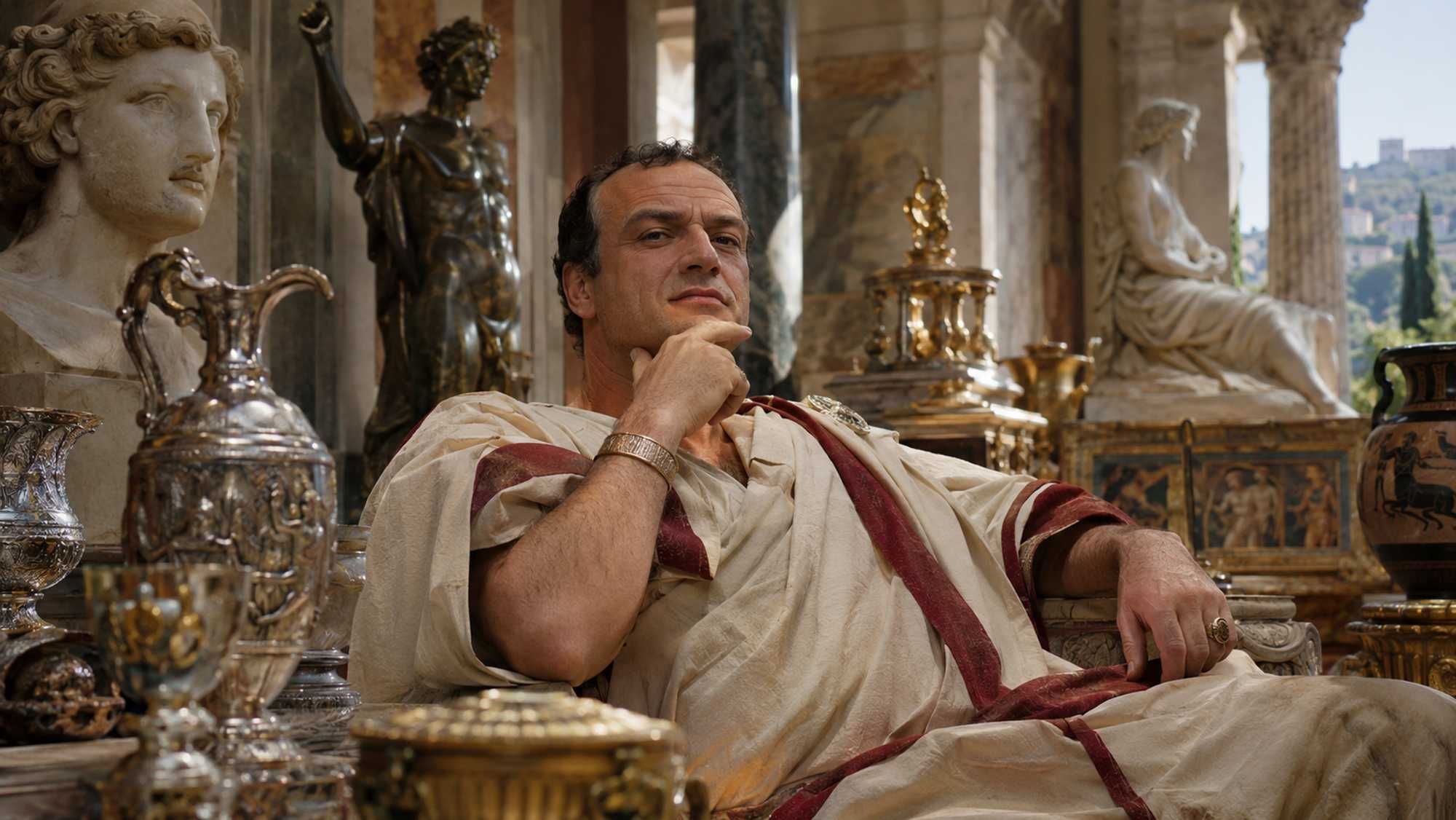
At the end of his three-year governorship of Sicily, Gaius Verres returned to Italy with a considerable collection of Greek artworks. Statues, paintings, precious metalwork, engraved gemstones and luxurious textiles had passed into his possession during his public career, many of them allegedly acquired through intimidation, extortion and the abuse of his authority.
The Sicilians, however, were unwilling to forget what had happened. Representatives of their communities travelled to Rome and entrusted their case to Marcus Tullius Cicero, setting in motion one of the most celebrated corruption trials of the Roman Republic.
The accusations extended far beyond the theft of beautiful objects. Verres was charged with manipulating judicial decisions, exploiting farmers, interfering in public appointments and ordering the execution of men whose rights he was supposed to protect. His passion for collecting art would become inseparable from his reputation as a provincial governor and, according to an ancient tradition, would eventually contribute to his death.
A Political Career Built on Betrayal
Little is known about the childhood of Gaius Verres. His father was a senator, and the family enjoyed connections with influential members of the Roman aristocracy, including the Metelli. Verres married Vettia, the sister of a Roman knight, and had a son and a daughter.
His political career began during one of the most turbulent periods of the Republic. As quaestor under Gnaeus Papirius Carbo, he was entrusted with public funds intended for military expenditure. When the fortunes of the Marian faction declined and Sulla gained the advantage, Verres abandoned Carbo and transferred his allegiance to the opposing side.
Cicero later accused him of appropriating 600,000 sesterces from the money entrusted to him. Verres had recorded that the sum had been left at Ariminum, without providing a satisfactory account of who had received it. Under Sulla, he also benefited from the confiscated estates of proscribed citizens near Beneventum.
In 80 BC, Verres became a legate under Gnaeus Cornelius Dolabella, governor of Cilicia. His journey through Greece and Asia Minor offered opportunities to acquire objects from some of the most celebrated sanctuaries of the Greek world.
At Delos, Cicero alleged, ancient statues were removed from the sanctuary of Apollo and placed aboard Verres' ship. A violent storm subsequently wrecked the vessel, washing the statues ashore. Dolabella ordered their restoration to the sanctuary.
Other communities were less fortunate. Paintings and statues were reportedly taken from the sanctuary of Hera on Samos, while the people of Tenedos lost an image of Tenes, their patron deity. Cicero claimed to have seen some of the treasures taken from Samos decorating Verres' house in Rome years later.
A Banquet That Ended in Tragedy
One of the most disturbing incidents of Verres' service under Dolabella occurred at Lampsacus, a Greek city on the Hellespont. According to Cicero, Verres learned that a prominent local citizen named Philodamus had an exceptionally beautiful unmarried daughter.
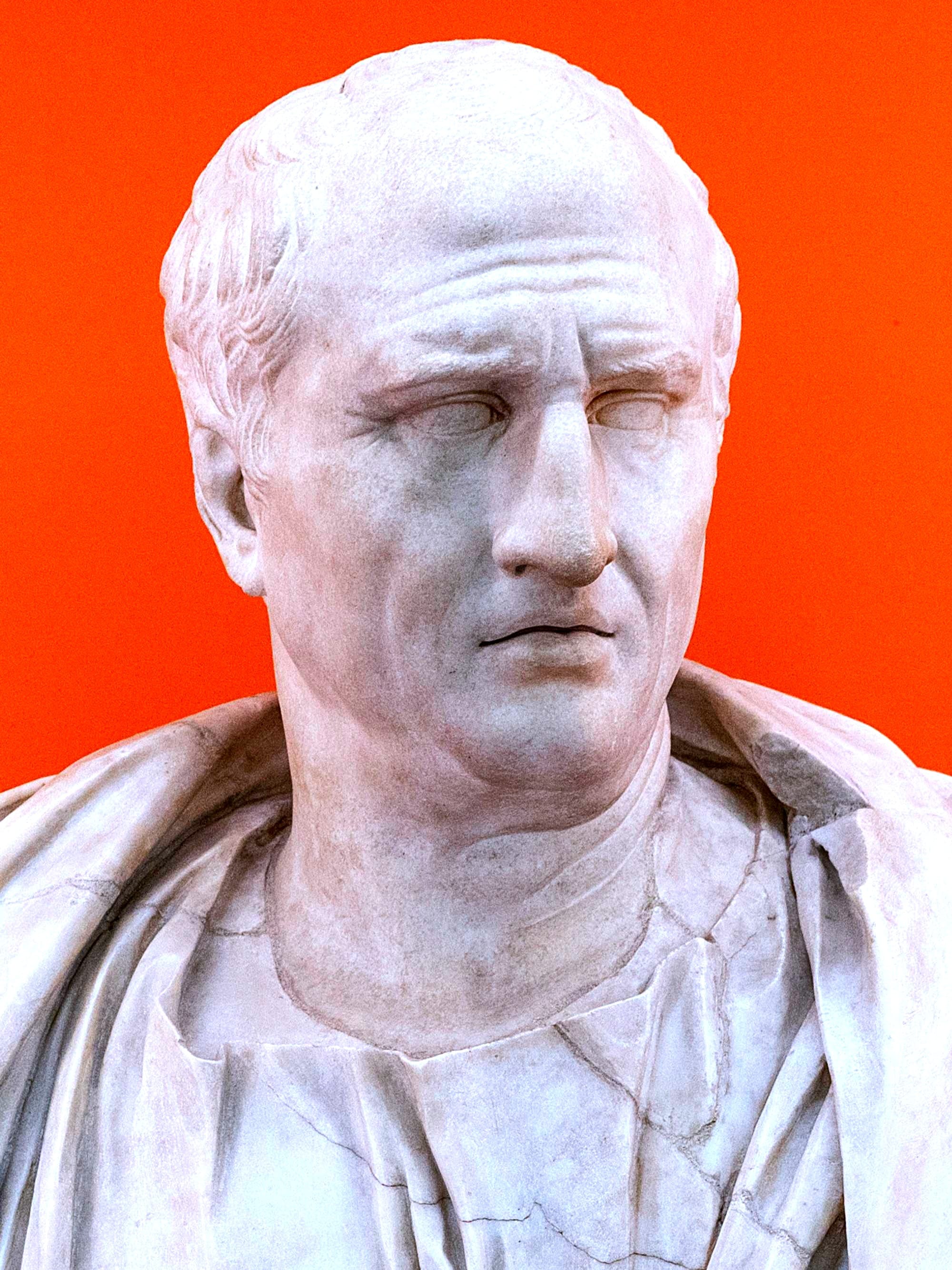
Verres was staying at the house of another citizen and arranged for one of his associates, Rubrius, to take up accommodation in the house of Philodamus. The latter initially objected but eventually accepted his guest and prepared a banquet in his honour. Rubrius invited several members of Verres' entourage, while the son of Philodamus went to dine with a relative.
As the drinking progressed, Rubrius asked his host why his daughter had not joined them. Philodamus explained that it was not customary for Greek women to attend such gatherings. His answer was met with protests, and Rubrius ordered the doors to be secured.
Realising the danger to his daughter, Philodamus called upon his servants to protect her and sent word to his son. A violent confrontation followed in which one of Verres' lictors, Cornelius, was killed and several others were injured.
Verres himself had not attended the banquet, but Cicero accused him of having organised the attempted abduction. The following day, furious inhabitants gathered outside the house where he was staying. Roman merchants residing in Lampsacus intervened, persuading the crowd to respect his position as a Roman representative.
The affair did not end there. Philodamus and his son were brought before Gaius Claudius Nero, governor of Asia, on charges arising from the death of the lictor. Cicero alleged that Verres enlisted Dolabella's assistance to influence the judicial proceedings. Both men were convicted and executed at Laodicea.
Verres subsequently became proquaestor following the death of Dolabella's quaestor, Gaius Publicius Malleolus. Appointed guardian of the deceased man's young son, he was later accused of appropriating much of the child's inheritance.
When Dolabella himself faced prosecution for extortion in 78 BC, Verres provided evidence against his former superior. Dolabella was convicted and went into exile, while Verres returned to Roman political life.
When Justice Had a Price
In 74 BC, Verres became urban praetor, an important magistrate responsible for administering justice in disputes between Roman citizens. Among the more colourful figures associated with his praetorship was Chelidon, a woman whom Cicero described as his mistress.
People seeking favourable judicial decisions reportedly visited her house, where they could attempt to secure her intervention with the magistrate. Cicero even claimed that Verres had effectively transferred his praetorship to her residence.
The accusations extended to disputed inheritances, the issuing of judicial decrees and the manipulation of public contracts. One particularly revealing episode involved the Temple of Castor and Pollux in the Roman Forum.
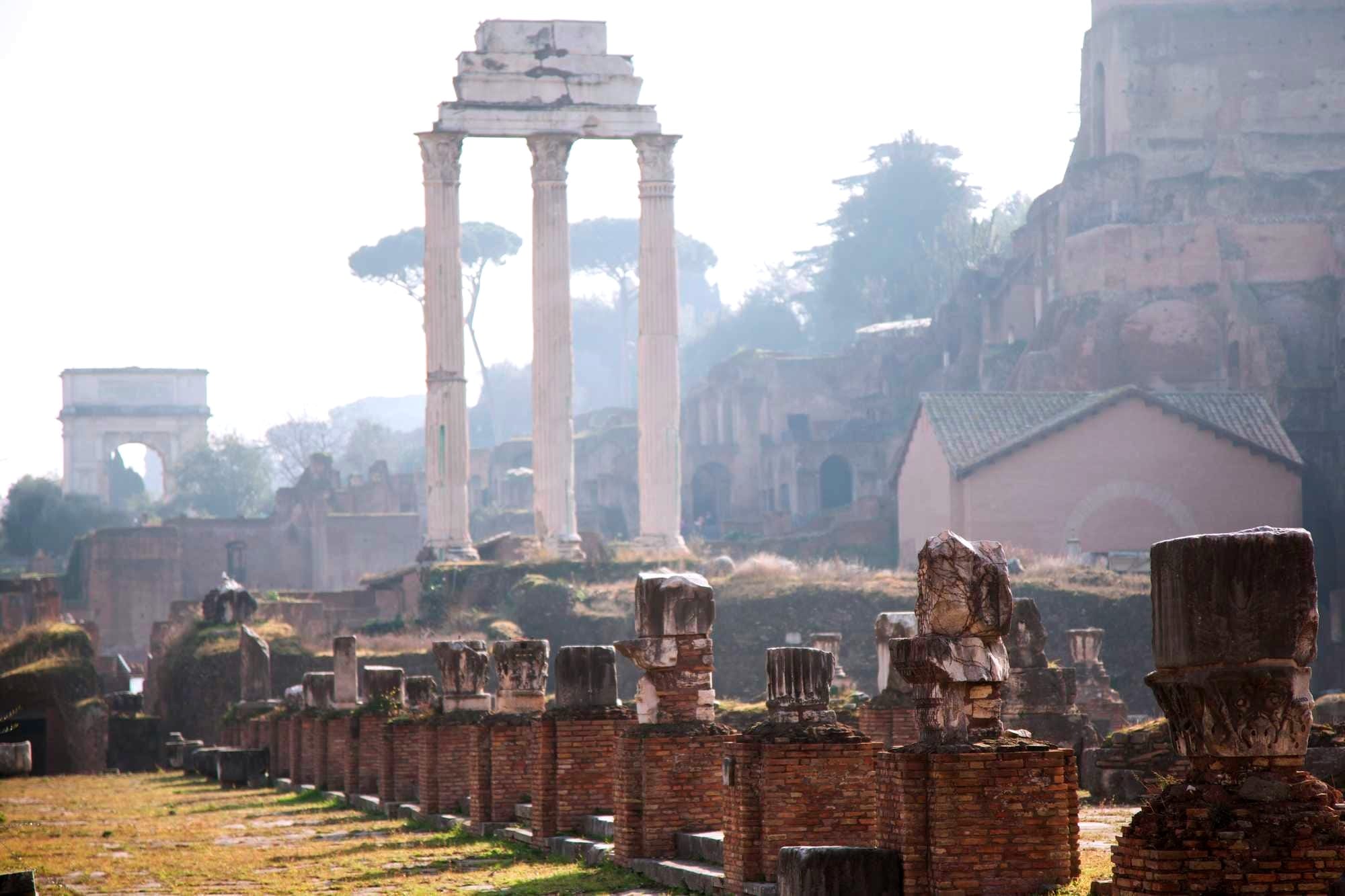
Verres had been entrusted with inspecting certain public buildings and determining whether contractors had fulfilled their obligations. Responsibility for maintaining the temple had originally belonged to a man named Publius Junius, who had died, leaving a young son.
When Verres inspected the building, he found it in excellent condition. According to Cicero, one of his associates then suggested that few architectural columns were perfectly vertical and that their alignment might provide a convenient excuse for demanding further work.
Verres ordered the columns to be tested with a plumb line, although the original maintenance contract had imposed no such requirement. The boy's guardians protested and attempted to negotiate a settlement, but Verres insisted on awarding a new contract.
An offer of 80,000 sesterces was rejected, and the cost of the new contract eventually reached 560,000 sesterces. The expense fell upon the young Junius' estate, while the work reportedly consisted largely of repositioning existing columns and applying fresh whitewash.
Cicero maintained that financial records and subsequent repayments demonstrated Verres' involvement in the transaction. By the time the praetor left Rome to assume the governorship of Sicily, allegations of corruption already extended across much of his public career.
Three Years at the Mercy of Verres
Sicily was Rome's oldest province and one of its most important sources of grain. Its fertile agricultural districts, wealthy merchants, prosperous cities and centuries of Greek artistic achievement made it an exceptionally valuable possession.
Verres arrived in 73 BC. His governorship coincided with the uprising of Spartacus in mainland Italy, and his appointment was extended amid the military emergency. Instead of serving for a single year, Verres remained in Sicily for three years.
The governor was assisted by numerous associates, among whom the freedman Timarchides occupied a particularly influential position. According to Cicero, Timarchides arranged payments, negotiated with those seeking favourable decisions and helped identify opportunities for extracting money from wealthy individuals.
One of the men who encountered this system was Sopater of Halicyae. Previously acquitted of a serious criminal charge under another governor, Sopater found himself facing the same accusation during Verres' administration.
Timarchides reportedly warned him that his enemies intended to purchase a conviction. After consulting his friends, Sopater agreed to pay 80,000 sesterces. His relief was short-lived, however, as Timarchides returned with the news that the prosecution was prepared to offer a larger sum.
Sopater refused to pay anything further. Verres allegedly arranged for members of the judicial council to depart and continued the proceedings despite the withdrawal of Sopater's advocate. The defendant was condemned, while the money he had already paid was retained.
Public and religious appointments could also become opportunities for favouritism. At Syracuse, the priesthood of Jupiter was traditionally awarded by drawing lots from three candidates selected by popular vote. Verres wished to secure the position for his acquaintance Theomnastus.
When the inhabitants insisted that their laws required the selection to be made by lot, Verres reportedly ordered three lots to be placed in the urn, each bearing the name of Theomnastus. The form of the ceremony was preserved, but its outcome was guaranteed.
At Cephaloedium, a candidate named Artemo Climachias allegedly obtained Verres' assistance by providing him with valuable silverware. His principal rival was away in Rome, so the governor ordered the local calendar to be advanced by a month and a half. By the time the rival returned, expecting to participate in the election, it had already taken place
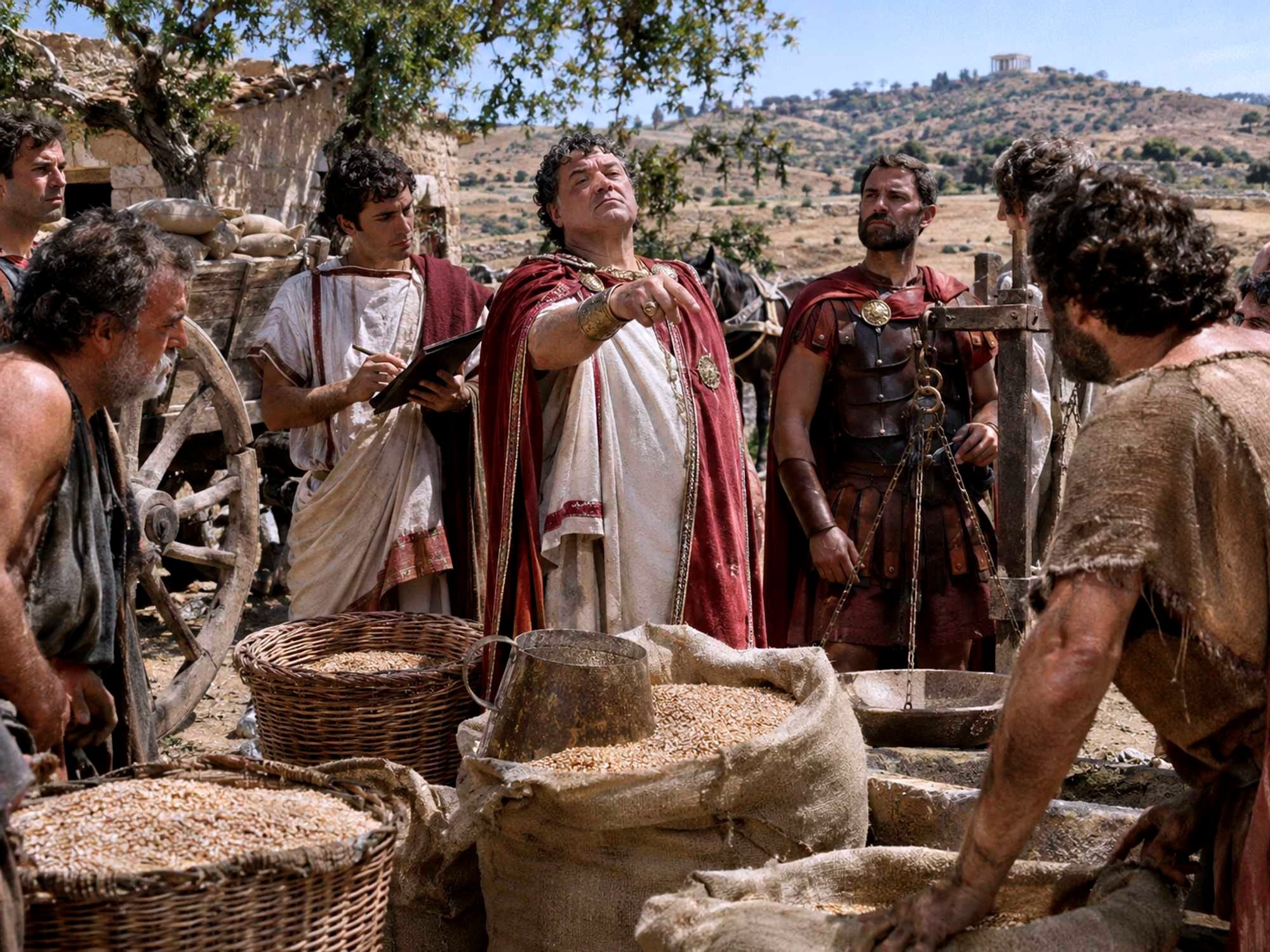
The exploitation of Sicily's agricultural wealth formed an even more substantial part of the subsequent prosecution. Roman taxation in the province included a system of tithes collected from agricultural produce. Cicero accused Verres of granting extraordinary powers to tax collectors, particularly a man named Apronius, who demanded quantities of grain far exceeding the lawful obligations of farmers.
Resistance could bring humiliation, financial ruin or physical punishment. Quintus Lollius, an elderly Roman knight approaching ninety years of age, refused to surrender more grain than he owed. Apronius had him brought before a banquet in the forum of Aetna, where the old man was mistreated until he agreed to the demands.
Cicero later cited official agricultural records indicating a substantial decline in the number of cultivators during Verres' administration. At Agyrium, for example, their number fell from 250 in the first year to 80 in the third. Lucius Metellus, Verres' successor, attempted to encourage farmers to return to their lands by promising to restore the established taxation arrangements.
The Governor Who Could Not Resist Greek Art
Among all the accusations brought against Verres, those concerning his collection of artworks have acquired particular fame. Cicero devoted an entire book of his second pleading to the subject. Although these speeches were never delivered in court, he subsequently published them, preserving a remarkably detailed account of the accusations against the governor.
“I come now to what Verres himself calls his passion what his friends call his disease, his madness; what the Sicilians call his rapine…” Cicero, In Verrem, II.4.1
Verres' interest in art appears to have extended well beyond the monetary value of the objects he acquired. He collected works associated with celebrated Greek artists, took an interest in engraved gems and decorative metalwork, and reportedly devoted considerable time to supervising skilled craftsmen.
In Messana, one of the most impressive private collections belonged to Gaius Heius. His residence contained an ancestral sanctuary that attracted visitors interested in its remarkable statues.
Among them was a marble Eros attributed to Praxiteles, a bronze Hercules attributed to Myron and two bronze figures of young women carrying sacred objects upon their heads, attributed to Polykleitos. Small altars stood before the images of Eros and Hercules.
The marble Eros had previously been borrowed by Gaius Claudius Pulcher to decorate the Roman Forum during the games he organised as aedile in 99 BC. After the festivities, it had been returned to Heius.
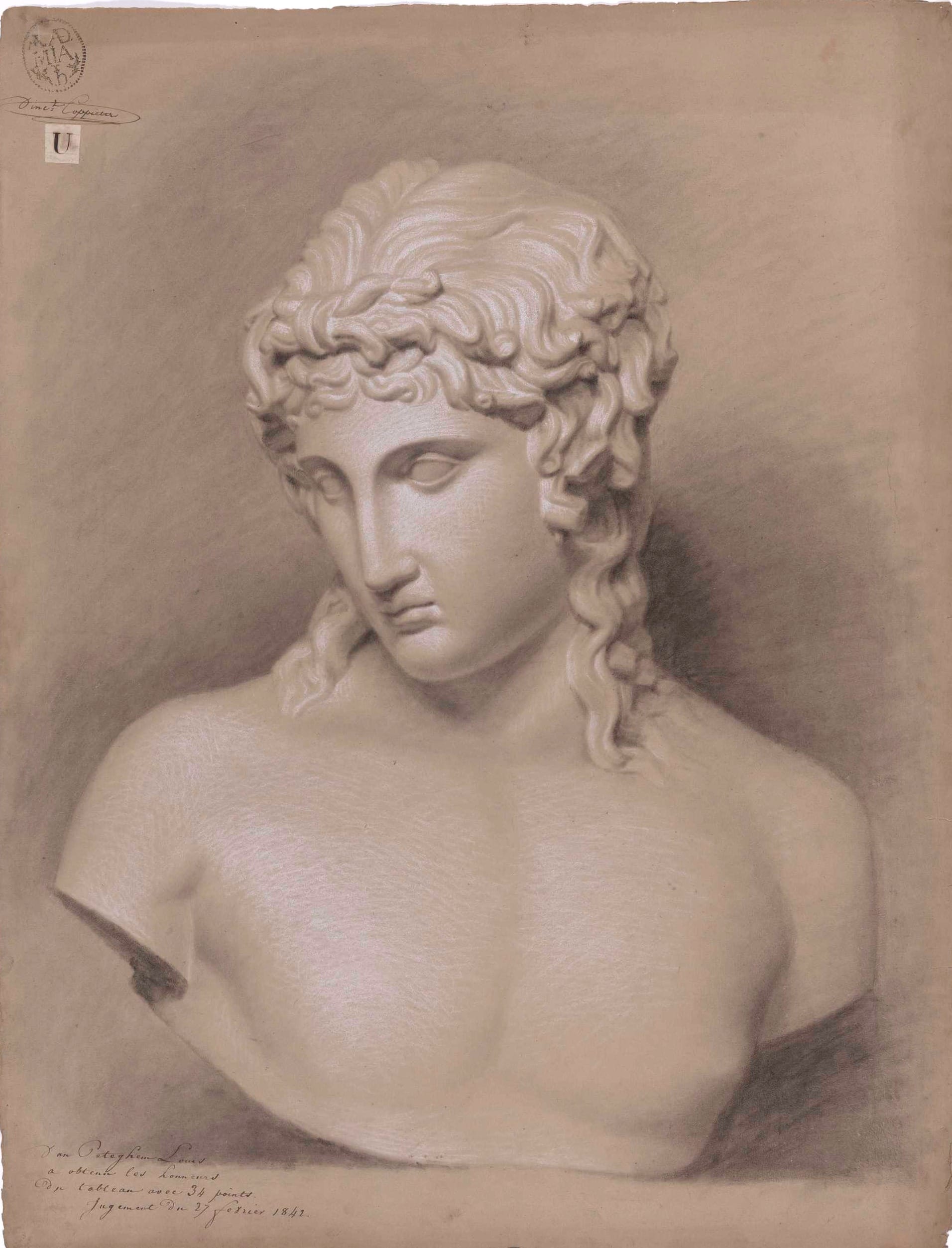
Verres obtained all four valuable sculptures, leaving behind only an ancient wooden statue of Fortuna. Although the transaction was represented as a purchase, Cicero used the owner's financial records to reveal the extraordinarily low price paid for the entire collection – just 6,500 sesterces.
The governor did not always locate such objects himself. Two Greek brothers from Cibyra in Asia Minor, Tlepolemus and Hiero, served as his artistic advisers. One was a modeller in wax and the other a painter. Cicero compared them to hunting dogs, searching the towns and houses of Sicily for objects that might interest their employer.
Their discoveries included the possessions of Diodorus, a native of Malta living at Lilybaeum. Among his treasures were two valuable drinking cups attributed to Mentor, a celebrated Greek silversmith.
When Verres demanded to see them, Diodorus explained that he had left them with a relative in Malta. The governor immediately dispatched messengers to the island to obtain them.
Diodorus secretly sent instructions to his relative to inform the governor's agents that the cups had already been returned to Lilybaeum. Meanwhile, he fled with his precious possessions, leaving Verres searching for both the man and his silverware.
Cicero alleged that the governor responded by attempting to arrange a capital prosecution against Diodorus. The affair attracted sufficient attention in Rome for Verres' father and friends to warn him against pursuing it. Diodorus nevertheless remained away from Sicily until the governor's departure.
Inside the Governor's Private Workshop
Verres' collecting activities were not confined to complete statues or vessels. He also coveted the decorative reliefs attached to silver objects, sometimes returning the vessels to their owners after having the ornaments removed.
One of his hosts, Eupolemus of Calacte, took the precaution of serving his distinguished guest with undecorated tableware. Unfortunately, he made an exception for two beautifully ornamented cups. According to Cicero, the governor tore off their decorative figures himself, in full view of the other guests.
The accumulated decorations were taken to Syracuse, where Verres established a workshop in the former palace of King Hieron II. Skilled metalworkers were instructed to incorporate them into new golden vessels, creating pieces that appeared as though the decorations had originally been designed for them.
Cicero claimed that the craftsmen spent eight months producing the gold objects alone. The governor himself reportedly spent much of his time in the workshop, wearing a simple tunic and a Greek mantle while supervising the work.
His interest could be remarkably specific. On another occasion, Verres noticed an attractive seal impressed upon a letter received by his interpreter. After discovering that the letter originated in Agrigentum, he sent instructions to acquire the ring responsible for the impression. Its owner, a Roman citizen named Lucius Titius, was consequently deprived of it.
Stealing from the Gods
Verres' activities were particularly offensive to Sicilian communities when the objects he coveted possessed religious or ancestral significance. Statues that had remained in sanctuaries for generations were not simply valuable works of art; they formed part of the religious and historical identity of their cities.
Even a foreign prince could find his possessions threatened. Antiochus, a member of the Syrian royal family, stopped in Sicily while returning from Rome and was entertained by Verres.
Among the prince's possessions was a magnificent golden candelabrum decorated with precious stones. It was intended as an offering to Jupiter Optimus Maximus in the temple on Rome's Capitoline Hill, which was undergoing reconstruction.
Verres persuaded Antiochus to send the candelabrum to his residence so that he could examine it privately. When the prince's attendants came to retrieve it, they were reportedly ordered to leave it behind.
Antiochus eventually appealed to the Roman citizens of Syracuse, publicly declaring that the object was dedicated to Jupiter. The affair would acquire particular significance during Verres' prosecution, since Quintus Lutatius Catulus, who was responsible for the reconstruction of the Capitoline temple, was among the jurors.
At Segesta, Verres coveted an ancient bronze statue of Diana. Its history made it especially precious to the inhabitants. The Carthaginians had previously carried it away, but Scipio Aemilianus restored it to the city following the destruction of Carthage in 146 BC.
The inhabitants resisted Verres' demands. According to Cicero, the governor subjected them to repeated levies and intimidation until their magistrates reluctantly agreed to surrender their sacred image.
No local workman was willing to remove it from its pedestal, and labourers had to be brought from Lilybaeum. When the statue was finally taken away, the women of Segesta accompanied it, decorating it with garlands and anointing it with perfumes as it was carried towards the boundaries of their territory. Even the pedestal upon which the statue had stood was subsequently removed.
The inhabitants of Agrigentum proved more successful in protecting one of their sacred treasures. Verres had already taken a bronze Apollo attributed to Myron, but the removal of another celebrated sculpture was to prove considerably more difficult.
One of the city's most revered possessions was a bronze Hercules housed in a temple near the forum. The statue bore visible traces of the devotion of generations of worshippers, whose custom of kissing the image during prayers had worn away parts of its mouth and chin.
According to Cicero, Verres sent Timarchides and a group of armed slaves to remove the statue during the night. The guards raised the alarm, and inhabitants rushed towards the sanctuary.
Despite prolonged efforts, the intruders were unable to move the figure from its pedestal. The citizens drove them away with stones, and Hercules remained in his temple. Cicero records that the Sicilians joked about the encounter as another of the mythical labours of Hercules, playing upon the meaning of Verres' name, which in Latin also designated a male pig or boar.
The governor was more successful at Henna, a city particularly associated with the worship of Ceres and Proserpina. Its sanctuary contained an ancient bronze figure of Ceres holding torches, recalling the goddess' search for her daughter.
Verres allegedly removed this statue. Two colossal figures of Ceres and Triptolemus proved too difficult to transport, but a beautiful figure of Victory held in the hand of the larger statue of Ceres was taken away.
Representatives of Henna subsequently demanded the restoration of their sacred objects. They were prepared to refrain from bringing official accusations against the governor if their treasures were returned.
The ancient sanctuaries of Syracuse suffered extensive losses of their own. From the Temple of Athena, Verres reportedly removed paintings depicting historical events and former rulers of Sicily, together with magnificent ivory carvings and golden ornaments decorating its doors.
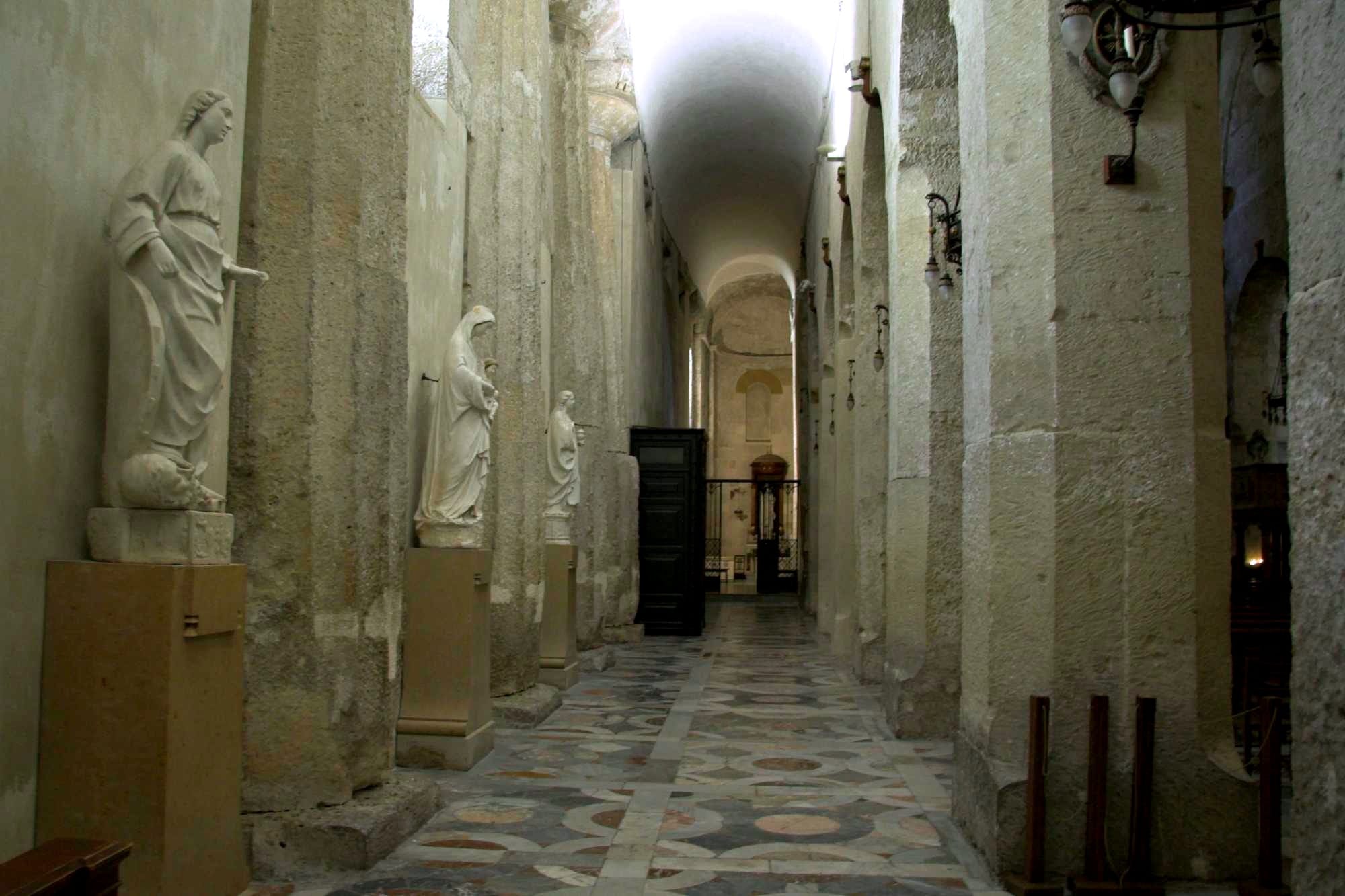
A statue of Sappho attributed to Silanion was taken from the city's prytaneum, while other sculptures disappeared from its religious buildings. Cicero observed that the guides of Syracuse, who had once shown visitors the city's artistic treasures, were reduced to explaining what had been taken away.
A Governor Surrounded by Roses
Despite the accusations concerning his administration, Verres could point to at least one important achievement. The uprising of Spartacus had not spread to Sicily during his governorship.
The historian Sallust records that Verres fortified the Sicilian shores nearest Italy. The danger was particularly significant for an island that had experienced major slave revolts within living memory.
Cicero nevertheless accused the governor of exploiting fears of rebellion for financial gain. Wealthy slave owners could find themselves threatened with accusations of conspiracy involving members of their households.
Apollonius of Panormus, for example, was accused in connection with an alleged conspiracy involving one of his enslaved herdsmen. He protested that he did not even possess a slave bearing the name given by the governor. According to Cicero, he nevertheless spent eighteen months in prison before being released without further proceedings.
The prosecutor also presented a remarkably colourful picture of Verres' daily life. When travelling through Sicily, the governor reportedly used a litter carried by eight men, furnished with a cushion made of fine Maltese linen and filled with roses.
He wore garlands around his head and neck and carried a small linen net containing roses, which he regularly raised to his nose. Upon reaching his destination, he could conduct official business from his private accommodation rather than appearing publicly in court.
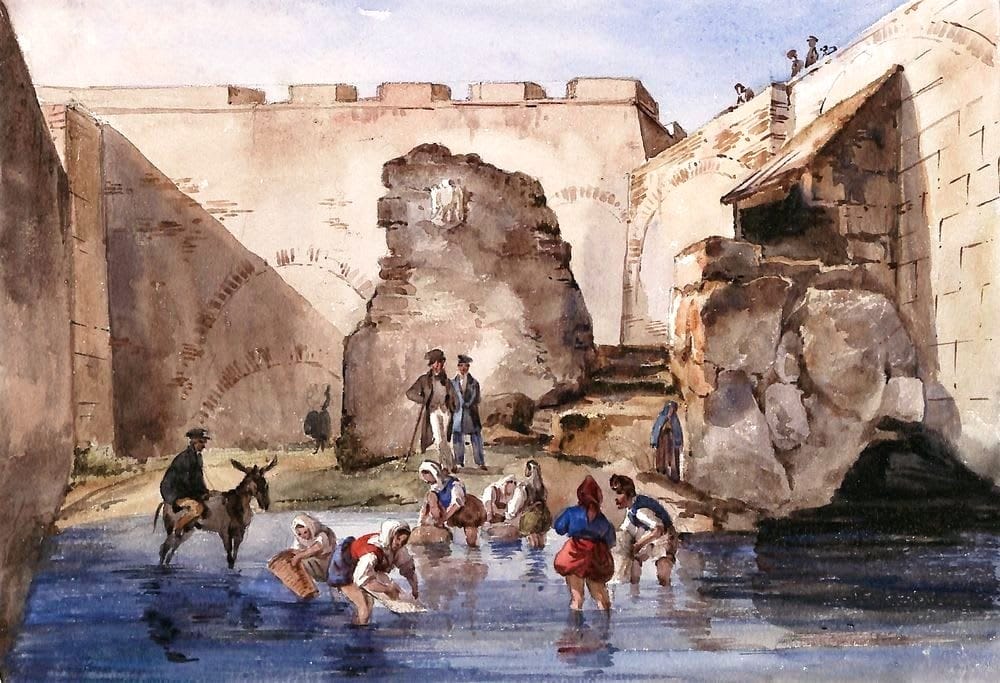
During the summer, Verres established a camp near the Fountain of Arethusa at Syracuse. Cicero described elaborate banquets, drinking parties and gatherings attended by women associated with the governor. Among them was Tertia, the daughter of an entertainer named Isidorus, whom Verres reportedly took with him when he left Sicily.
The Pirates of Syracuse
Piracy remained a considerable danger in Sicilian waters. The provincial cities were required to contribute ships, crews or resources towards the fleet responsible for protecting the island.
Cicero accused Verres of turning these obligations into another source of personal income. Men were allegedly allowed to purchase exemption from naval service, while money intended for the maintenance of crews was diverted elsewhere.
Messana, whose treaty with Rome required it to provide a warship, was reportedly released from this obligation. Instead, the city constructed a large merchant vessel for the governor's personal use. Gaius Heius, the owner of the four precious sculptures, subsequently testified concerning its construction.
The command of the Sicilian fleet was eventually entrusted to Cleomenes of Syracuse. According to Cicero, the appointment was connected with Verres' relationship with Cleomenes' wife, Nice. By sending her husband away on naval duties, the governor could continue their relationship without his presence in Syracuse.
When the fleet encountered pirates commanded by Heracleo, it suffered a humiliating defeat. Several ships were abandoned and burned by the pirates, who subsequently entered the harbour of Syracuse itself.
Cicero attributed the disaster to the shortage of sailors, the inadequacy of supplies and the conduct of Cleomenes. He claimed that the hungry crews had been reduced to gathering wild palm roots to feed themselves during the expedition.
Rather than accepting responsibility for the loss of the fleet, Verres brought charges against the surviving captains. Cleomenes himself escaped punishment.
Among the accused was Heraclius of Segesta, who maintained that he had remained at Syracuse because of a severe eye condition and had not participated in the expedition. Another naval captain, from Heraclea, prepared a written account concerning the deficiencies of the fleet and the circumstances in which sailors had been discharged.
The captains' families travelled to Syracuse in an attempt to save them. Cicero describes parents spending the night outside the prison, denied even the opportunity to embrace their sons before their executions.
The prosecution also produced testimony concerning payments demanded from the relatives for permission to bury the dead. Onasus of Segesta testified that he had paid money to Timarchides for permission to bury Heraclius.
“I Am a Roman Citizen”
The ancient stone quarries of Syracuse, known as the Latomiae, had long served as places of imprisonment. During Verres' governorship, Cicero alleged, Roman citizens were confined there, sometimes following the confiscation of their ships and valuable cargoes.
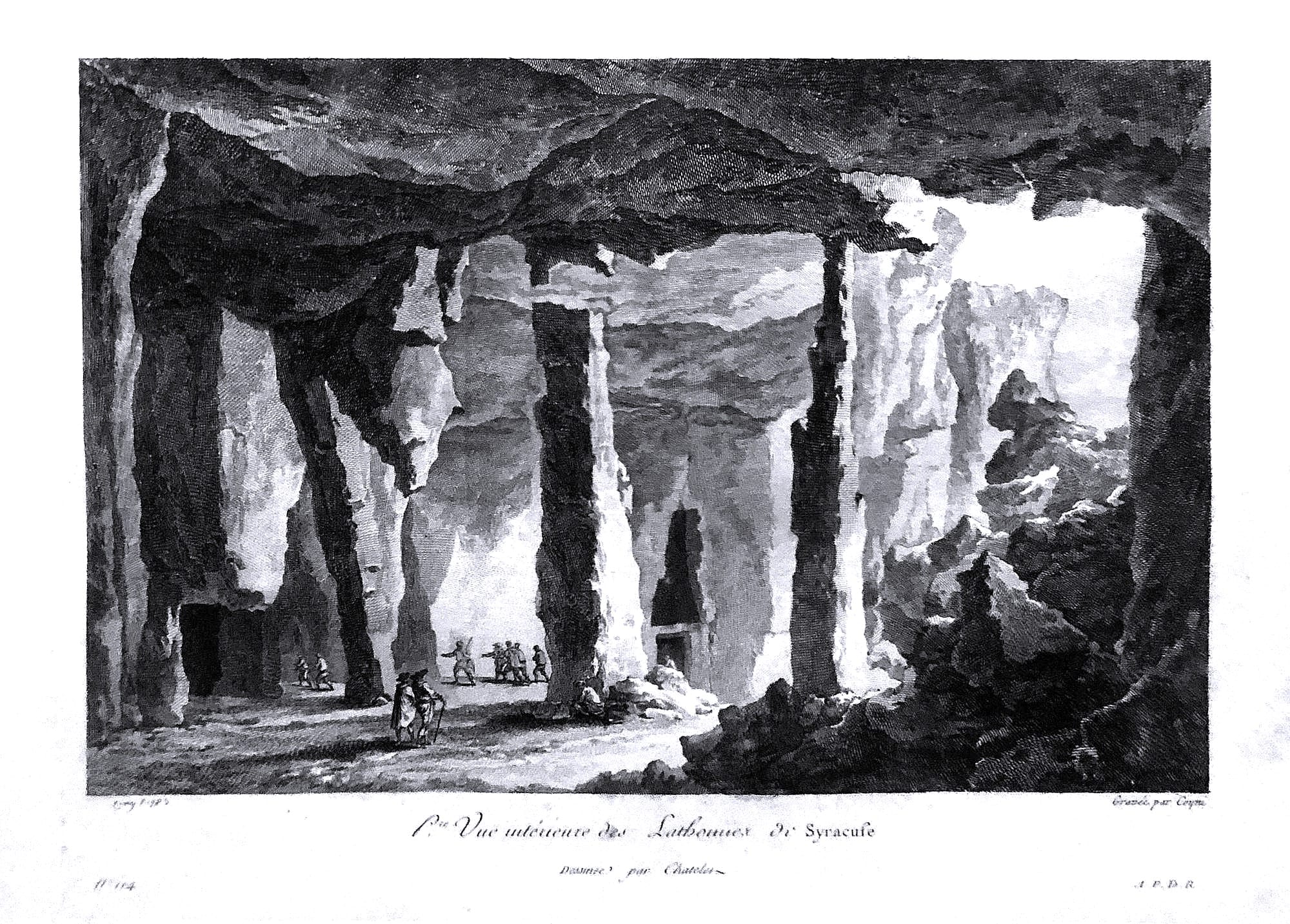
Some prisoners were accused of being former supporters of Quintus Sertorius, whose resistance to Rome in Spain had recently ended. Others were suspected of collaborating with pirates. Cicero referred to prison records identifying men who had been incarcerated and subsequently executed.
Among the most famous of these prisoners was Publius Gavius, a man from Italy who claimed Roman citizenship. Having escaped from imprisonment at Syracuse, he reached Messana, where he intended to embark for the mainland.
Believing himself almost beyond the governor's reach, Gavius openly complained about his treatment and announced his intention of seeking justice in Rome. He was arrested by the local authorities, who brought the matter to Verres' attention.
Gavius asserted his Roman citizenship and named a Roman knight residing at Panormus who could confirm his identity. Verres nevertheless accused him of espionage on behalf of the rebellious slaves in Italy and ordered him to be flogged publicly.
According to Cicero, Gavius repeatedly appealed to the protection that his citizenship should have afforded him, uttering the words Civis Romanus sum – I am a Roman citizen. His appeal was unsuccessful, and he was condemned to crucifixion.
Cicero alleged that Verres ordered the cross to be erected near the shore, where the dying man could look towards Italy. In his published prosecution, he expressed the gravity of the accusation in one of the most memorable passages associated with Roman citizenship:
“It is a crime to bind a Roman citizen; to scourge him is a wickedness; to put him to death is almost parricide. What shall I say of crucifying him?” Cicero, In Verrem, II.5.170
The Trial Money Could Not Buy
When Verres left Sicily, the inhabitants of several cities began removing the monuments erected in his honour. At Tauromenium, his statue was removed, leaving its pedestal standing. At Tyndaris, the figure of Verres was taken down from an equestrian monument, leaving the bronze horse without its rider.
Meanwhile, representatives of Sicilian communities travelled to Rome. They sought the assistance of Cicero, who had served as quaestor at Lilybaeum in 75 BC and had established favourable relations with many of the island's inhabitants.
Verres secured the services of Quintus Hortensius Hortalus, one of Rome's most distinguished advocates. Before Cicero could undertake the prosecution, however, he faced competition from Quintus Caecilius Niger, a former quaestor of Verres who also wished to bring charges against the governor.
Cicero argued that Caecilius' previous involvement in the administration made him unsuitable to investigate its irregularities. He also alleged that Verres and Hortensius would prefer him as their opponent. A preliminary hearing resulted in Cicero being chosen as prosecutor.
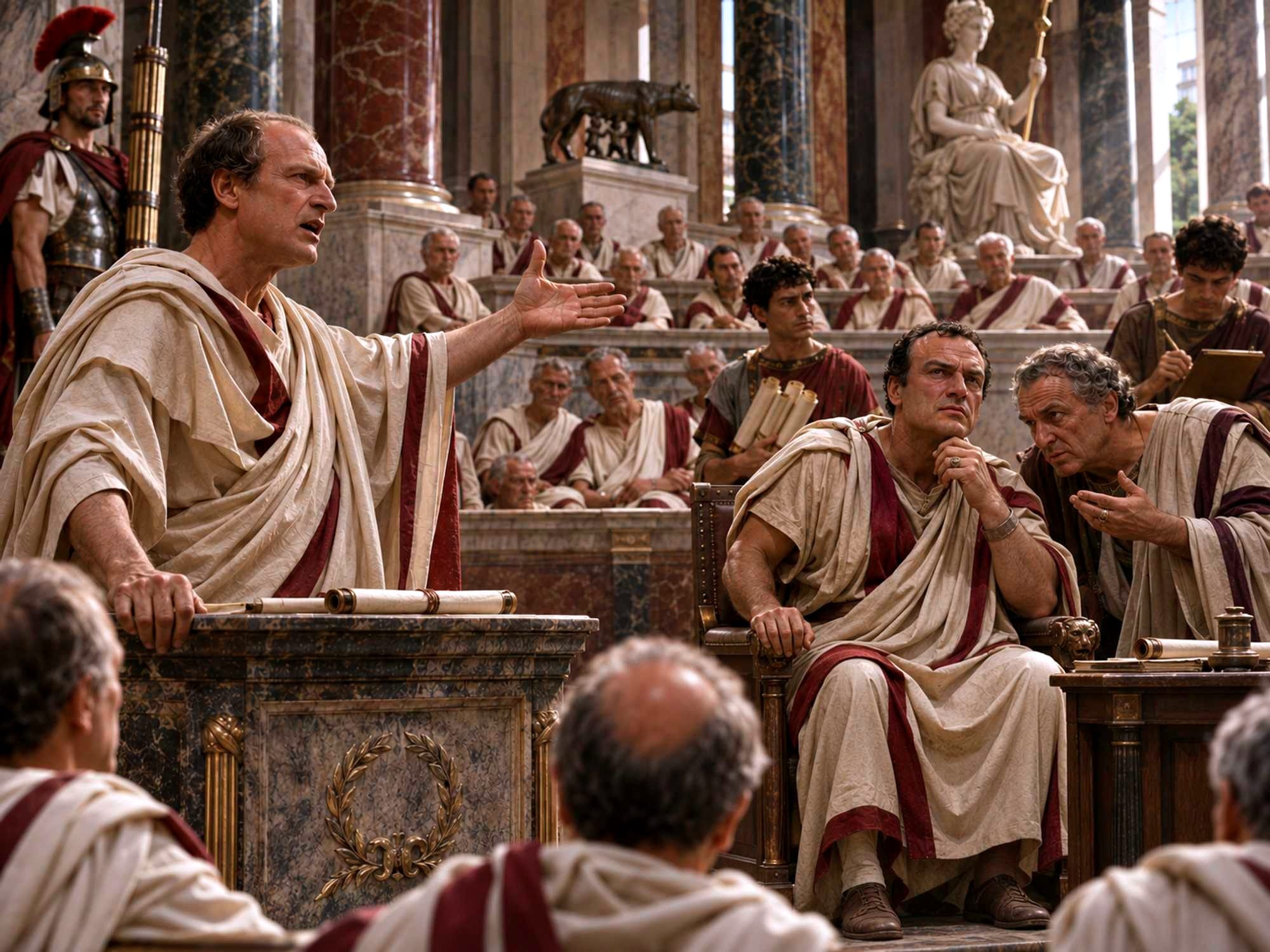
Granted 110 days to prepare his case, Cicero travelled to Sicily with his cousin Lucius. He subsequently claimed to have completed his investigation in only fifty days, collecting financial records, contracts, official decrees and witness testimonies.
One particularly interesting discovery concerned the financial accounts kept by Lucius Carpinatius. Cicero identified suspicious alterations to entries that he believed had originally referred to Verres and obtained certified copies of the records for use in the prosecution.
The political circumstances of the trial were equally important. Under Sulla's judicial arrangements, senators controlled the extortion courts, and their conduct had attracted considerable criticism. Cicero presented the case as an opportunity for the senatorial jury to demonstrate its integrity.
The elections of 70 BC nevertheless offered Verres considerable hope. Hortensius and Quintus Caecilius Metellus were elected consuls for the following year, while Marcus Caecilius Metellus was elected praetor and assigned responsibility for the extortion court.
If the proceedings could be delayed until 69 BC, Verres would face a court presided over by a member of an influential family with which he had connections, while his defence lawyer occupied one of the highest offices of the Republic. According to Cicero, Verres' friends were already congratulating him on his acquittal after the election of Hortensius.
The trial finally opened on 5 August 70 BC, under the presidency of Manius Acilius Glabrio. With numerous public games and festivals approaching, prolonged speeches threatened to consume the limited time available for the proceedings.
Cicero therefore adopted an unexpected strategy. Instead of delivering an elaborate opening address, he briefly outlined the accusations and proceeded directly to the examination of witnesses and the presentation of evidence.
The formal charge concerned the unlawful acquisition of forty million sesterces from Sicily. Over the following days, the testimony placed increasing pressure upon Verres and his defenders.
Plutarch preserves an amusing exchange between the two advocates. Verres had reportedly given Hortensius an ivory sphinx, and when the latter remarked that he had no skill in solving riddles, Cicero responded:
“And yet,” said Cicero, “thou hast the Sphinx at thy house.” Plutarch, Life of Cicero, 7.6
Verres eventually departed into voluntary exile before the conclusion of the proceedings. He was convicted in his absence, although the precise amount of the financial penalty imposed upon him is uncertain.
Cicero subsequently published the five speeches intended for the second stage of the trial, which never took place. Together with his earlier speeches, they became known as the Verrines and preserved an extraordinary record of the accusations against the former governor, as well as the lives, religious traditions and material wealth of the Sicilians under Roman rule.
The Treasures That Allegedly Cost Him His Life
Verres settled in Massilia, modern Marseille, where he spent the remaining twenty-seven years of his life in exile. Little survives concerning his activities during this period, although his reputation as a collector endured.
In 43 BC, following the establishment of the Second Triumvirate by Octavian, Mark Antony and Lepidus, Verres became a victim of the proscriptions. Pliny the Elder records a remarkable tradition concerning the circumstances of his death.
Antony reportedly coveted some of the valuable Corinthian bronzes in Verres' possession. When their owner refused to surrender them, he was included among the proscribed.
Another ancient account, preserved by Seneca the Elder from the historian Asinius Pollio, describes Verres as facing his death with remarkable courage. Among those who also lost their lives during the proscriptions of that year was Marcus Tullius Cicero, the man whose prosecution had ended Verres' political career almost three decades earlier.
Cowles, Frank Hewitt (1917). Gaius Verres: An Historical Study. Cornell University Press.
Miles, Margaret M. (2002). Cicero’s Prosecution of Gaius Verres: A Roman View of the Ethics of Acquisition of Art. International Journal of Cultural Property, 11(1).
Baudry, Robinson (2023). Les monuments et les erga de Sicile dans le corpus cicéronien. In Un monde partagé: la Sicile du premier siècle av. J.-C. entre Diodore et Cicéron.
Gildenhard, Ingo (2011). Cicero, Against Verres, 2.1.53–86: Latin Text with Introduction, Study Questions, Commentary and English Translation. Open Book Publishers.
Cicero – In Verrem and Divinatio in Caecilium. English translation by C. D. Yonge.
Plutarch – Life of Cicero. English translation by Bernadotte Perrin.
Sallust – Histories.
Pliny the Elder – Natural History.
Seneca the Elder – Suasoriae.

About the Roman Empire Times
See all the latest news for the Roman Empire, ancient Roman historical facts, anecdotes from Roman Times and stories from the Empire at romanempiretimes.com. Contact our newsroom to report an update or send your story, photos and videos. Follow RET on Google News, Flipboard and subscribe here to our daily email.
Follow the Roman Empire Times on social media: