
The Battle of the Milvian Bridge: Constantine, Maxentius and the Fight for Rome
On 28 October AD 312, Constantine confronted Maxentius outside Rome in a battle that ended with a disastrous retreat toward the Tiber. Ancient accounts describe fierce fighting, broken bridges and the drowning of an emperor, but disagree over how the final moments unfolded.

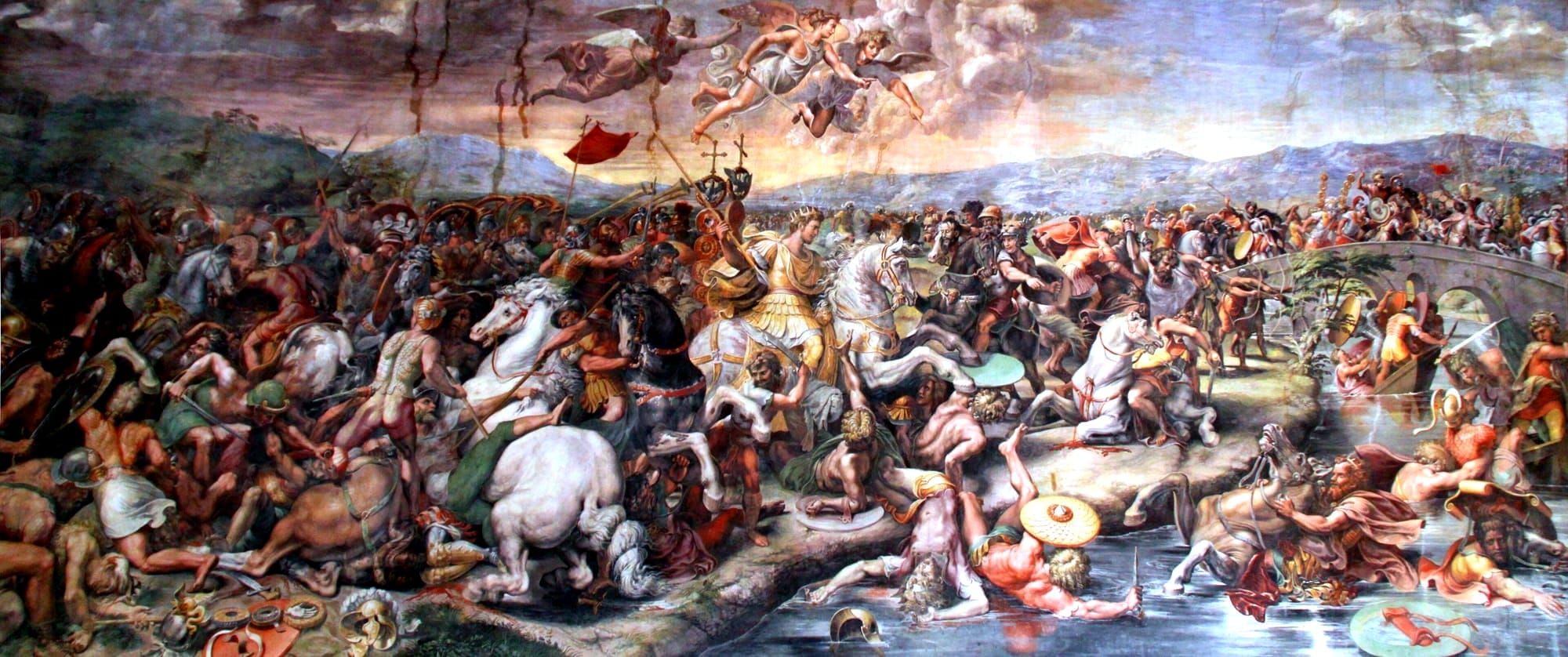
On 28 October AD 312, two Roman armies fought north of Rome, near the Milvian Bridge, where the Via Flaminia crossed the Tiber. One was commanded by Constantine, who had invaded Italy from his territories in the west. The other belonged to Maxentius, who had ruled Rome for six years and had already survived several attempts to overthrow him. By the end of the day, Maxentius had drowned in the river, his army had been defeated, and Constantine had won control of the approaches to the capital.
The confrontation followed a campaign in which Constantine crossed the Alps, defeated Maxentius' forces in northern Italy and advanced toward Rome. His opponent still had the advantage of defending a city protected by formidable walls. Maxentius nevertheless chose to meet him outside those defenses, positioning his army north of the Tiber, with the river and its crossings behind it.
The battle is also remembered for the accounts of Constantine receiving a Christian sign before the fighting. Those religious narratives became an important part of how his victory was understood, but the surviving descriptions of the military confrontation tell a story of campaigning, rival Roman armies, determined resistance and a retreat that ended disastrously at the river.
Constantine's Campaign Against Maxentius
The conflict developed from the breakdown of the tetrarchic system established by Diocletian. That arrangement distributed imperial authority among several rulers and was intended to regulate succession, but competing claims increasingly undermined it after Diocletian and Maximian retired in AD 305.
Constantine was proclaimed emperor by his father's soldiers in Britain in 306. Later that year, Maxentius was proclaimed emperor in Rome, supported by members of the military establishment and groups dissatisfied with the existing imperial arrangements. Both men were sons of former emperors, but neither had entered power through the succession originally planned by Diocletian.
Maxentius demonstrated that removing him would not be easy. In 307, Severus advanced against Rome but failed to overthrow him. Galerius also attempted an invasion and was forced to withdraw. Maxentius retained control of Italy and the capital, supported by troops associated with Rome and protected by defenses that had already frustrated two challengers.
His position was nevertheless complicated by conflicts elsewhere. A rebellion led by Lucius Domitius Alexander in North Africa threatened provinces closely connected with Rome's grain supply. Maxentius eventually suppressed the rebellion and recovered the African territories, but the disruption exposed the vulnerability of a government dependent on maintaining military and political control across several regions.
Relations with Constantine had also deteriorated. Maximian, Maxentius' father, attempted to regain imperial authority while staying with Constantine in 310. After his defeat, he died under circumstances described differently by the ancient sources. Maxentius subsequently presented his hostility toward Constantine in part as a response to his father's death, giving their rivalry a personal and dynastic dimension.
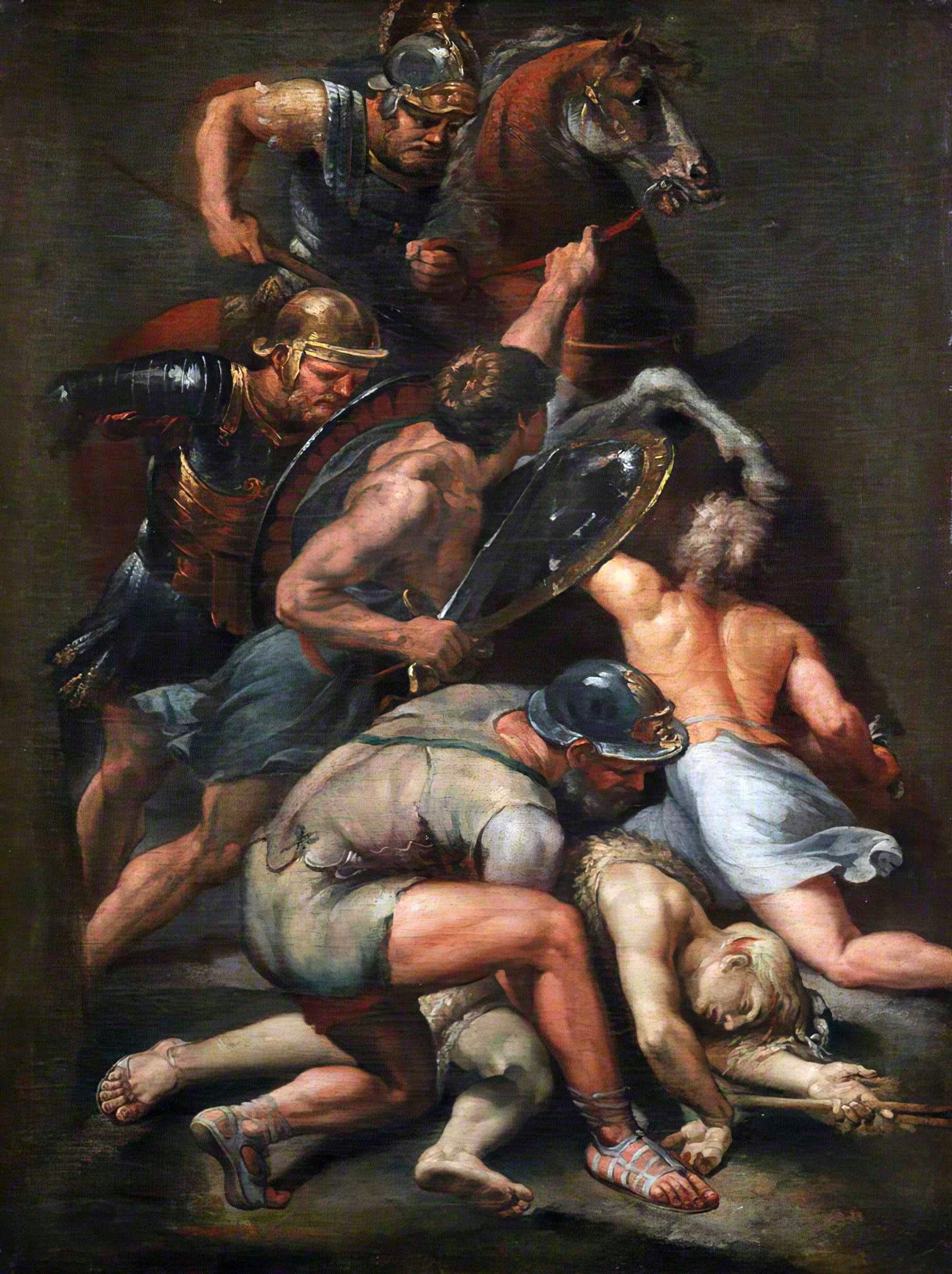
In 312, Constantine crossed the Alps and began his invasion of Italy. His first objective was to defeat the forces defending northern Italy before they could prevent him from reaching Rome.
The campaign began with resistance at Susa, where Constantine overcame the defenders and took the city. Continuing into the Po valley, he encountered another army near Turin. This force included heavily armoured cavalry, which the panegyric delivered in Constantine's honour the following year describes as fighting in a compact formation.
The account presents Constantine defeating these cavalrymen through effective manoeuvring and determined attacks. Its details belong to the engagement at Turin, rather than the later battle outside Rome, but they show that his invasion involved significant fighting before he reached Maxentius' capital.
After the victory near Turin, Milan accepted Constantine's authority. His army then advanced toward Verona, where Maxentius' forces offered more substantial resistance under a commander generally identified as Ruricius Pompeianus.
The struggle around Verona involved fighting near the fortified city and the defeat of an army assembled to relieve it. Pompeianus was killed, and Constantine eventually secured Verona. The victory opened the route through northern Italy and deprived Maxentius of another important defensive position.
These successes transformed the military situation. Maxentius had lost several armies and important cities, while Constantine had maintained the momentum of his advance. The invading army could now approach Rome without facing an intact network of field forces capable of preventing its movement south.
The numbers involved remain uncertain. The panegyric of 313 claimed that Constantine crossed the Alps with scarcely a quarter of his army and faced an opponent possessing 100,000 armed men. Such statements were intended to emphasize the scale of his achievement and do not establish the number of soldiers who eventually fought at the Milvian Bridge.
Zosimus, writing centuries later, gave Constantine 90,000 infantry and 8,000 cavalry, while assigning Maxentius 170,000 infantry and 18,000 cavalry. These figures are generally considered excessive and cannot be treated as reliable battlefield strengths. They concern the forces attributed to the rival emperors, rather than an independently documented count of the troops present beside the Tiber on 28 October.
Constantine had nevertheless achieved a substantial military success. He had advanced through hostile territory, overcome several armies and reached Rome. Maxentius still possessed forces capable of fighting him, but the choice of how to use those troops had become critical.
The Opposing Armies and Maxentius' Imperial Guards
The armies that met north of Rome belonged to the same Roman military world. Their soldiers served rival emperors, but they shared many of the same military institutions, traditions and types of equipment. Both commanders could employ infantry and cavalry, including troops accustomed to campaigning in different parts of the empire.
Constantine's army included men experienced in the western provinces, particularly along the Rhine frontier, where military operations had formed an important part of his early reign. They had subsequently participated in the invasion of Italy and the victories at Turin and Verona.
The ancient narratives mention cavalry and infantry, but do not provide a complete list of the units engaged on 28 October. Attempts to identify particular formations from the military reliefs on the Arch of Constantine have produced intriguing suggestions, although the evidence remains disputed.
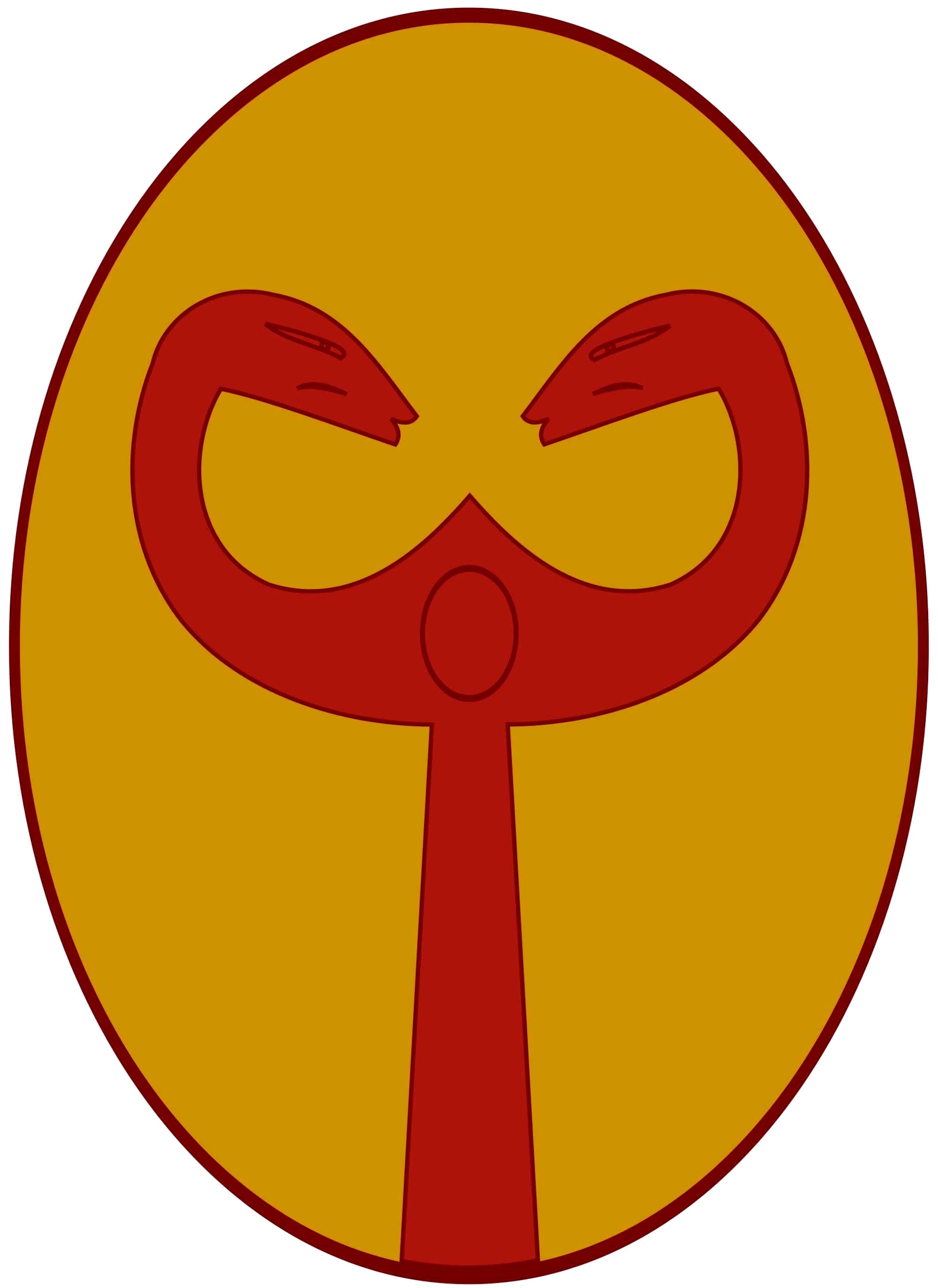
One proposed identification concerns the Cornuti, a military formation associated with horned insignia. Distinctive shield designs depicted on the arch have been interpreted as evidence that these troops participated in Constantine's victory. Yet no early written account explicitly names the Cornuti at the battle, and the original date and subject of some of the sculptural scenes have been questioned. The reliefs cannot establish which units delivered the decisive attacks.
Maxentius' army had a particularly close connection with the imperial establishment at Rome. The most famous troops associated with his regime were the Praetorian Guards, whose history reached back to the early Empire. Their responsibilities had long extended beyond guarding the emperor, and they had repeatedly played a role in determining who controlled imperial power.
The Praetorians had supported Maxentius' accession in 306. Their position and privileges were consequently bound up with the survival of his government, making them a military formation whose future under Constantine would be uncertain.
Another important organization was the equites singulares Augusti, the emperor's mounted bodyguards. These soldiers were distinct from the Praetorian Guard and maintained their own barracks on Rome's Caelian Hill. Their possible participation in Maxentius' final battle has attracted particular attention because their establishments were later demolished under Constantine.
The evidence does not establish how many Praetorians or mounted guards were present at the bridge. Nor can the theoretical strength of their establishments be used to calculate the number actually available for the final confrontation. Earlier fighting in northern Italy had already affected Maxentius' military resources, and surviving figures for the organization of particular units are not battlefield returns.
The panegyric of 313 describes some of Maxentius' soldiers continuing to fight after others began to retreat. The speaker presents these men as committed supporters of the defeated emperor who had little expectation of mercy from Constantine. They remained at their positions and were killed.
These defenders may have included Praetorians or imperial horse guards, but the panegyrist does not identify them by name. Their resistance is better understood as evidence that parts of Maxentius' army continued fighting even after the wider force was defeated, rather than proof of the precise deployment of one particular unit.
Maxentius therefore commanded more than an anonymous collection of troops. His army included formations with longstanding connections to his government, alongside other soldiers who had served in the defense of Italy. The defeat of those forces would have immediate consequences for the military institutions supporting his rule.
The Battlefield: Saxa Rubra, Tor di Quinto and the Milvian Bridge
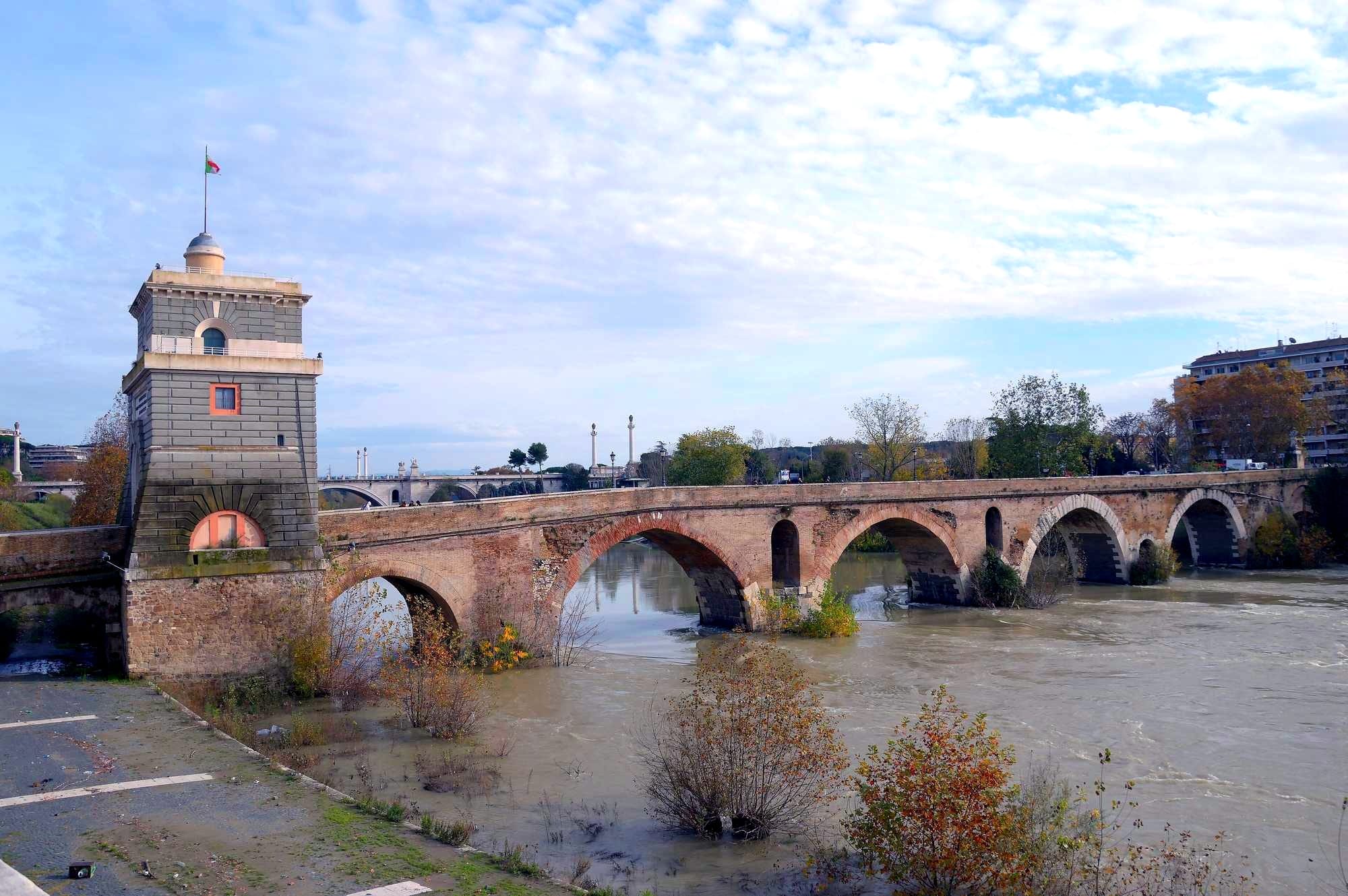
The geography north of Rome shaped the confrontation. The Via Flaminia approached the capital from the north and crossed the Tiber at the Milvian Bridge, an important route connecting Rome with central and northern Italy.
The crossing had been in use since the Roman Republic, and a stone bridge was constructed there in 109 BC. By the time Constantine and Maxentius fought, it was already an established part of Rome's road network. The structure visible today incorporates repairs and alterations made over many centuries.
The approaches to the bridge passed through a landscape that was more complicated than an uninterrupted plain. Roads connected the district with the Via Cassia and other routes leading into Rome. Tombs, gardens, buildings and older Roman establishments occupied parts of the surrounding area, particularly near the principal roads.
These features are relevant to understanding the movements available to an army approaching from the north. The surviving archaeological evidence, however, cannot establish which structures stood in precisely the same condition in 312 or how individual units moved around them during the fighting.
The actual battlefield has never been conclusively identified. Aurelius Victor places the confrontation at Saxa Rubra, north of the Milvian Bridge along the Via Flaminia. The name refers to the reddish rock of the surrounding terrain, where the road passed through a more restricted landscape than the open ground nearer the river.
Another frequently proposed location is the plain of Tor di Quinto, closer to the Milvian Bridge. This comparatively broad area offered space for opposing formations to deploy and for cavalry to manoeuvre. The Tiber curved around the district, creating a significant obstacle behind troops positioned to defend the northern approaches to the city.
Some reconstructions place the main encounter at Tor di Quinto, while others favour Saxa Rubra or suggest fighting along a wider stretch of the approach road. It is possible that the armies encountered one another at more than one point, but the evidence does not establish that two separate major battles occurred on 28 October.
An earlier episode in Roman history has also complicated the interpretation of Saxa Rubra. In AD 193, soldiers of the Praetorian Guard who had supported Didius Julianus were dismissed there following the advance of Septimius Severus. The later abolition of the Praetorian Guard after Constantine's victory creates an unusual parallel, although it does not prove that an ancient writer confused the events or misplaced the battle of 312.
One feature of the battlefield is consistently emphasized in early accounts: Maxentius' army fought with the Tiber behind it.
The panegyric delivered in 313 describes retreating soldiers becoming obstructed by the narrowness of the Milvian Bridge. Nazarius, speaking in 321, similarly portrays Maxentius as deploying his troops close to the river, leaving them little opportunity to escape once the fighting turned against them.
Both accounts were written in praise of Constantine, and their descriptions are influenced by that purpose. Nevertheless, they identify the practical difficulty facing an army positioned north of the river. Troops could fight across a relatively broad area but would have to withdraw through much narrower approaches to reach Rome.
The problem became particularly severe once formations began to break. Infantry and cavalry retreating under pressure would converge on the crossings, while soldiers unable to reach them risked entering the Tiber. The roads, riverbanks and available bridge space would determine how quickly men could escape.
Several ancient sources also describe a temporary bridge constructed from boats near the permanent crossing. Its precise location has not been established. The anonymous Epitome de Caesaribus places such a bridge a little upstream from the Milvian Bridge, while other accounts provide less geographical detail.
No securely identified archaeological remains establish its position, dimensions or method of construction. It is also uncertain whether the different writers were always describing the same crossing when they discussed the bridge that failed during the retreat.
The presence of the Tiber behind Maxentius' army, however, was enough to make a defeat exceptionally dangerous. Once the soldiers lost their positions, the river and its restricted crossings became major obstacles to escape.
Why Maxentius Left Rome's Defenses
Maxentius' decision to meet Constantine outside Rome remains one of the most consequential choices of the campaign.
The capital possessed formidable defenses, and earlier challengers had failed to overthrow him despite advancing into Italy. A prolonged attempt to take Rome would have created difficulties for Constantine, who had to maintain his army and its supplies after a campaign through hostile territory.
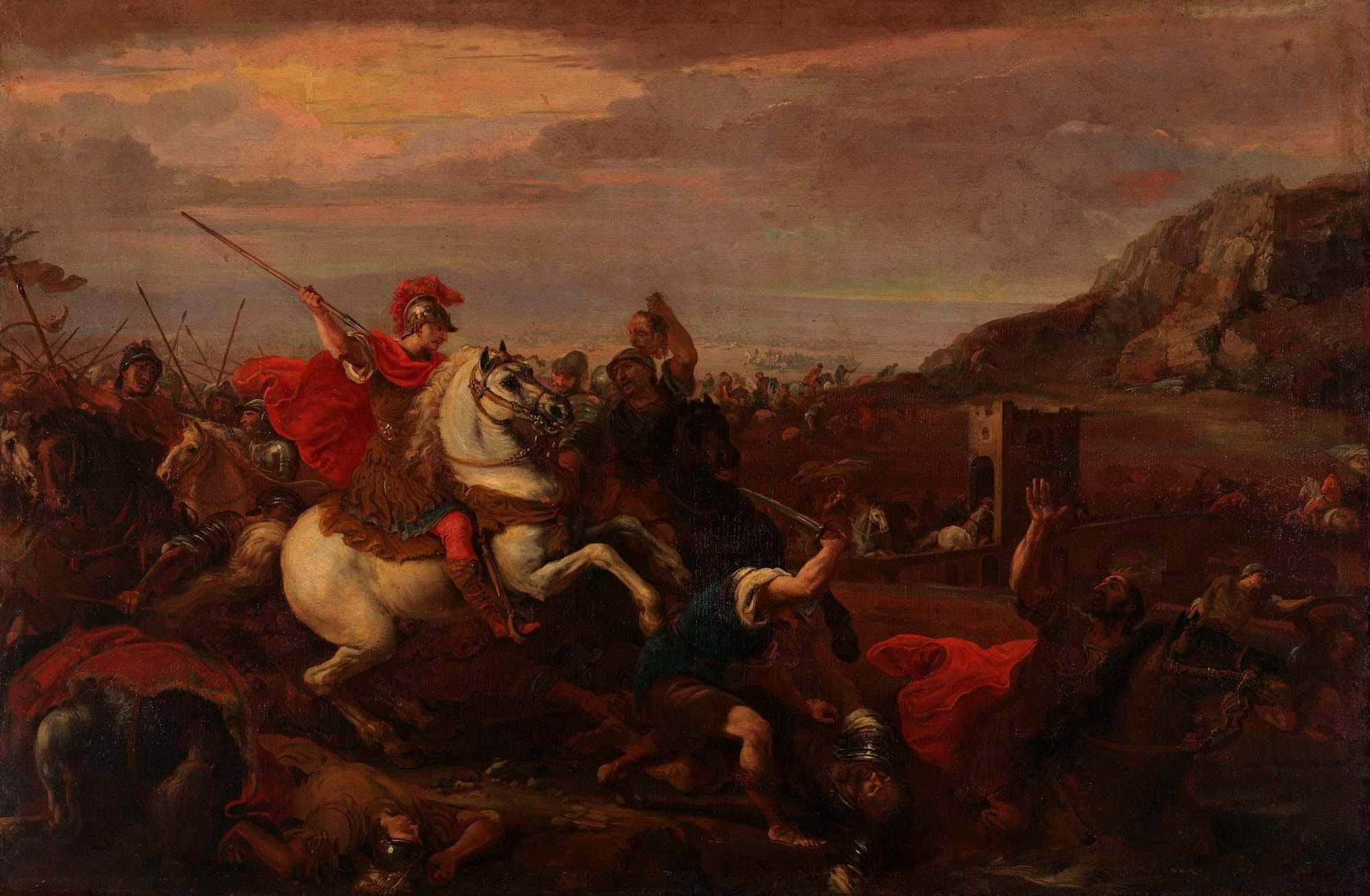
Maxentius nevertheless brought his forces outside the city to confront the invader. The ancient accounts attempt to explain his decision, although they were generally written by authors hostile to him.
Lactantius provides the most detailed narrative. According to him, Maxentius initially remained in Rome while his soldiers conducted military operations. During public games, the spectators reportedly began shouting that Constantine could not be defeated. Alarmed by the disturbance, Maxentius consulted the Sibylline Books. According to Lactantius, they contained the following prediction:
“On the same day the enemy of the Romans should perish.” Lactanius, On the Deaths of the Persecutors, 44
He interpreted the prophecy as a promise of Constantine's defeat and left the city to join the fighting. In Lactantius' account, the prediction is fulfilled through Maxentius' own death.
The story is closely connected with Lactantius' belief that Maxentius was punished by divine judgment. It preserves an early explanation of the emperor's conduct, but cannot establish his private reasoning or prove that an oracle determined his military decision.
The date was also politically significant. Maxentius had been proclaimed emperor on 28 October 306, and the battle fell on the sixth anniversary of his accession. The ancient descriptions connect the events with anniversary celebrations, although their chronological details are not entirely consistent.
The panegyric delivered in 313 presents Maxentius' departure from Rome as a disastrous error. Its author argues that the defeated emperor abandoned the protection of his capital and exposed his army to Constantine's attack. The interpretation forms part of the speech's broader presentation of Maxentius as a ruler whose conduct justified his overthrow.
Other explanations are possible. Maxentius may have considered an encounter outside the walls preferable to allowing Constantine to establish positions around Rome or interfere with the capital's communications and supplies. He may also have wanted to demonstrate his ability to defeat the invader in the field, particularly after the reverses suffered by his commanders in northern Italy.
No surviving military order explains his intentions. His decision must therefore be assessed through its consequences rather than attributed to a strategy that the evidence does not preserve.
By leaving Rome's defenses, Maxentius placed his remaining field forces north of the Tiber. The position allowed him to oppose Constantine before the invader reached the city, but the crossings behind his army would become critical if his soldiers were defeated.
The Fighting on 28 October
The surviving descriptions of the battle differ in their treatment of the opening engagement, the cavalry fighting and the resistance of Maxentius' infantry. No single source provides a complete account of the movements of both armies.
Lactantius says Constantine advanced close to Rome and established his camp opposite the Milvian Bridge. Shortly before the confrontation, Constantine reportedly received instructions in a dream to mark the shields of his soldiers with a heavenly sign. He obeyed the command and prepared his troops for battle.
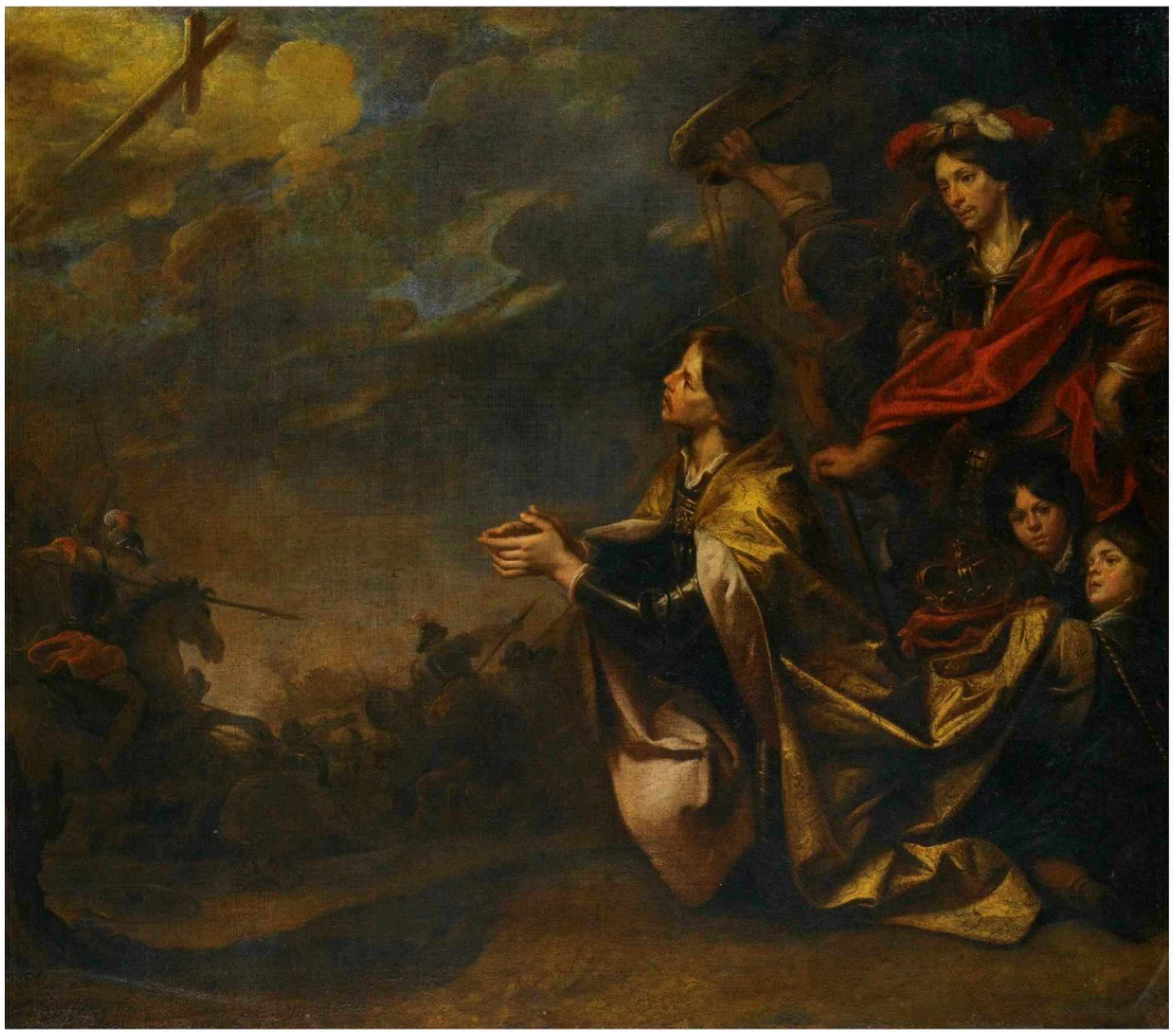
This account is one of the earliest descriptions connecting Constantine's victory with a Christian sign. It differs from the much later narrative in Eusebius' "Life of Constantine", where the emperor and his army are said to have witnessed a luminous cross in the sky.
Lactantius then describes the forces of Maxentius advancing without their emperor.
“The enemies advanced, but without their emperor, and they crossed the bridge.” Lactanius, On the Deaths of the Persecutors, 44
The opposing armies met and fought with considerable determination. He writes:
“The armies met, and fought with the utmost exertions of valour, and firmly maintained their ground.”Lactantius, On the Deaths of the Persecutors, 44.
The description indicates that Maxentius' soldiers initially resisted Constantine's forces, rather than collapsing without fighting. The account then introduces the disturbances in Rome and Maxentius' consultation of the Sibylline Books, after which the emperor joins the battle.
The panegyric of 313 gives a different impression of the engagement's opening stages. Its author emphasizes the speed and power of Constantine's attack, describing his opponents as giving way before the victorious emperor. This language was intended to glorify Constantine and does not establish that all of Maxentius' soldiers fled at the first assault.
Zosimus provides one of the more detailed surviving military descriptions. In his account, Constantine's cavalry attacked the cavalry of Maxentius and eventually threw it into confusion. The infantry then became involved, and the retreat of Maxentius' horsemen contributed to the collapse of the wider army.
The account suggests that cavalry action played an important role in the battle, although its precise sequence cannot be reconstructed with certainty. Zosimus wrote centuries after the event and does not identify the formations responsible for each stage of the fighting.
His description also contains difficulties in its presentation of Maxentius' cavalry, which appears to have been defeated while elements subsequently continued to resist.
The panegyric of 313 describes a division among the defeated soldiers as the fighting turned against them. Some fled toward the river, while others remained at their positions and were killed. The speaker identifies these men as particularly committed supporters of Maxentius, who had little expectation of mercy from Constantine.
Their resistance has been associated with the Praetorian Guard and with the equites singulares, but the passage itself does not name either formation. The description establishes that some soldiers continued to fight after the main force began to retreat, not the exact identities of the men involved.
The duration of the battle remains uncertain. Nazarius, speaking in 321, presents Constantine's victory as rapid and refers to having discussed the fighting more fully in a speech delivered the previous day. That earlier speech has not survived, and his remarks do not provide an exact measurement of the engagement.
Modern estimates suggesting that the fighting lasted less than an hour are therefore interpretations rather than times recorded by the ancient witnesses. A comparatively brief defeat of the main army could still have involved determined fighting by particular units, especially those unable or unwilling to withdraw.
The accounts agree on the outcome of the confrontation. Constantine's army prevailed, Maxentius' troops lost their positions, and the defeated soldiers began moving toward the river crossings. Their retreat brought them into a much more restricted area than the ground over which they had been fighting.
The most destructive stage of the battle followed as the army attempted to escape across the Tiber.
The Retreat, the Bridges and Maxentius' Death
The defeat drove Maxentius' soldiers toward the Milvian Bridge and the neighbouring river crossings. Infantry and cavalry withdrawing under pressure were forced into narrower approaches, where the movement of large numbers of men could become difficult to control. Those unable to reach a crossing faced the danger of entering the Tiber itself.
The earliest extended description of the disaster comes from the panegyric delivered in 313. Its author says that the retreating soldiers were obstructed by the narrowness of the Milvian Bridge. Some fled into the water, while others remained behind and were killed.
The orator also describes Maxentius attempting to escape with his horse and distinctive military equipment. He struggled to climb the steep opposite bank of the river but failed. According to the speech, other bodies were carried downstream, while Maxentius' body remained near the place where he drowned, allowing it to be recovered.
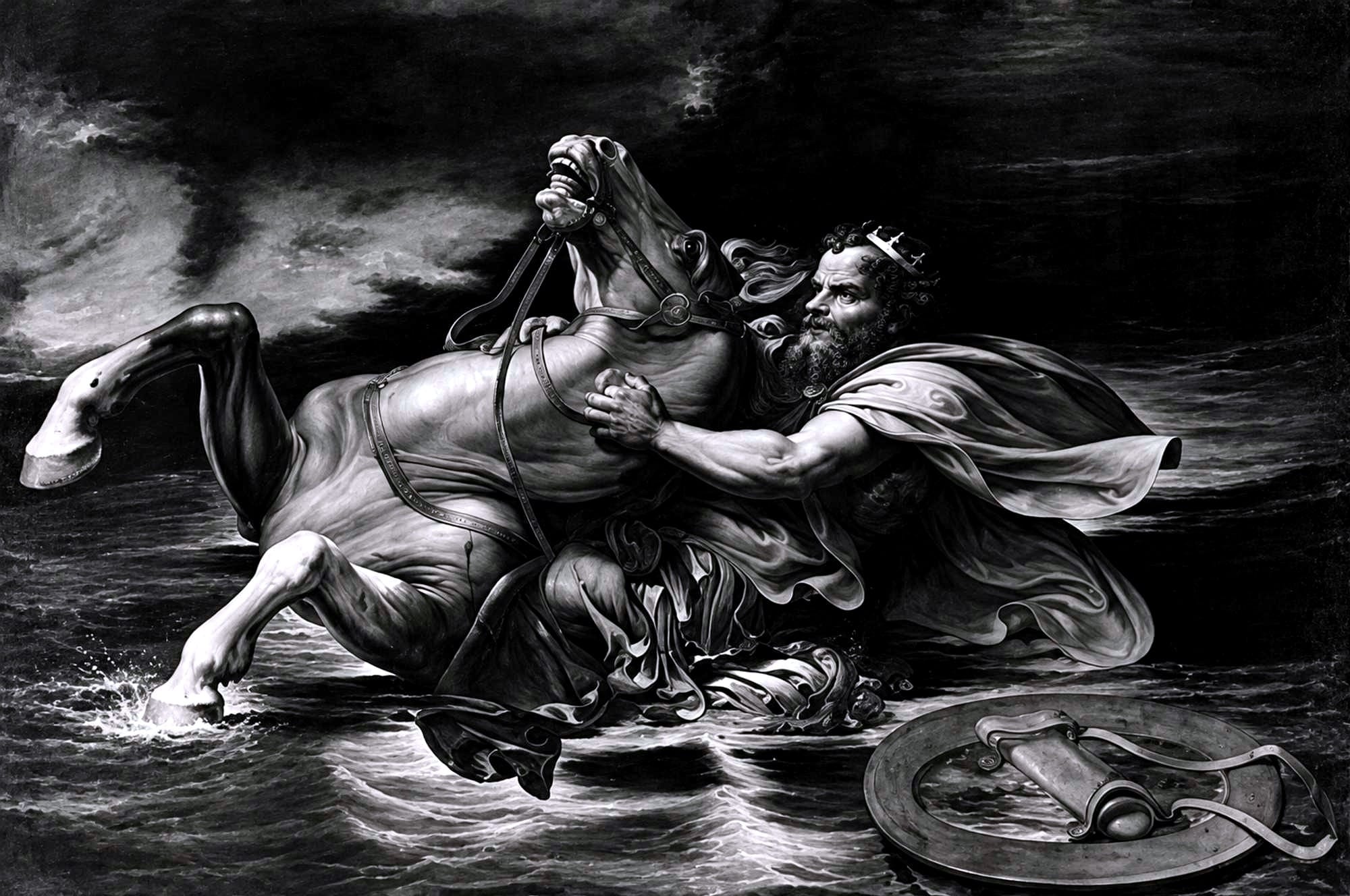
The account places the narrow crossing, the retreating soldiers and the riverbanks at the centre of the catastrophe. It does not describe a concealed trap or a mechanism designed to bring down a temporary bridge.
Lactantius gives a related but different version. He states that a bridge behind Maxentius had been broken down before the emperor attempted to retreat. He does not identify who damaged the crossing, explain how it was broken or clearly distinguish between the permanent Milvian Bridge and any temporary structure nearby.
His description of Maxentius' final attempt to escape is particularly vivid:
“He fled towards the broken bridge; but the multitude pressing on him, he was driven headlong into the Tiber.” Lactantius, On the Deaths of the Persecutors, 44.
In this account, Maxentius is forced into the river by the pressure of the retreating crowd. Lactantius does not describe a slipping horse or a deliberately activated bridge trap.
Eusebius, writing in his Ecclesiastical History, provides another version, involving a bridge constructed from boats. He describes Maxentius using the temporary bridge to bring his forces across the river toward Constantine. After the defeat, the emperor attempted to escape, but the crossing failed, and boats and soldiers sank into the Tiber.
“the bridge over the river being broken, the passageway settled down” Eusebius, Ecclesiastical History 9.9.7
Eusebius compares Maxentius' fate with the destruction of Pharaoh's army in the Red Sea. His account therefore combines a description of the emperor's death with a religious interpretation of Constantine's victory.
The temporary bridge became an increasingly prominent element in later descriptions of the battle. In Life of Constantine, written after the emperor's death, Eusebius added that Maxentius had prepared a concealed mechanism intended to destroy Constantine during a crossing. The trap then became the means of its creator's own destruction.
The earlier Ecclesiastical History does not contain this elaborate account of a hidden device. The relevant Greek passage in the later work also presents textual difficulties, with different modern editors proposing different restorations of the wording. The precise arrangement of the supposed mechanism cannot be reconstructed securely.
Zosimus provides an even more detailed description. He presents the temporary crossing as a wooden bridge built in two sections, held together by removable iron fastenings. According to him, workmen were instructed to release the fastenings when Constantine's soldiers attempted to cross.
Yet Zosimus does not clearly say that the workmen carried out those instructions. When he describes the eventual collapse, he attributes it to the timbers giving way beneath the weight of Maxentius' retreating soldiers.
The distinction is important because the existence of a plan to sabotage a crossing does not establish that the plan was executed. The account was also written considerably later than the battle, when the story of Maxentius' death had already undergone substantial elaboration.
Another version appears in the anonymous Epitome de Caesaribus. This work places a bridge of boats a little upstream from the Milvian Bridge and describes Maxentius' horse slipping near the crossing. The emperor fell into the river, where the weight of his equipment prevented him from escaping.
The passage does not securely establish whether Maxentius was advancing or retreating at the particular moment described. Its explanation also differs from Lactantius' account of the emperor being pressed into the water by his soldiers and from the panegyric's description of his unsuccessful attempt to climb the riverbank.
The various accounts have led to different reconstructions of the crossing. Some propose that the permanent Milvian Bridge had been damaged before the battle and that a temporary bridge was built nearby to provide an alternative route. Others place the boat bridge farther upstream, with the retreating army attempting to escape through more than one crossing.
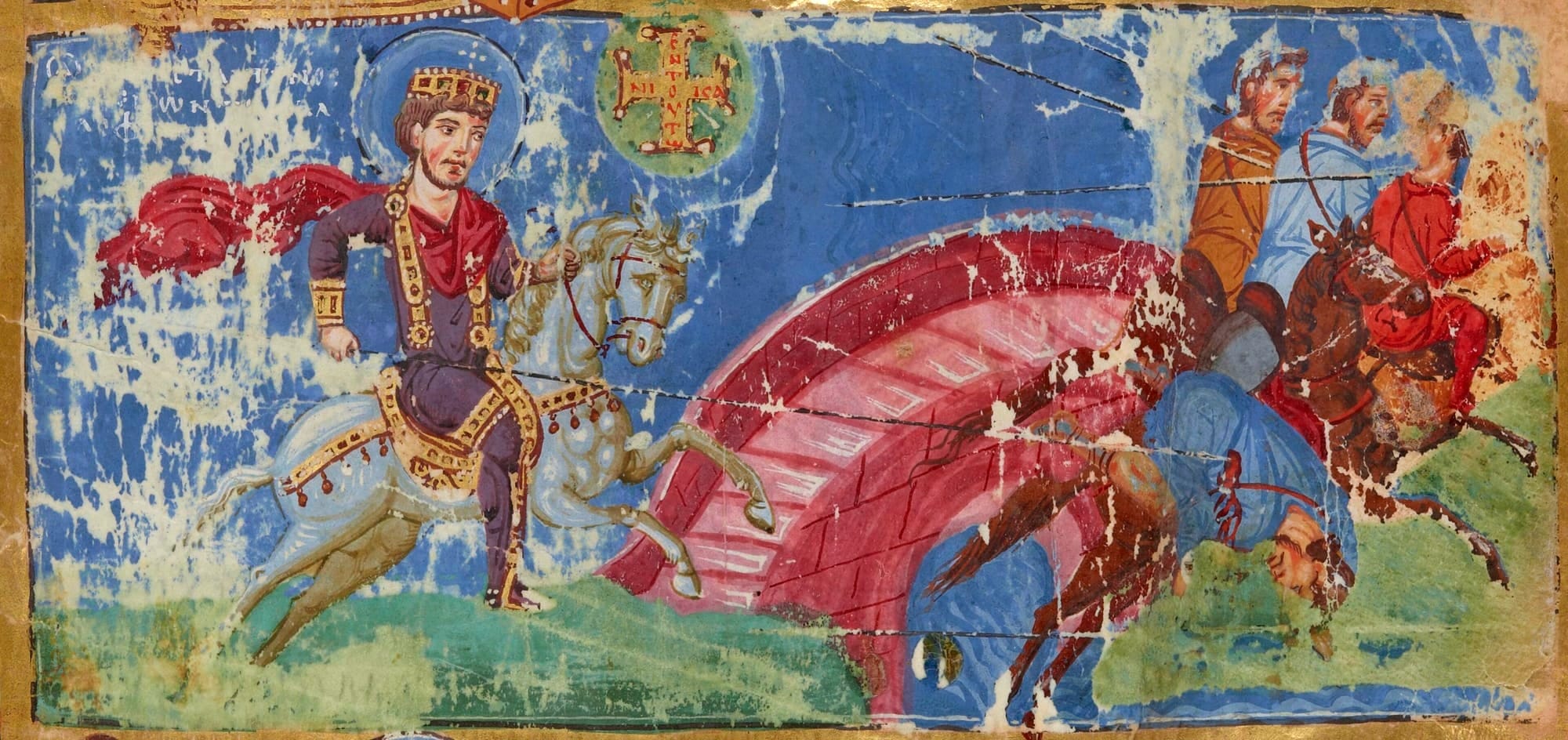
Neither arrangement can be established in all its details. The exact position of the temporary structure remains unknown, and the ancient writers do not consistently explain whether the damaged bridge they describe was the permanent crossing or the bridge of boats.
The story also developed within established literary traditions. Eusebius' description of Maxentius' boat bridge uses language associated with ancient accounts of Xerxes' temporary crossings over the Hellespont. The comparison was already familiar in Constantine's political world: a panegyric of 310 had contrasted Constantine's achievements in bridge construction with those of Xerxes and Caligula.
This literary background does not mean the temporary bridge was invented. Roman military engineers possessed the skills required to construct crossings from boats, and several accounts refer to such a structure. It does, however, show how the destruction of Maxentius could be presented through familiar examples of rulers whose ambitions ended in disaster.
The clearest common elements are the defeat of Maxentius' army, its disastrous retreat toward the river and the emperor's drowning. The precise crossing involved, the circumstances of its failure and the immediate cause of Maxentius' fall remain different in the surviving narratives.
Constantine's Victory and the Fate of Maxentius' Army
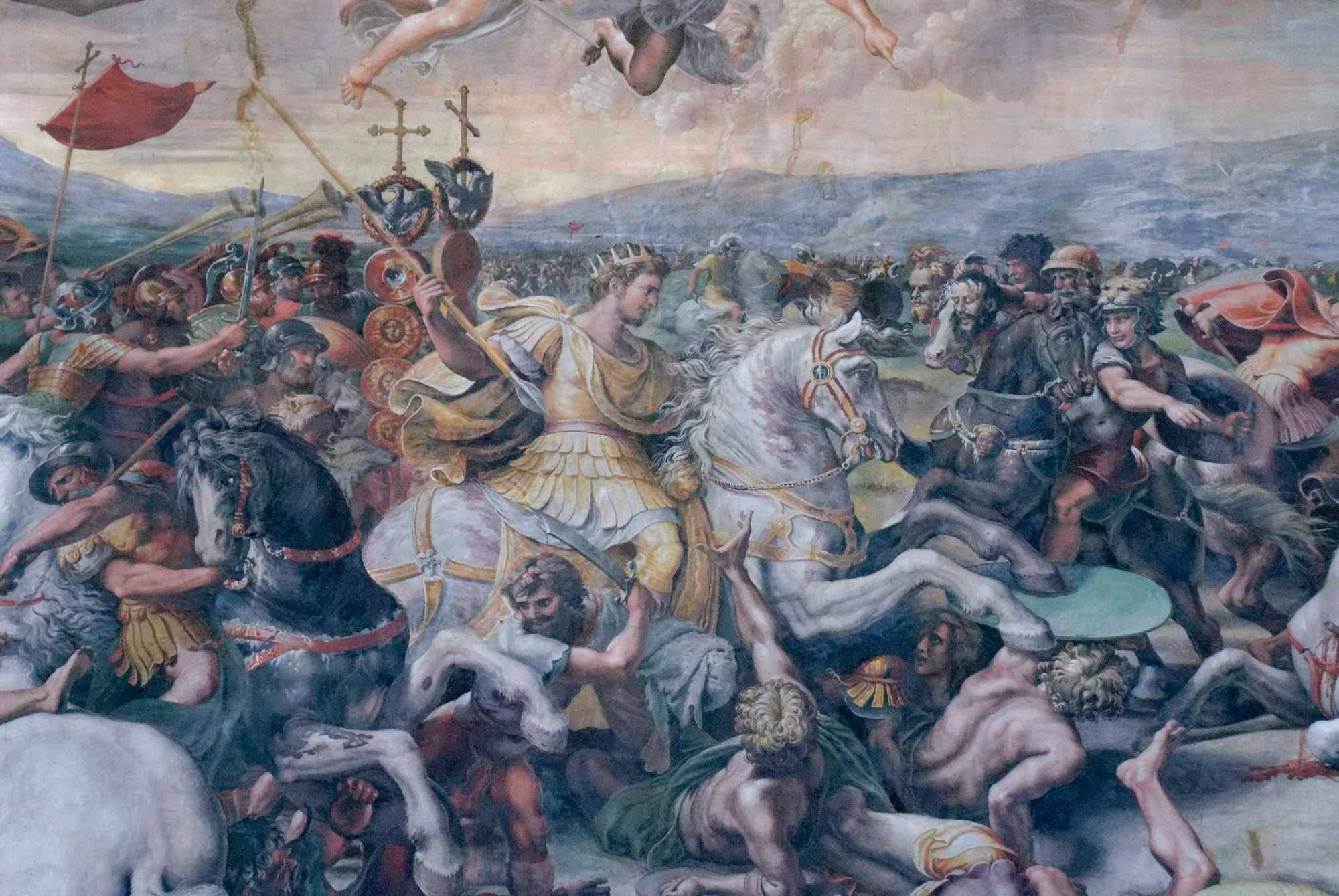
Maxentius' body was recovered after the battle, and his head was severed and displayed publicly. The panegyric of 313 describes it being carried on a spear during the celebrations, while Zosimus reports that its appearance convinced inhabitants of Rome who initially doubted the news of the emperor's death.
The display provided confirmation that the ruler who had controlled the capital since 306 was dead. Nazarius later reported that the head was also sent to Africa, where Maxentius had previously faced a serious rebellion.
Constantine entered Rome on 29 October, the day after the battle. Later Roman commemorative records distinguished the defeat of Maxentius on 28 October from Constantine's arrival on the following day.
The defeated army did not disappear entirely. Some men had died during the fighting and the retreat, including the determined defenders described by the panegyrist. Others survived and were subsequently incorporated into Constantine's forces.
The panegyric delivered in 313 reports that Constantine first disarmed captured soldiers and then returned weapons to some of them so that they could serve against external enemies. According to the speaker, former soldiers of Maxentius were subsequently guarding the Rhine and Danube frontiers.
The passage does not identify the units to which these men had previously belonged. It therefore cannot establish that particular Praetorians or mounted guards were among those transferred. It does, however, show that surviving soldiers from the defeated army could continue their military careers under Constantine.
The Praetorian Guard itself was abolished. Aurelius Victor and Zosimus both describe its dissolution after the victory, marking the end of an institution that had played a prominent role in imperial politics since the beginning of the Principate.
The abolition of the guard did not necessarily mean the execution of every soldier who had served in it. Constantine could dismantle the institution while accepting surviving men into other formations, although the precise fate of individual Praetorians is not recorded.
The equites singulares also disappeared as a separate imperial guard organization. Their barracks on Rome's Caelian Hill were demolished, and the site subsequently became associated with Constantine's new construction, including the development of the Lateran complex.
The treatment of these establishments reflects the removal of military organizations closely associated with Maxentius' regime. Their dissolution was one of the most visible institutional consequences of the battle, alongside the transfer of political authority in Rome.
Constantine's victory was commemorated in the city's monumental landscape. The Arch of Constantine, dedicated in 315, celebrated the defeat of an emperor presented as a tyrant. Its inscriptions and sculptural decoration gave the victory a permanent place among Rome's public monuments, although the identification of particular figures and military incidents in the reliefs remains disputed.
By the time Constantine's monument was dedicated, Maxentius' government had disappeared, his principal guard institutions had been abolished, and Constantine's authority extended over Rome and Italy. Other soldiers who had fought against him were already serving under the emperor whose invasion they had tried to stop.
Alföldi, Andrew, and Marvin C. Ross. “Cornuti: A Teutonic Contingent in the Service of Constantine the Great and Its Decisive Role in the Battle at the Milvian Bridge.” Dumbarton Oaks Papers 13 (1959): 169–183.
Cowan, Ross. Milvian Bridge AD 312: Constantine's Battle for Empire and Faith. Oxford: Osprey Publishing, 2016.
Elton, Hugh. “Warfare and the Military.” In The Cambridge Companion to the Age of Constantine, edited by Noel Lenski. 2nd ed. Cambridge: Cambridge University Press, 2012.
Odahl, Charles Matson. Constantine and the Christian Empire. London and New York: Routledge, 2004.
Potter, David S. Constantine the Emperor. Oxford: Oxford University Press, 2013.
Serfass, Adam. “Maxentius as Xerxes in Eusebius of Caesarea's Accounts of the Battle of the Milvian Bridge.” The Classical Quarterly 72, no. 2 (2022): 822–833.
Speidel, Michael P. “Maxentius and His Equites Singulares in the Battle at the Milvian Bridge.” Classical Antiquity 5, no. 2 (1986): 253–262.
Van Dam, Raymond. Remembering Constantine at the Milvian Bridge. Cambridge: Cambridge University Press, 2011.
Panegyrici Latini, VI(7), panegyric of AD 310.
Panegyrici Latini, XII(9), panegyric of AD 313.
Panegyrici Latini, IV(10), panegyric of Nazarius, AD 321.
Lactantius. On the Deaths of the Persecutors, 44.
Eusebius of Caesarea. Ecclesiastical History, 9.9.
Eusebius of Caesarea. Life of Constantine, 1.26–41.
Aurelius Victor. De Caesaribus, 40.
Zosimus. New History, 2.15–17.
Anonymous. Epitome de Caesaribus, 40.

About the Roman Empire Times
See all the latest news for the Roman Empire, ancient Roman historical facts, anecdotes from Roman Times and stories from the Empire at romanempiretimes.com. Contact our newsroom to report an update or send your story, photos and videos. Follow RET on Google News, Flipboard and subscribe here to our daily email.
Follow the Roman Empire Times on social media: