
How Did Romans Do Math?
How Romans handled arithmetic without modern numerals, from finger reckoning and abaci to fractions, interest, multiplication, division and engineering calculations.

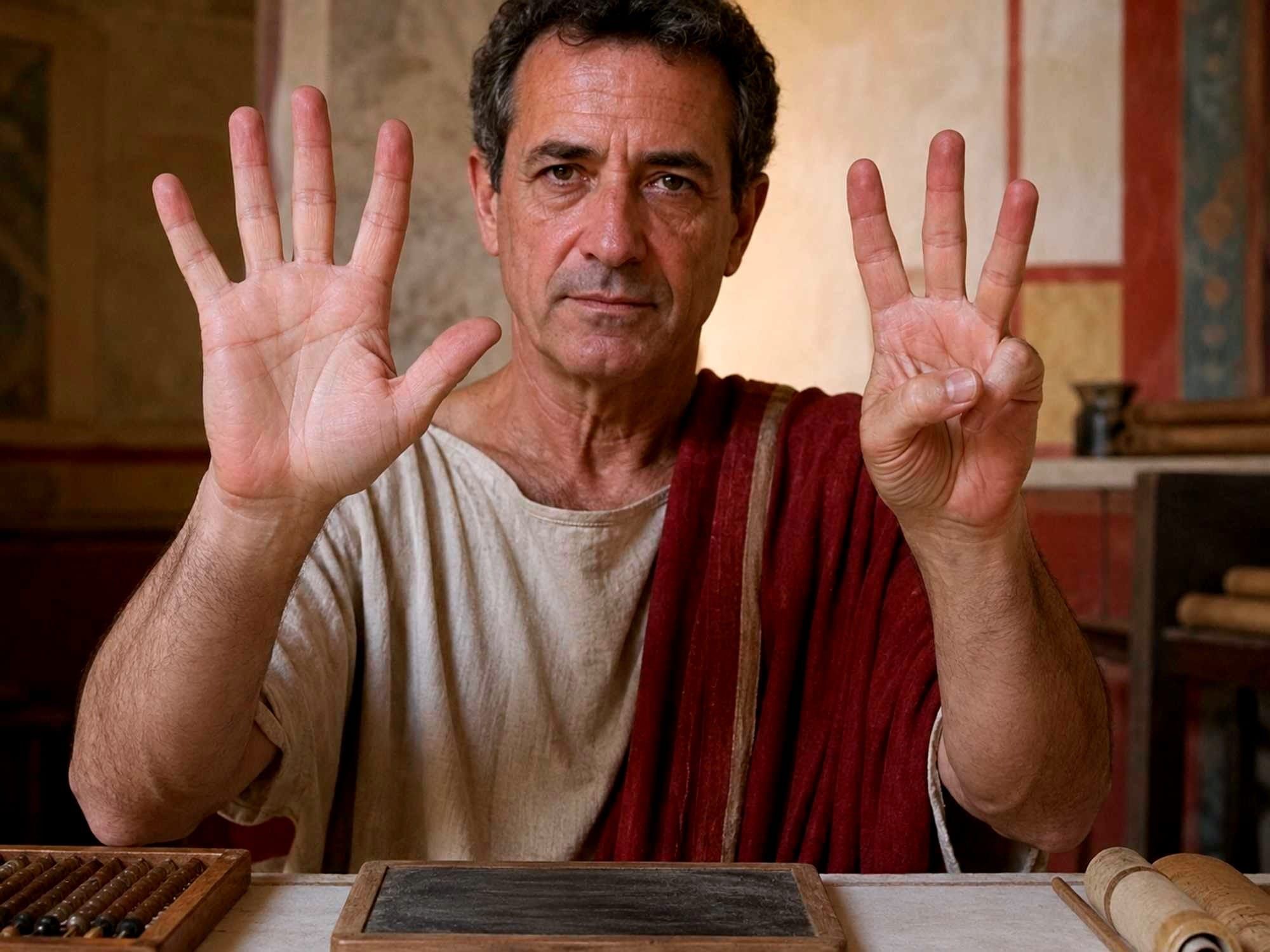
Roman numerals are familiar enough that most people can still decipher a date such as MDCCCLXXXVIII with a little patience. Trying to multiply that number by CCCLXIV is another matter. Without positional notation, a written zero, or the column arithmetic taught in modern schools, even an ordinary multiplication problem can appear unnecessarily difficult.
The Romans nevertheless had to calculate constantly. Land had to be measured and divided, prices and debts reckoned, interest calculated, inheritances apportioned, taxes and agricultural yields assessed, construction dimensions worked out and enormous quantities recorded in accounts. Roman texts preserve calculations involving large whole numbers, percentages and complicated fractions, while references to finger reckoning and counting devices show that written numerals were only part of the process.
What has largely disappeared is the working itself. No surviving schoolboy's exercise or merchant's wax tablet takes us through an ordinary Roman multiplication or division from beginning to end, and even the surviving accounts of the Pompeian businessman Caecilius Jucundus record transactions without showing the calculations behind them.
That absence is important because it limits how confidently the exact procedures can be reconstructed. Roman authors often preserve the figures they reached, and material evidence preserves some of the instruments available to them, but the movements of the counters or intermediate calculations were rarely recorded. The question is therefore not whether the Romans could perform arithmetic—they clearly could—but how much can be recovered about the methods they used.
Roman Numerals Were Only Part of the Story
For whole numbers, Roman counting was fundamentally decimal. Latin number words proceed through tens, hundreds and thousands, and written notation supplied signs such as I, V, X, L, C, D and M. The important difference from the modern system is that ordinary Roman notation did not use positional place value.
In the modern number 505, the two instances of 5 have different values because of their positions, while the zero preserves an empty tens position. The Romans had no equivalent numerical zero functioning as a placeholder in this way.
Roman numerals could still be used for written calculations. They were particularly convenient for recording quantities and totals, and simple addition and subtraction could be handled by grouping and manipulating corresponding signs. The difficulty of Roman numerals should therefore not be exaggerated into an inability to calculate with them. At the same time, Romans possessed other methods that avoided many of the inconveniences of written notation.
The abacus or counting board operated according to a principle much closer to positional arithmetic. A pebble or bead had one value in one column and another value in the next. A counter might represent one in the first position, ten in the next, one hundred in the next and so on.
Roman finger reckoning likewise distinguished units, tens, hundreds and thousands through different positions of the hands and fingers. Both systems could therefore embody place value even though ordinary Roman numerals did not.
This helps explain why judging Roman arithmetic solely from inscriptions covered in I, V and X gives a misleading impression. The notation used to record a quantity did not necessarily tell us how the quantity had been calculated.
Arithmetic Started at School
Arithmetic formed part of Roman education, although the evidence is much fuller for what pupils were expected to know than for the precise classroom methods used to teach them. Memorization and repeated drill appear to have been important, just as learning multiplication tables remained important in much later schooling.
Horace gives one of the clearest glimpses. In the Ars Poetica, a Roman boy is questioned about fractions of the as. If an uncia, one-twelfth, is removed from a quincunx, five-twelfths, the pupil is expected to answer triens, one-third. When the twelfth is returned, he gives semis, one-half. Horace turns the lesson into a joke about the boy eventually being capable of looking after his property, but the arithmetic itself is treated as elementary knowledge.
Later evidence preserves extensive numerical tables. The fifth-century Calculus of Victorius of Aquitaine included products involving units, tens, hundreds, thousands and Roman fractions, with whole numbers multiplied by values from two to fifty. It is the earliest surviving multiplication table of this sort for Roman numerals and fractions.
Earlier calculations in authors such as Columella have been taken to indicate that comparable tables already existed or could be produced when needed. The surviving table notably contains products of whole numbers and fractions, but not fractions multiplied by one another.
Petronius offers another glimpse of ordinary numeracy. One of Trimalchio's freedmen boasts that he has not studied geometry or literary criticism but can reckon in hundredths involving bronze, weight and money. The passage places practical arithmetic among the useful skills of someone involved in the commercial world. The same discussion of Roman education also connects school arithmetic with use of the abacus and probably finger reckoning.
Romans Really Did Count on Their Fingers
Finger reckoning in Rome was not simply counting from one to ten. Different positions could express different numerical values, and Roman writers expected their readers to recognize these gestures.
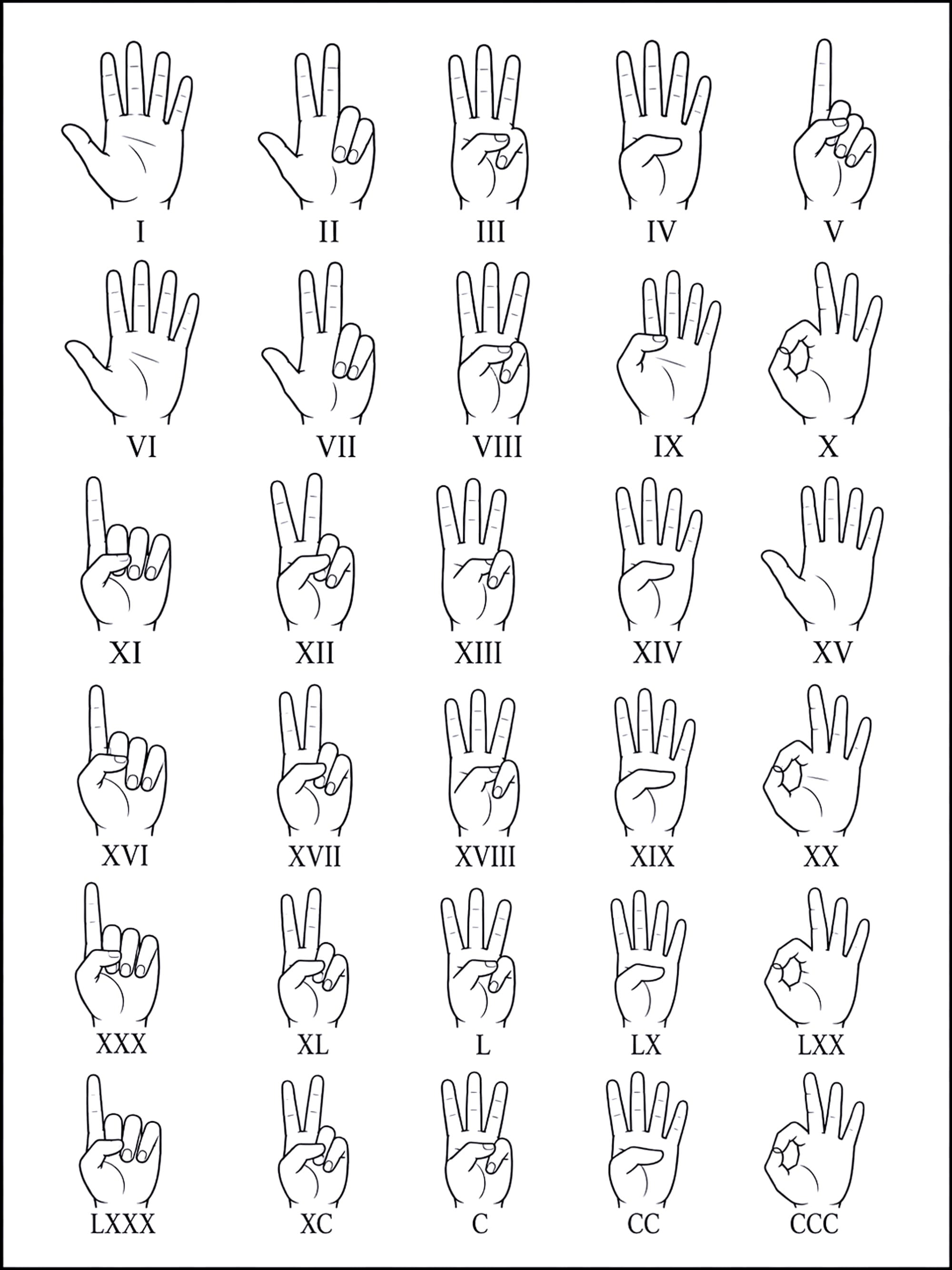
Plautus describes a character apparently calculating with the fingers of his right hand. Cicero expects Atticus to follow a financial calculation with his fingers. Pliny associates particular hand positions with the number 365, and Quintilian treats the correct use of numerical gestures as something an educated speaker ought to know.
Quintilian makes the point particularly clearly while discussing the education of an orator:
“Such knowledge is frequently required in actual cases, in which a speaker is regarded as deficient in education, I will not say if he hesitates in making a calculation, but even if he contradicts the calculations which he states in words by making an uncertain or inappropriate gesture with his fingers.”
The remark assumes that the gesture accompanying a number could itself be judged correct or incorrect. Calculation on the fingers was not an eccentric trick but part of a recognizable numerical language.
The fullest written instructions for this system survive from the early Middle Ages, so those later descriptions cannot simply be transferred wholesale to earlier Rome. There is, however, Roman-period evidence that confirms much of the basic structure. Small carved bone discs, probably dating from the first three centuries AD, show hands arranged in numerical positions together with Roman numerals. Their gestures correspond closely with much of the later system.
Units from one to nine could be indicated through positions of fingers on the left hand, while the thumb and index finger dealt with the tens. Corresponding gestures on the right hand represented hundreds and thousands. In this system, combinations of the two hands could express values up to 9,999.
The evidence becomes much less secure above that point, and later methods involving the position of the hands against different parts of the body should not automatically be assumed for the Roman period.
The system was also useful for actual reckoning. A Roman monument associated with L. Calidius Eroticus and Fannia Voluptas shows a traveller and an innkeeper with their hands extended while discussing a bill. The accompanying inscription runs through wine, bread, other food, a woman and fodder for the traveller's mule. The hands have been interpreted as registering the successive additions, allowing the total to be followed by both parties as the charges accumulated.
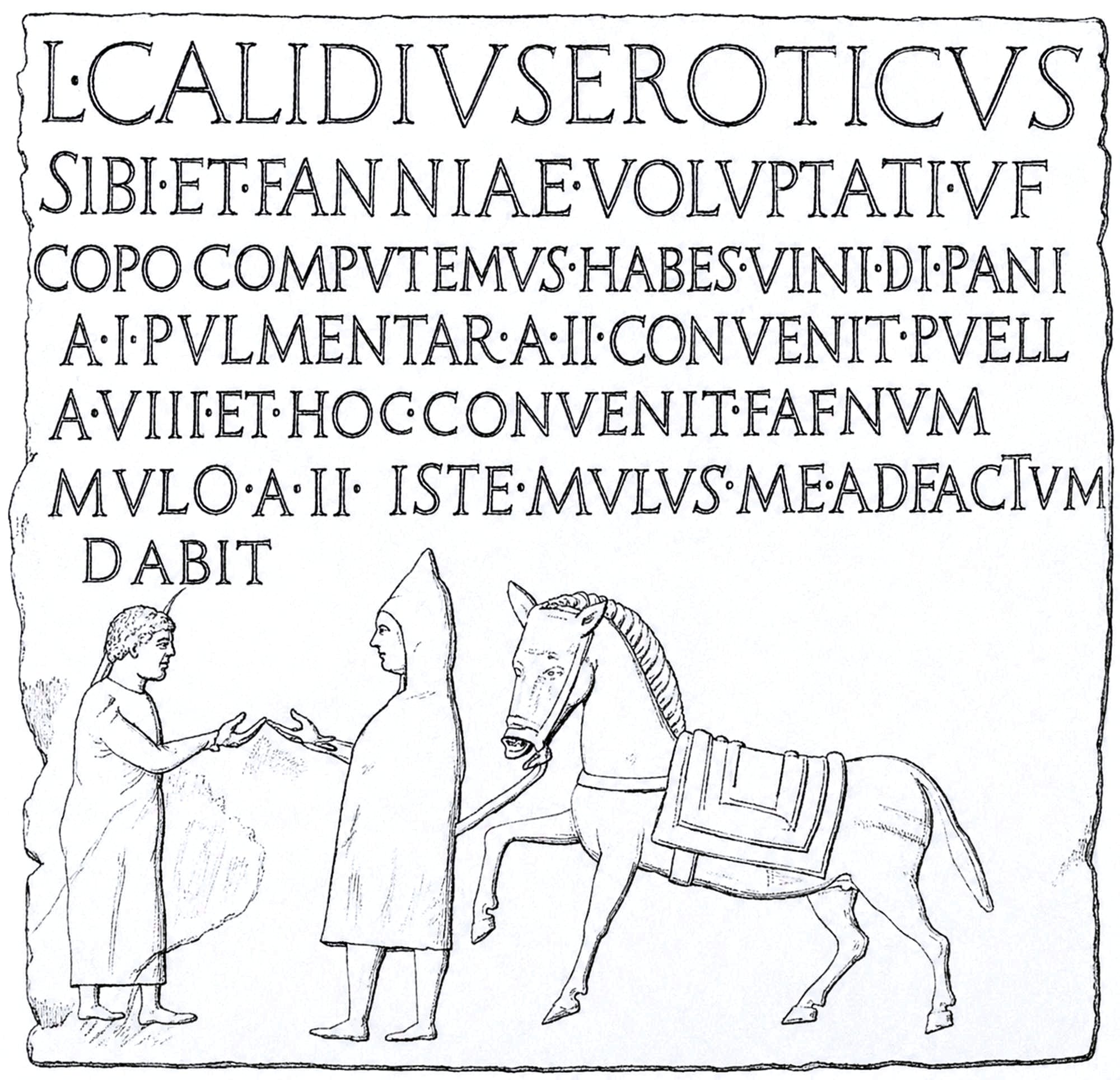
For commerce, the advantages were obvious. Fingers required no tablet, counters or writing equipment, and the people involved in a transaction could see the reckoning as it was performed.
Pebbles, Counting Boards and the Roman Abacus
The connection between counting and small stones survives in language. The Latin calculus meant a small stone or pebble, while calculi could be used as counters. From this comes the later language of calculation itself. A flat surface or tabula could be marked so that the counters occupied positions corresponding to different numerical values.
No ordinary Roman counting board of this type has been securely identified archaeologically. If many were wooden, their disappearance would hardly be surprising. Roman literature nevertheless contains enough references to counters to show that they were widely familiar. The terminology generally refers to the counters and the board rather than consistently using abacus in the modern sense.
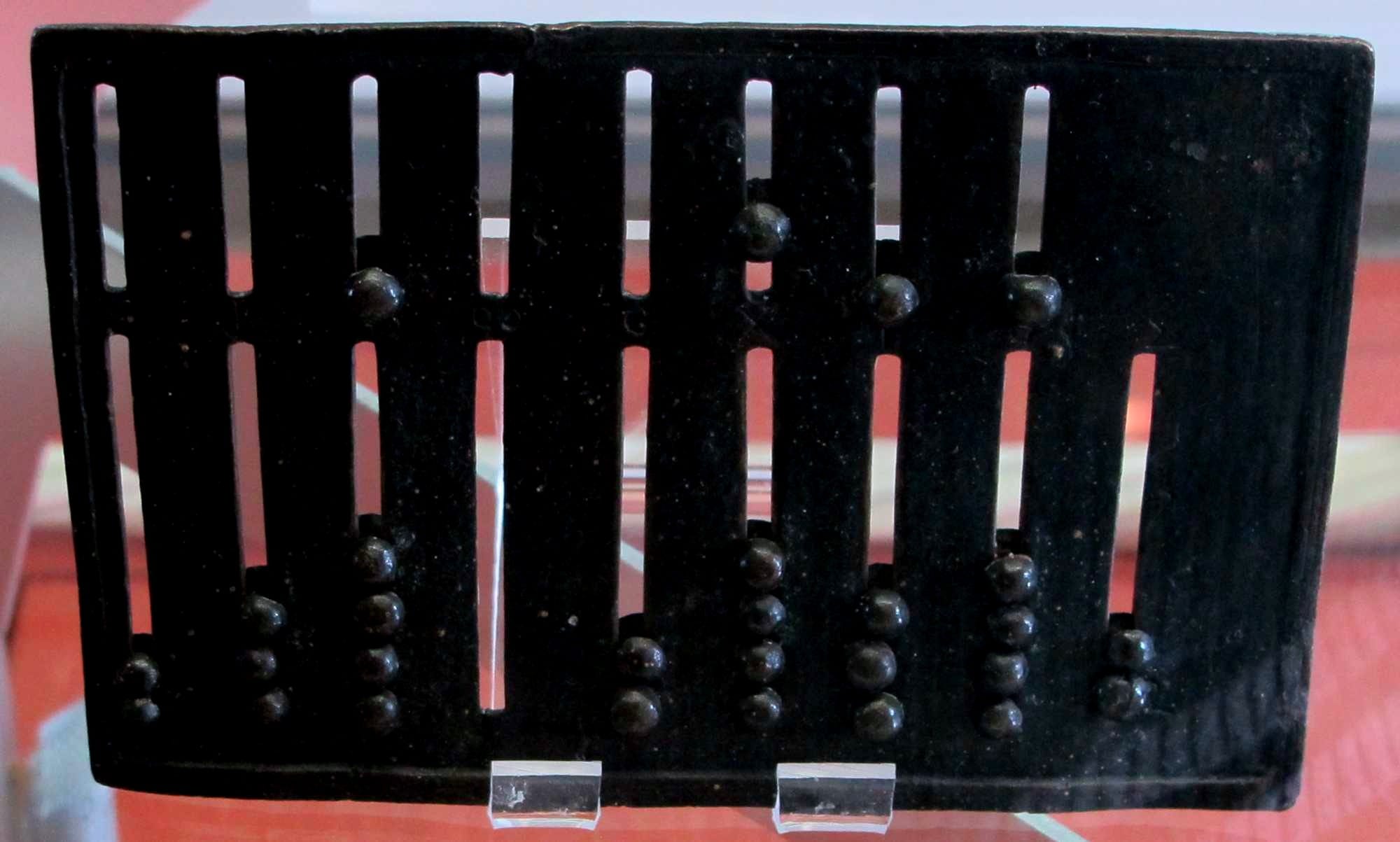
A different type of device does survive: the portable Roman hand abacus. These were small metal instruments with parallel grooves or slots in which beads could be moved. The principal part of the device was arranged decimally, with successive positions for increasing powers of ten. An upper bead represented five times the value represented by each lower bead in the same position. This permitted quite large numbers to be displayed with relatively few beads.
The fractional side of these instruments is especially revealing. It was not simply a decimal calculator with Roman symbols added to it. Separate positions were designed to handle the fractional relationships used in Roman measurement and money, particularly divisions based on the uncia. The portable devices could also be adapted to different Roman accounting conventions as monetary reckoning changed between bronze, denarius and sestertius systems.
The physical instrument therefore joined two numerical habits that can otherwise seem incompatible. Whole numbers could be treated in decimal positions, while fractions followed specifically Roman systems of subdivision. Someone could record the finished result in Roman numerals without having manipulated that result in the same non-positional form throughout the calculation.
Addition and Subtraction
Addition and subtraction are the operations that can be reconstructed with the greatest confidence because the structure of the counting board gives relatively little room for radically different methods.
A number could be laid out across columns representing units, tens, hundreds and thousands. To add another quantity, counters were placed in the corresponding positions. Whenever enough accumulated in one position, they could be exchanged for a counter of the next higher value. Subtraction reversed the process, removing counters and exchanging a higher-value one for lower units whenever necessary.
Roman numerals themselves could also be manipulated directly. A worked modern demonstration using Roman notation subtracts 126 from 378:
CCCLXXVIII − CXXVI = CCLII
Equivalent symbols can be grouped and removed, leaving the result. The example illustrates why written Roman arithmetic was cumbersome by modern standards without being impossible.
A reconstructed counting-board example begins with 4,739 and adds 1,456. Counters are added through the units, tens, hundreds and thousands positions, producing 6,195. Subtraction proceeds in reverse. The procedure is reconstructed, but for addition and subtraction the physical arrangement of the board sharply restricts the possible ways in which the operation could have been carried out.
Multiplication and division are more difficult because several workable procedures can be devised for the same instrument, and the surviving Roman evidence does not tell us which one was routinely preferred.
How Did Romans Multiply?
Roman authors preserve calculations that could not have been obtained without multiplication. Late antique multiplication tables also make the operation explicit. The difficulty is not establishing that Romans multiplied but recovering their normal method.
Repeated addition provides the most elementary route: to multiply a number by five, add it five times. Doubling and combining results could reduce the work considerably, while memorized multiplication tables would allow many products to be supplied immediately. A counting board could then hold and combine partial products.
One reconstruction of multiplication on an ancient board uses a procedure documented in Greek mathematics. Instead of beginning with the lowest-value figures, as modern written multiplication commonly does, it starts with the highest-value components and progressively accumulates the products.
The procedure adapts readily to an abacus. The source presenting it, however, explicitly derives the technique from Greek examples and does not possess a Roman multiplication exercise proving that Romans used precisely the same sequence.
That distinction has to remain. Romans knew multiplication and had instruments capable of performing it, but a procedure that works on a Roman counting board is not automatically a documented Roman algorithm.
The late table of Victorius is useful because it shows the scale of numerical relationships that could be tabulated. Its columns provide products for units, tens, hundreds, thousands and fractions, multiplied by whole numbers as high as fifty. Such a table would dramatically reduce the amount of computation required from scratch. Earlier calculations do not preserve comparable tables themselves, but they show the kind of arithmetic for which such memorized or written numerical relationships would have been useful.
Division and the Problem of Roman “Long Division”
Division is still harder to reconstruct. The Romans unquestionably divided quantities, but no surviving classical Roman document gives the equivalent of a modern textbook demonstration of long division.
A counting board could handle division through subtraction. Rather than repeatedly subtracting the divisor one unit at a time, an experienced reckoner could remove known multiples of it, progressively determining the quotient. One reconstruction divides 808 by 35 by subtracting suitable multiples until the quotient reaches 23 and a remainder of 3 is left. The method is workable, but the source presenting it explicitly warns that it cannot be claimed as the exact procedure Romans used.
The Roman administrative evidence from Veleia shows why this distinction between result and procedure is necessary. The Tabula Alimentaria records two imperial alimentary schemes at the northern Italian town in the second century AD. Loans were made to landowners against declared property, while the interest helped finance payments for the upbringing of selected local children. The tablet records the property declarations and resulting loans but not the calculations that connected them.
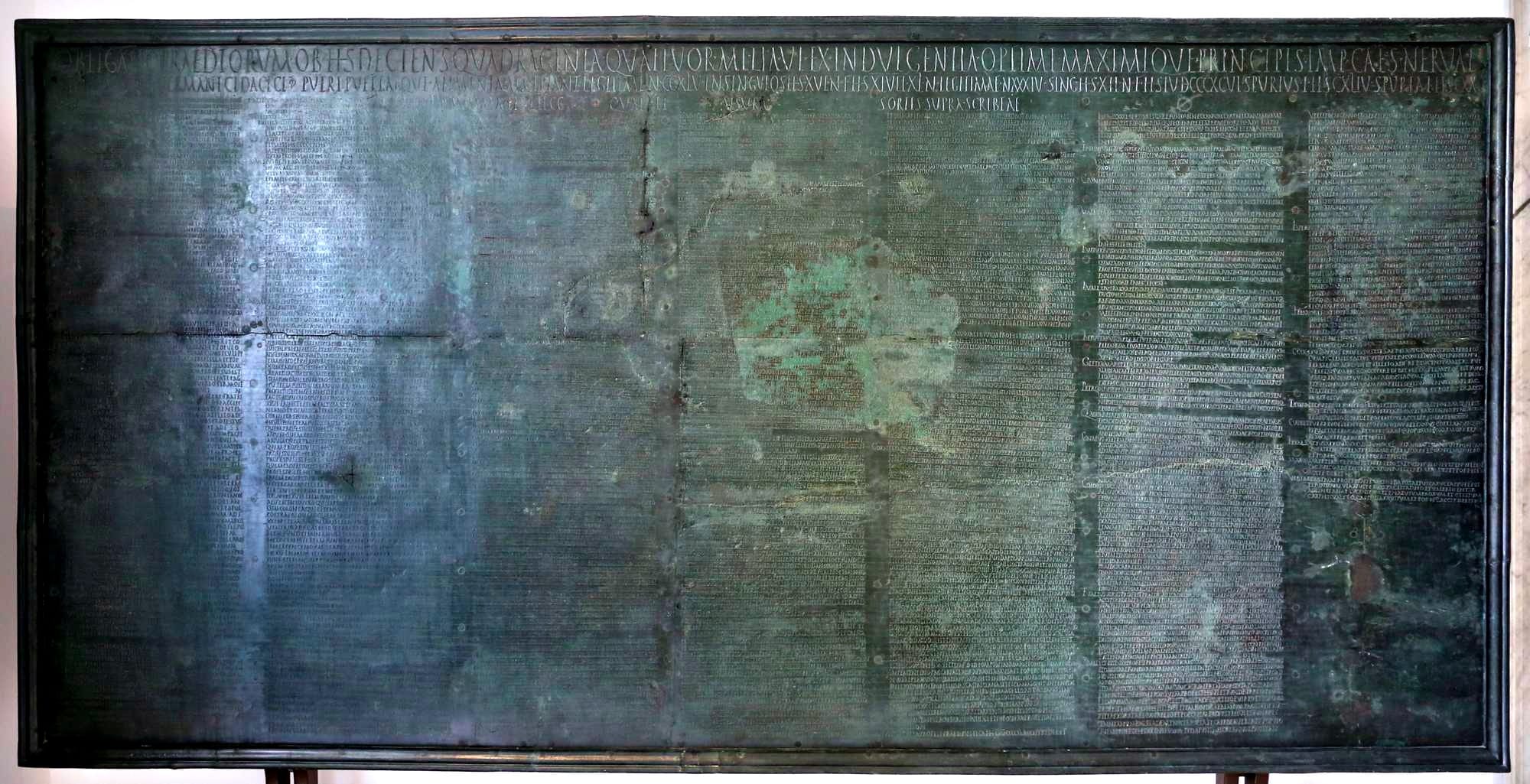
Analysis of these figures indicates that property values were rounded down to the nearest thousand sesterces before a fractional multiplier was applied. Earlier attempts expressed the multiplier as 8.05 per cent, but a rate of 8 7/144 per cent fits Roman fractional practice much more naturally. Using that formula gives the exact inscribed loan figure for 35 of the 46 cases. Several other results appear to come from the same calculation followed by rounding, while a few anomalies remain.
The details even provide clues about the order in which one accountant may have worked. In one case, finding a 144th part first and then multiplying it by seven produces the wrong figure. Multiplying by seven first and only then dividing by 144 produces the number on the tablet. This has been interpreted as evidence that the numerator was multiplied first in that particular calculation.
A repeated-subtraction method using counters can reproduce such a division, and rounding some figures could have reduced the work. Yet the proposed procedure remains conjectural. The Veleia figures preserve Roman administrative arithmetic at work, but not the accountant's hands moving across the board.
Why Roman Fractions Were Built Around Twelve
For someone accustomed to decimal fractions, the Roman fractional system can initially look more complicated than the whole-number notation. Its most familiar structure was based on twelfths.
The as was divided into twelve unciae. Six unciae made a semis, one-half; four made a triens, one-third; three made a quadrans, one-quarter. Five-twelfths was the quincunx, two-thirds the bes, and three-quarters the dodrans. These were named quantities rather than fractions normally written with a numerator above a denominator.
Subdivisions continued well below one-twelfth. The semiuncia represented 1/24, the duella 1/36, the siculus 1/48, the sextula 1/72, and the scripulum 1/288.
Twelve offered practical advantages because it divides evenly by two, three, four and six. Roman fractional terminology developed particularly from systems of weight and land measurement. The uncia, one-twelfth of the as, became the central fractional subunit, while smaller fractions were often related to halves, thirds, quarters and sixths of it.
The Romans did not ordinarily write general fractions in the modern form 5/17 or 37/357. Their traditional notation relied heavily on named unit fractions and combinations of them. This did not prevent them from approximating other ratios, but it affected the way the results were expressed.
It is also important not to imagine that all Roman arithmetic was rigidly based on twelfths. Authors could speak of parts of a hundred, and some Roman texts contain more general fractional relationships. What survives shows several numerical habits coexisting rather than one perfectly uniform system.
Percentages, Interest and Columella's Vineyard
Interest calculations provide one of the clearest examples of Romans moving between their traditional fractional vocabulary and what we would describe as percentages.
Columella discusses the cost of establishing a vineyard and arrives at 29,000 sesterces. He then calculates interest at a rate equivalent to one-half of one per cent per month, or six per cent annually. For two years the interest is 3,480 sesterces, giving a combined principal and interest of 32,480. He next states that an annual return of 1,950 sesterces would be required on that total.
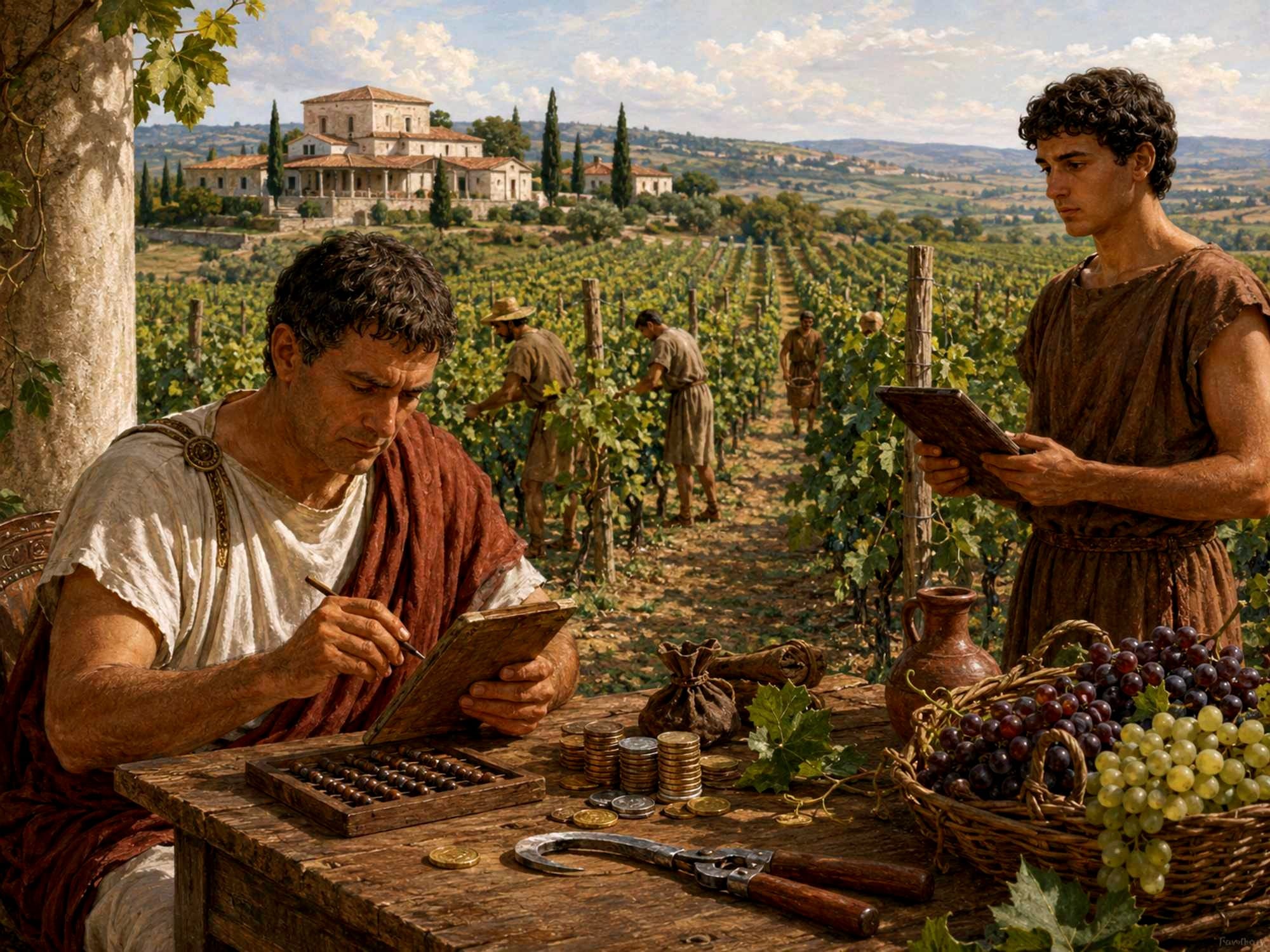
The first calculation is exactly correct by modern arithmetic: six per cent of 29,000 for two years is 3,480. Six per cent of the resulting 32,480, however, is 1,948.8 rather than 1,950. Columella gives the result without explaining his working. Several ways of reproducing it have therefore been proposed, including rounding and decomposing the percentage into Roman unit fractions.
One reconstruction begins by finding one-twelfth of the original sum, then applying a sequence of smaller unit fractions while discarding remainders. That sequence can reproduce Columella's figures, but the calculation is a proposed reconstruction rather than something Columella himself describes.
The example is useful precisely because the answer survives without the method. It shows that Roman financial arithmetic could deal successfully with quantities equivalent to percentage interest while leaving open more than one possibility for how the calculation was carried out.
Cicero, Taxes and Large Quantities
Cicero's speeches show that numerical calculation also belonged to public life and the law. In the prosecution of Verres he works through large quantities of grain, beginning with an amount calculated from agricultural land, subtracting the grain represented by the tithe sale, adding a further fractional levy and arriving at a final total.
Rendered in modern notation, the sequence includes a multiplication of 90,000 by six to obtain 540,000, subtraction of 216,000 to leave 324,000, calculation of three-fiftieths of 540,000 as 32,400, and addition of that amount to produce approximately 360,000.
Quintilian's insistence that advocates should be capable of handling numbers therefore had a practical setting. Cases involving land, taxes, debts, inheritances or accounts could demand arithmetic, and a Roman speaker who became confused over his figures risked appearing poorly educated.
Land Surveying and Fractions
Roman land measurement also depended heavily on numerical relationships. Varro describes the iugerum and its subdivisions in a way that allows the dimensions to be checked mathematically.
A square actus measured 120 feet by 120 feet. A iugerum contained two square actus, giving an area of 28,800 square feet. Its smallest named subdivision, the scripulum, was a square ten feet on each side and therefore measured 100 square feet. There were consequently 288 scripula in one iugerum.
Inscriptions show the same fractional language being used in actual land descriptions. One records two iugera together with ten-twelfths and another twenty-fourth, equivalent to 2 7/8 iugera. Another Roman inscription uses fractions when recording the lengths of theatre seating allocated to the Arval Brotherhood.
The combination of decimal whole numbers and duodecimal subdivisions was therefore not an abstract mathematical curiosity. It appeared in the practical measurement and division of Roman property.
Vitruvius and Large-Scale Calculation
Vitruvius provides several examples of arithmetic connected with architecture, measurement and machinery. In one passage he uses the conventional figure of 252,000 stadia for the circumference of the earth, converts it into 31,500,000 paces and then calculates one-eighth as 3,937,500 paces.
His description of an ancient distance-measuring device also gives numerical information about a wheel four feet in diameter and twelve and a half feet in circumference. From those figures his implied value for π is 3⅛. Later Roman calculations could use a closer approximation.
These examples do not tell us which instrument Vitruvius used while calculating, but they show the kind of multiplication, division and proportional thinking expected in Roman technical writing.
Frontinus and the Mathematics of Rome's Water Supply
Some of the most elaborate surviving Roman arithmetic appears in Frontinus's account of Rome's aqueducts, completed around AD 98 after his appointment to oversee the city's water supply.
Frontinus had to deal with pipe dimensions, water depths, widths, areas and capacities. In one straightforward example he records water five feet deep and one and three-quarter feet wide and gives the resulting area as eight and three-quarter square feet. More difficult sections compare different standardized pipe sizes and the relationships between circular and square measurements.
In one passage, the square digitus is said to exceed the corresponding circular one by 3/14 of its own area, while the circular form is smaller by 3/11. Working backwards from these ratios shows that Frontinus was using 22/7 as an approximation for π. The relationship can be established from his figures, but the manuscripts contain the fractions written out in words and do not preserve his intermediate calculations.
Frontinus then returns to more traditional Roman fractional notation when comparing pipe capacities. An uncia pipe is described in relation to the quinaria through a combination of an eighth, scripula, and a fraction of a scripulum. In modern decimal terms, one of his resulting comparisons differs from the calculated value by less than four parts in one hundred thousand. Other comparisons are less precise but still show substantial computational work.
His use of fractions is particularly interesting because he does not always express quantities in the same form. In some passages he uses ratios such as 3/11 and 3/14, while elsewhere he returns to combinations of familiar Roman fractions. One interpretation is that more general fractions may have been useful during calculation before the result was translated into the fractional language most familiar to the intended reader. The exact process remains uncertain.
Frontinus is therefore valuable not because he leaves us a Roman arithmetic manual, but because his finished figures show what a Roman technical administrator could accomplish even though the workings have disappeared.
What Roman Arithmetic Actually Looked Like
There was no single object or notation that can be called “the Roman calculator.” Different tasks could be handled in different ways. Roman numerals were useful for recording quantities and could themselves support some calculations. Fingers provided a portable numerical language. Pebbles on a board allowed numbers to be manipulated positionally. Portable metal abaci combined decimal whole numbers with fractional subdivisions. Memorized tables reduced repeated computation, while writing surfaces could presumably hold intermediate figures when a problem became too complicated for fingers or the available abacus.
The sources also show that Roman numerical practice was not confined to merchants. Schoolchildren were taught fractions; advocates needed numerical competence; farmers calculated investment returns; surveyors divided land; administrators established loan amounts; architects converted large measurements; and the official responsible for Rome's aqueducts dealt with sophisticated relationships between areas and capacities.
What remains uncertain is the exact algorithm used in many individual operations. The surviving evidence does not allow a standard Roman multiplication procedure or Roman long-division method to be written down with the confidence of a modern textbook. Reconstructions demonstrate ways in which the known instruments could produce the surviving answers, and some Roman datasets even provide clues about the order of particular operations, but those reconstructions have to remain separate from what the ancient evidence directly records.
Roman numerals may look awkward to modern eyes, but the calculations preserved in Roman literature, inscriptions and administration show a society perfectly capable of performing the practical arithmetic its schools, markets, farms, courts, surveyors and engineers required.
J. Hilton Turner, “Roman Elementary Mathematics: The Operations,” The Classical Journal 47, no. 2 (1951), pp. 63–74, 106–108.
David W. Maher and John F. Makowski, “Literary Evidence for Roman Arithmetic with Fractions,” Classical Philology 96, no. 4 (2001), pp. 376–399.
Charles Stewart, “Fractional Arithmetic in the Tabula Alimentaria of Veleia,” Journal of Roman Studies 109 (2019), pp. 89–102.
Flip de Bree, “Aes Excurrens and the Abacus,” Ancient Society 48 (2018), pp. 115–145.
Horace, Ars Poetica.
Plautus, Miles Gloriosus.
Cicero, Letters to Atticus and Against Verres.
Quintilian, Institutio Oratoria.
Varro, De re rustica.
Columella, De re rustica
Petronius, Satyrica.
Vitruvius, De architectura.
Frontinus, De aquaeductu urbis Romae.
Pliny the Elder, Natural History.
About the Roman Empire Times
See all the latest news for the Roman Empire, ancient Roman historical facts, anecdotes from Roman Times and stories from the Empire at romanempiretimes.com. Contact our newsroom to report an update or send your story, photos and videos. Follow RET on Google News, Flipboard and subscribe here to our daily email.
Follow the Roman Empire Times on social media: