
A Roman Ritual for Night Lightning Comes to Light at Hadrian’s Villa
An inscribed slab found in place at Hadrian’s Villa points to a Roman lightning rite. Its ancient parallels show what the evidence can – and cannot – tell us.

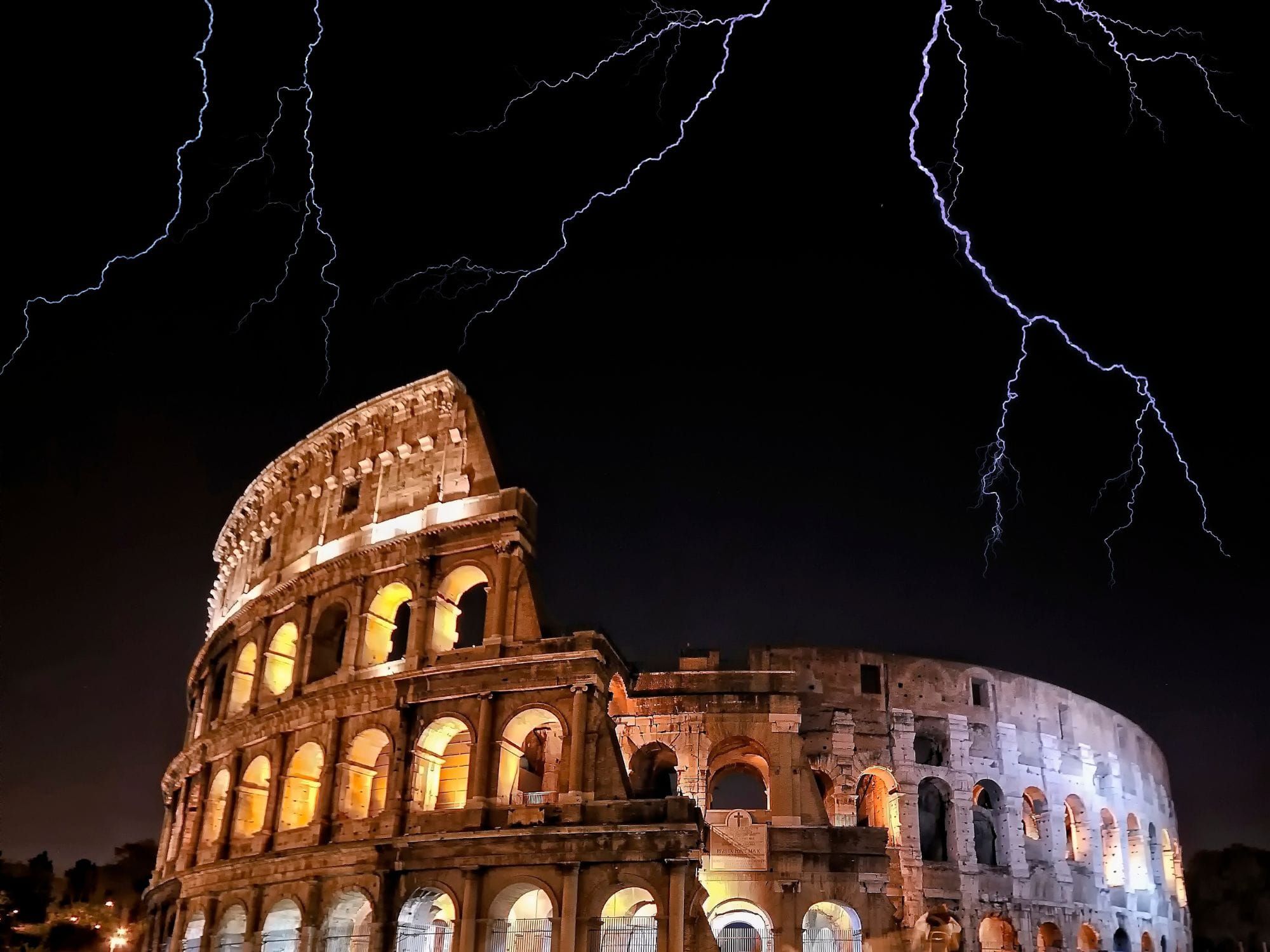
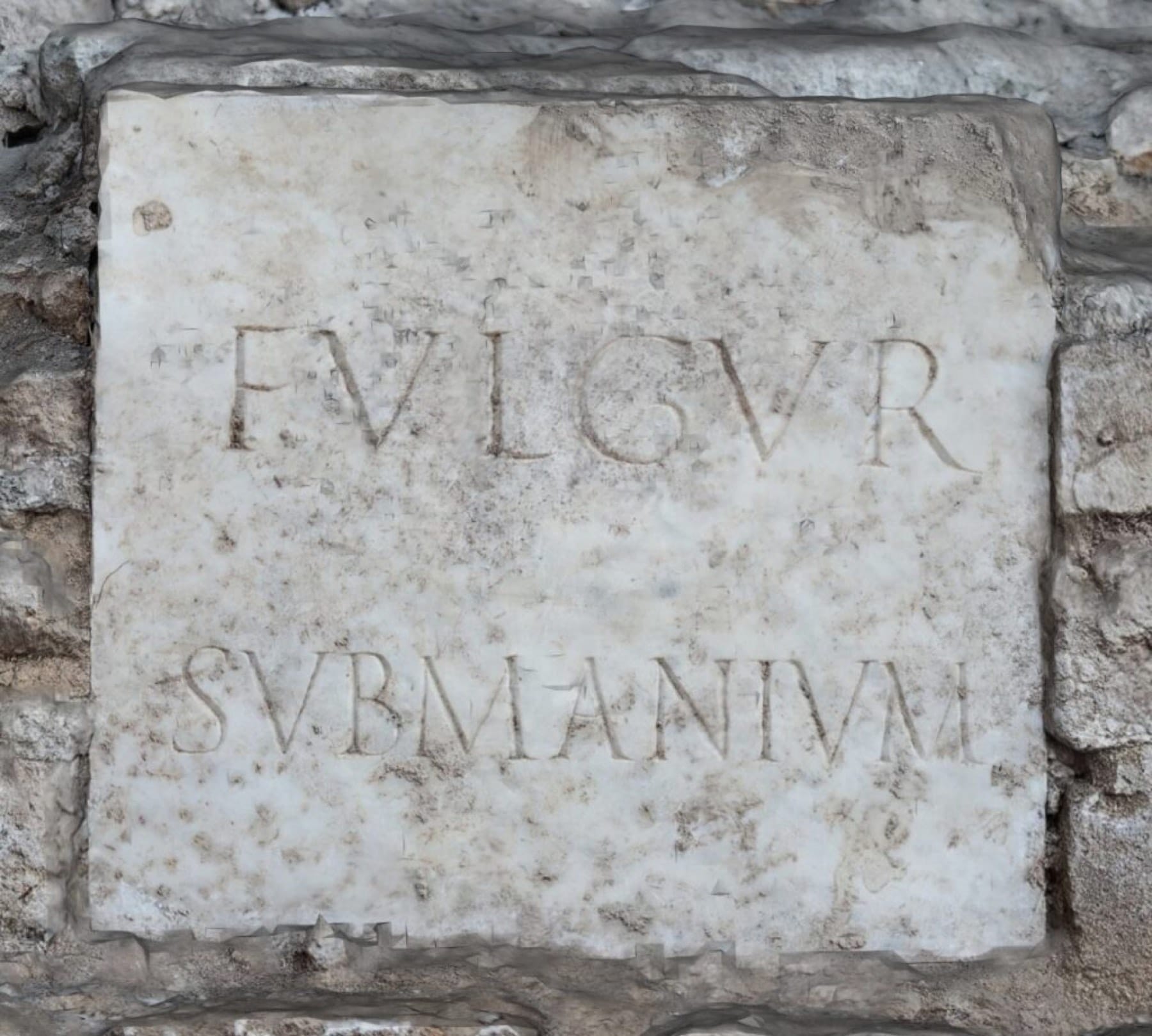
An inscribed marble slab found at Hadrian’s Villa, near Tivoli, has given archaeologists rare evidence for how Romans marked a place associated with a lightning strike. The two-line text names a fulgur Summanium—lightning attributed to Summanus, a deity linked with the night. It was found in its original position within a small structure, according to the Italian institute responsible for the site.
The discovery was announced in September 2026 after excavations near the villa’s so-called Amphitheatre. The institute interprets the structure as a possible bidental, a ritually separated place connected with lightning.
A slab found in place
The inscription emerged inside a small quadrangular structure built with mortared tufa, a volcanic stone. The area lies between a tufa bank and the feature traditionally called the Amphitheatre. The marble slab measures about 40 by 35 centimetres. Its position matters because many other lightning inscriptions survive without the setting in which they were first placed.
Excavation is being carried out by a University of Urbino team under a concession from Italy’s Ministry of Culture, in collaboration with the institute that manages Hadrian’s Villa. The institute identifies the two lines as FVLGVR SVBMANIVM. In Roman lettering, V can represent the vowel U, giving the reading fulgur Summanium.
As aforementioned, the find belongs to the landscape of Hadrian’s Villa at Tivoli, a residence whose monuments acquired different uses and histories over time. The institute says the relationship between this structure, a palace area excavated in 2024, and later levelling or burial is still being investigated. The inscription’s original position is secure; the full story behind it is not yet 100% clear.
Why Summanus appears on the stone
Summanus was associated with lightning at night, whereas Roman discussions also distinguished lightning in daylight. The institute reads the name on the slab in that religious framework. The wording identifies the kind of lightning the marker commemorated; it does not supply a date, describe the storm, or name the person who carried out the observance.
Other evidence shows that this was not an isolated way of naming a strike. A scholarly study of Roman lightning burials records a fulgur Summanium inscription at La Turbie, in what is now southeastern France. The parallel supports the reading of the Hadrian’s Villa text, with the two monuments not having identical settings or ceremonies, but still bear a lot of similarities.
Roman religion could give different divine identities to natural events. Our overview of the gods Romans worshipped introduces the better-known Jupiter; Summanus appears much less often in surviving accounts. At the villa, the name on the marble is the direct evidence. Any account of who witnessed the strike or decided to mark it would go beyond what has been reported.
What the lightning rite involved
Ancient texts and excavated examples describe a practice often called fulgur conditum, literally a lightning strike that has been “buried.” Material thought to have been affected by the strike could be collected and placed in the ground. A marker, enclosure or other boundary could then set the place apart. These details change from one site to another, hence the slight differences between them.
The term bidental is commonly used for such a lightning place, but it does not guarantee a temple or a permanent public shrine. Some accounts include sacrifice and ritual words; the archaeology does not recover those acts at every location. The derivation of the term from a two-year-old sacrificial animal has also been debated, so the word itself cannot prove that a particular animal was sacrificed at Hadrian’s Villa.
The observance makes sense within Roman practices of worship and sacrifice, in which a striking event could call for a formal response. Yet the villa’s announcement identifies a possible ritual space, not the complete contents of a buried deposit. No victim, officiant, prayer or sequence of actions can presently be assigned to this structure with confidence, as no direct evidence is yet found.
Parallels beneath Roman streets
The material record gives a more varied picture than a single recipe for 'burying lightning'. At Ostia, a house contained an inscribed brick container in its peristyle, or columned courtyard, dated by the excavator to the later first century CE. At Pompeii, a mound and shaft in a house held damaged materials associated with a lightning marker. Both examples put the response within ordinary built spaces.
At Minturnae, south of Rome, architectural fragments were buried in a well in the forum; at Luni in northern Italy, an enclosure yielded ash, roof tiles and a sculpted head. These cases were assembled in a peer-reviewed study of the rite. They show why a slab at Hadrian’s Villa is especially informative when it survives with part of its surrounding structure.
A gilded bronze statue of Hercules found near Rome’s former Theatre of Pompey offers a larger-scale parallel. Its nineteenth-century discovery was connected with a lightning burial, although the circumstances differ from the villa’s newly excavated stone. Together, such finds indicate that Romans might separate damaged objects or a struck place from ordinary use, while leaving the exact ritual history of each find to be established individually.
.jpg?ref=romanempiretimes.com)
A lightning story in Cicero
The literary evidence shows why lightning could carry religious weight without serving as a field report for the new excavation. In Cicero’s On Divination, the speaker Quintus asks a question about the prophetic value of lightning. The wording comes from William Armistead Falconer’s 1923 translation of Book 1, section 16:
Again: is it possible for us to doubt the prophetic value of lightning?
Quintus then recounts a story about a clay image of Summanus on the temple of Jupiter Optimus Maximus at Rome. After lightning struck it, its head was said to have been found in the Tiber, in keeping with a prediction attributed to diviners. Cicero frames the episode as part of a debate about divination; it is evidence for how a Roman author presented lightning signs, similar to the ones found in Hadrian's villa.
Readers interested in the writer behind that debate can turn to our account of Cicero’s life and philosophical work. His story helps explain the religious language on the slab, but the stone and its excavated setting remain the main evidence for this discovery.
What the villa can still reveal
The institute’s announcement places the stone in a structure that may have marked the struck spot. Its location near the so-called Amphitheatre gives excavators a defined area to investigate, and its survival in place makes it possible to examine how the inscription related to the building. That context is what sets the discovery apart from an unprovenanced marker.
The next questions are archaeological. Investigators need to establish when the structure was built, whether deposits beneath or around it belong to the lightning observance, and how its use fits later changes to this part of the villa. The institute has left the relationship between the small structure and the nearby palace area open.
For now, the secure claim is specific: a marble marker at Hadrian’s Villa names lightning attributed to Summanus, and the excavators consider its setting a possible place set apart after a strike. The wider Roman record explains why that interpretation is plausible. Further excavation will determine how much of this particular ritual can be recovered, so the mystery of 'burying lightning', is finally solved.
Istituto Villa Adriana e Villa d’Este, official discovery announcement (10 September 2026)
Nicolas Laubry, “Les « coups de foudre » de Jupiter et l’exportation de la religion romaine en Gaule,” Gallia 73-2 (2016), 123–144
Cicero, On Divination 1.16, translated by William Armistead Falconer (Loeb Classical Library, 1923)
Sarah E. Bond, “The Ancient Romans Had a Strange Ritual After Thunderstorms,” National Geographic (29 September 2026)
About the Roman Empire Times
See all the latest news for the Roman Empire, ancient Roman historical facts, anecdotes from Roman Times and stories from the Empire at romanempiretimes.com. Contact our newsroom to report an update or send your story, photos and videos. Follow RET on Google News, Flipboard and subscribe here to our daily email.
Follow the Roman Empire Times on social media: