
DNA Reveals Man with Leprosy Trekked 800 Miles Across Europe as the Roman Empire was Falling
A richly furnished boat grave at Fallward combines possible Danubian ancestry, Roman-associated objects and ancient leprosy in the life of a fifth-century man.


A man buried in a wooden boat on Germany’s North Sea coast may have had family roots near Rome’s Danubian frontier, according to a new ancient DNA study. His grave at Fallward also contained a Roman military belt, elaborately carved furniture and the genetic traces of the bacterium that causes leprosy.
The combination brings fresh evidence to a burial excavated in the 1990s. Archaeologists had already recognised the wealth of its furnishings and their connections with the Roman world. The new research adds a possible southeastern European ancestry connection and identifies an ancient branch of the leprosy pathogen in the same individual.
Published in iScience on 15 October and announced by Kiel University on 3 November 2026, the research concerns a man who died in the second quarter of the fifth century. Its authors propose that he or his recent ancestors moved northwest from the broader Danubian region, while treating his precise origins as unresolved.
A cemetery preserved in coastal clay
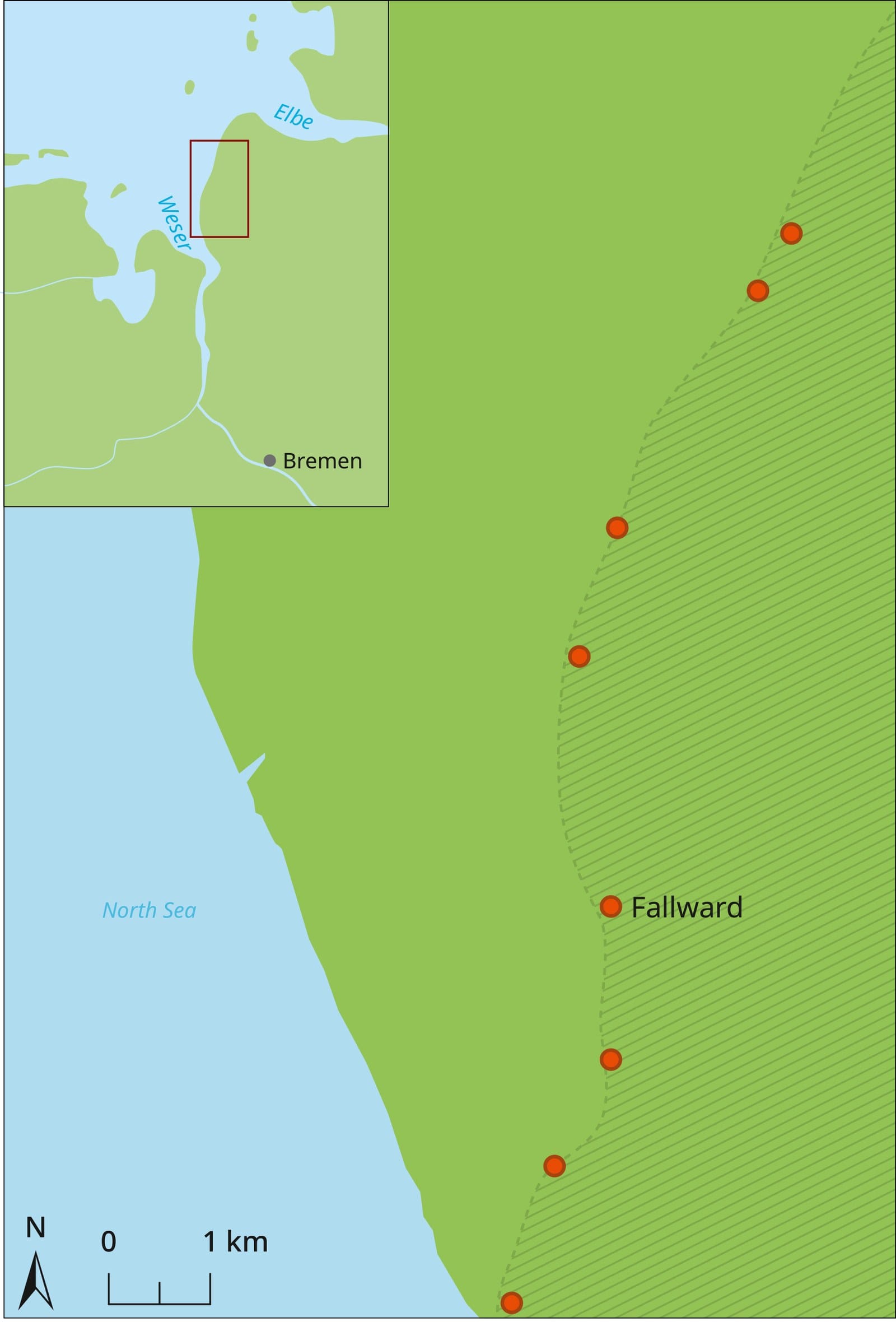
Fallward lay in the area between the Elbe and Weser rivers in present-day northwestern Germany. Its inhabitants built on an artificial dwelling mound, known as a wurt or terp, above a natural beach ridge. Before coastal dikes existed, raised ground offered protection from high tides, flooding and storm surges.
The surrounding marshland provided fertile agricultural land. Settlement began in the first century BCE, and the cemetery was used from the end of the third century into the late fifth. Excavations uncovered approximately 200 cremation burials and 60 graves containing unburnt bodies, providing evidence for several generations of coastal life.
Deep grave pits reached permanently damp marsh clay, preserving materials that usually disappear. Wooden furniture, clothing fabrics, furs and plant bedding survived alongside metal and ceramic objects. These finds are now being re-examined through an interdisciplinary project, including the laboratory excavation of graves originally lifted as intact blocks.
A boat furnished for a man of status
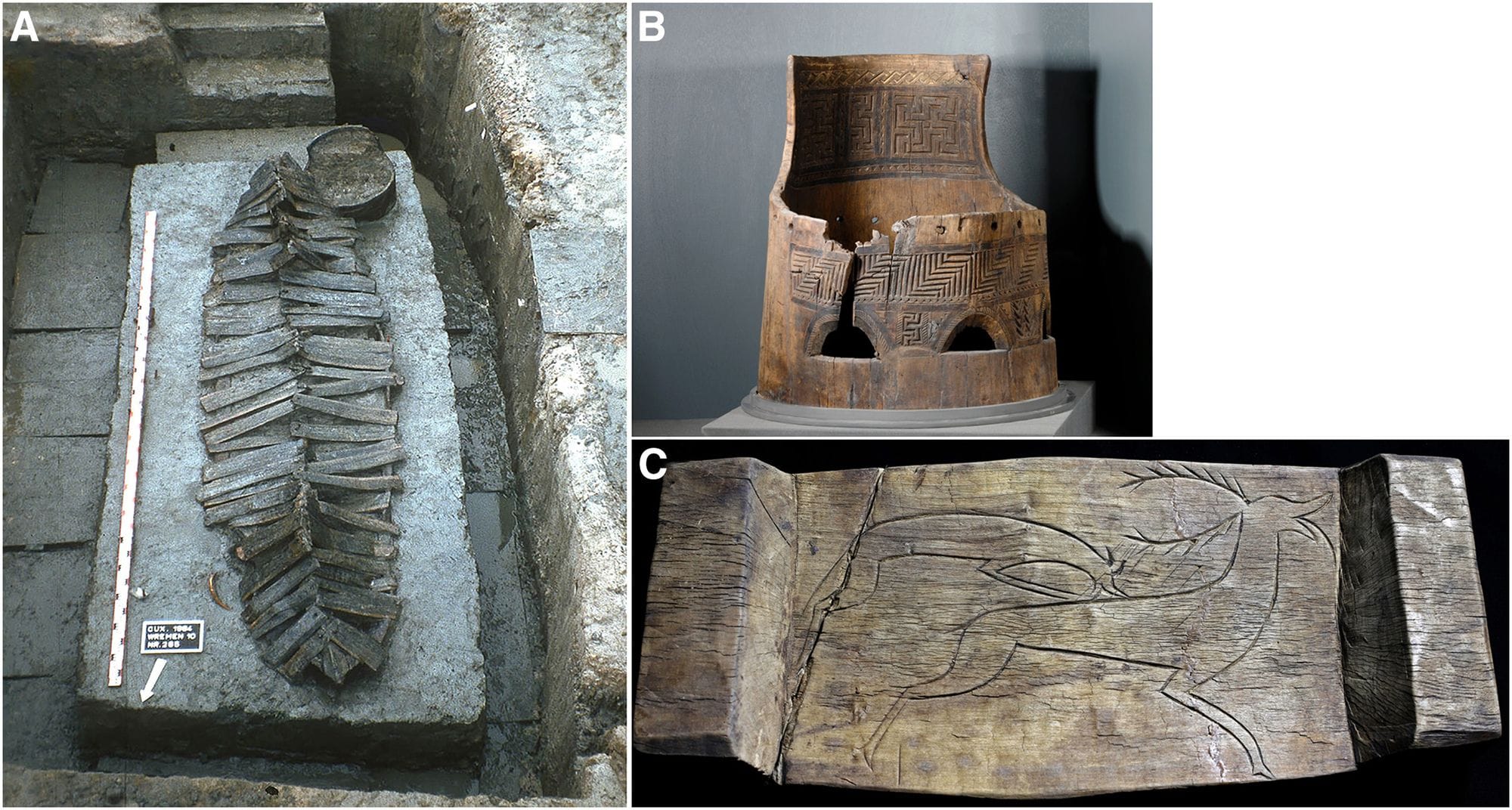
The burial designated grave 265 held a man estimated to have been about 50 years old. He lay in an oak boat more than 4 metres (13 feet) long, beneath wooden panels arranged into a roof-like covering. A reed mat supported his body, while fish bones and a small box shaped like a water bird added to the maritime character of the grave.
A chair carved from an alder trunk stood outside the boat. Its notched decoration and possible painted finish have encouraged its interpretation as a throne or symbol of authority. At the man’s feet was a maple stool bearing a hunting scene and a runic inscription; a game table, bronze basin and ceramic vessel accompanied him.
Signs of wear and repair indicate that the objects had been used before burial. The researchers associate their quality and quantity with privileged local status. His strongly developed upper arms, considered together with the boat and other waterside objects, also suggest frequent physical activity of the kind undertaken by a boatman or fisherman.
Three genomes reveal different connections
The researchers examined 12 skeletal samples from 11 people buried at Fallward. Only three individuals yielded enough usable human DNA for population comparisons: the man from grave 265, another adult and a child. That small group supplies individual case studies rather than a complete genetic portrait of the cemetery. The study also draws on published data from communities in post-Roman Pannonia.
The other two individuals clustered with northwestern European populations. Comparisons with ancient genomes placed them close to Iron Age and early medieval groups, including individuals associated with Anglo-Saxon England. The paper considers these affinities alongside the wider movement of people across the North Sea during this period.
The man in the boat followed a different pattern in the principal component analysis, a method for comparing genetic variation. He clustered with Roman Iron Age and Migration Period individuals from the central and southern Danubian frontier. The reference samples came from areas within present-day Croatia, Slovenia, Hungary and Serbia.
The Danube emerges in the DNA
A geographic model strengthened the proposed southeastern connection. It compared the man’s genetic affinities with a reference dataset of ancient individuals and mapped areas where similar ancestry was most likely around 500 CE. The highest modelled similarity lay more than 1,400 kilometres (870 miles) southeast of Fallward, near the Roman frontier.
That distance describes the separation between the grave and a modelled area of genetic similarity, rather than a measured itinerary. The model also identified other regions of elevated affinity, and further statistical comparisons lacked the resolution to establish a distinct ancestry profile separating him securely from the other two Fallward individuals.
The paper therefore places the possible movement within his own life or that of recent ancestors. This leaves room for a family connection extending across generations. The archaeological and genetic evidence together support investigating a Danubian link.
Leprosy leaves a separate genetic trail
DNA from both a tooth and the man’s heel bone contained Mycobacterium leprae, the bacterium responsible for leprosy. The bacterial genome was much better preserved than his human DNA. Its characteristic ancient damage patterns helped the researchers establish that the genetic traces belonged to an old infection.
Comparison with 44 ancient and 185 modern strains placed the Fallward bacterium on branch 4 of the pathogen’s family tree. An earlier representative of that branch had been recovered from an Egyptian mummy dated between the fourth and second centuries BCE. Kiel University described the Fallward case as the first identified European representative of this group.
The man’s bones showed no lesions specific to leprosy. Because the disease can take years to develop, the researchers consider either an infection without outward symptoms or symptoms confined to soft tissues. The detection adds evidence for the pathogen’s ancient distribution, although the genetic relationship to the Egyptian strain does not identify where this man became infected.
A Roman belt beyond the frontier
The military belt supplies the most direct object connection with Rome. Alongside the DNA result, it prompted the suggestion that he could have moved from Roman military service to life as a settler near the North Sea. Military service remains one possible biography: the paper also identifies trade, inheritance and war booty as ways such a belt could change hands.
The wooden furnishings add a different kind of connection. Their materials were locally sourced, according to the archaeological analysis cited in the study, while their decoration reflects late antique artistic traditions. The hunting scene on the stool has numerous parallels within the Roman Empire, linking coastal craftsmanship with a wider visual culture.
Fallward’s rich grave now joins a possible Danubian family history, Roman-associated possessions and an identified infection in one fifth-century individual. That combination gives the ±1300 km (±800 miles) journey a more substantial foundation than the belt alone. Whether military service, exchange or an earlier family migration best explains his arrival remains the historical question surrounding the man in the boat.
About the Roman Empire Times
See all the latest news for the Roman Empire, ancient Roman historical facts, anecdotes from Roman Times and stories from the Empire at romanempiretimes.com. Contact our newsroom to report an update or send your story, photos and videos. Follow RET on Google News, Flipboard and subscribe here to our daily email.
Follow the Roman Empire Times on social media: