
Ketton’s Roman Mosaic Preserves a Different Trojan War Story
A study of the Rutland villa’s mosaic traces its Trojan War narrative to Aeschylus and its designs to pottery, coins and silverware across the ancient world.

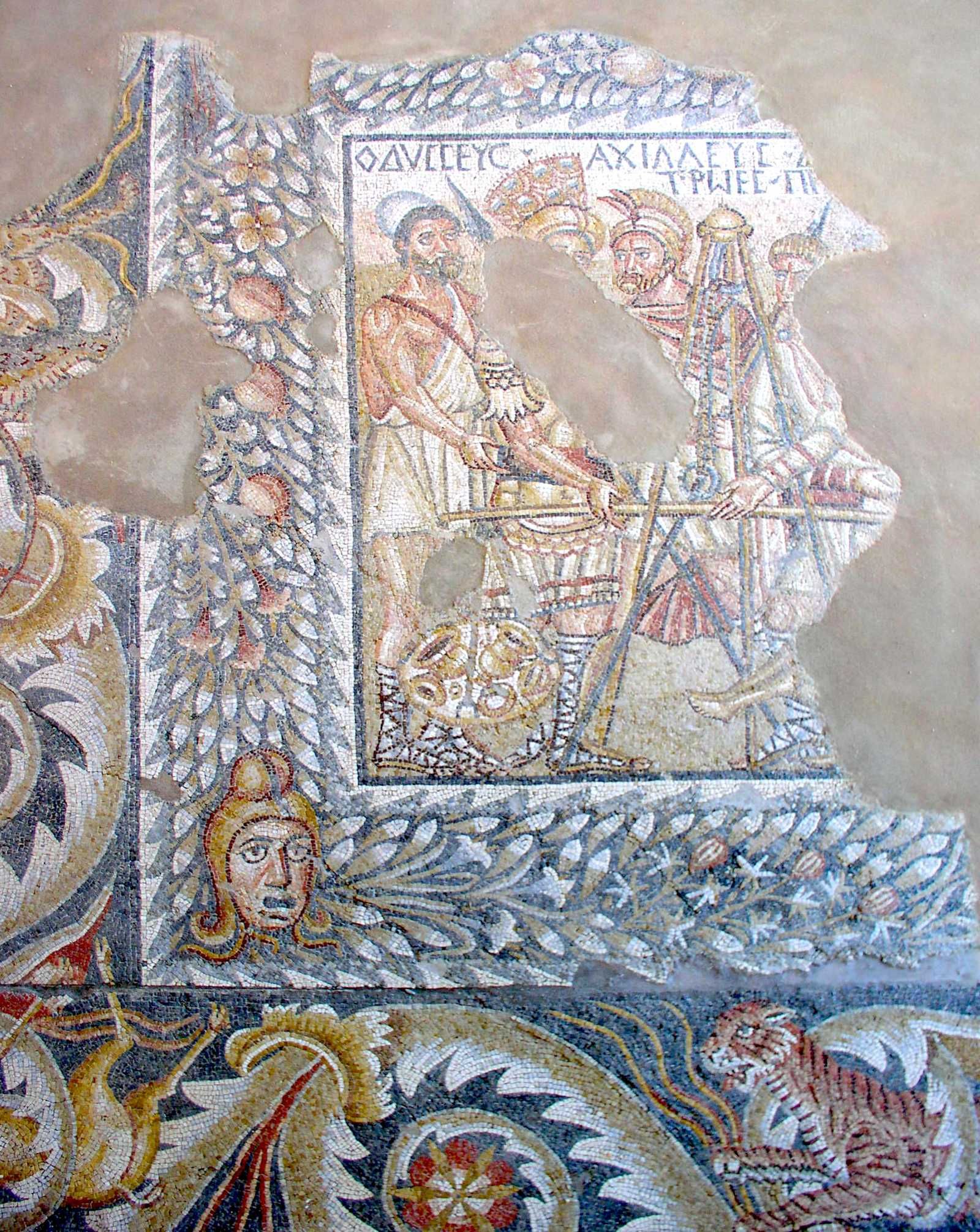
A Roman mosaic uncovered beneath farmland at Ketton in Rutland preserves a version of the Trojan War that differs from Homer’s Iliad. Its three narrative panels follow Achilles and Hector from combat to the return of Hector’s body, with an unusual ransom scene providing the strongest clue to the story’s origins.
A study published online in Britannia on 3 December 2025 connects that narrative to Phrygians, a fragmentary tragedy by the Greek playwright Aeschylus. The analysis also traces the pavement’s designs across other ancient objects, linking a late Roman household in Britain with artistic traditions from the Mediterranean.
The discovery itself dates to 2020, when Jim Irvine investigated remains on his family’s farm. Excavation subsequently revealed a substantial villa complex. The later study examines how the mosaic’s combination of narrative details and visual models reached that setting, where guests could encounter Greek heroic stories on a monumental domestic floor.
Pottery and cropmarks led to the mosaic
The investigation began with a walk across the family’s land during the COVID restrictions of summer 2020. Irvine noticed pottery, tiles and oyster shells concentrated in one area, then examined satellite imagery. Cropmarks outlined a rectangular building with projecting curved ends and an adjoining structure, suggesting substantial buried remains.
The imagery had been taken in June 2018 and became widely available through Google Earth in 2020. The cropmarks were also reported to Leicestershire County Council, which recorded a possible Roman villa.
He reported the floor, and archaeologists assessed its condition before a programme of excavation and survey followed. University of Leicester Archaeological Services returned in September 2021 to expose the mosaic room fully. Historic England supported the investigation, while geophysical surveys mapped buildings, courtyards and boundary ditches across the surrounding complex.
A reception room arranged around a story
The pavement measures approximately 10 by 5.3 metres (33 by 17 feet). It occupied a room at the northern end of the main villa building, interpreted as a triclinium, or dining room, or an audience chamber. Pottery and coins indicate that the mosaic was in use during the later fourth century AD.
An apse provided the viewing position for the sequence. Beyond a geometric register nearest that end, three broad picture panels presented successive episodes involving Achilles, Hector and Priam. Braided borders separated the scenes, giving visitors a structured narrative to follow along the length of the decorated floor.
The wider site included agricultural and service buildings as well as the principal residence. Excavation found painted wall plaster, decorative marble and evidence of underfloor heating. The villa and mosaic became a scheduled monument on 23 November 2021, protecting archaeological remains whose occupation and later reuse extend beyond the floor’s original setting.
Hector’s weight in gold supplies the clue
The first panel shows Achilles and Hector confronting each other with spears from chariots. The second depicts Achilles dragging Hector’s body behind his team, while Priam, Hector’s father and king of Troy, approaches with outstretched arms. The final panel brings the sequence to the ransom of the dead Trojan prince.
Here a man supports an enormous balance across his shoulders. Hector’s body lies in one pan; gold occupies the other, and Priam brings vessels to add to it. The transaction turns the corpse’s weight into the measure of the ransom, making the scales central to the scene’s meaning.
In the Iliad, Priam brings a collection of textiles, gold and vessels to recover his son. The literal balancing of Hector against gold belongs to a different tradition. Ancient commentary associates that device with Aeschylus’ Phrygians, also known as The Ransom of Hector, whose story continued to circulate through later texts and images.
A snake points towards Patroclus’ tomb
A smaller detail in the dragging scene strengthens the study’s identification. Beneath the horses appears a partially preserved, rearing snake. Comparison with early Greek vase paintings leads the analysis to interpret it as a marker for the burial mound of Patroclus, Achilles’ companion, whose death prompted his revenge against Hector.
On an Athenian water jar now in Boston, the tomb is labelled with Patroclus’ name and accompanied by a supernatural snake. Other painted vessels use a similar arrangement. The Ketton study argues that the pavement preserves this older convention for locating the action beside the Greek warrior’s tomb.
Later retellings commonly placed the dragging around Troy’s walls, following a variant found in Euripides’ Andromache. The combination at Ketton of the tomb-associated snake and the gold-weighing ransom therefore narrows the narrative tradition further. It is the conjunction of those details that supports the proposed connection with Aeschylus.
Pottery, coins and silverware share the designs
The study follows the mosaic’s visual ancestry through several materials. The dragging scene resembles compositions on Athenian pottery made about eight centuries earlier. Standing and running figures, a shield, the chariot group, Hector’s body and the snake recur within a comparable arrangement, despite changes to individual identities and artistic style.
Chariot figures also have parallels on Roman provincial coins from Ilium, the city associated with Troy in what is now Turkey. Coins of the second and third centuries show Hector with rearing horses.
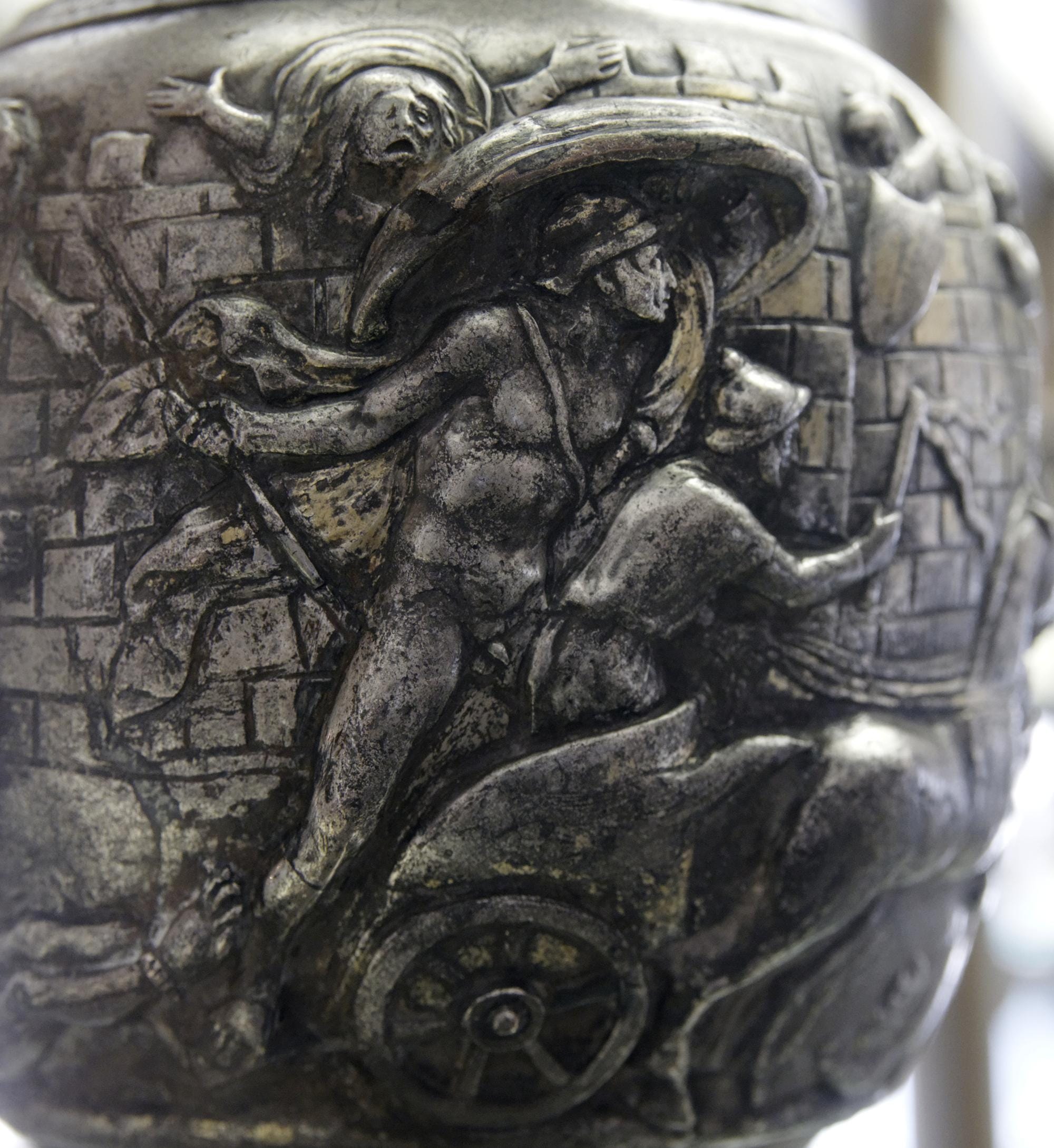
The ransom panel shares its basic arrangement with silverware from the Berthouville treasure found in France. Achilles sits on one side, Priam approaches from the other, and Hector’s body occupies the balance between them. These comparisons underpin the argument that craftspeople inherited and adapted a repertoire of designs across different media.
How the story reached a British villa
The paper considers three routes by which the composition might have reached Ketton: an illustrated copy of Aeschylus’ play, illustrations accompanying a later retelling, or a combination of existing artistic models. It favours the third explanation, while recognising the importance of literature in keeping the narrative familiar to Roman audiences.
The distinction concerns the immediate model used to make the floor. A direct copy from an illustrated Phrygians remains hypothetical, since no such manuscript survives. Shared visual patterns offer identifiable comparisons in pottery, coinage and metalwork, and allow the mosaicist a role in assembling the three scenes into a coherent sequence.
For the villa’s owner, the finished pavement offered a large display of Greek cultural knowledge in a contemporary Roman setting. Its classical subject and inherited designs connect the household with the wider empire’s artistic resources. The remaining question is how the maker obtained that particular combination of models, whether locally or through access to collections elsewhere.


About the Roman Empire Times
See all the latest news for the Roman Empire, ancient Roman historical facts, anecdotes from Roman Times and stories from the Empire at romanempiretimes.com. Contact our newsroom to report an update or send your story, photos and videos. Follow RET on Google News, Flipboard and subscribe here to our daily email.
Follow the Roman Empire Times on social media: