
5 Roman Myths People Still Believe Today – and What the Evidence Really Says
Ancient Rome still lives in stories people repeat with complete confidence. But some of its most famous details – from Nero’s fiddle to Caesar’s birth – turn out to be far less certain, and far more revealing, than the myths that replaced them.


Ancient Rome survives not only in ruins, inscriptions, and marble, but in stories people still repeat with complete confidence. Some are vivid, convenient, and endlessly entertaining: emperors playing music while their city burned, diners slipping away to vomit between courses, a horse raised to high office, an empire poisoned by its own pipes. Yet the Rome preserved in popular imagination is often not the Rome the evidence reveals. Between myth and history lies a world that is stranger, subtler, and far more interesting than the legends most people think they know.
Myth: Nero Fiddled While Rome Burned
Nero and the Myth of the Fiddle
The familiar phrase that Nero “fiddled while Rome burned” has become so deeply embedded in modern speech that it now functions almost like a proverb. It appears in popular writing, everyday conversation, and political commentary, usually as shorthand for a ruler who remained detached, useless, or perversely absorbed in trivialities while disaster unfolded around him.
But the expression depends first on the meaning of the word “fiddle,” and that creates an immediate historical problem.
If the phrase is taken literally, it is plainly anachronistic. The fiddle, in the sense of a violin or a related bowed string instrument, did not exist in Nero’s time. Instruments of that family emerged much later, so the emperor could not possibly have “fiddled” in the modern musical sense while Rome was burning.
The phrase survives because the word also carries a second meaning: behaving frivolously, wasting time, or making no useful effort. In that looser sense, the image suggests not only music, but uselessness – a man who should have acted, yet merely “fiddled around.”
Both meanings have shaped the popular legend. On one level, the phrase conjures the image of Nero calmly entertaining himself while others suffered. On another, it reduces him to a symbol of ineffectual leadership. Yet even this second idea is not straightforwardly supported by the evidence. The force of the saying has kept it alive, but its historical basis is far less secure than its familiarity suggests.
To understand how the story formed, it is necessary to look at the musical instruments of Nero’s age. The stringed instruments known in the Roman world were inherited largely from Greek culture, especially from the musical traditions associated with festivals of Apollo and Dionysus.
The two most prominent were the cithara and the lyre. They were related, but not identical. The cithara was the heavier and more elaborate instrument, strongly built and associated with professional performance. The lyre was lighter in construction and often made with more delicate materials. Roman authors generally kept the distinction between the two.
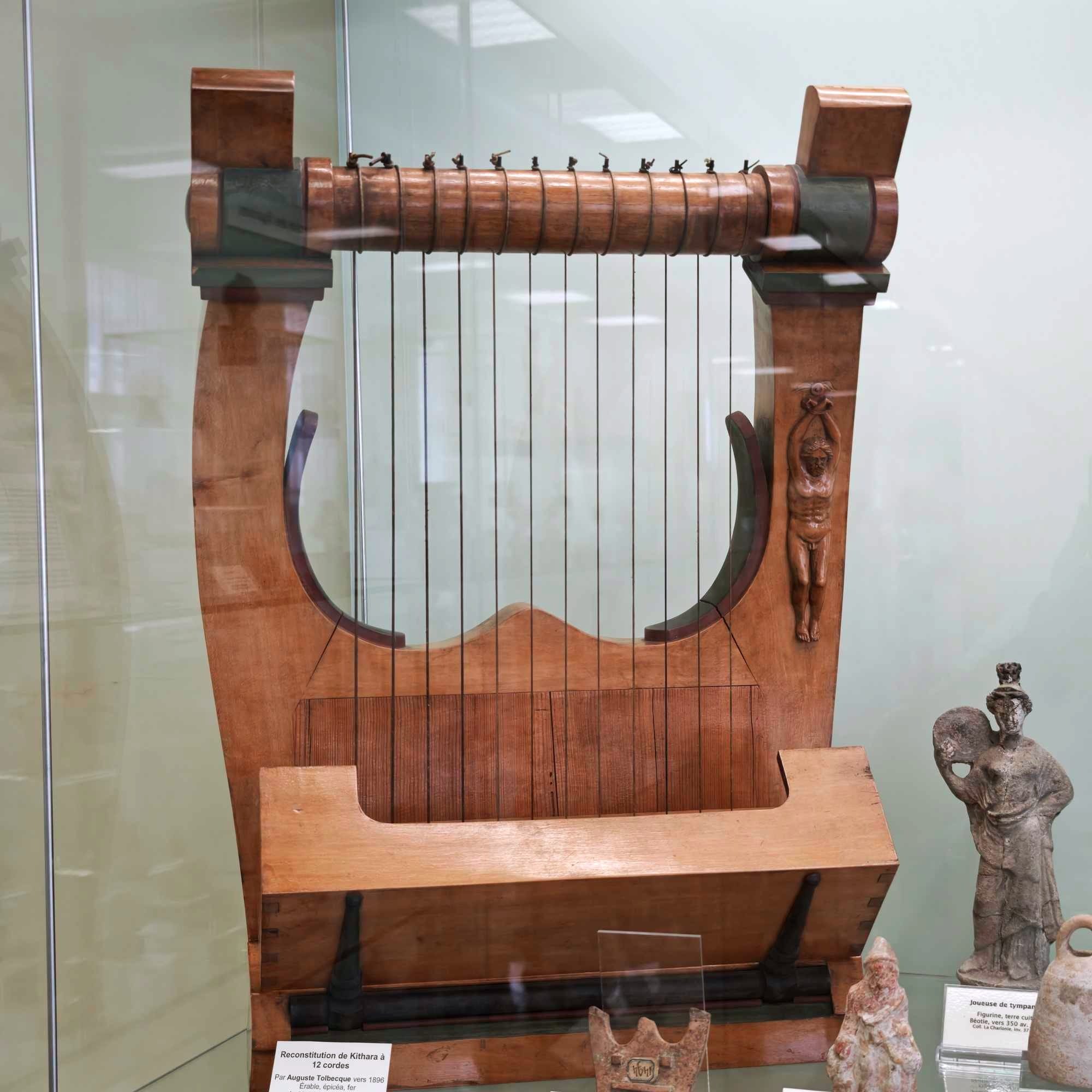
There were also Latin terms derived from the idea of string, such as fides and the diminutive fidicula, which could be used for stringed instruments more generally. Their exact range is uncertain, but they clearly belonged to the world of plucked strings, not bowed instruments. Even so, there is no evidence that Nero was ever associated with such a term in a way that would support the later wording of the phrase.
What is beyond doubt is Nero’s passion for music. Ancient writers repeatedly record that he sang and performed, and that he took these appearances with complete seriousness. He introduced musical competitions at Rome in the Greek style and later inaugurated the Neronia, a grander festival intended to recur every five years. In these performances he did not remain a distant patron.
He appeared as a contestant himself, with all the vanity, anxiety, and ambition that such a role involved. His longing for artistic recognition was not superficial. He cared intensely about the reception of his performances and followed the formal conventions expected of a cithara-player.
The instrument most closely associated with him was therefore not a fiddle of any kind, but the cithara. Multiple ancient sources identify it as the instrument he played, and they also preserve the unease it provoked among more traditional Roman observers. To many of them, the most disturbing thing was not simply that Nero loved music, but that a Roman emperor would expose himself in public performance at all.
The spectacle offended their sense of dignity and hierarchy. Nero, however, delighted in it. He enjoyed these appearances so much that he revived the Neronia sooner than planned and even traveled through Greece, where he could perform before audiences more receptive to his artistic ambitions. There he arranged for various festivals to be held in the same year so that he could compete in all of them.
The Fire of Rome and the Birth of a Legend
Nero’s passion for music eventually became entangled with the most famous disaster of his reign. In 64 AD, a catastrophic fire broke out in Rome while the emperor was at Antium. Once he learned what had happened, he returned to the city and took practical steps to relieve the crisis.
He opened his gardens and public buildings to those left homeless and arranged for grain to be brought in from nearby towns. These measures, however, failed to quiet suspicion.
The reason was not simply the scale of the destruction, but the rumor that quickly attached itself to Nero’s character. Tacitus reports that stories were already circulating that, while Rome burned, the emperor had taken to a private stage and sung of the destruction of Troy, casting the present calamity in the image of an ancient one. The force of the story lay in its symbolism. It turned Nero into a ruler who did not merely fail to stop disaster, but seemed to aestheticize it.
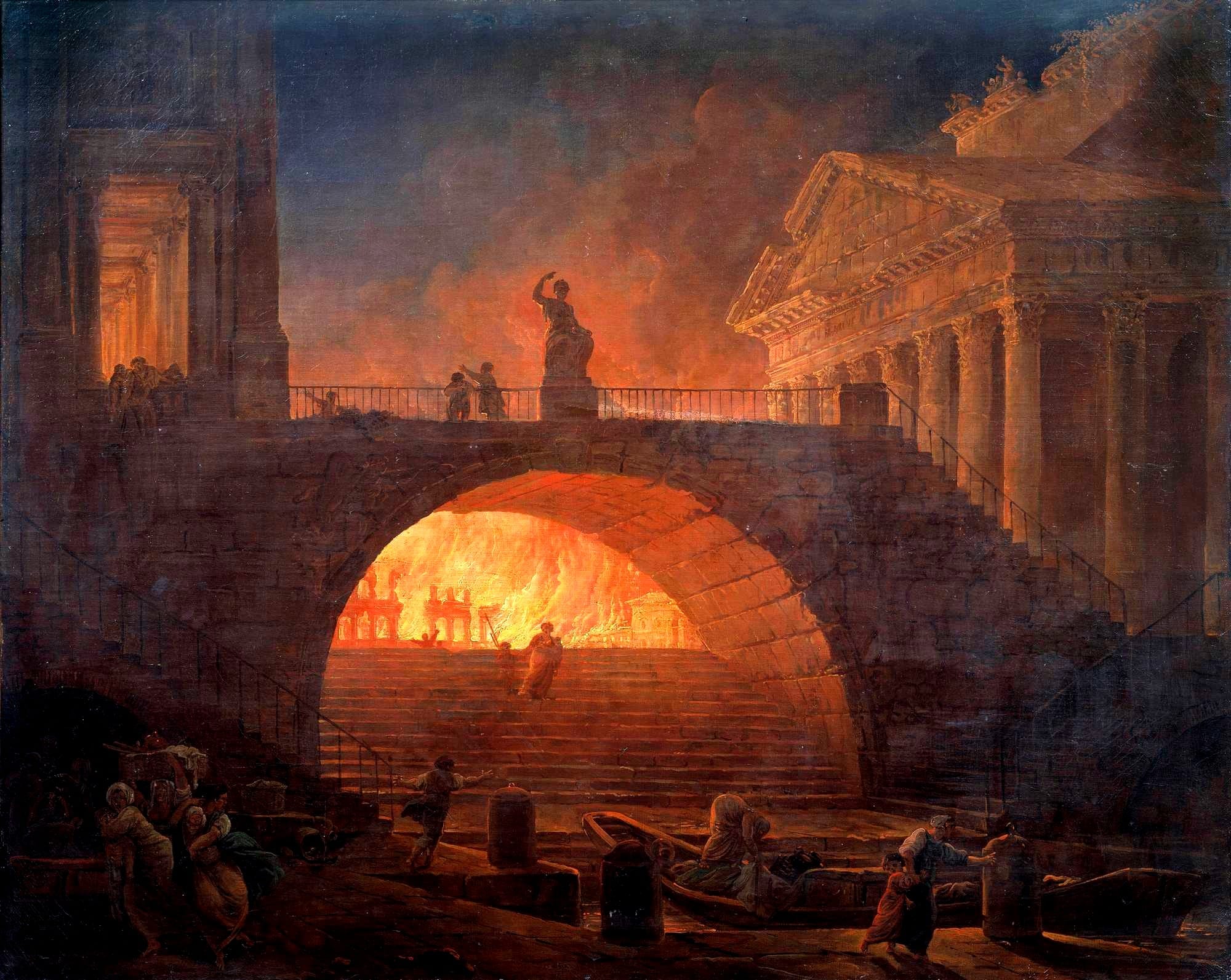
Suetonius presents the episode even more starkly. For him, Nero watched the fire from the tower of Maecenas and sang of the Sack of Ilium in theatrical costume, as though the burning of Rome had become a scene in one of his performances. By this point, the story is no longer framed as rumor but as fact, and the image of the emperor as performer begins to harden into legend.
Yet even here, the emphasis remains on singing rather than on any specific instrument. It is only much later, in Dio Cassius, writing more than a century after the event, that the image becomes more explicitly musical. Dio says Nero appeared in the dress of a cithara-player and sang of the Capture of Troy from a rooftop vantage point. Even then, the instrument itself is not described in direct detail so much as implied through the costume.
Later writers preserve the same broad pattern. By their time, Nero’s reputation as persecutor had largely overshadowed Nero the musician, but when his musical activity is mentioned in connection with the fire, the focus still falls above all on performance, costume, and song.
Orosius, following the earlier tradition, says that Nero watched the blaze from the tower of Maecenas and declaimed in the dress of a tragedian. Once again, the scene is theatrical, but the instrument remains elusive.
That point matters. If the goal is to trace how the famous expression developed, the evidence shows that the earliest literary descriptions of the fire do not place a fiddle in Nero’s hands – or even explicitly any instrument at all. The later imagination supplied something sharper and more memorable than the ancient sources had actually said.
Even so, the likelihood that Nero performed with the cithara is strong. In the Greek and Roman world, poetry was commonly sung or recited with instrumental accompaniment, and Nero’s public musical identity was firmly associated with the cithara. Ancient writers consistently present it as his favored instrument, and there is material evidence to support that image: Suetonius says Nero had statues and coins made showing himself as a cithara-player, and such coins survive. The historical Nero may well have imagined himself in precisely that role. But that is still a long way from the later claim that he “fiddled while Rome burned.”
From Nero the Musician to Nero the Persecutor
What emerges from the evidence is relatively clear. Nero was devoted to performance on the cithara, and if he did sing during the fire of Rome, the most likely accompaniment would have been that instrument. There is no meaningful basis for linking him either with the fidicula or, still less, with the violin-like “fiddle” imagined by later tradition. The familiar phrase collapses very different musical worlds into one dramatic but false image.
As the centuries passed, that musical Nero faded from view. From late antiquity onward, much of the historical writing that survived in the Latin West came from Christian authors whose main concern was not the emperor’s artistic vanity, but his place in the story of the Church.
For them, the most important fact about Nero was not that he sang, competed, and displayed himself as a cithara-player, but that he stood at the beginning of imperial persecution and was held responsible for the deaths of Peter and Paul.
That shift in emphasis changed the way Nero was remembered. Writers increasingly treated him above all as a persecutor, a tyrant, and an enemy of Christianity. The musical side of his life, once so striking to pagan historians, lost much of its force in a world that judged emperors according to very different priorities. As a result, Western chroniclers for centuries either ignored Nero altogether or reduced him almost entirely to the role of persecutor.
Only rarely did traces of the older image survive. In most medieval historical writing, Nero the singer and performer had largely disappeared, replaced by Nero the monstrous ruler whose significance lay in Christian memory rather than in the cultural life of his own age.
That transformation in the tradition helps explain how later legend could simplify him so easily. Once the musician had receded and the villain remained, the path was open for the famous image to harden into the proverb that still circulates today. ("Nero Fiddled While Rome Burned" by Mary Francis Gyles)
Romans Used Vomitoria to Throw Up After Feasts
The Vomitorium That Never Existed
Few myths about ancient Rome have proved as durable as the idea that wealthy diners slipped away from the table to a special room – a vomitorium – to empty their stomachs before returning for more food. The story seemed to capture everything people wanted Rome to represent: excess, indulgence, and a taste for spectacle even in private life. It was vivid, memorable, and entirely misleading.
The truth is simpler. A vomitorium was not a banquet chamber for vomiting, but a passage associated with crowd movement in places of spectacle. Even that meaning, however, is less ancient and less straightforward than modern usage suggests.
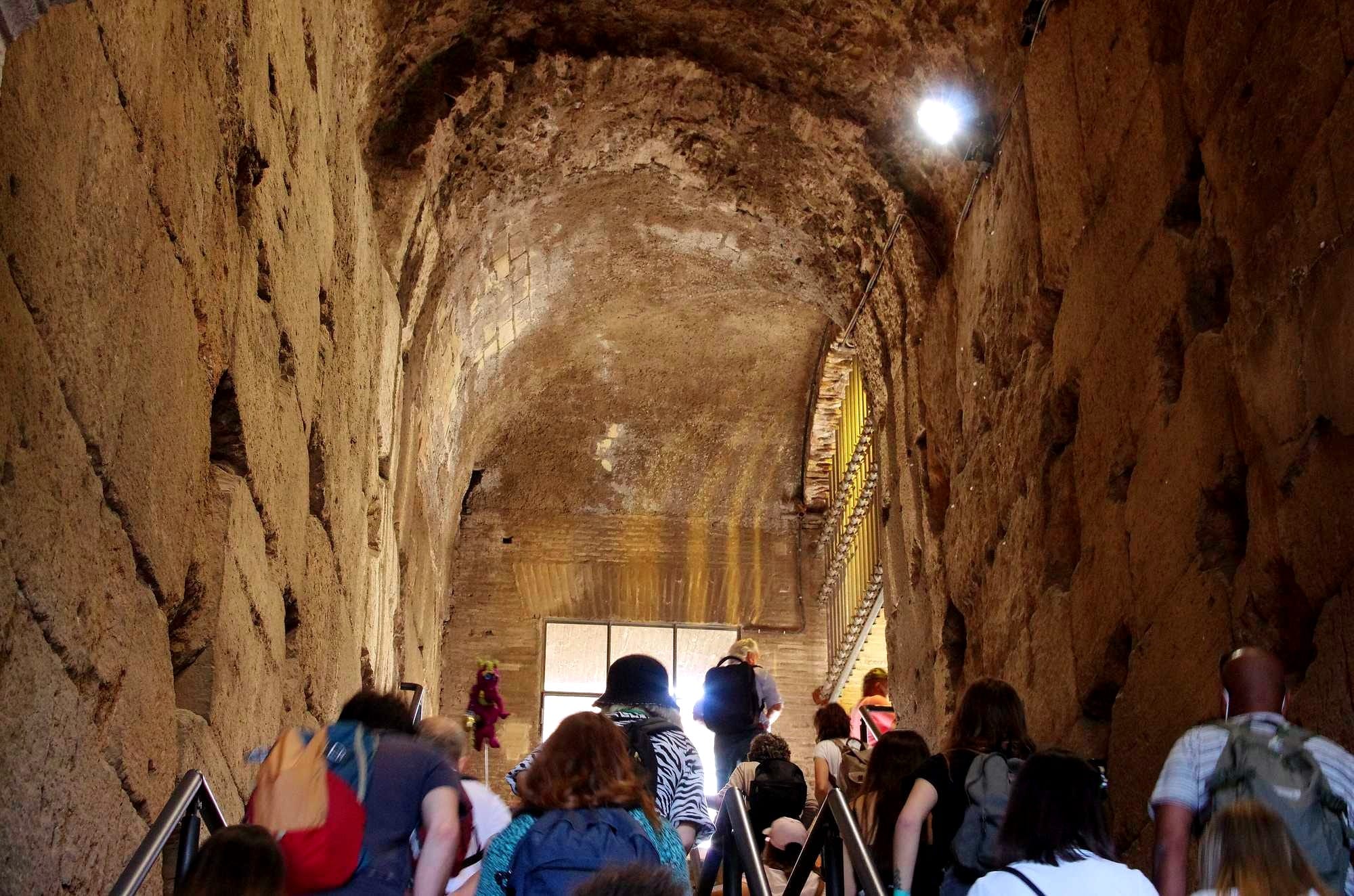
In Latin, vomitorius naturally referred to vomiting or to emetics, and only one surviving ancient text applies the word to the flow of spectators into their seats. In that late passage, the expression is clearly figurative rather than technical. The architectural feature itself was real, but the term seems to have functioned more as a vivid nickname than as standard Roman vocabulary.
That matters because the modern correction often goes too far in the other direction. Once the “vomit-room” is rejected, people are still tempted to keep the larger picture of Romans as cheerful banquet-purgers. Yet the evidence for that is thin.
A few passages mention vomiting, but usually in medical or rhetorical contexts, not as a routine part of elite dining. One famous line from Seneca gives the sharpest version of the stereotype:
“They vomit to eat, and eat to vomit.”
It is unforgettable, but it stands almost alone, and it comes in a moral attack on luxury rather than in a neutral description of normal behavior.
Other texts often cited in support of the myth turn out to be weaker than they look. Seneca’s complaints about the mess left by drunken diners do not actually require vomiting at all, and Cicero’s account of Caesar wanting to vomit after dinner refers to a medical regimen involving emetics, not to some decadent social custom.
Roman writers certainly knew excess, and moralists were happy to describe it in revolting terms. But that is not the same thing as proving that deliberate purging at banquets was common practice.
So the myth collapses on both sides. There was no special Roman “vomit-room,” and there is little reason to imagine diners regularly excusing themselves to purge between courses. The vomitorium survives because it flatters a caricature of Rome that people still enjoy: a civilization so decadent that even overeating required its own architecture. The real story is less lurid, but more revealing. The famous room never existed, and the Rome people think they know is, once again, more theatrical than true. ("Vomiting Romans: or, were the Romans happy chuckers?" by Dr Peter Gainsford)
Lead Poisoning Caused the Fall of Rome
Did Lead Poisoning Bring Down Rome?
Few explanations for the fall of Rome sound as neat as the theory that the empire was slowly poisoned by its own civilization. The Romans mined lead on a vast scale, used it in pipes, cookware, containers, sweeteners, cosmetics, and countless other aspects of daily life. To modern readers, the idea feels almost irresistible: a great empire undone not only by war, politics, and instability, but by the hidden toxicity of the material it embraced so confidently.
There is enough truth in that picture to explain why the theory has endured. Lead exposure in the Roman world was real, and in some settings it may have been significant. The wealthy were especially vulnerable, since wine and sweeteners could carry lead contamination, and elite households made broader use of the kinds of vessels and products that increased contact with the metal.
Ancient writers themselves were not wholly unaware of the danger. They recognized that lead and its fumes could be harmful, even if they did not describe chronic poisoning in the precise way later medicine would.

That, however, is not the same as proving that lead poisoning played a decisive role in Rome’s collapse. The stronger version of the theory has often claimed that lead exposure weakened the ruling class, reduced fertility, damaged judgment, and helped bring about the long decline of Roman power. But once the evidence is examined closely, the case becomes much less dramatic.
The extent of exposure varied widely, the use of lead in food and drink was not uniform, and the historical record does not show a clear recognition of the kind of widespread chronic poisoning that such a theory would seem to require.
The archaeological evidence also complicates the story. Skeletal analyses confirm that Romans were exposed to lead, but not at levels that automatically justify the sweeping claim that the empire was brought down by poisoning. Episodes of toxicity may well have occurred, and certain groups probably faced heavier exposure than others.
Yet the evidence points more toward a real environmental and social problem than toward a single hidden cause of imperial decline.
In the end, that is what makes the myth so attractive and so misleading. It takes a genuine Roman hazard and turns it into a total explanation. Lead contamination was part of the Roman world, and sometimes a serious one. But the idea that it brought down the empire asks the evidence to carry more than it can bear. The fall of Rome was a far more complex process, and lead, however troubling its presence, is unlikely to have been one of its decisive causes. ("Lead poisoning and the downfall of Rome: Reality or myth?" by Louise Cilliers and Francois Retief)
Caligula Made His Horse a Consul
Caligula’s Horse and the Joke That Became History
The story that Caligula wanted to make his horse consul is one of the most famous accusations ever attached to a Roman emperor. Ancient writers preserve it, but neither fully explains what Caligula actually said or did to produce such a belief. Instead, the anecdote survives in a form already sharpened for scandal: a ruler so irrational, so theatrical, and so contemptuous of public office that he was supposedly ready to hand the consulship to his favorite horse, Incitatus.
The details surrounding Incitatus certainly encouraged that impression. The horse was treated with extraordinary extravagance. He was said to have had a marble stable, an ivory manger, purple coverings, jeweled ornaments, a household of servants, and even guests entertained in his name.
Another version adds golden barley, wine served in golden cups, and oaths sworn by the animal’s safety and fortune. These details make the story memorable, but they do not prove that Caligula genuinely meant to appoint the horse consul. They show above all that the horse had become a symbol of excess and imperial absurdity.
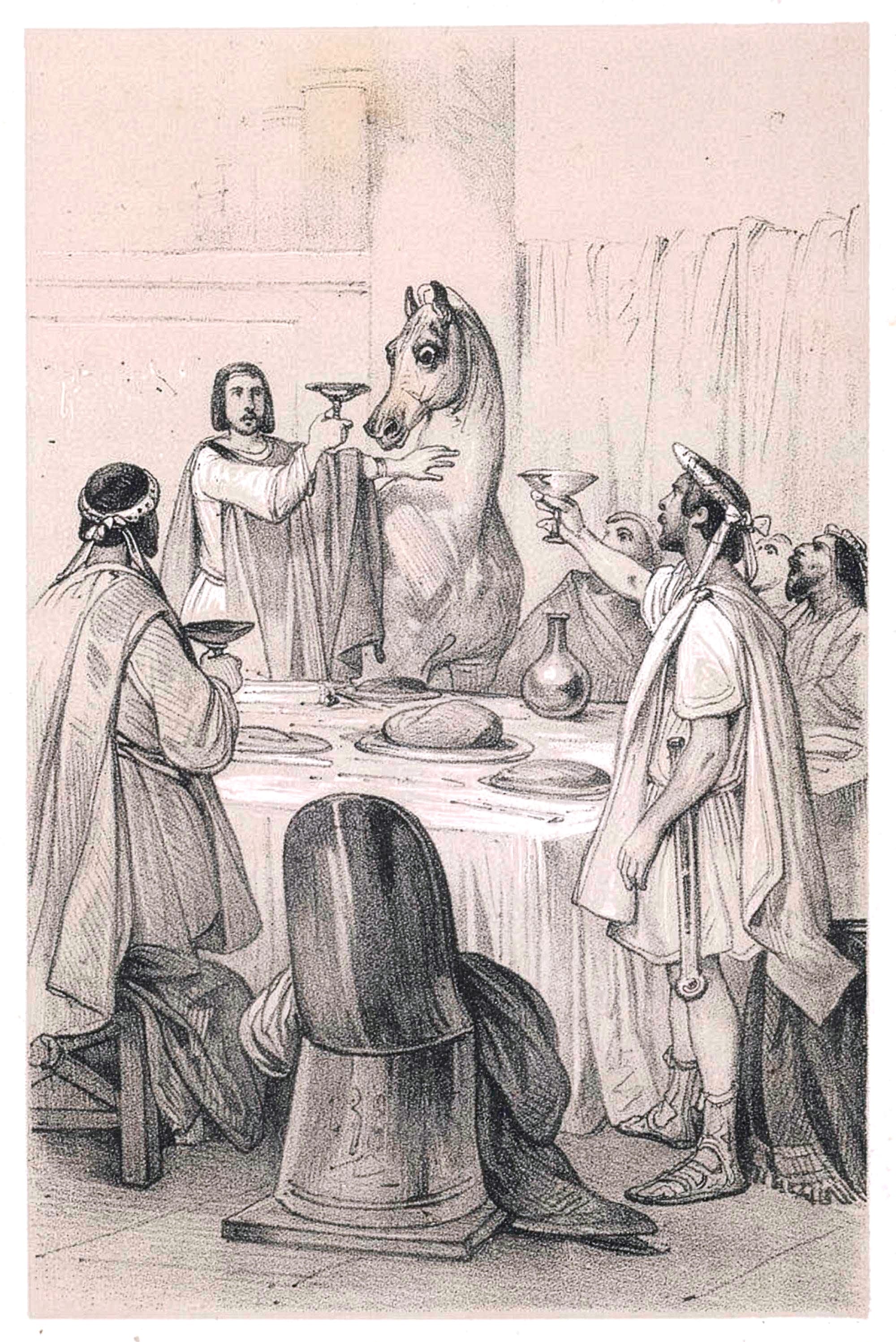
Modern interpretations have usually assumed that the story grew out of a joke or sarcastic remark later taken literally. The real problem is not whether the remark was a joke, but what kind of joke it was. One possibility is that Caligula was mocking the consulship itself or insulting the Senate by suggesting that a horse would do as well as the men who held office. Another is that he was making a pointed comment about particular candidates whose names or reputations lent themselves to wordplay.
That possibility matters because Roman humor often delighted in puns and verbal barbs. The horse’s name, Incitatus, carried the sense of speed and motion, which may have invited comparison with actual men competing for high office. On that reading, the anecdote did not begin as a serious proposal but as a cutting piece of imperial wit directed at the political class. What later generations remembered was not the immediate target of the joke, but the outrageous surface of it: Caligula and the horse.
Two figures make especially plausible targets. One was Claudius, whose name could be associated with lameness and whose elevation to office may have provoked comment because of his physical frailty and awkward public reputation. The contrast between a “lame” man and a “swift” horse could easily have produced the kind of joke that, once detached from its original moment, hardened into legend.
The other possible target was Asinius Celer, whose name offered even richer possibilities for mockery. Here the joke may have worked by comparing a prized racehorse with a political candidate whose very name could be bent into ridicule. In such a setting, the horse was not really the point. The insult was aimed at the men around Caligula.
This makes better sense of the anecdote than the simple idea that the emperor literally intended to appoint an animal to the consulship. Caligula’s humor could certainly be cruel and theatrical, but it was often sharper than the later story suggests. A drawn-out attempt to turn a horse into a statesman would have been less witty than a sudden and memorable comparison used to humiliate real contenders for office.
There is, however, one complication. At one point a horse was apparently appointed priest of Caligula’s cult, and this has often been taken as proof that the emperor was perfectly capable of going further. Yet even this does not settle the matter. Such appointments carried financial burdens, and the move may itself have been another joke at someone else’s expense rather than a sign of pure affection for the animal. In that case, the horse again functioned less as a genuine office-holder than as an instrument of mockery.
What survives, then, is probably not a straightforward record of insanity, but the fossil of a joke whose original target has been partly lost. The legend endured because it suited the image of Caligula that later writers wanted to preserve. Once the emperor had been fixed in memory as erratic, cruel, and contemptuous of Roman norms, the notion of a horse-consul no longer needed explanation. It sounded too perfect not to be repeated. ("Caligula, Incitatus and the consulship" by David Woods)
Julius Caesar Was Born by Caesarean Section
Julius Caesar and the Caesarean Birth Myth
The widespread belief that Julius Caesar was born by Caesarean section has little to support it. In Roman usage, the word Caesar had long since become associated with imperial rule more generally, so a term like “cesarean” did not have to point directly to Julius Caesar himself.
More importantly, the procedure in antiquity was overwhelmingly fatal for the mother. For that reason, it was almost never performed on living women until much later. Since Julius Caesar’s mother is known to have lived on well after his birth and remained a visible presence in his adult life, it is virtually impossible that she underwent such an operation.
The real origin of the term is far less certain than the popular story suggests. One explanation links it to an early Roman law, traditionally associated with the age of the kings, which required that a child be cut from the womb of a woman who died late in pregnancy before burial. Over time, that regulation came to be associated with imperial authority and was remembered as a “Caesarean” law. In that context, the word had less to do with one famous man than with a legal and royal framework surrounding birth, death, and burial.
A second explanation is more linguistic and more straightforward. It traces the word back to the Latin verb meaning “to cut,” from which a phrase for a child delivered by incision could easily have developed. On this view, the term arose not from biography or legend, but simply from the act itself.
That uncertainty helped the myth flourish. Because Caesarean birth was rare, dangerous, and often surrounded by awe, those believed to have been delivered in this way were sometimes imagined as unusual or marked out in some special fashion. Ancient and later traditions attached extraordinary births to heroic, divine, and semi-divine figures, and the idea naturally lent itself to mythmaking. Over time, Julius Caesar was drawn into that larger pattern.
The myth also survived because it fits the kind of greatness later ages wanted to project onto him. A man who transformed Rome on such a scale seemed almost to demand an extraordinary entrance into the world. But the evidence points in the opposite direction. Julius Caesar was not born by Caesarean section, and the procedure did not take its name from his birth. What endured was not history, but a legend too neat and memorable to disappear. ("The Birth of Caesar and the Cesarean Misnomer" byTonse N.K. Raju, M.D., D.C.H.)
The endurance of these myths says as much about us as it does about Rome. We prefer a burning emperor with a fiddle, a horse in high office, a poisoned empire, a surgical birth fit for legend, and a civilization so decadent it required rooms for vomiting. Such stories are tidy, dramatic, and easy to remember. The truth is less theatrical, but more interesting. Ancient Rome was strange enough without the embellishments, and the closer one looks, the more its real history resists the fantasies built on top of it.


About the Roman Empire Times
See all the latest news for the Roman Empire, ancient Roman historical facts, anecdotes from Roman Times and stories from the Empire at romanempiretimes.com. Contact our newsroom to report an update or send your story, photos and videos. Follow RET on Google News, Flipboard and subscribe here to our daily email.
Follow the Roman Empire Times on social media: