
Holy Cow: Roman Emperors Put Animal Sacrifice to Work
Bulls, banquets and one unfortunate goose reveal how Roman emperors turned animal sacrifice into a public language of power, generosity and loyalty.

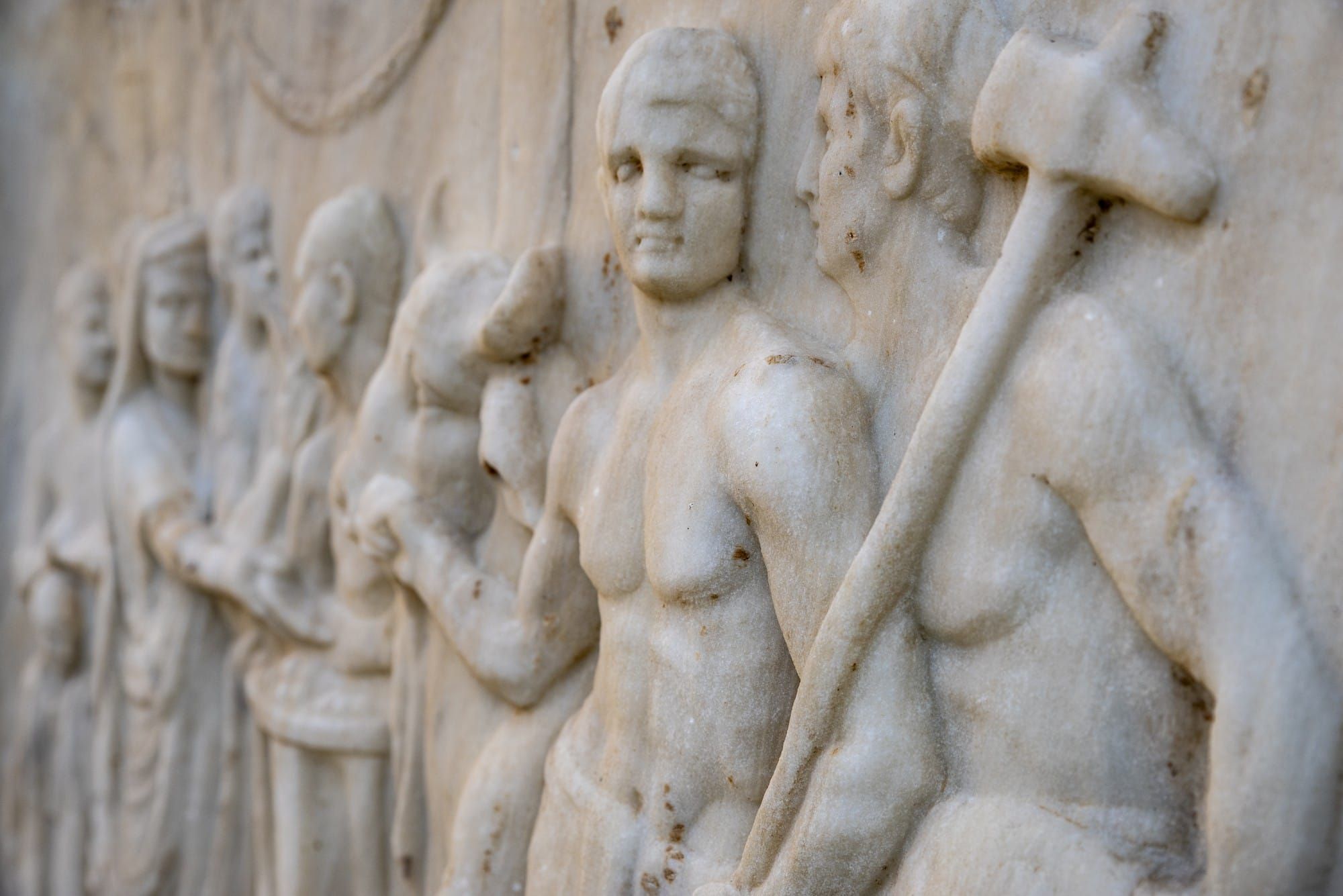
In 362 CE, the emperor Julian went to Apollo’s sanctuary at Daphne, outside Antioch in what is now southern Turkey, expecting a festival fit for a great city. In his satirical Misopogon, he describes imagining sacrificial animals, incense and a procession. Instead, he found a priest who explained that the city had made no preparations. The priest had brought a goose from home. Julian records the priest’s reply:
I have brought with me from my own house a goose as an offering to the god, but the city this time has made no preparations.
Julian, Misopogon 362b
The emperor’s disappointment was about considerably more than the catering. In Julian’s telling, neglecting the gods exposed a failure of civic responsibility. His quarrel with Antioch joined worship, public generosity and the obligations of rulers and citizens. The episode belongs to the strained relationship behind Julian’s restoration of traditional worship, and it opens a window onto a much older imperial habit: making sacrifice carry the weight of politics.
Across the Roman Empire, animal sacrifice helped people recognise the emperor’s place in their world. He appeared as the man who honoured the gods on everyone’s behalf, while communities offered sacrifices connected with his health, anniversaries and success. These practices could accommodate different gods and local customs. Their strength lay in bringing people into a shared relationship with the ruler through familiar ceremonies, often organised by their own officials and benefactors. The emperor could be central to the occasion even when he was nowhere near the altar.
The gods received a share. The guests did too
A Roman animal sacrifice brought together a procession, prayer, offerings and skilled work. The person presiding usually drew a fold of his toga over his head. Incense and wine preceded the consecration of the victim with wine and salted flour. Attendants handled and killed the animal, and its entrails were examined for acceptance by the deity. The officiant occupied the most prominent position, while much of the physical labour belonged to assistants.
Cattle, sheep and pigs were the principal victims, and they represented valuable resources. Someone able to provide animals regularly, especially expensive adult cattle, possessed means beyond those of most neighbours. That spending could become a public demonstration of religious devotion as well as wealth. In communal worship, the person at the altar was often already a household head, magistrate or priest. Sacrifice allowed an established position in society to be performed before an audience, with the gods as the other party in the exchange.
The occasion also produced something immediately useful: meat. In the usual Greek and Roman forms of animal sacrifice, selected portions went to the gods and substantial parts remained for human consumption. Meat might be eaten at a banquet, distributed for later use or enter the market. A wealthy sponsor could therefore honour a deity, preside over a ceremony and feed fellow citizens through the same expenditure. Public generosity and public standing met at the altar, then continued at the meal. This was a particularly effective setting in which to display who could provide for a community.
Augustus knew the value of a covered head
Augustus inherited a visual language that already connected sacrifice with civic authority. A late Republican relief conventionally associated with the so-called Altar of Domitius Ahenobarbus places a presiding official beside an altar, opposite Mars. A bull, ram and pig approach for a suovetaurilia, a sacrifice used in purification rites. The scene connects the census, the citizen body and its religious protection. Long before imperial portraits spread through the provinces, an officiant at an altar could communicate public leadership.
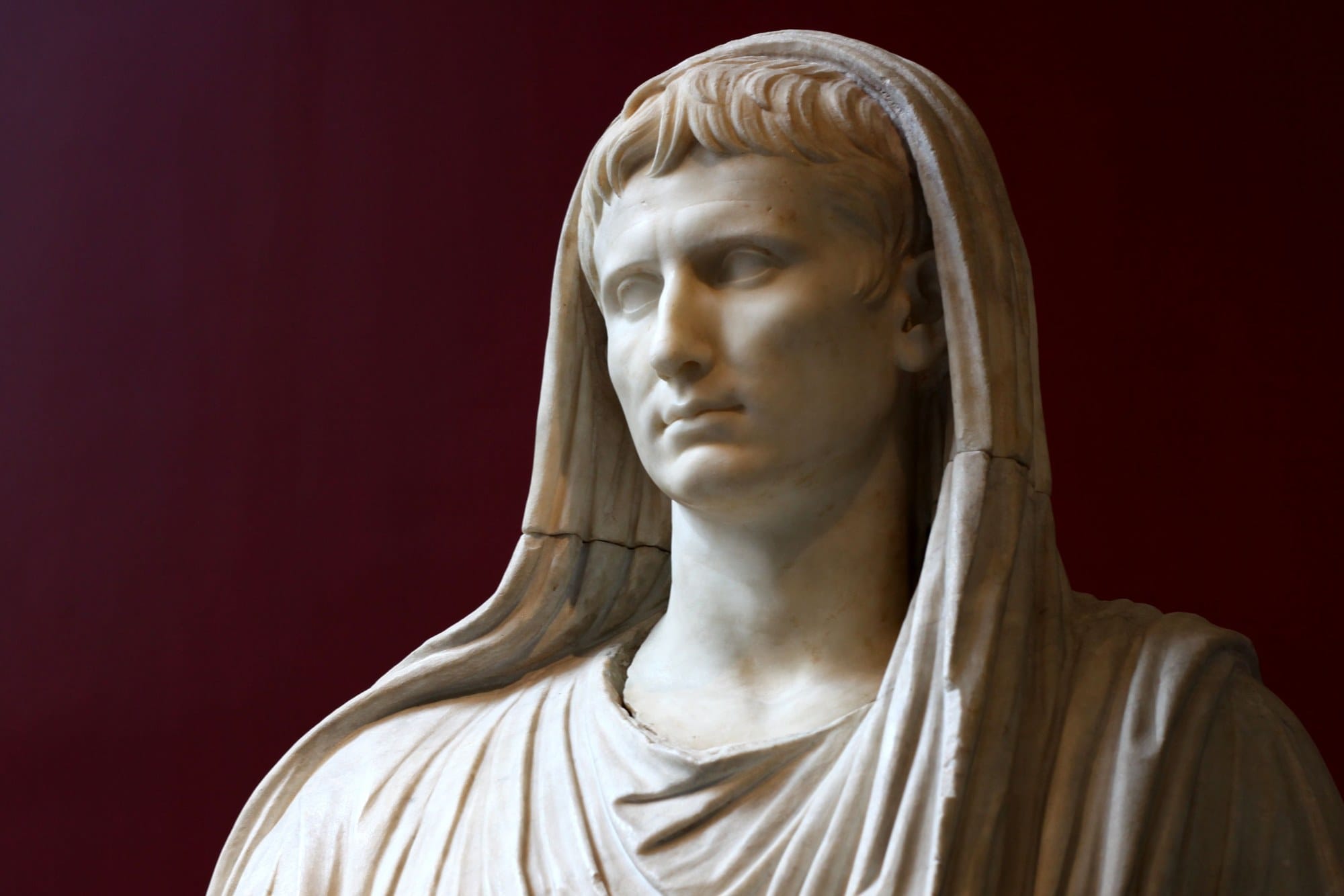
The making of Rome’s first emperor involved adapting such familiar forms to an extraordinary position. The statue known as the Via Labicana Augustus presents him in a toga with his head covered. Its hands are missing, but the pose is generally understood as that of an officiant making a preliminary offering. The clothing and gesture gave viewers a readily recognisable account of his relationship with the gods. Religious service became one way to represent supreme authority in the guise of an established Roman responsibility.
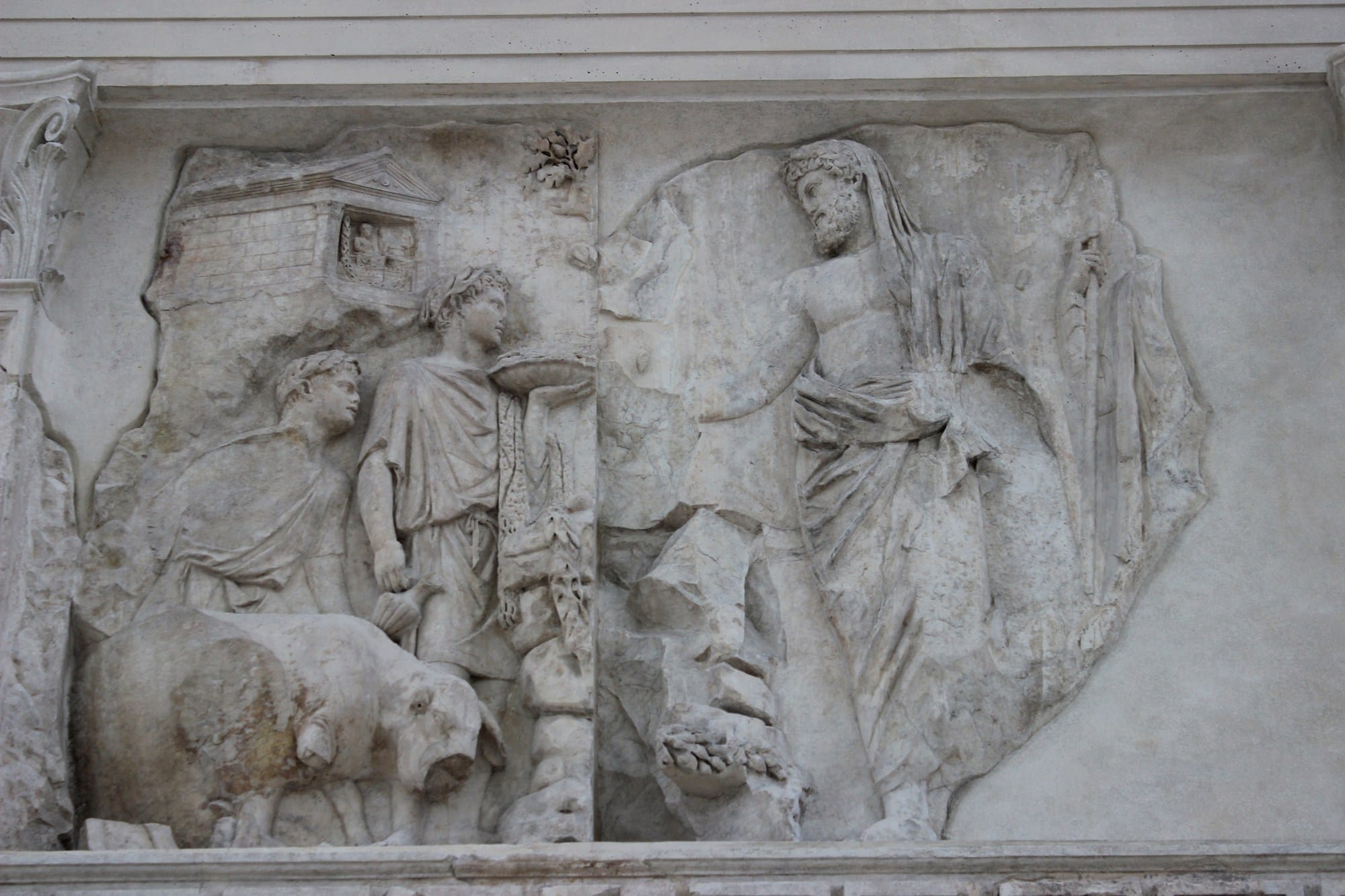
The Ara Pacis, the Altar of Augustan Peace, dedicated in 9 BCE, handled the message more delicately. Augustus appears among participants in a procession towards sacrifice. On another panel, a veiled figure traditionally identified as Aeneas offers a sacrifice; the identification has also been disputed in favour of Numa, Rome’s legendary second king. Procession, priestly dress and ancestral piety connected the new political order with venerable religious practice. Within Augustus’s promise of Roman peace, the ruler’s authority acquired the reassuring appearance of continuity.
The emperor could travel further in stone
An emperor could preside over sacrifices in Rome, on campaign or during a visit. Most subjects, however, encountered his sacrificial role through images. Statues, reliefs and coins carried the officiant into places the living ruler would never reach. A local ceremony involved a particular group assembled around a real altar. An imperial image could extend that familiar arrangement across the empire, presenting the ruler as the outstanding intermediary between the human community and its gods.
The political reading of these images rests on the same relationship that made a local benefactor prominent. The sponsor possessed resources, publicly honoured the gods and offered benefits to fellow citizens. Imperial imagery placed the emperor at the summit of that hierarchy. It invited viewers to understand his exceptional authority through the recognisable figure of the generous, pious officiant. The point reached beyond the particular animal or ceremony depicted: the ruler was being presented as someone whose standing qualified him to act for others.
This imagery varied considerably over time. Sacrificing emperors are almost absent from coin designs before Vespasian’s reign, become especially popular in the later second century, and grow scarce across media after about 230 CE. Monumental examples nevertheless stretched from Lepcis Magna in present-day Libya to Thessaloniki in Greece. The image remained recognisable over more than three centuries, in different media and far-flung places, even as its popularity changed. A familiar religious action could reach an audience far beyond those attending the actual sacrifice.
A birthday worthy of a bull
The emperor also entered people’s lives through the calendar. Birthdays, accession anniversaries, victories and moments of danger provided occasions for offerings. A community could mark its relationship with a distant ruler by assembling at a local shrine on a particular day. Repetition made the connection part of ordinary civic and military time. The ruler’s well-being became a recurring public concern, expressed through ceremonies whose organisation, scale and participants could differ from one place to another.
Two unusually informative records reveal the choices involved. In Rome, the Arval Brothers, a priestly college revived or reworked under Augustus, recorded sacrifices linked to the imperial family. Their observance of imperial anniversaries used bovine victims. The Feriale Duranum, a military festival calendar preserved on papyrus from the 220s CE at Dura-Europos on the Euphrates, distinguishes major anniversaries with animal victims from lesser occasions observed with incense and wine. Birthdays accumulated across generations of rulers, giving a military unit a ritual connection with the dynasty and its predecessors.
Cities maintained their own arrangements. At Narbo, modern Narbonne in southern France, regulations for an altar of Augustus’s numen, or divine will, assigned offerings to a board of equestrians and freedmen. They also provided incense and wine for the people. At Gytheion in southern Greece, local magistrates were instructed to sacrifice a bull during an imperial festival. Animal sacrifice was generally associated with the more important occasions in the surviving evidence. Even within a shared practice, the choice of victim and the size of the ceremony helped distinguish levels of honour.
For the emperor, or to the emperor
The destination of an offering could be more complicated than its public setting suggested. Sacrificing to a ruler and sacrificing to a god for that ruler’s welfare created different religious relationships. In the Greek-speaking East, surviving inscriptions often describe offerings on the emperor’s behalf. Others speak of offerings to the emperors, or use wording that leaves the relationship less precisely defined. Imperial worship accommodated this range of formulations rather than imposing one uniform explanation of the living emperor’s divine status.
Gytheion offers a useful example. Its bull was sacrificed in front of an imperial temple, but the inscription specified the rulers’ welfare and the enduring continuation of their rule as the purpose. At Akraiphia in central Greece, an inscription honouring a benefactor records a bull sacrificed to the Sebastoi, the collective emperors, alongside Hermes and Herakles. Another sacrifice to the emperors was followed by a public feast. Similar animals and ceremonies could thus establish relationships through different religious language, shaped within particular communities.
In Rome and the Latin West, offerings could be directed to an emperor formally deified after death, or to the living ruler’s genius, his divine counterpart, or his numen. The military calendar from Dura-Europos makes such distinctions practical. It prescribes bovine sacrifices to deified emperors on their birthdays, while an anniversary of the reigning Severus Alexander called for a bull to his genius. The ruler, his divine associations and the traditional gods occupied related but distinguishable positions in the ritual calendar.
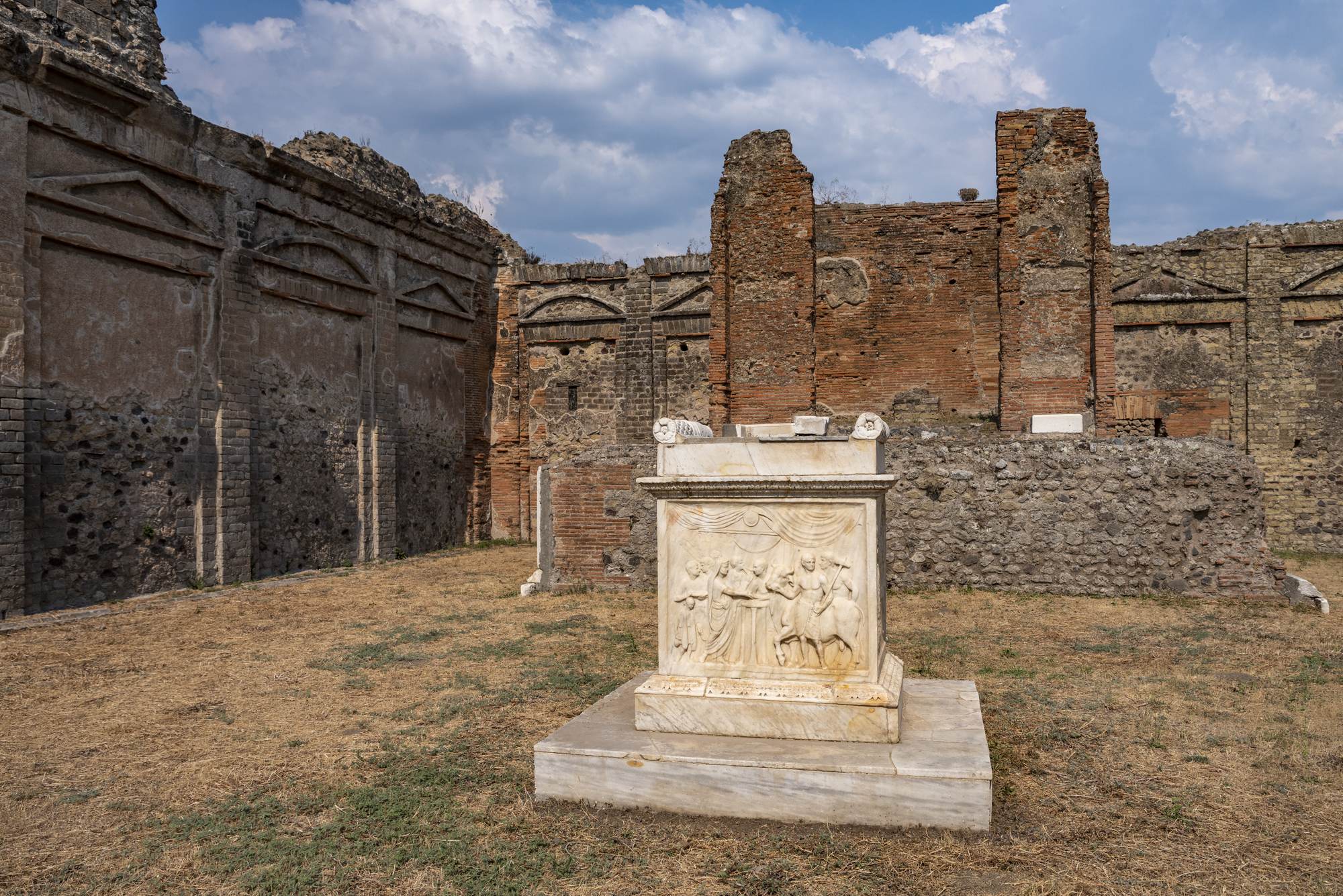
One interpretation of this flexibility is that sacrifice established a relationship more readily than it settled a theological argument. People honoured the emperor or sought divine protection for him; imperial power, in turn, was associated with the greater benefits of peace, security and prosperity. The exchange was unequal, just as the relationship between ruler and subjects was unequal. In an image, the emperor stood with the community before its gods. In offerings directed towards him or his welfare, he became the exceptional figure around whom the community gathered.
The bargain depended on who joined in
Jewish worship shows how much room that flexibility could provide. Sacrifices to the Jewish god on behalf of an emperor allowed religious obligations and recognition of Roman rule to coexist. Offering divine worship to the ruler himself crossed a different boundary. The arrangement could bring a community into an imperial relationship while preserving the identity of the deity receiving its offerings. Religious convergence could therefore mean recognising the same ruler through different practices, with clear differences in what participants believed they were doing.
It could also become a point of conflict. Philo’s account of an embassy to Gaius, better known as Caligula, reports the emperor’s displeasure that Jewish sacrifices benefited him while being offered to another deity. In 66 CE, Josephus describes the rejection of foreign gifts and sacrifices at the Jerusalem Temple, bringing offerings connected with the emperor to an end. An established means of acknowledging Roman power became part of a rupture with it. These episodes expose the political weight carried by choices about the recipient, sponsor and purpose of a sacrifice.
By Julian’s time, Christian opposition to sacrifice created a further obstacle to using it as common religious ground. Julian’s own complaint about Daphne was sharpened by his conviction that honouring the gods and caring for the city belonged together. The neglect he described became an accusation against the citizens’ priorities. His expectation of a public sacrifice required a civic response, and the priest’s private offering made the missing collective effort painfully conspicuous.
For emperors, sacrifice could turn wealth into visible piety, public occasions into expressions of loyalty and local rituals into relationships with a distant ruler. Its reach came from customs that many communities already understood, together with the freedom to adapt them. That freedom also left participation open to negotiation and conflict. The same altar could place the emperor at the centre of a shared ceremony or reveal how far ruler and subjects had drifted apart. Julian’s goose, belonged to the second story.


About the Roman Empire Times
See all the latest news for the Roman Empire, ancient Roman historical facts, anecdotes from Roman Times and stories from the Empire at romanempiretimes.com. Contact our newsroom to report an update or send your story, photos and videos. Follow RET on Google News, Flipboard and subscribe here to our daily email.
Follow the Roman Empire Times on social media: