
How to Tour Herculaneum's Suburban Baths till 12 December
The remaining Saturday visits take small groups inside a Roman bathhouse restoration site, ahead of its permanent reopening.

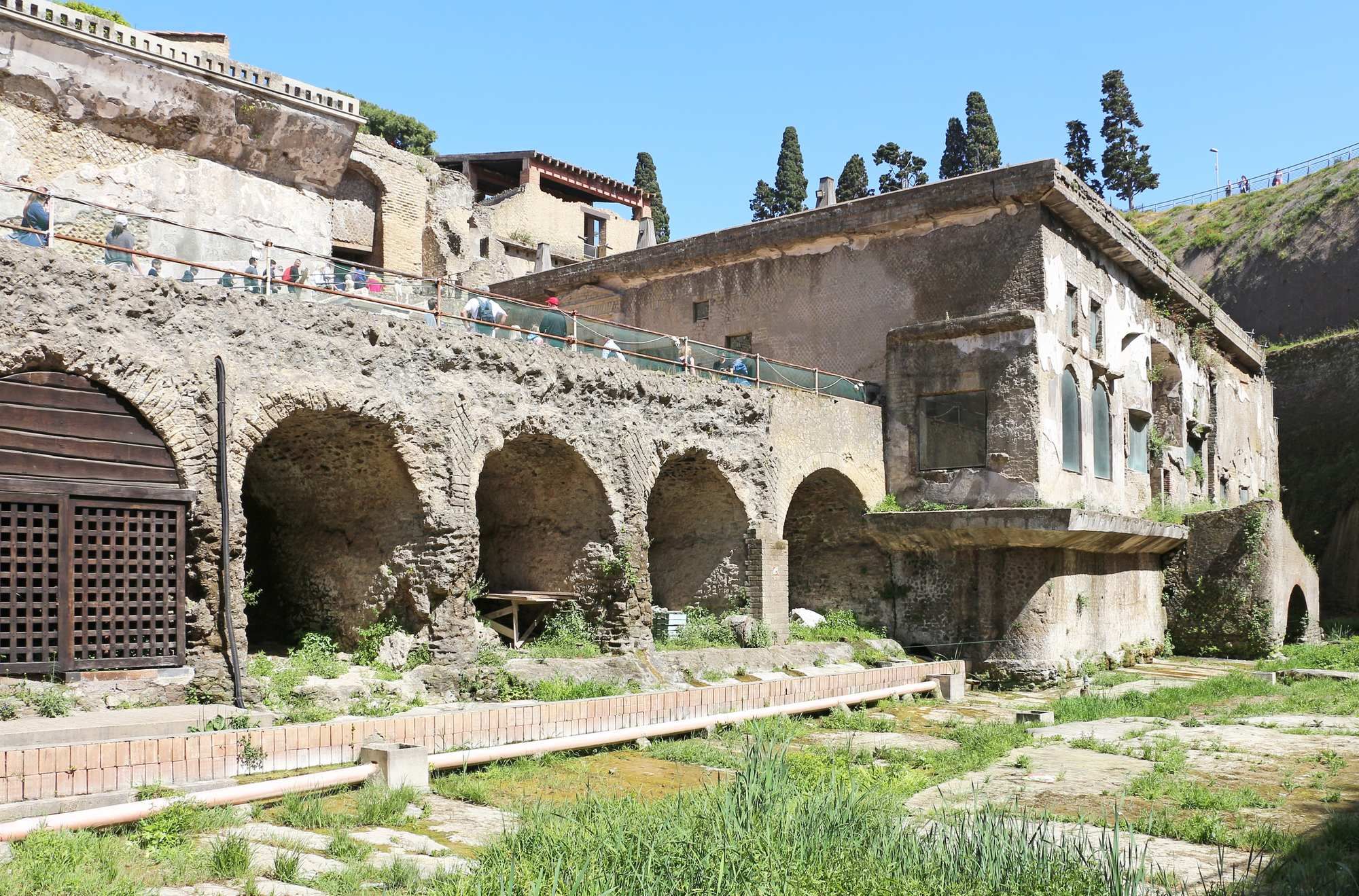
Guided visits to Herculaneum’s Suburban Baths will continue through 12 December 2026, giving small groups access to the Roman complex while restoration work proceeds. The archaeological park’s latest announcement confirms the remaining Saturday appointments and encourages advance booking after earlier visits sold out.
The visits bring the public into a conservation worksite ahead of the monument’s permanent reopening. Park staff accompany groups through the complex, where bathing pools, decorated rooms, wooden fittings and parts of the water and heating installations survive. Participants wear protective helmets and can consult additional material through QR codes.
The news concerns one of Herculaneum’s seafront buildings, buried with the town during the eruption of Vesuvius in AD 79. Its preserved interiors connect the practical arrangements for a modern visit with the architecture, decoration and equipment of bathing in a Roman coastal town.
Four Saturdays Remain in the Tour Programme
As of 15 November, the remaining announced dates are 21 and 28 November and 5 and 12 December. The park’s update, published on 14 November, also listed that day’s appointments. Each visit lasts approximately an hour, with a maximum of 15 participants meeting on the Terrace of Marcus Nonius Balbus.
The Saturday timetable offers Italian-language visits at 9.30am, 11.30am and 2.30pm, alongside English-language visits at 10.30am and 3.30pm. The programme therefore provides a choice of language and morning or afternoon entry. The park recommends booking in advance because the dates already held had reached capacity.
The announced integrated ticket covers both the archaeological park and the Suburban Baths and costs €21. A €7 concession is listed for eligible EU citizens and non-EU citizens covered by reciprocal arrangements aged 18–25. Admission is free for under-18s and other legally exempt visitors; children under 12 must be accompanied by an adult. Reservations are available online and at the ticket office through CoopCulture and official park channels.
A Bathhouse Facing the Ancient Shore
The Suburban Baths stand outside the ancient city walls, at the southwestern corner of Herculaneum. Originally facing the sea, the building occupied three levels: a terrace used as a gymnasium, the bathing rooms, and the spaces containing water and heating equipment. This arrangement placed the baths between the town and its waterfront.
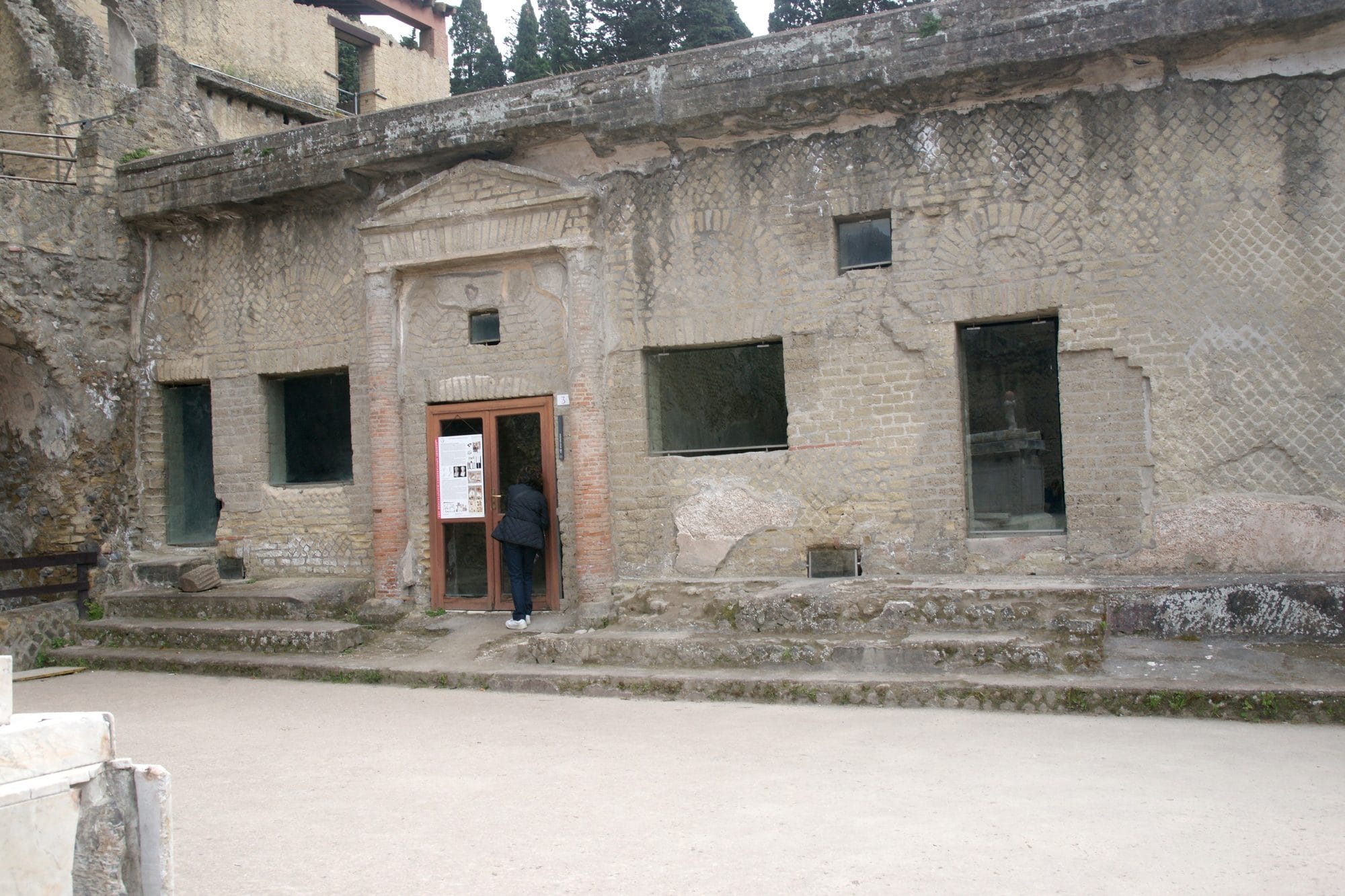
The park’s guide dates the original complex to the beginning of the first century AD and associates its construction with Marcus Nonius Balbus, a politician and benefactor of Herculaneum. The main entrance opens onto his terrace, where a statue and funerary monument commemorate him. The earliest baths were smaller than the complex eventually buried by Vesuvius.
A separate brick ramp connected the baths directly with the beach, providing another approach from the shore. The coastal setting can also be followed in our account of Herculaneum’s reopened ancient beach. Inside the baths, large windows gave the bathing and resting rooms views towards the sea and the Gulf of Naples.
Apollo’s Fountain and the Cold-Water Pool
A staircase retaining wooden steps leads into a small atrium framed by four columns and two levels of arches. Its marble-lined basin collected rainwater, while a sculpted head of Apollo formed part of a fountain. The mechanism controlling the water jet survives on the floor, preserving a small but unusually tangible part of the installation.
On the eastern side of the atrium lies the frigidarium, the cold-bathing room. A vaulted ceiling and central skylight cover its rectangular pool, entered by semicircular steps. Coloured marble, painted architectural designs and decorated stucco framed the bath, giving the room a finish that extended well beyond the pool itself.
The room also preserves traces of the eighteenth-century Bourbon excavation tunnels. A doorway filled with volcanic material was left in place by Amedeo Maiuri, whose twentieth-century excavations brought the baths back to light. These features place the Roman rooms alongside visible evidence of their burial and later archaeological investigation.
Marble Benches Between Warm and Hot Rooms
A surviving wooden door linked the cold room with the tepidarium, a heated space where bathers could rest before entering hotter rooms. Terracotta wall ducts carried hot air through the building. Marble benches stood along the sides and beneath a large window, with carved supports taking the form of griffin heads.
The warm room’s decoration included seven male warriors modelled in white stucco relief. Their precise identification has been debated, with proposals involving the heroes of Thebes or the eponymous heroes of Athens. The park’s guide connects the decorative programme with the commemoration of Nonius Balbus, whose statue stood outside on the entrance terrace.
The adjoining calidarium, or hot-bathing room, contained a rectangular pool and a separate marble basin for cold-water washing. Coloured marble covered its floor and lower walls, while stucco ornament decorated the upper surfaces and vault. Parts of a wooden window frame also survived, preserving details of how the interior was enclosed and lit.
Heat Beneath the Pool and Through the Walls
A larger bathing hall contained a pool with a substantial bronze heating vessel at its centre, described in the park’s guide as a “samovar” arrangement. Beneath the pool, brick supports created a cavity through which furnace heat circulated. The installation combined heated water with warmth delivered through the structure below it.
The hypocaust heating used in Roman baths also involved spaces and ducts beyond the floor. At Herculaneum, terracotta elements carried hot air through the walls and vault. Grooves in the vault helped channel condensation towards the sides, rather than allowing droplets to fall directly onto bathers.
Two smaller, intensely heated rooms opened off the large hall. One communicated directly with the furnace area and had benches; the other was circular, with niches and a conical vault. A central skylight helped regulate heat and release steam, while its mosaic floor included a vessel entwined with ivy.
Restoration Looks Towards Regular Access
The current project began in September 2024 and combines conservation with preparations for regular public access. The park identifies control of temperature and humidity, safety work on masonry and installations, and the protection of surviving decoration as central objectives. New access routes are another part of the programme described in its guide.
That work sits within a longer partnership with the Packard Humanities Institute. A peer-reviewed account published in 2019 describes how the Herculaneum Conservation Project developed planned maintenance across the archaeological site, recording the needs of individual walls, doors, mosaics and other features. It explains a system of repeated inspection, intervention and updated records.
The present tours let visitors see conservation work alongside the Roman spaces it protects. The park’s latest announcement still places them ahead of permanent reopening, with 12 December marking the end of the announced worksite-visit cycle. For the remaining Saturdays, access continues through reserved, staff-led groups inside the bath complex.



About the Roman Empire Times
See all the latest news for the Roman Empire, ancient Roman historical facts, anecdotes from Roman Times and stories from the Empire at romanempiretimes.com. Contact our newsroom to report an update or send your story, photos and videos. Follow RET on Google News, Flipboard and subscribe here to our daily email.
Follow the Roman Empire Times on social media: