
AI Reconstructs a Pompeii Escape and the City Before Vesuvius
A broken mortar and a restored Roman house underpin two Pompeii projects that use AI to communicate archaeological findings and reconstruct ancient settings.

Artificial intelligence is helping Pompeii turn archaeological findings into scenes that visitors can understand: a man trying to escape the eruption of AD 79, and houses and public buildings reconstructed on a screen. Two projects combine digital tools with the physical evidence preserved in the ancient city.
The Pompeii Archaeological Park announced the victim reconstruction on 27 April 2026, working with the University of Padua’s Digital Cultural Heritage Laboratory. A separate augmented-reality project, Portyl, accompanied the reopening of the House of the Citharist on 24 June. Both projects place archaeological research behind the images presented to the public.
The first draws on human remains and objects excavated outside Porta Stabia, one of Pompeii’s gates. The second brings together studies of buildings, digital surveying and reconstructed environments. Their subjects range from the possessions carried during an escape to the organisation of a large Roman household and the city’s places of entertainment.
Two men on the route towards the coast
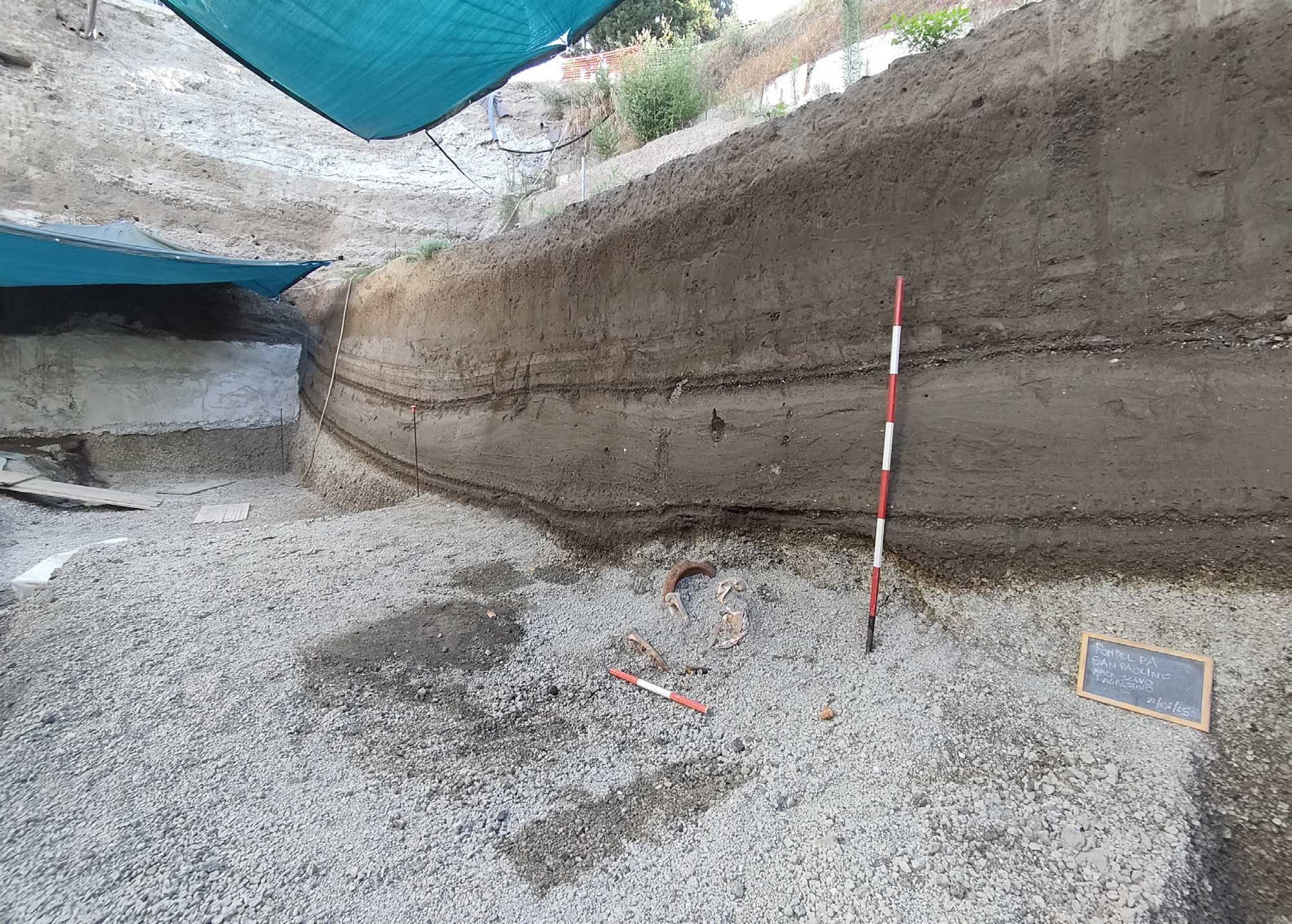
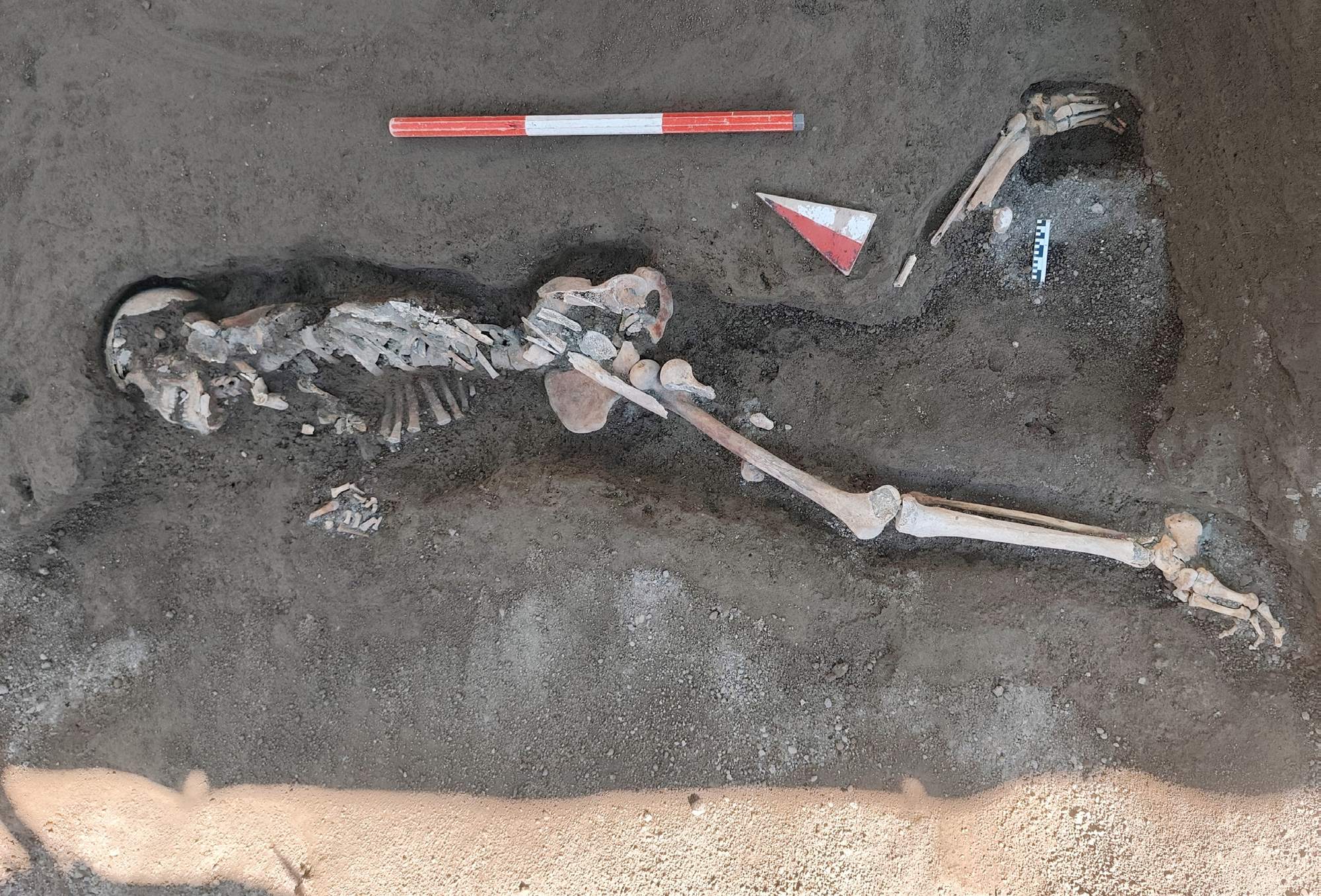
The human remains came to light in the necropolis outside Porta Stabia, during work completing the investigation of the tomb of Numerius Agrestinus Equitius Pulcher. Archaeologists identified two men who had attempted to reach the coast. Their bodies lay in different volcanic deposits, indicating that they died at different stages of the eruption.
The older man was found within the lapilli, the small fragments of volcanic material that fell over Pompeii. Beside him was a large terracotta mortar with visible fractures. The excavators interpret the vessel as an improvised shield held over his head during the falling debris.
The younger man was found above the lapilli, in the ash deposit. The park considers it likely that a pyroclastic current, a hot flow of volcanic ash and gas, overtook him. The positions of the two bodies therefore preserve a sequence of danger along an escape route beyond the city walls.
A lamp, a ring and ten bronze coins
The older man had a ceramic lamp with him, which the excavators connect with the need to find a way through poor visibility. A small iron ring remained on the little finger of his left hand, and ten bronze coins accompanied him. These objects form part of the evidence used to reconstruct his escape.
The mortar supplies another part of that reconstruction. In its archaeological summary, the park explains that falling material included dense lava fragments as well as the lighter pumice. The broken vessel and the position of the body underpin the interpretation that the man was trying to protect himself from this debris.
The researchers also connect the gesture with Pliny the Younger’s account of the eruption. His description of people fastening cushions to their heads provides an ancient parallel for improvised protection. The mortar gives the excavators a separate material example of a similar response to the falling volcanic fragments.
Building an image from the excavation
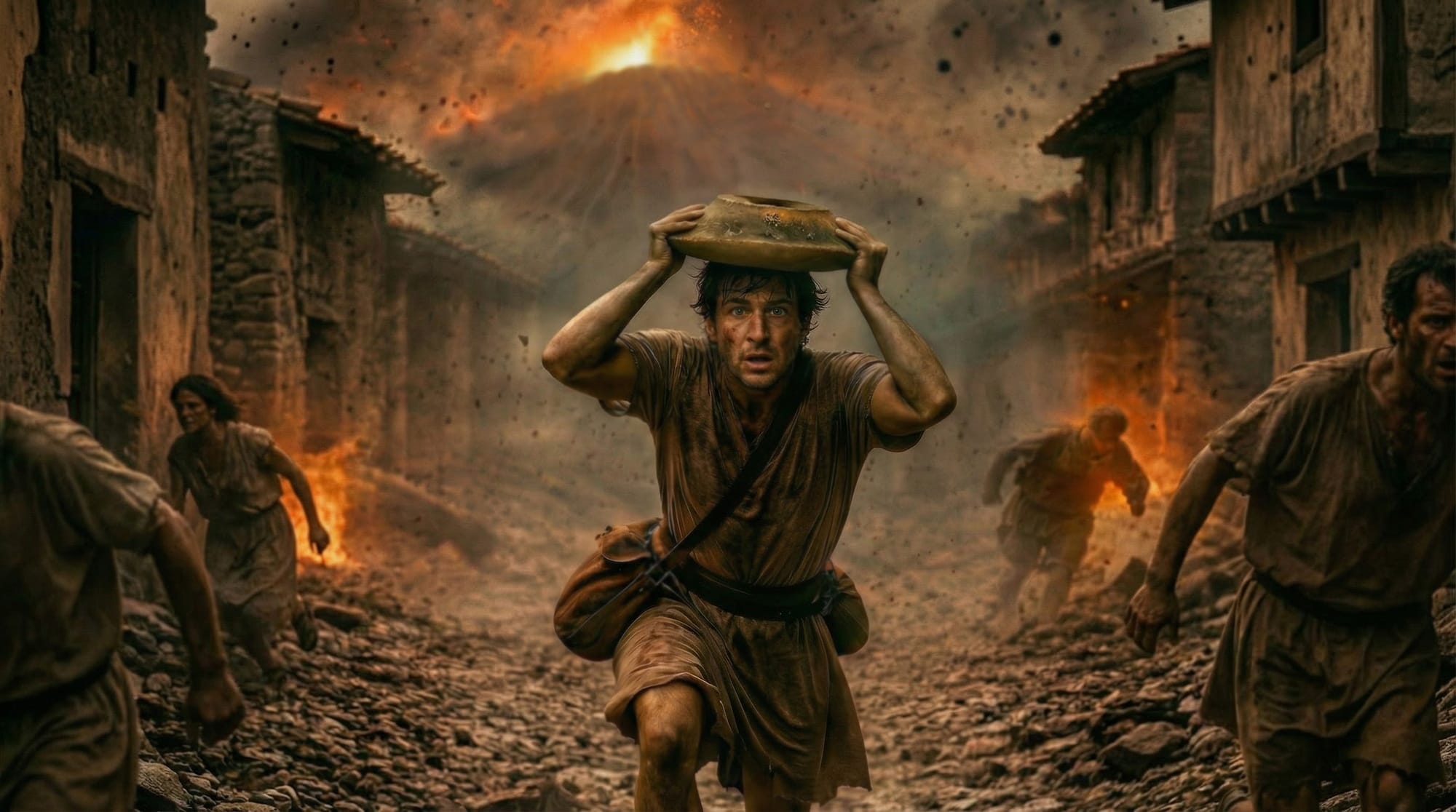
The park and the Padua laboratory developed the basic image with ChatGPT Pro, inserted the terracotta vessel using Photoshop, and used Nano Banana Pro for the surroundings and visual details. The reconstruction represents the older victim with the mortar, drawing on the objects and circumstances documented in the excavation.
The park describes the result as an experimental prototype intended to make archaeological findings more accessible to people outside the specialist audience. The image is an interpretation built from the excavation, rather than a recovered portrait of the man. Its purpose is to communicate the research through a recognisable human action.
The collaboration places the production of that image within archaeological work. The university’s laboratory presents AI as a tool for interpretative models and communication, used alongside specialists. In this case, the excavated remains, associated possessions and volcanic deposits supply the starting point for the digital scene.
A Roman house returns on screen
The House of the Citharist is the first residence included in Pompeii’s Portyl project. Its name comes from the bronze figure of Apollo associated with the house. Excavations began there in 1853, and many paintings and objects were subsequently taken to the museum in Naples, making the surviving rooms harder to understand together.
The digital model draws on multidisciplinary research coordinated by the park, with teams from the University of Salerno and the Politecnico di Milano. AI tools helped build the model that supplied a scientific basis for the visitor app. The reconstructed household brings architecture, furnishings and scenes of daily activity into a shared view.
The residence grew from the union of earlier houses into a complex covering about 2,700 square metres (29,000 square feet), with entrances on Via dell’Abbondanza and Via Stabiana. Its reopening followed structural work, conservation and improvements to accessibility. The digital experience accompanies a restored archaeological setting that visitors can move through in person.
From the Forum to the amphitheatre
Portyl extends beyond the house to the Forum, Amphitheatre, Large Theatre and Odeon, the smaller theatre. The park describes reconstructions that include buildings, people, animals and activities. Visitors can view scenes of gladiatorial combat and theatrical performance, as well as a representation of the eruption of Vesuvius.
The app, made by Histoury Inc., uses LiDAR, photogrammetry and generative AI. LiDAR surveys and photographic recording contribute to the digital documentation of the sites; the company’s artists studied and recreated the settings. The resulting environments are presented through compatible iPhones, Android smartphones and tablets.
A GPS-based geofencing system recognises when a visitor enters an enabled area. It then aligns the reconstructed environment with the person’s physical position, allowing the screen to show the historical setting around that location. The June announcement also provided for a remote mode, extending access beyond a visit to Pompeii.
Keeping the archaeology behind the reconstruction
For the park, the value of these projects lies in making complex research understandable to a wider audience. Its launch statement describes an opportunity to reach new generations and reduce cultural and physical barriers. The digital presentation is intended to connect visitors with the buildings and objects that archaeological investigation has documented.
The same statement gives archaeologists an active responsibility for the results. Reconstructions should rest on evidence that can be verified and shared, with specialists directing how the heritage is communicated. The park warns against producing digital content that loses its connection with scientific research and the authentic archaeological remains.
Together, the two projects show how Pompeii is applying that approach at different scales. One assembles a scene around a broken mortar, a lamp and a man caught in the eruption; the other rebuilds the surroundings of houses and civic spaces. Both make the passage from excavated evidence to public interpretation part of the visitor experience.

About the Roman Empire Times
See all the latest news for the Roman Empire, ancient Roman historical facts, anecdotes from Roman Times and stories from the Empire at romanempiretimes.com. Contact our newsroom to report an update or send your story, photos and videos. Follow RET on Google News, Flipboard and subscribe here to our daily email.
Follow the Roman Empire Times on social media: