
Watch: Metal Detectorist Finds 934 Roman Silver Coins Near Cologne
A reported 934 denarii recovered near Wesseling form an unusually large hoard from Hadrian’s era. Archaeologists have not identified who buried them or why.


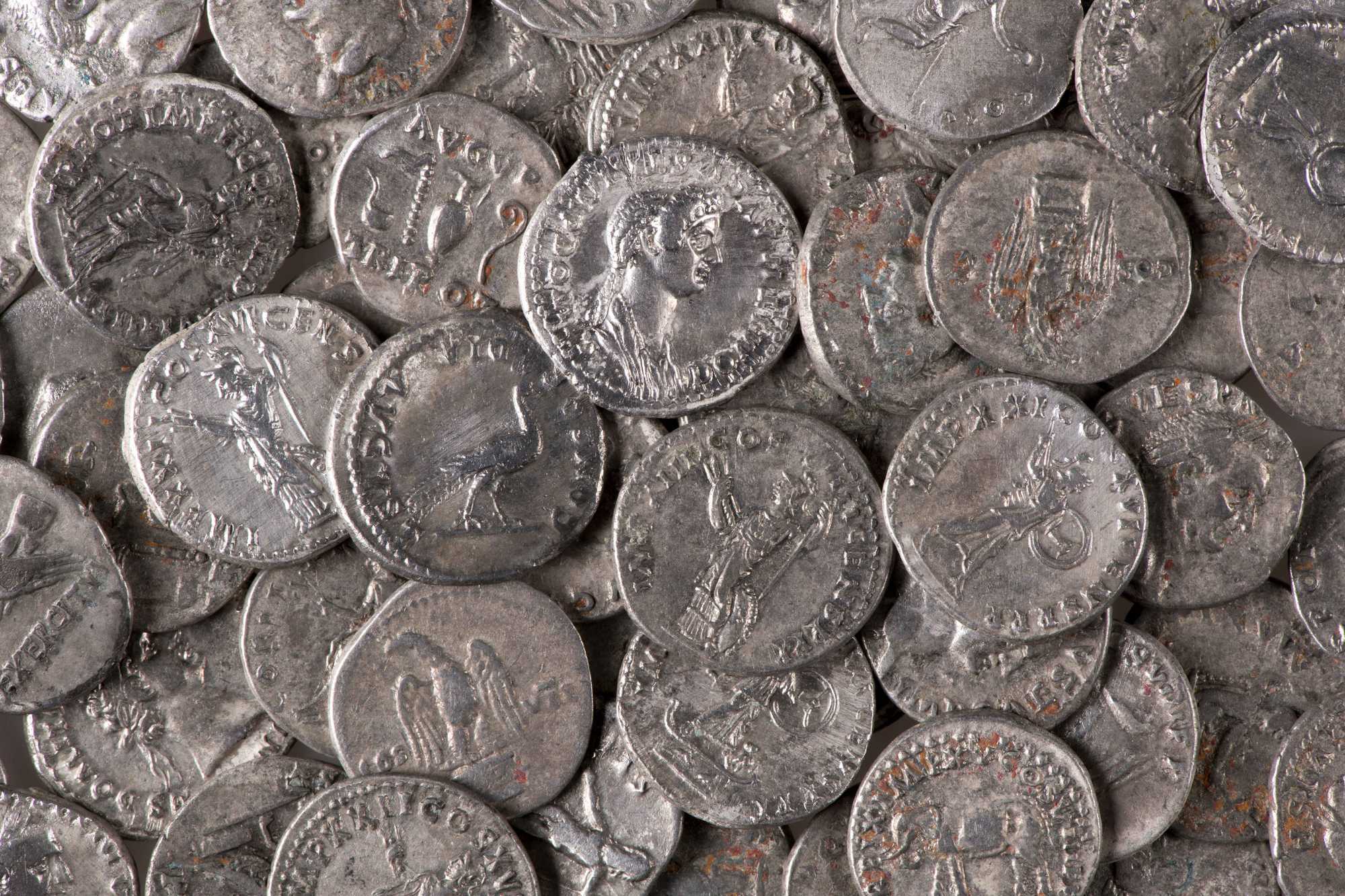
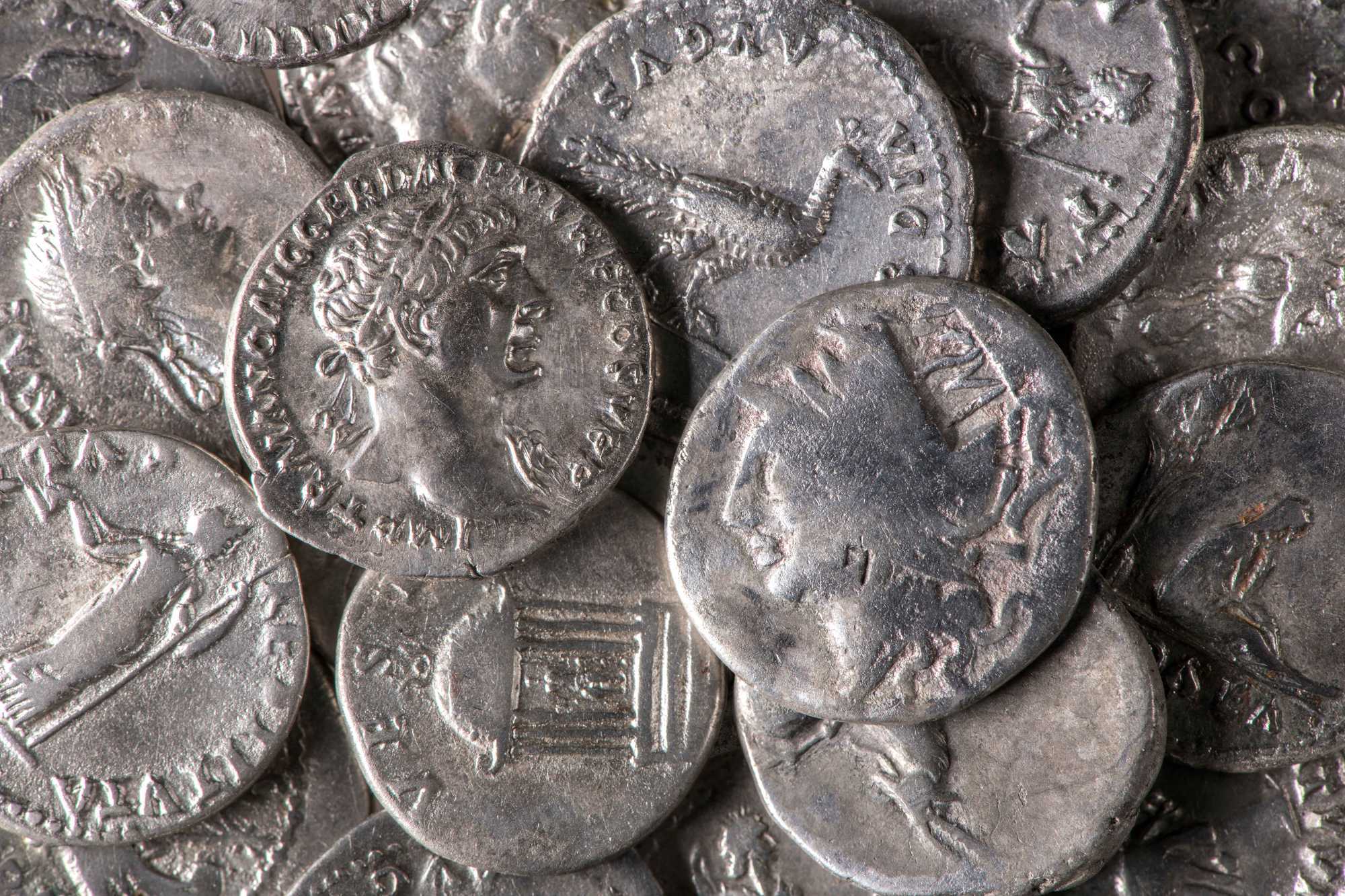
An amateur archaeologist searching a field near Wesseling, south of Cologne, found several Roman silver coins and alerted the authorities when his detector continued to signal. A subsequent investigation recovered 934 denarii, according to the Rhineland archaeological office as reported by the Associated Press. The coins weigh about 3.1 kilograms in total.
The find was made about a year before officials presented it on 22 September 2026 at the LVR-LandesMuseum Bonn. Archaeologists think the group was deliberately buried in the second quarter of the second century AD. They have not identified the person who assembled it or established why the money was left in the ground.
Reports have called the group Germany's largest Roman silver-coin hoard, but the archaeological office's stated comparison is narrower: it is the largest coin hoard found in present-day Germany from the time of Hadrian. That qualification matters because Roman coins were deposited across many centuries and in very different quantities. The Wesseling find belongs to a specific early imperial context.
From a field signal to an archaeological recovery
Oliver Riedl first found several coins while detecting in a field near Wesseling. When the signals continued, he contacted the authorities rather than treating the objects as isolated finds. Specialists then excavated the spot and recovered the full group of 934 silver denarii. The public presentation followed roughly a year after the initial find.
The sequence is significant to the evidence available from the site. Coins found together can be studied as a group, but their location and relationship to the surrounding soil and objects also affect what archaeologists can infer. Research on Roman coin finds stresses that the find context is essential to distinguishing a deliberate deposit from scattered losses or material moved after burial.
The report available at the time of announcement gives the count, combined weight and broad burial date. It does not provide a published catalogue of each coin, a full description of the container, or a detailed stratigraphic report. Those limits leave questions about the collection's formation open even though the main find is secure.
Why Hadrian's period matters
The archaeological office dates the probable burial to the second quarter of the second century AD. Hadrian ruled from AD 117 to 138, so the comparison used in its record claim concerns hoards associated with that reign. A coin struck under an emperor establishes when that coin could first have entered circulation; it does not, on its own, establish the exact year when a collection was buried.
The Oxford Coin Hoards of the Roman Empire database now has an entry for Wesseling, with Hadrian listed as its closing reign. That public entry currently lacks a coin-by-coin inventory and lists zero coins in its total field. Its incomplete fields should not be read as a correction to the 934-coin figure announced by the excavating authority.
Roman coinage changed over a long period, and the denarius was one of its enduring silver denominations. Readers seeking the wider monetary background can consult our account of Roman coins and the monetary system. For this hoard, the key point is more limited: 934 coins were recovered together, and the authorities place their deposition around Hadrian's era.
Wesseling in the Roman Rhineland
Wesseling lies on the Rhine between modern Cologne and Bonn. The Rhineland's historical atlas identifies a Roman settlement and likely road station in the area of present-day Niederwesseling. A road from the Eifel met the north-south Roman route there, making the locality a junction within the province's communications network.
The same atlas says the built remains suggest a civilian settlement, or vicus, but treats the existence of an auxiliary fort as uncertain. It also records a riverside villa, traces of rural estates, burials beside the roads and evidence pointing to a sanctuary. These finds establish an inhabited Roman landscape around Wesseling without identifying the newly found hoard's owner or tying it to any one building.
Cologne, to the north, was the provincial capital of Lower Germany. The LVR describes its Roman roads as connecting the city with the wider region and routes toward Trier. This setting helps explain why Roman money circulated in the area, but it does not demonstrate that the Wesseling coins belonged to a soldier, official, merchant or resident of a particular settlement.
What 934 denarii could represent
At the Bonn presentation, a researcher from the archaeological office used army pay to illustrate the hoard's scale. She said an ordinary legionary in the period earned 300 denarii a year and that roughly half could be withheld for food and equipment. On those assumptions, accumulating 934 denarii would require about six years of saving all remaining pay.
That is a comparison, not an identification of the person who buried the money. Scholarship on Roman army pay draws on fragmentary pay accounts and shows that deductions varied. The calculation offers a sense of magnitude, but it cannot establish either the owner's occupation or the purchasing power of the coins in every local transaction.
The sum could have been accumulated in more than one way, and the announcement does not provide evidence for a particular source of income. Roman financial life included forms of credit and deposit as well as physical coin holdings; our article on credit and banking in ancient Rome provides background. The Wesseling deposit itself remains a physical group whose original purpose is unresolved.
Why the coins stayed buried
The archaeological office considers deliberate burial probable, but its director said the motive can only be speculated upon. Safekeeping is one possibility. He also suggested that the person who knew the location may have died before retrieving the money, without passing that knowledge on. Neither suggestion is established by the coins alone.
Numismatic research warns against treating every hoard as automatic proof of war or sudden disaster. A group of coins can record savings, planned recovery, a special deposit or other behaviour, depending on its context. Without a detailed account of the Wesseling excavation and the individual coins, the announcement does not support a single story about why this particular group was buried.
The role of careful recovery is clear. In another German case, metal-detected Roman denarii at Kalkriese became part of a much larger archaeological investigation. The two sites should not be equated: the Wesseling coins have been reported as a buried collection, while the Kalkriese finds were studied with battlefield evidence. Their common lesson is that context, rather than the metal alone, shapes interpretation.
For Wesseling, the questions now lie with the detailed study of the recovered group: the dates and types of its individual denarii, their condition, and the documented circumstances of burial. The confirmed public account establishes the 934-coin discovery and its broad Hadrianic setting, but still leaves the identity and intention of the ancient owner unanswered.
Associated Press, “Amateur archaeologist finds 934 ancient Roman silver coins in western Germany,” 22 September 2026.
LVR, Rheinischer Städteatlas Wesseling, Part 1: Settlement.
LVR, “VIA – Erlebnisraum Römerstraße”.
Stefan Krmnicek, “Contextual numismatics,” Heritage Science 11, 256 (2023).
M. Alexander Speidel, “Roman Army Pay Scales,” Journal of Roman Studies 82 (1992).
Oxford Coin Hoards of the Roman Empire, Wesseling record.
Oxford Coin Hoards of the Roman Empire, Holzthum–Um Rank record.

About the Roman Empire Times
See all the latest news for the Roman Empire, ancient Roman historical facts, anecdotes from Roman Times and stories from the Empire at romanempiretimes.com. Contact our newsroom to report an update or send your story, photos and videos. Follow RET on Google News, Flipboard and subscribe here to our daily email.
Follow the Roman Empire Times on social media: