
Cremated Remains Reveal Migrants in Roman Colchester
A study of 22 Roman cremation burials traces movement to Colchester and adds a new chapter to the story of its gladiator-decorated vase.

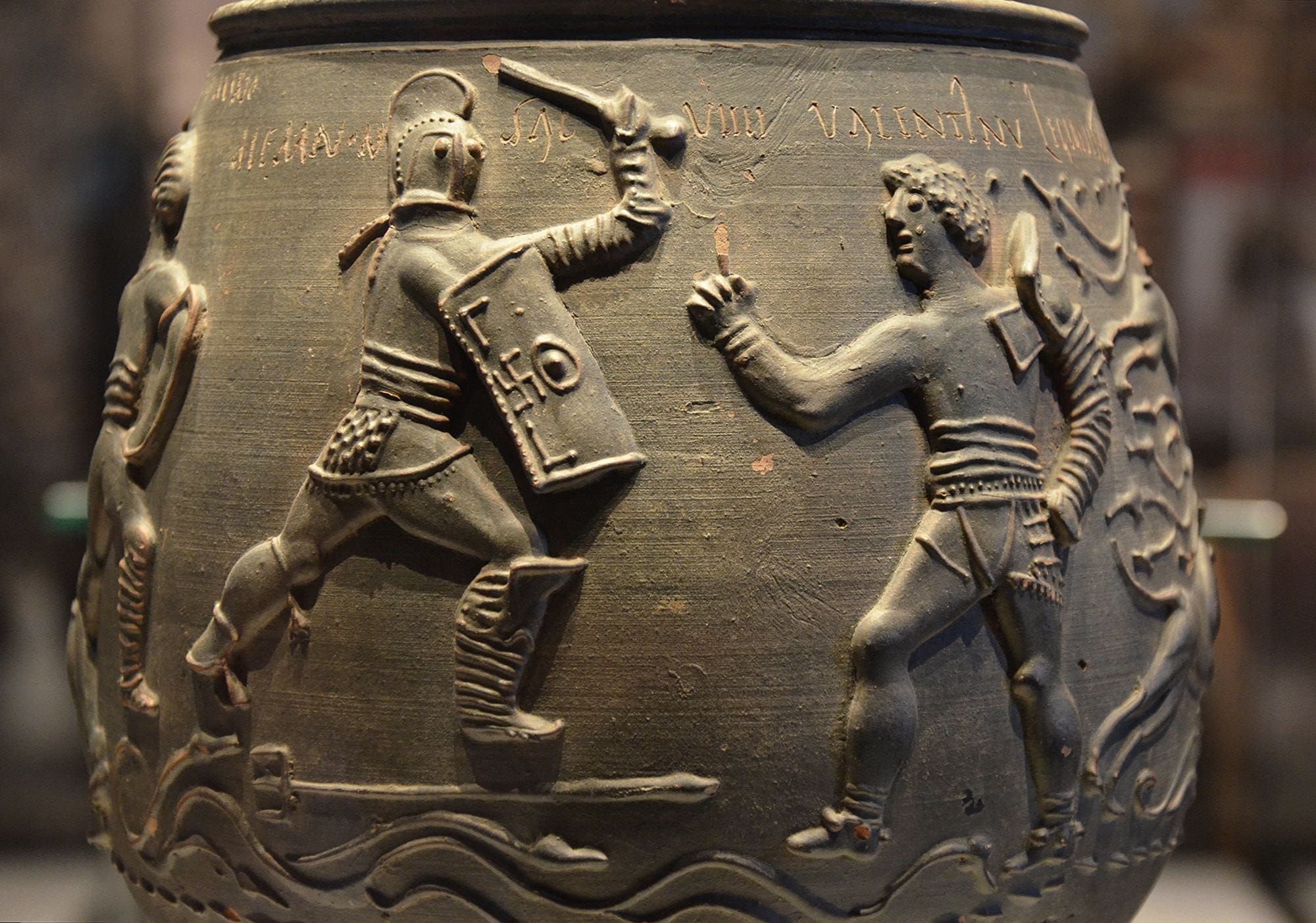
Cremated remains from Roman Colchester have revealed people who travelled to Britain from other parts of the empire, including three with probable Mediterranean origins. A new study combines two chemical signatures preserved in burned bone to examine the lives of people buried in and around the provincial capital.
The research analysed material from 22 cremation burials held in museum collections. Its findings include evidence of movement within Britain and journeys across the sea, with one of the clearest results coming from remains placed inside the Colchester Vase, a vessel decorated with gladiatorial combat and animal hunting.
Published in Royal Society Open Science on 4 November and presented in a Durham University report on 18 November, the study brings a new method to collections assembled generations ago. Most of the burials date to the first and second centuries AD, when cremation was a prominent part of Roman funerary practice.
Colchester’s burials return to the laboratory
Known in antiquity as Camulodunum, Colchester developed from an important Iron Age centre into a Roman legionary fortress and the first capital of the province of Britannia. Connections with continental Europe already existed before conquest, and traders and administrators continued to arrive during Roman rule as settlement, religious practices and material culture changed.
The burials examined in the study came largely from antiquarian collections acquired by the museum in the late nineteenth century, with others belonging to collections formed in the early twentieth century. The Decoding the Dead project, undertaken by Colchester Museums and the University of Reading in 2020–2021, reassessed the remains alongside their vessels and associated objects.
Those containers included pottery face pots, other ceramic vessels, glass jars and metal ossuaries, or receptacles for the dead. Three pewter examples contained later Roman cremation deposits. Several deposits held more than one person, although a single surviving petrous bone could provide the material selected for isotope analysis in each burial.
Two parts of the skull record different years
The researchers sampled the petrous portion of the temporal bone, a dense part of the skull surrounding the inner ear. Its otic capsule begins forming before birth and stops remodelling after approximately the first two years of life. Strontium preserved there records early dietary exposure, including a contribution received through the mother.
The outer petrous bone follows a different growth pattern, reaching its adult size around the ages of 12 to 15. Its later turnover is less clearly understood. Comparing material from the inner capsule with the outer surface therefore offers evidence about different stages of a person’s life and possible changes in where they lived.
Strontium reaches the skeleton through food and drink, carrying a signature influenced by the geology supplying them. Lead provides another line of comparison, reflecting exposure to metal sources used by a community. Together, the two isotope systems can distinguish people whose strontium values alone resemble those expected around Colchester.
Six people had strontium signals from elsewhere
Six sampled individuals had strontium ratios outside the expected local range. Five showed higher values associated with older geological formations, with possible British comparisons including Wales, Scotland and south-western England. A sixth had lower values consistent with chalk or limestone landscapes, which occur in Britain and around the Mediterranean.
Where paired samples were available, some early-forming capsules had values further from the Colchester range than the later-forming outer bone. That change points towards movement after early childhood to Colchester or another area with similar geology. The comparison gives a sequence within a life, with the later bone moving towards a different environmental signature.
Most of the people sampled had strontium results compatible with Colchester or southern Essex. Similar values occur widely across Europe, making the additional lead measurements particularly useful. The combination allowed researchers to identify probable incomers among people whose strontium results fitted the local geological range.
Lead points towards Mediterranean connections
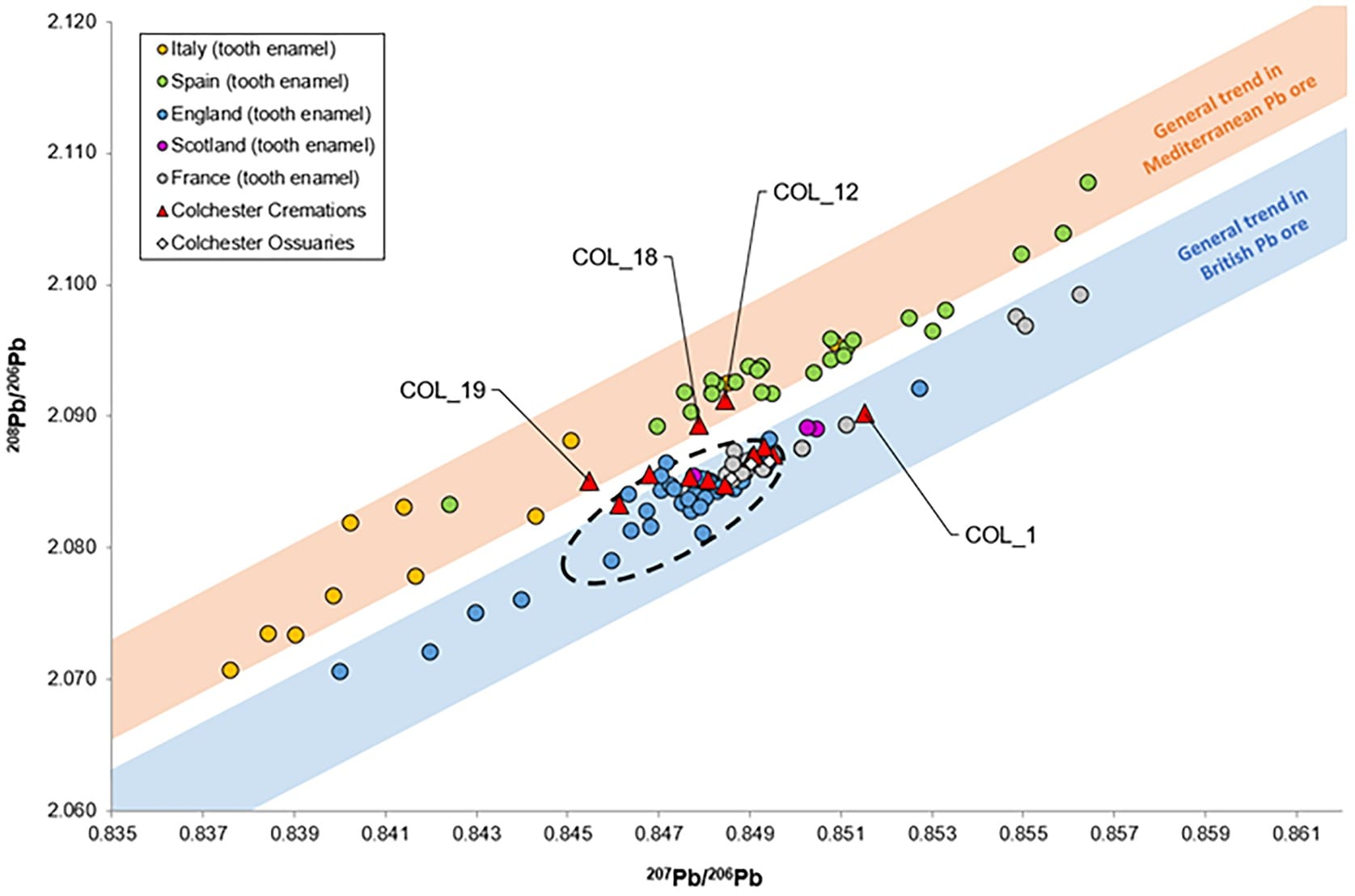
The lead analysis identified three people whose results most closely resembled those of Roman populations in Mediterranean regions. Comparisons included people from Spain, Italy and Lebanon. The paper treats these as probable broad origins: overlapping isotope signatures allow several possible regions to share a similar chemical pattern.
A fourth person had a lead signature different from the main Colchester group, with comparisons pointing towards northern Britain or France. Across the sample, many other lead results clustered with the English and Welsh sources commonly represented in Romano-British human remains, linking their exposure to the metal sources exploited in Britain.
Five people had been buried in vessels containing lead, including pewter ossuaries and a glass container with a lead lid. Their bones had absorbed lead from the burial environment, and cleaning failed to remove the contamination. The researchers excluded these five from the lead-based investigation of childhood mobility while retaining the wider study of their remains.
The Colchester Vase gains a migration history
Among the Mediterranean cases was the man whose remains were placed in the Colchester Vase. Both his strontium and lead results supported a nonlocal origin, with Italy or Spain suggested by the combined evidence. He was the one person for whom both isotope systems supported the study’s interpretation of migration to Britain.
The vase depicts a gladiatorial munus, a staged combat spectacle, and an animal venatio, or hunt. Durham’s account of the research suggests that the man may have trained gladiators or financed their contests as a wealthy patron. This remains an interpretation of the decorated burial vessel and its occupant’s possible connection with Roman entertainment.
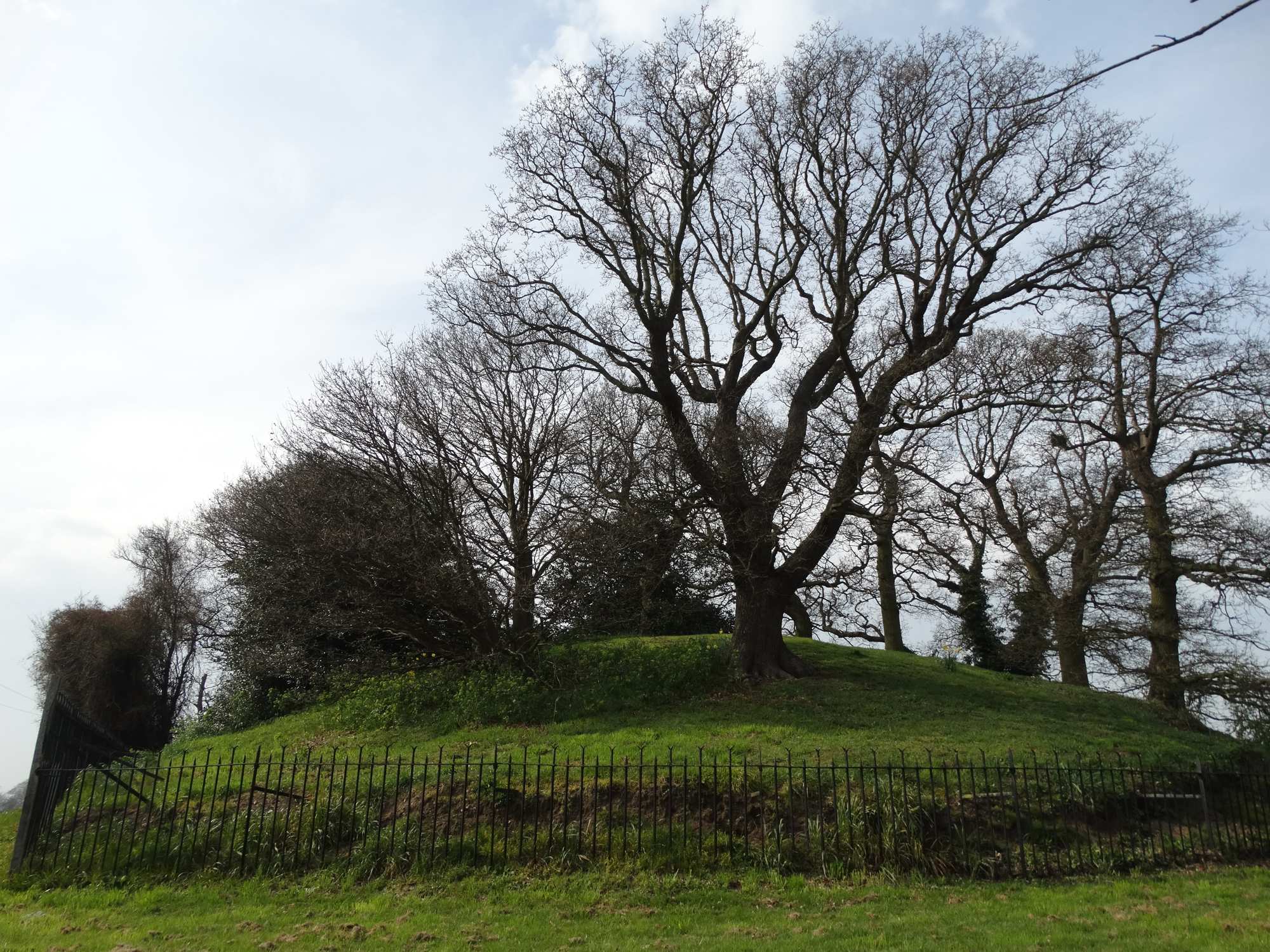
The study also examined the rich Mersea Barrow burial, accompanied by frankincense and a glass jar within a lead ossuary. Its high strontium ratio indicated origins away from the Colchester baseline. The distinctive vessels and grave offerings supplied archaeological context for the laboratory results, bringing together evidence about funeral choices, status and personal mobility.
A new method for long-held cremation collections
The research addresses a substantial gap in studies of Roman Britain. Earlier isotope investigations concentrated largely on uncremated burials from the middle and later Roman periods. Applying the approach to cremations extends investigation into people buried during the early centuries of provincial life, when burning the dead was a dominant funerary practice.
Strong heating changes bone’s crystalline structure, helping fully calcined material preserve its strontium signature against later alteration. Combining that evidence with lead measurements is a promising development whose reliability requires further testing and replication. The Colchester results also give a practical warning about the lasting contamination caused by lead-bearing burial containers.
Old museum collections can now contribute evidence about the people who settled in a major Roman town. The Colchester study connects movement within Britain with probable arrivals from Mediterranean regions, and gives the occupant of the gladiator-decorated vase a place among those journeys. The combined isotope results suggest an early-life connection with Italy or Spain.




About the Roman Empire Times
See all the latest news for the Roman Empire, ancient Roman historical facts, anecdotes from Roman Times and stories from the Empire at romanempiretimes.com. Contact our newsroom to report an update or send your story, photos and videos. Follow RET on Google News, Flipboard and subscribe here to our daily email.
Follow the Roman Empire Times on social media: