Romulus Augustulus: The Boy Who Became Rome’s Last Emperor

Romulus Augustulus is remembered as the last western Roman emperor, but his importance lies less in what he did than in what his fall came to mean.

Romulus Augustulus: The Boy Who Became Rome’s Last Emperor
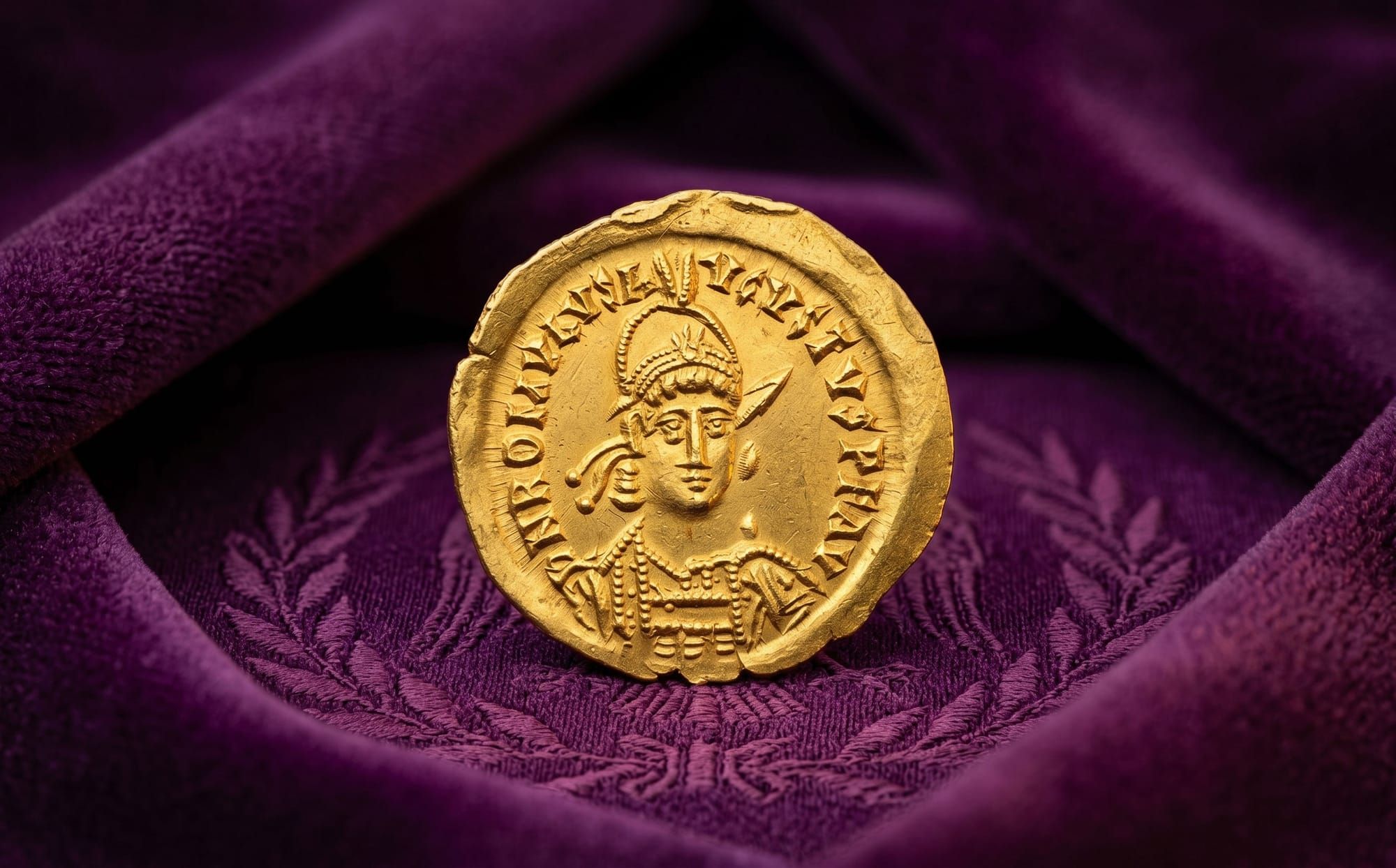
A Romulus Augustulus Golden Roman Coin. Credits: Roman Empire Times, Gemini

By the time Romulus Augustulus appeared on the imperial throne, the Western Roman Empire was already little more than a shell of what it had once been. He was young, obscure, and never meant to become a figure of lasting fame, yet history fixed on him because his brief reign came to stand at the edge of something enormous. When he was deposed in 476, it was not simply a boy-emperor who disappeared from power, but the last Western ruler whom later generations would remember as the final Roman emperor.

A Boy Emperor at the End of the West

Romulus, later nicknamed Augustulus, “the little Augustus,” is usually remembered as the last emperor of the Western Roman Empire. He was the son of Orestes, a general who had once served Attila the Hun as a secretary and had also taken part in embassies to Constantinople.

In 475, the western emperor Julius Nepos appointed Orestes commander-in-chief in Gaul. But discontent within the multi-ethnic army under his authority soon changed everything. When the soldiers’ demands for land were refused, Orestes turned against Nepos and marched on Ravenna. Nepos fled by sea to Salona, and on 31 October Orestes placed his own young son, Romulus Augustus, on the throne in his place.

Romulus was probably only around ten to fourteen years old when he became emperor. The surviving sources agree that he did not rule in any meaningful sense himself. Real power remained in the hands of his father, and the arrangement followed a familiar late Roman pattern in which a child-emperor stood in front while a powerful general governed behind him.

Earlier in the fifth century, the western empire had already seen similar pairings, such as Honorius with Stilicho and Valentinian III with Aetius. But Romulus’ position was weaker from the beginning. Unlike those earlier emperors, he had no dynastic connection that could strengthen his legitimacy, either to earlier western rulers or to the emperor in the east.

At the same time, Julius Nepos was still alive and still claiming the western throne from Dalmatia, which made Romulus appear less like a true successor and more like a usurper. Nepos also had a family connection to the eastern emperor Zeno, and there is no sign that Zeno ever accepted Romulus as the legitimate western Augustus.
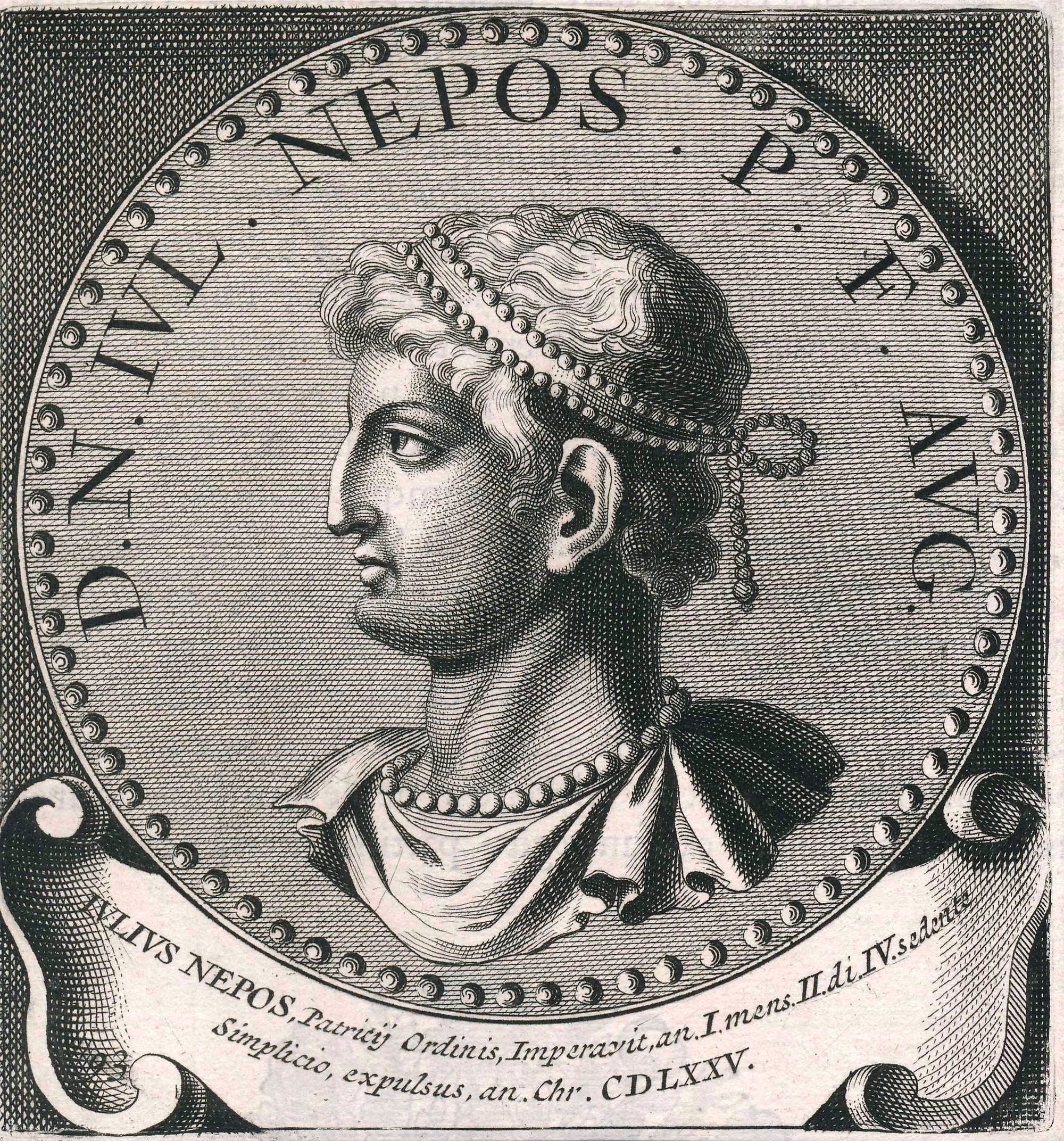
engraving in medallion of Julius Nepos, last emperor of the western Roman empire 474-475
Engraving in medallion of Julius Nepos, last emperor of the western Roman empire 474-475. Public domain

The regime lasted only ten months. In late August 476, the barbarian general Odovacer killed Orestes and seized control in Italy. Romulus himself was deposed, but because of his youth and, according to the tradition, his good looks, he was spared. He was sent to live in Campania at the castellum Lucullanum and given a yearly allowance of six thousand solidi.
He may later be the same Romulus who, around 508 or 511, renegotiated this allowance for himself and his mother under Theoderic, the Ostrogothic king of Italy. He may also have played some part in founding the monastery of St. Severinus at Lucullanum in the later fifth century. After that, he disappears into obscurity, and the date of his death is unknown.

Very little survives about the policies of his reign, and the sources are too thin to tell us much about what his government actually tried to do. What made Romulus memorable was not his actions, but the symbolism attached to his fall. When Odovacer removed him, the imperial regalia were sent east to Emperor Zeno, along with the message that the west no longer needed its own emperor. In later memory, that gesture came to stand as the moment when the western empire ceased to exist as a separate political power. (“Romulus Augustulus” by Meaghan McEvoy)

A Family from the Frontier World

Romulus Augustulus did not emerge from one of the old imperial dynasties that had once given the western throne a sense of continuity. He came from a frontier world shaped by military service, shifting loyalties, and close contact with the Huns. His father, Orestes, was Roman by birth but from Pannonia, a region that had fallen under Hunnic power.

Before he rose to prominence in the western empire, he had served at Attila’s court, moving in the uneasy space where Roman and barbarian politics overlapped. That background matters, because it places the future “last emperor” not in the secure center of Roman power, but on the edge of an empire already being reshaped by outside forces.

The same world touched the family on both sides. One important fragment preserves the memory of an embassy to Attila in which a man named Romulus — the maternal grandfather of the future emperor — appears among western envoys. He was already an older man, experienced in public affairs, and his presence suggests that the family had standing within the provincial upper ranks.

The paternal side points in the same direction. The only source to mention Romulus Augustulus’ grandfather on Orestes’ side gives the name Tatulus, and that family too seems to have belonged to the Pannonian world. In other words, the boy who would later sit on the western throne appears to have been born from two families rooted in the Danubian provinces, in regions where Roman administration, military command, and barbarian pressure had long become entangled.

This background also helps explain why Orestes’ career looked the way it did. The late empire produced many such men, especially in the fifth century: figures who moved between Roman and barbarian courts, advanced through military service, and turned frontier experience into political power.

A possible representation of Orestes, father of Romulus Augustulus.
A possible representation of Orestes, father of Romulus Augustulus. Credits: Roman Empire Times, Gemini

Orestes belonged to that class. He was not an accidental usurper dropped into history from nowhere, but part of a larger pattern in which command on the edges of the empire could become a path to dominance at its center.

One passage about these earlier contacts with Attila is especially revealing because it places Orestes in the company of another family whose fate would later intersect with his own. It notes that Orestes was active at Attila’s court at the same time as Edeco, father of Odovacer.

In other words, the fathers of the man who briefly wore the western crown and the man who removed him had both belonged to the same Hunnic orbit. Long before 476, the worlds around Romulus Augustulus and Odovacer were already crossing.

The Name, the Bloodline, and the Problem of Origins

The name “Romulus” itself seems to have come from the maternal side. Since it was common in the empire to name the eldest son after his paternal grandfather, the fact that the future emperor bore the name of his mother’s father makes it unlikely that he was Orestes’ firstborn son.

That detail may seem small, but it helps place him more clearly within a real family structure rather than leaving him as the symbolic child-emperor of later memory.

Even so, the exact place from which his mother’s family came remains uncertain. For a long time it was often assumed that they came from Poetovio in Noricum, but the argument depends on a disputed gap in the text of Priscus. Once that uncertainty is taken seriously, the confident identification falls away. What can be said with more confidence is that the family belonged broadly to the Norican-Pannonian frontier zone, not that its precise hometown can be securely named.

That uncertainty is worth preserving, because it shows how fragile the evidence is and how easily later reconstructions can become firmer than the sources allow.

Still, the larger picture is clear enough. Romulus Augustulus was not the child of old Roman Italy in any simple sense. His family ties ran into the provinces along the Danube, into a world of embassies, military commands, and negotiations with the Huns. His story began in the frontier belt where the western empire was already learning to live with transformed realities.

After the Throne

The end of Romulus Augustulus’ reign is famous, but what happened afterward is far less certain. Once removed from power, he vanished from the center of politics and passed into a quieter, more obscure existence in Campania. The place of exile, the castellum Lucullanum, had once grown out of the luxurious seaside estate of Lucullus near the bay of Naples.

By late antiquity it had become something very different — not a grand aristocratic villa in its old form, but a fortified settlement and administrative center.

This change in the site’s history suits Romulus himself. He too passed from symbol to obscurity. The former emperor, sent there with his relatives and a generous allowance, seems to have lived on in a diminished but not miserable condition. The usual image of a fallen child-emperor disappearing into total poverty is not what the evidence suggests. He was removed from public life, not destroyed.

Romulus Augustulus resigns the Roman crown to Odoacer.
Romulus Augustulus resigns the Roman crown to Odoacer. Public domain

There are also traces, though uncertain ones, that the family remained significant after the fall. A woman of high senatorial rank named Barbaria appears at Lucullanum in connection with the cult of Saint Severinus, and many have wanted to identify her as Romulus’ mother. The association is tempting, especially because another later document records payments confirmed for one Romulus and his mother. Yet the identification cannot be proved. It remains possible, but only possible.

That uncertainty is important because it reminds us how little can finally be known about the life of Rome’s last western emperor after his deposition. There are hints of survival, family continuity, religious patronage, and even a modest afterlife under Ostrogothic rule, but not enough to restore him fully to view. What survives is not a complete retirement narrative, but fragments.

This makes Romulus Augustulus a strangely fitting figure for the end of the western empire. Even his family background belongs to a world in transition — Roman, provincial, military, and deeply marked by the Huns. And after his fall, he does not die in a dramatic final act. He recedes. The sources leave him not with a grand ending, but with uncertainty: a youth from the frontier provinces, briefly raised to empire, then carried off into the half-light of exile and memory. (“The family of Romulus Augustulus” by Marjeta Sasel Kos – Ljubljana)

More Symbol Than Man

Romulus Augustulus has remained famous partly because he is so difficult to recover as a person. Almost nothing certain survives about his inner life, his habits, his voice, or his ambitions. No speeches, letters, or sayings can be securely attached to him. Even his appearance slips away on inspection.

The surviving coin portrait shows only the stylized face of an emperor, not a recognizable individual, and the one solid descriptive detail preserved by later tradition is simply that he was young and apparently handsome. In practical terms, the last western emperor is remembered less as a fully visible human being than as a figure onto whom later generations projected the end of an age.

That symbolic force grew stronger in the months after his fall. The western throne was not followed by a dramatic final battle or a heroic last stand. Instead, what followed was negotiation. Odovacer sent envoys to Constantinople with a message that there was no longer any need for two imperial courts, one in the east and one in the west. Romulus, now deposed and effectively under orders, was made to sign the letter. The gesture mattered because it turned the former emperor into part of a settlement that reduced him from ruler to instrument.

The regalia made the point even more starkly. The imperial belt, the white robe with its precious border, and the purple-and-gold cloak were handed over to Emperor Zeno in the east. In a world where rule had to be seen as much as proclaimed, these were not decorative extras. They were the visible language of authority.

Stripped from the western emperor and sent away, they turned the loss of power into something ceremonial and unmistakable. The transfer suggested not merely that Romulus had been removed, but that the west itself no longer possessed an emperor of its own.

engraving in medallion of Romulus Augustulus, last emperor of the Western empire 475-476
Engraving in medallion of Romulus Augustulus, last emperor of the Western empire 475-476. Public domain

Yet even here the situation was not perfectly clean. Julius Nepos was still alive in Dalmatia and still claiming the western throne. Zeno’s response exposed the awkwardness of the moment. Odovacer was recognized as patrician, but he was also told to acknowledge Nepos as emperor. It was a compromise without conviction, a formula that kept appearances alive without restoring the old order.

In constitutional terms, Nepos could still be treated as the legitimate western Augustus. In political reality, Odovacer governed Italy. Romulus, caught between them, became something even stranger than a fallen ruler: a deposed emperor whose office had not quite died with him because another claimant still survived.

This is one reason 476 remained so powerful in memory. The year did not mark the end of all Roman life in the west, nor did it instantly erase Roman institutions, habits, or elite culture. But it did mark the end of autonomous western imperial rule.

After Romulus was removed, no new western Roman emperor appeared to take his place. Whatever claims survived on paper, and however long Julius Nepos remained alive, the old arrangement had broken. Italy would still be governed, but it would be governed differently.

A later chronicler gave the event the form in which it would long be remembered:

“With this Augustulus perished the western empire of the Roman people.”

The line is stark, simplified, and shaped by hindsight, but it captures the emotional truth that later ages found in the deposition. The western empire had not vanished in a single afternoon, yet Romulus’ fall became the moment that seemed to gather its long decline into one image: a boy-emperor displaced, his robes and insignia sent east, and the imperial office in the west left empty.

That is why Romulus Augustulus remains so haunting a figure. He is important not because we know him well, but because we do not. His obscurity helped turn him into a symbol. The less that could be said about the man himself, the easier it became for posterity to see in him the last thin outline of western Rome — young, powerless, and carried out of history almost before he had entered it.

Why 476 Felt Final

By the time Romulus Augustulus was removed, the western empire had already spent decades losing the habit of recovery. That is what gave 476 its force. The date mattered not because the empire had been strong until that moment and then suddenly collapsed, but because so much had already been damaged that the old western order no longer seemed capable of restoring itself. The deposition of the last boy-emperor became significant because it arrived at the point when hope in the west had grown thin.

Writers close to the period had long been describing a world under pressure. In Noricum, life was marked by the fear of sudden raids and the steady collapse of Roman protection. In Gaul, famine, siege, and insecurity pressed hard on urban life. In Spain and Portugal, chroniclers wrote in the language of plunder, pestilence, and shrinking horizons. In Britain, the picture was no less bleak: breached towns, flight, slaughter, and a sense that the old imperial shelter had gone.

Portrait of a young prince called Romulus Augustulus, ca. 140-150 AD, from the Giustiniani collection
Portrait of a young prince called Romulus Augustulus, ca. 140-150 AD from the Giustiniani collection. Credits: Sailko, CC BY 3.0

These accounts do not all describe the same experience in the same way, but they share one important feature. They do not suggest that the west was waiting for a triumphant recovery. They suggest a world learning to live with loss.

That atmosphere matters because it changes how 476 should be read. The deposition of Romulus Augustulus did not create western decline from nothing. It came after decades in which military disasters, provincial fragmentation, shrinking resources, and repeated political breakdowns had worn away confidence.

A useful comparison is the language of Salvian, writing already in the 440s:

“In the past the Romans were the most powerful, now we have no strength. They were feared; now it is we who are fearful.”

This is not the voice of a society expecting easy renewal. It is the voice of one that already knows the balance has shifted.

The east makes the contrast even sharper. Constantinople still projected power, order, ceremony, and continuity. Its walls stood firm, its court remained intact, and its imperial government still had the means to look like empire.

The west, by comparison, had become vulnerable, improvised, and unstable. When senators traveled east after 476, they were moving from a world where imperial authority had become fragile into one where it could still appear overwhelming. That imbalance helps explain why the end of a separate western emperor could be accepted at all. The old western court no longer had the strength to insist on itself.

What makes 476 feel final, then, is not a single dramatic overthrow, but the fact that no one in the west could truly reverse it. The event did not close down Roman life, Roman memory, or Roman institutions all at once. But it did end autonomous imperial rule in the west.

After Romulus was gone, there was no new western emperor to rebuild the arrangement on its old terms. Local Roman elites survived, courts survived, churches survived, titles survived, and habits of Roman government survived in altered forms. What did not survive was the old western imperial center.

This is why 476 proved stronger as a symbol than many more violent moments. There was no single apocalyptic battle to match the scale of the change. Instead, there was something quieter and in some ways more unsettling: the realization that what had been lost was not coming back.

The west had seen invasions, military defeats, and political murders before. What it had not seen before was the disappearance of its own emperor without replacement. That gave the year its lasting power. 476 marked the point at which decline ceased to look temporary and began to look permanent. (“The last Roman. Romulus Augustulus and the decline of the West” by Adrian Murdoch)


Romulus Augustulus did not rule long enough to shape the empire in any lasting way, yet his fall came to represent something larger than his own brief life. By the time he disappeared from the throne, the western empire had already been hollowed out by decades of strain, retreat, and uncertainty. That is why his deposition endured in memory. It seemed to gather the long fading of Roman power in the West into one final image: a child-emperor removed, the regalia sent east, and a political world that would not be restored on the old terms again.

About the Roman Empire Times

See all the latest news for the Roman Empire, ancient Roman historical facts, anecdotes from Roman Times and stories from the Empire at romanempiretimes.com. Contact our newsroom to report an update or send your story, photos and videos. Follow RET on Google News, Flipboard and subscribe here to our daily email.


Follow the Roman Empire Times on social media: