
More Than 1,000 Roman Dice Found at Grand, Raise a Ritual Mystery
Excavations in France have produced an exceptional concentration of bone dice. A possible basin, altar fragments and Fortuna coins offer clues to their use.

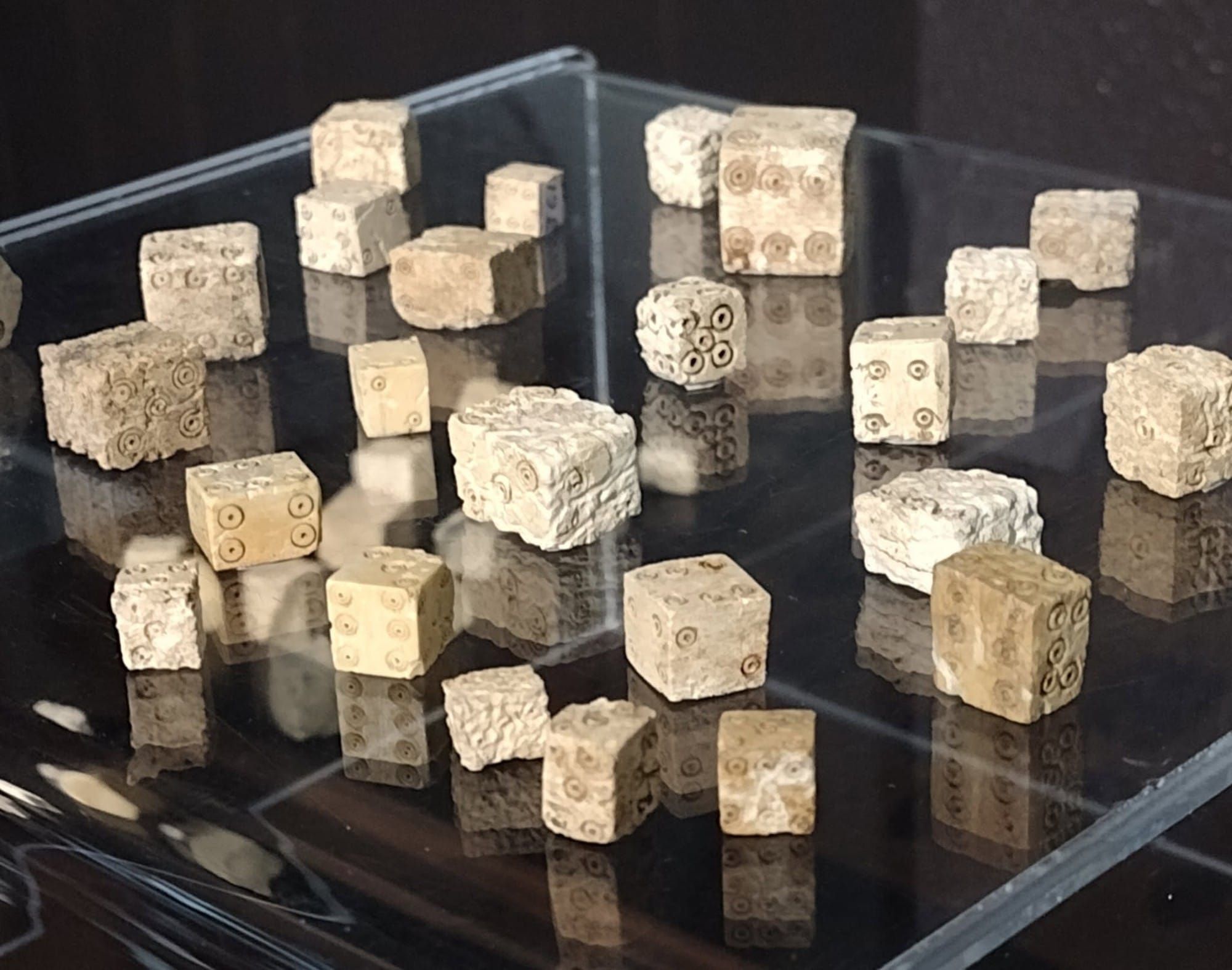
Archaeologists at Grand, in northeastern France, have recovered more than 1,000 Roman bone dice during excavations near the town’s celebrated mosaic. The concentration has prompted competing explanations for the site: a workshop, a place for games or a setting for religious activity. Finds beside a possible basin have brought the ritual interpretation into particular focus.
The discoveries belong to the summer 2026 excavation campaign in the Vosges. Local reporting documented more than 1,000 dice by 29 July, before the story gained renewed international attention in October. The “ancient Las Vegas” comparison in that later coverage is a journalistic nickname; the excavators are still investigating the activities that produced the assemblage, and if it was directly related to gambling.
The excavation leader, Thierry Dechezleprêtre of the Musée d’Archéologie nationale, has described both gambling and divination as possible uses of dice in the Roman world. The objects are now being studied alongside the buildings, water installations and other finds, with further excavation expected to help explain why so many accumulated in this part of Grand.
Returning to the Grand Jardin
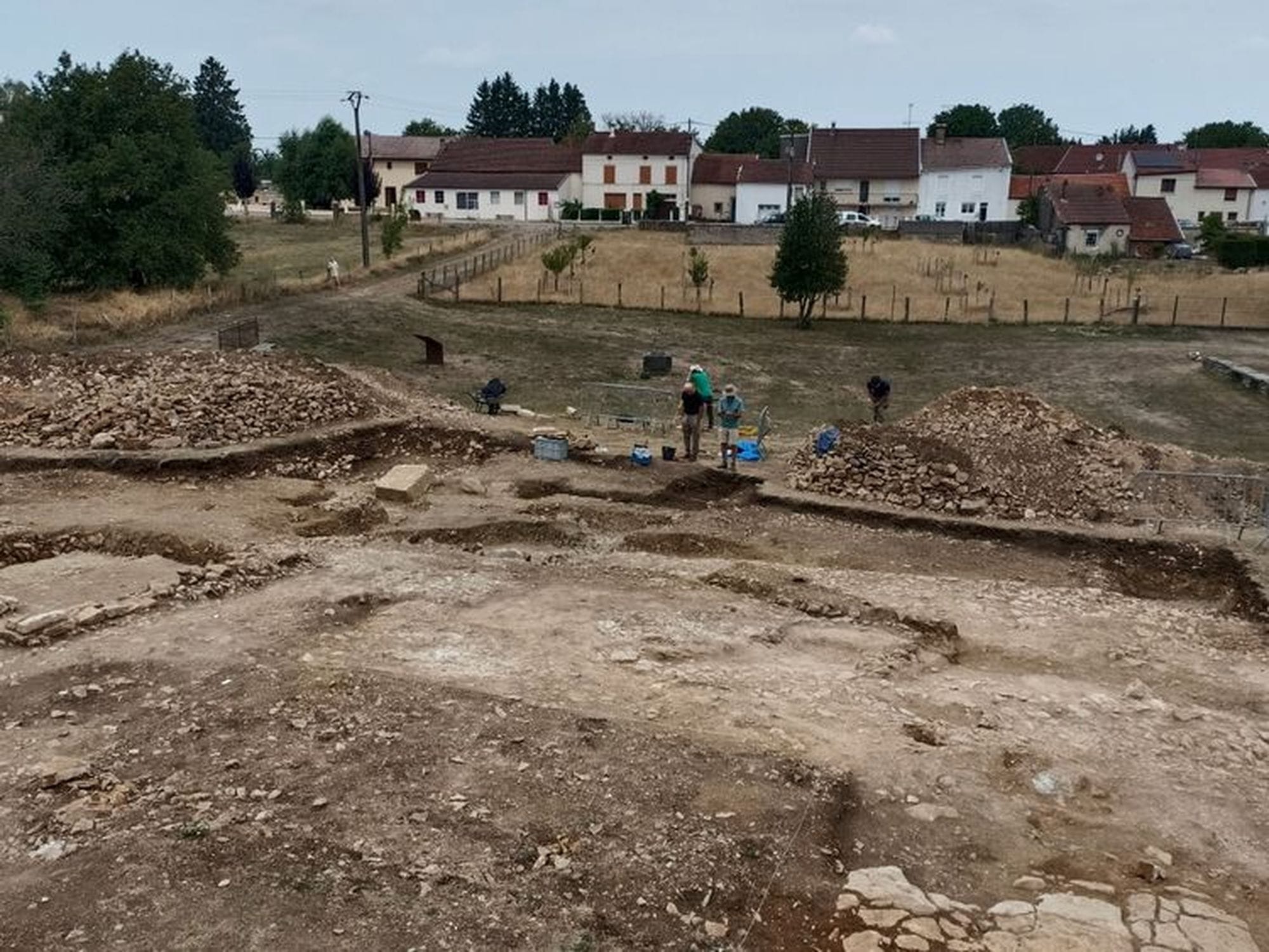
The present investigation began in 2022, revisiting an area examined during the 1960s beside the building traditionally called the basilica. Archaeology students from several French universities have joined the work, conducted by the Vosges departmental authorities with support from the Ministry of Culture. The campaign combines renewed excavation with the reassessment of earlier discoveries.
France 3’s report of 21 July recorded about 500 dice in the area and recalled the 197 recovered in 2024. By the end of that month, ICI Lorraine was reporting more than 1,000. The changing figures reflect reports made at different stages of the investigation.
The deposits also contained bronze coins, pottery, animal bones, shoe nails, needles and fibulae, the brooches used to fasten clothing. Dechezleprêtre told France 3 that finding ten or fifteen dice would be more usual. Here, the exceptional concentration has made the relationship between the objects and the nearby structures a central research question.
A small building with painted walls
Excavations in 2023 and 2024 exposed a small structure measuring approximately 4.5 by 3.8 metres. It stood on the alignment of an east–west road, opened towards the east and had walls decorated with red paint above a yellow base. Vosges Télévision’s July account places these architectural details within the continuing investigation of the building’s function.
Three dice were incorporated into its foundations. North of the structure, archaeologists traced a water conduit along a trench about twenty metres long. Two surviving iron fittings indicate that sections of wooden pipe had been joined together. A rectangular pit at the end of the conduit was being investigated as a possible wooden basin.
The August interview in Historia added a broader reconstruction of the road: it was about eight metres wide and led towards the amphitheatre. The excavation leader provisionally dated it to the first century CE, with a building installed on it in the second century. Another, probably earlier, small building also occupied the road’s alignment.
Altars, coins and a possible ritual setting
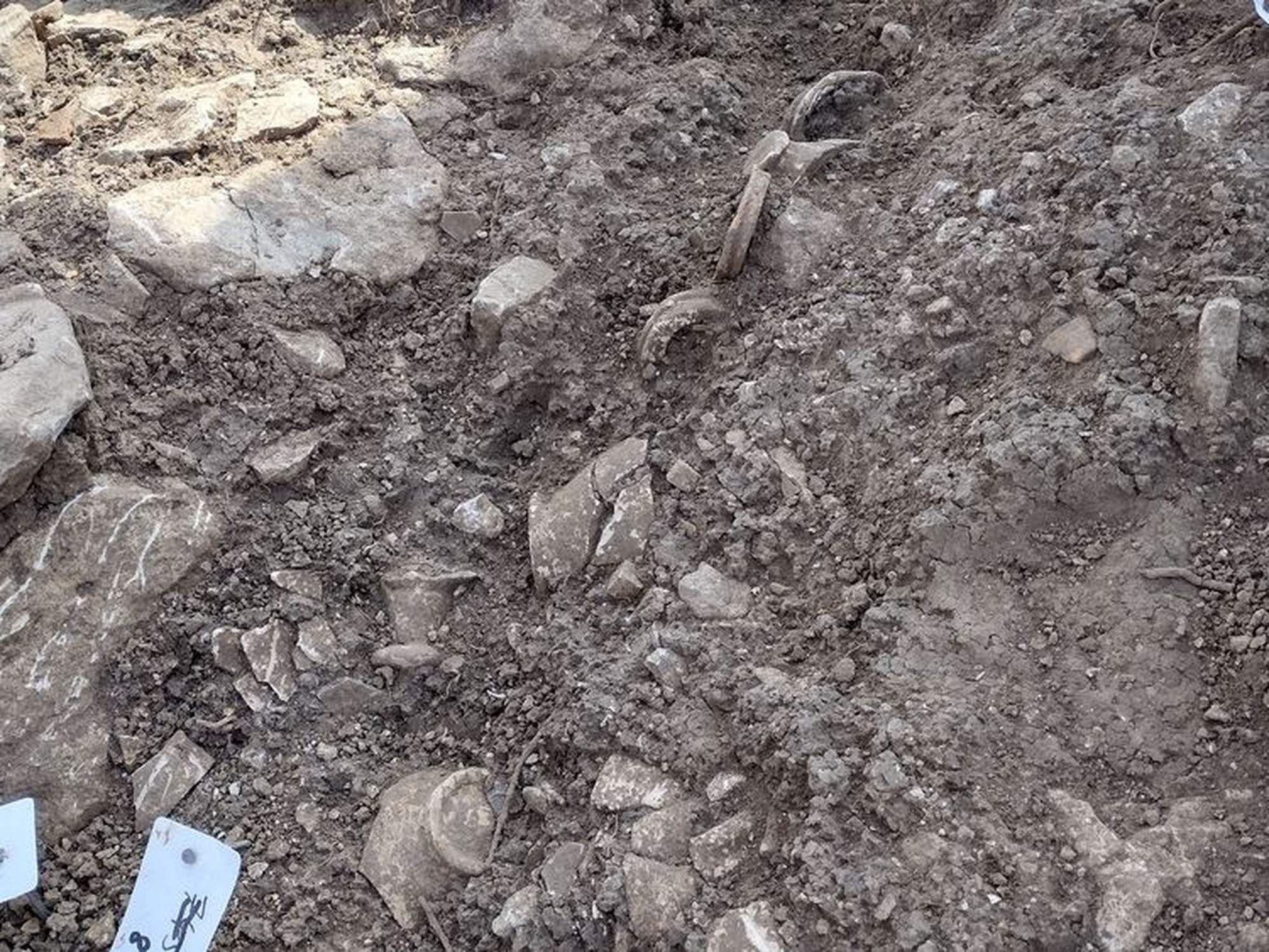
Dechezleprêtre favours a devotional interpretation for the group of structures described in his August interview. Two fragments of a stone altar and the upper part of a small shrine were recovered. Such a shrine, with a pediment and columns, would have sheltered a deity. Coins included examples showing Fortuna, the goddess of luck, on their reverse.
Most of the dice discussed in that interview came from around the basin, while others lay farther north near a structure that may have supported altars. Small jugs and cups were also recovered, often associated with dice or containing them. This combination underlies the proposed connection with religious activity.
Dice could also serve in games of chance, as described in our account of gambling in ancient Rome. The possibilities considered at Grand have included manufacture, play and a sanctuary. October reporting still describes the site’s use as an open question, with an establishment connected to Fortuna among the suggestions being investigated.
Bone cubes with familiar numbers
ICI Lorraine described dice ranging from roughly half a centimetre to more than a centimetre across. Most carried engraved numbers recognisable to a modern player. TF1’s August report described the familiar arrangement in which one faces six, two faces five and three faces four: each pair of opposite faces adds up to seven.
Vosges Télévision identified the markings as small concentric circles, or ocelles, engraved with a fine metal tool. Wax mixed with charcoal could darken the incisions and make them easier to read against the bone. The combination of numbered faces and ring-shaped markings gives the recovered objects their distinctive appearance.
According to the excavation leader, most were carved from cattle or sheep bones. Some are flatter than a regular cube, reflecting the size of the available bone. Other examples appear unmarked, raising the possibility that painted numbers have disappeared. The variation in shape and marking is part of the collection’s continuing study.
Why Roman dice could be lopsided
A peer-reviewed study published in 2022 offers useful context for these uneven shapes. It measured twenty-eight Roman-period dice from thirteen sites in the Netherlands; twenty-four were visibly asymmetrical. The sample contained bone or antler, bronze and ceramic examples, with shapes ranging continuously from near-cubes to markedly flattened or elongated forms.
The researchers also asked twenty-three volunteers to mark clay dice of different proportions. Participants commonly put six on a larger face, either because it needed more space or because they began with one and put six opposite it. The experiment suggested that this arrangement could arise through the marking process rather than a deliberate attempt to manipulate throws.
The study interprets the acceptance of uneven dice partly through beliefs that divine favour or fate influenced individual throws. This is a proposed explanation for the wider archaeological pattern, rather than an analysis of Grand’s collection. Research on the Roman gaming board from Coriovallum likewise examines physical objects to investigate ancient play, there using wear patterns and simulations to test possible rules.
Gaming, divination and the next excavation
Roman gaming reached the imperial household as well as provincial towns. Suetonius describes the emperor Claudius as an enthusiastic player in his Life of Claudius, even during travel. His account gives a concrete example of the place that gaming could occupy in an emperor’s daily activities:
He was greatly devoted to gaming, even publishing a book on the art, and he actually used to play while driving, having the board so fitted to his carriage as to prevent his game from being disturbed.
Grand also preserves evidence of another means of consulting the future. Two ivory diptychs, folding tablets bearing celestial and zodiacal imagery, were recovered in fragments from a well in 1967–68. The Ministry of Culture identifies them as supports for horoscopes and medical astrology. Its account describes a town whose ancient name remains unknown, with a 148-metre amphitheatre accommodating an estimated 16,000–17,000 spectators and a 232-square-metre mosaic.
A selection of the dice found in 2024 was already displayed at Grand’s mosaic exhibition, and the collection formed part of the Fête de la Science programme on 10–11 October. Further excavation is expected next summer. The concentration of dice, vessels and religious objects has given researchers a specific problem to resolve: how games, offerings and consultations of the gods were connected at this location.
Sources used:
ICI Lorraine, “PHOTOS – Plus d’un millier de dés découverts sur le site gallo-romain de Grand dans les Vosges” (29 July 2026).
Yves Quemener / France 3 Grand Est, “La plus importante collection de dés à jouer de l’Antiquité mise au jour lors de fouilles archéologiques dans les Vosges” (21 July 2026).
Vosges Télévision, “Grand : une campagne de fouilles explore le mystère d’un bâtiment antique aux 500 dés à jouer” (20 July 2026).
Elise Neyret / Historia, interview with Thierry Dechezleprêtre on at least 1,000 Gallo-Roman dice from Grand (2 August 2026; updated 3 August).
Caroline Fruhauf / TF1 Info, report on the dice from Grand, with Léa Kebdani (20 August 2026).
Jonathan Blanchet / 100% Vosges, “Fête de la science : Grand ouvre la boîte à mystères” (6 October 2026).
Jelmer W. Eerkens and Alex de Voogt, “Why are Roman-period dice asymmetrical? An experimental and quantitative approach,” Archaeological and Anthropological Sciences 14, 134 (2022).
Ministère de la Culture, “L’agglomération antique de Grand.”
Suetonius, Life of Claudius 33.2, translated by J. C. Rolfe, Loeb Classical Library (1914), via LacusCurtius.
Roman Empire Times, study of the Roman gaming board from Coriovallum (background on wear patterns and possible rules).
Gary Manners / Ancient Origins, “1,000 Roman Dice Found at Site Speculated to be an Ancient Las Vegas” (11 October 2026; later international coverage).
About the Roman Empire Times
See all the latest news for the Roman Empire, ancient Roman historical facts, anecdotes from Roman Times and stories from the Empire at romanempiretimes.com. Contact our newsroom to report an update or send your story, photos and videos. Follow RET on Google News, Flipboard and subscribe here to our daily email.
Follow the Roman Empire Times on social media: