
Copenhagen’s Glyptotek Adds Roman Perfume to Its Fashion Exhibition
Four scent stations and three modern products reveal how the Glyptotek and Karmameju interpret Roman fragrance, from ancient texts to a sealed perfume flask.

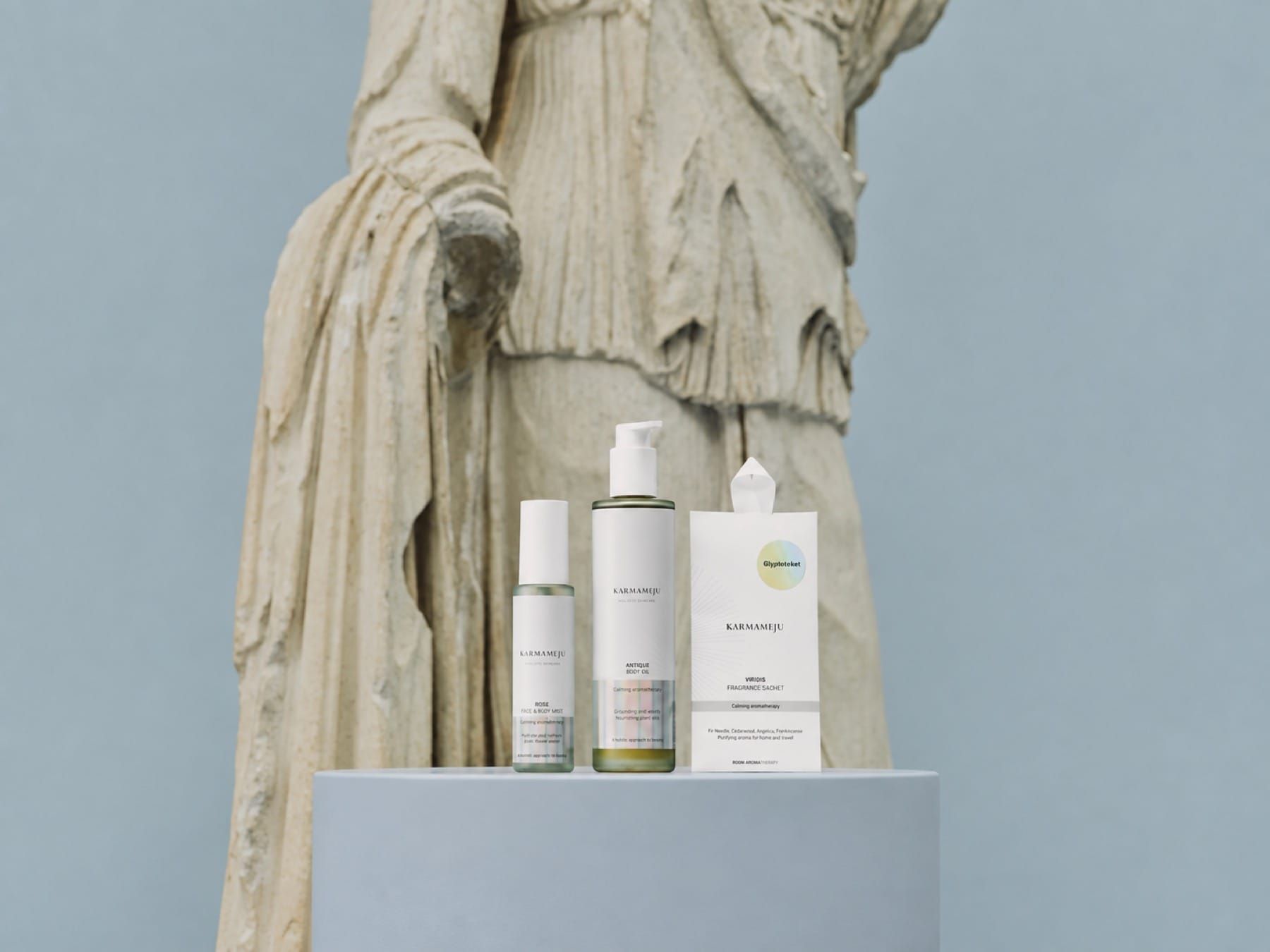
Four scent stations invite visitors to smell their way through The Power of Fashion in the Roman Empire at Copenhagen’s Ny Carlsberg Glyptotek. Developed with Danish skincare company Karmameju, the installation draws on the museum’s research into ancient perfume recipes. Its subject is more than a collection of pleasant aromas: the museum uses fragrance to ask how a person’s body could signal gender, status and belonging in Roman society.
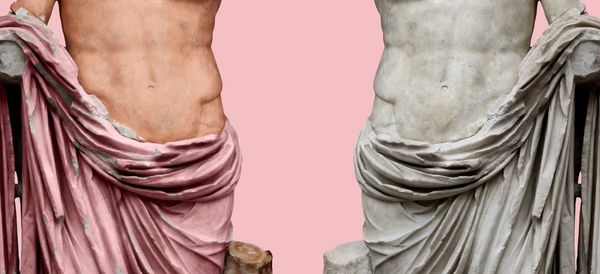
The stations belong to the same exhibition that presents a newly coloured portrait of Tiberius and rare surviving tunics. Our account of Roman fashion and power at the Glyptotek follows those visual exhibits. The scent installation adds a sense that a sculpture or garment alone cannot convey, while raising a practical question: what can the evidence actually tell us about a Roman perfume?
Karmameju has also released three products in connection with the exhibition: ANTIQUE body oil, ROSE face and body mist, and VIRIDIS fragrance sachet. Those products are modern interpretations for use today. The company’s founder says their fragrances refer to ingredients named in ancient written sources, while she explicitly describes the rose product as an interpretation rather than a reconstruction of an ancient formula. The four museum stations and the three products therefore serve related, distinct purposes.
Four stations, three modern products
The Glyptotek says its four stations are based on ancient perfume recipes and introduce visitors to fragrance in relation to social position and gender. Karmameju adds to description that they function as a sensory installation within the fashion exhibition. Their accounts support the number of stations and their historical theme, but do not support a claim that visitors are smelling exact copies of four surviving Roman perfumes.
The three products have names and purposes of their own. ANTIQUE is a body oil presented as an interpretation of woods, resins and oils in ancient bathing and perfumery. ROSE is a rosewater face and body mist. VIRIDIS is a scented sachet for clothing storage or a room, drawing on green plants, woods and resins.
In an interview published by Karmameju, founder and product developer Mette Skjærbæk says the range was made with the museum and a perfumer in England. She says the team limited its scent choices to materials with references in written sources, while also making products people would want to use now. For ROSE, it chose Rosa damascena. Skjærbæk notes that the species used in ancient rose perfume is uncertain, which is why she does not present this version as a faithful reconstruction.
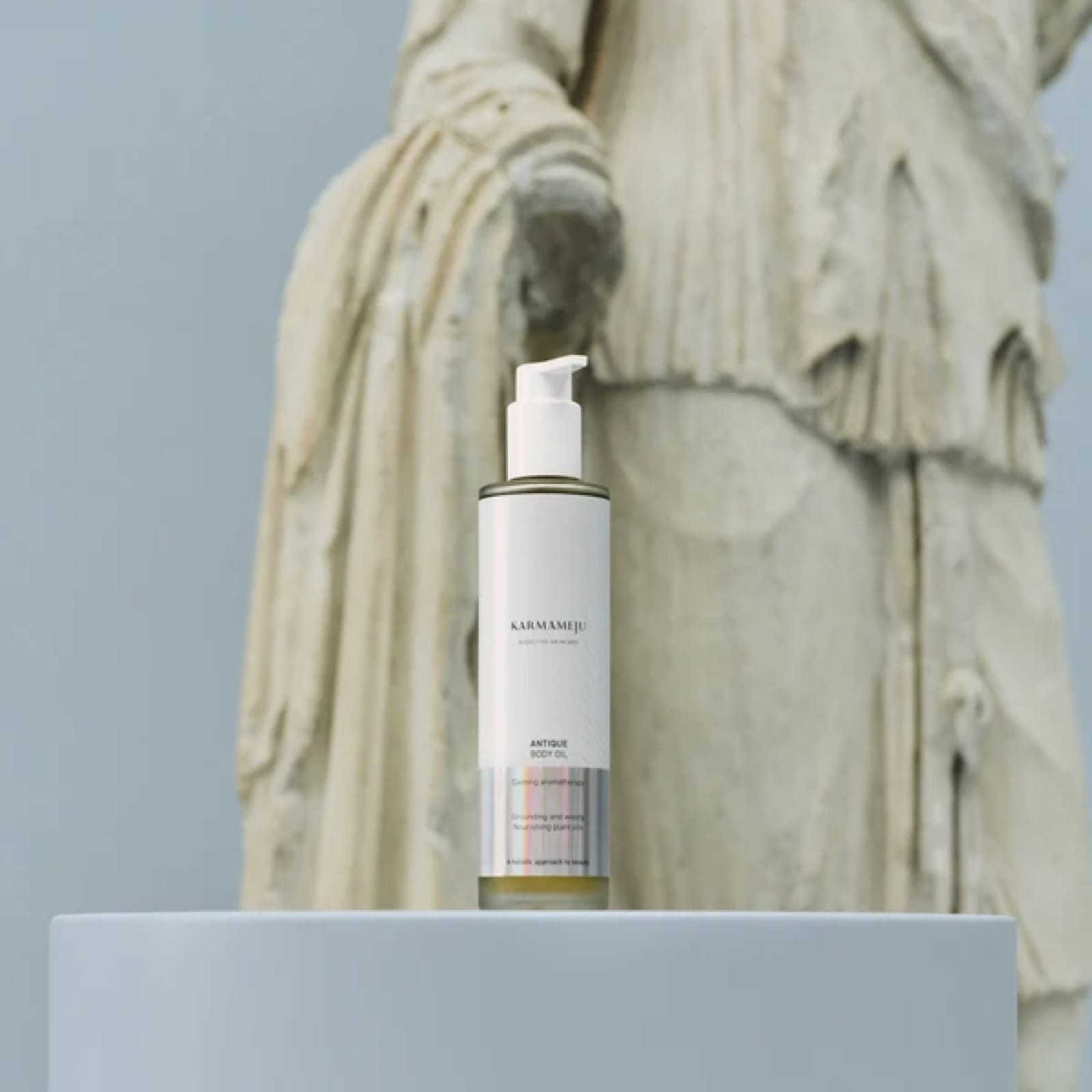
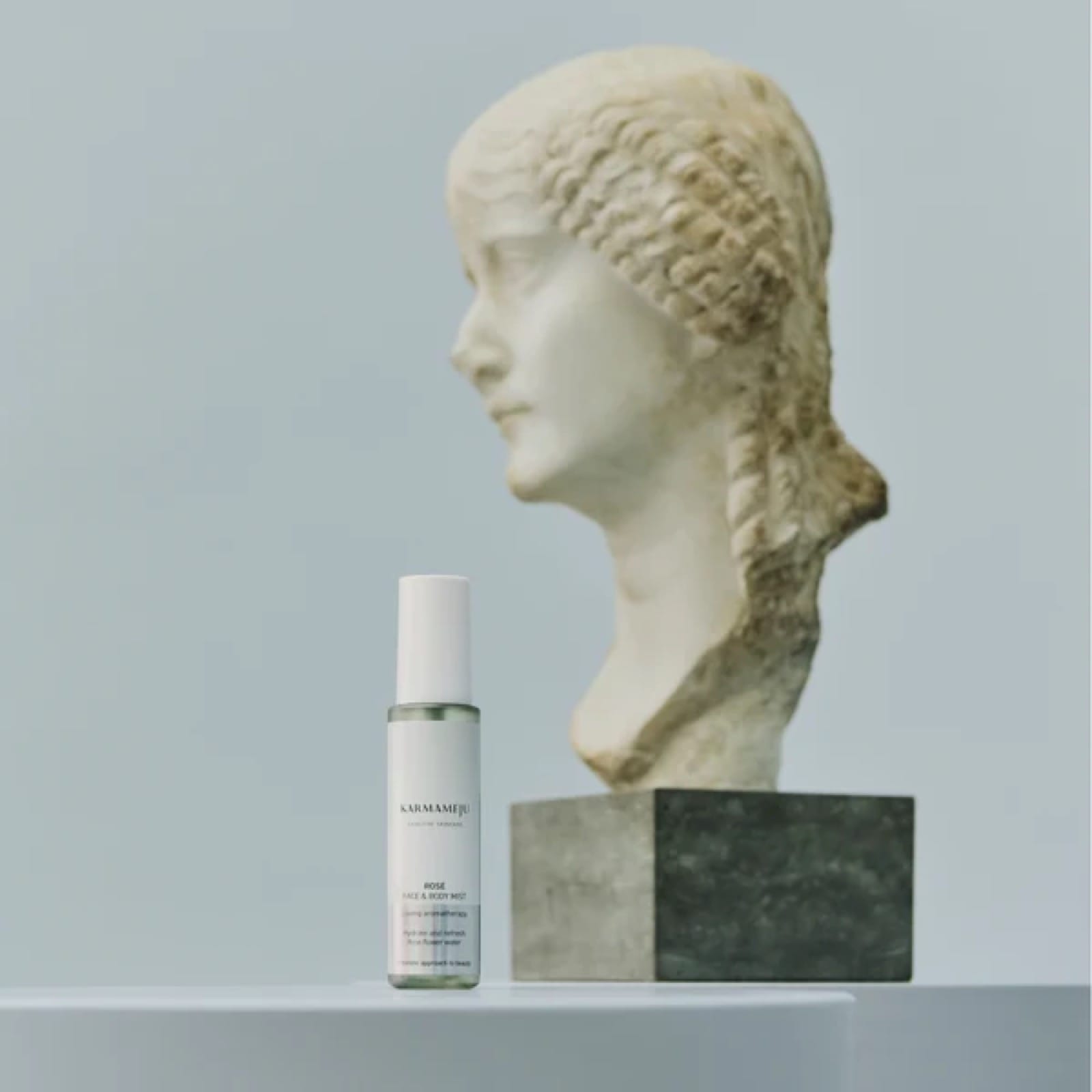
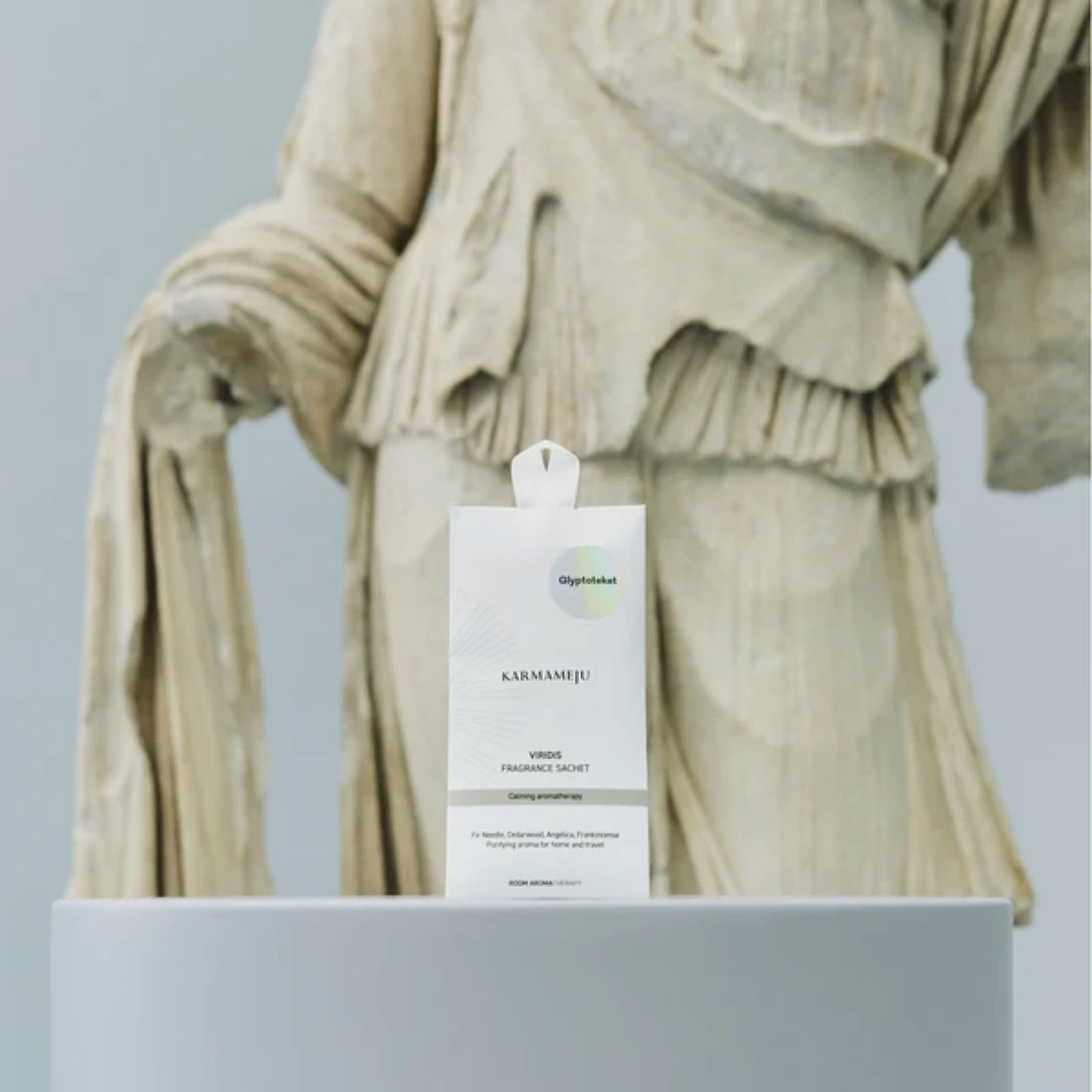
From left: ANTIQUE body oil interprets woody and resinous notes as a skin ritual; ROSE face and body mist centres on rosewater; VIRIDIS is a green, woody fragrance sachet for clothing or a room. Modern Karmameju x Glyptoteket products. Images: Karmameju Skincare.
What an ancient recipe can preserve
One ancient account shows what perfume making could involve. In Concerning Odours, the Greek writer Theophrastus describes fragrant material combined with a liquid and discusses oil as a vehicle intended to make a smell last. He names rose, myrrh, lily and other aromatic materials and considers how ingredients are prepared and blended. His work predates the Roman Empire; it is evidence for a Mediterranean technical tradition that Roman writers and craftspeople later engaged with, not a recipe book for every Roman household.
The use of oil had importance because the ancient preparation was unlike a modern alcohol-based spray. Theophrastus discusses the choice of carrier, the order in which fragrant materials enter it and the problem of keeping an aroma from fading. Karmameju’s account also describes botanical material steeped in oil. Olive oil production and its Roman uses form part of the wider history of a material that served many purposes beyond fragrance.
Written recipes have limits. Names for plants do not always map securely onto a single modern species, a point the Glyptotek stresses in Karmameju’s interview. Instructions can leave quantities or procedures unclear. Even when an ancient author names a flower or resin, that does not give a modern perfumer its exact ancient variety, processing method, concentration or finished smell. Choosing a rose that smells appealing now is a transparent modern decision, provided it is labelled as such.
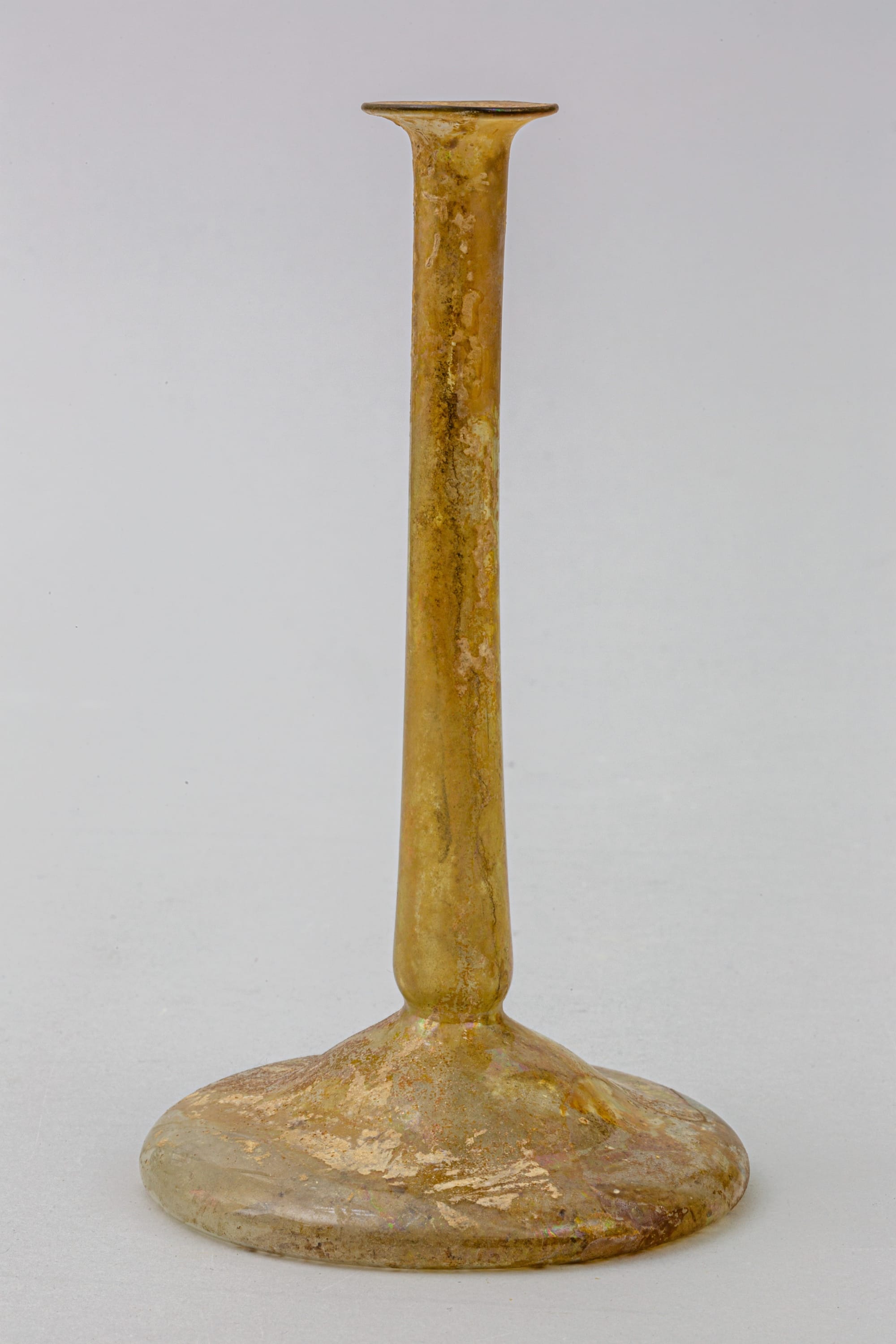
A sealed flask gives a different kind of evidence
Occasionally, archaeology can test what a vessel held rather than relying only on a text. A sealed rock crystal unguentarium, or perfume flask, found in a Roman tomb at Carmona, in southern Spain, contained residue that researchers analysed with several chemical methods, including gas chromatography and mass spectrometry. Their 2023 study identified a vegetable fat and aromatic compounds whose profile was closer to a modern patchouli oil reference than to their nard reference.
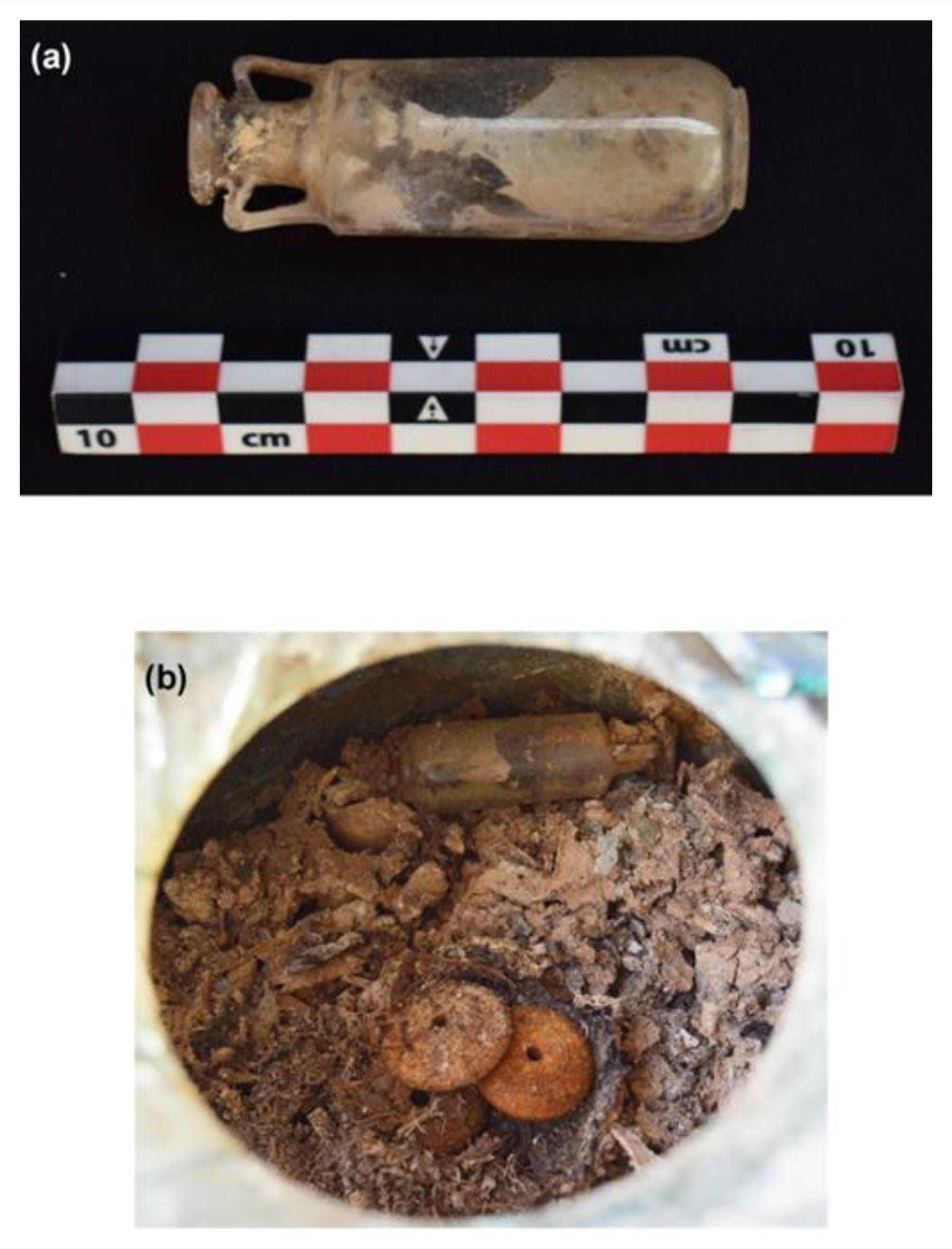
The researchers call patchouli the probable source of the aromatic component, not an unequivocal identification. They could not determine the exact vegetable oil, the plant species used, or the original smell after centuries of chemical change. The sealed flask is unusual precisely because many excavated perfume vessels preserve little or no identifiable aroma.
The Carmona result offers a useful test for any claimed recreation. A list of ingredients from an ancient author and a chemical trace inside one burial flask are different forms of evidence, and neither supplies a complete formula for the Glyptotek’s four stations. Our broader account of perfume and social display in ancient Rome follows the many contexts in which scented oils appeared. The Copenhagen installation concentrates that larger subject into a question a visitor can experience directly.
Who was a fragrance for?
The exhibition connects scent with gender, but ancient preferences are best read as statements made in particular texts. Theophrastus, for example, calls lighter rose and lily preparations suitable for men and stronger, longer-lasting perfumes suitable for women.
Karmameju’s founder makes that distance visible in the interview. After discussing Theophrastus’s categories, she says she considers scents open to everyone today. The company also labels ANTIQUE as a unisex body oil. The installation can thus present an ancient way of classifying fragrance while its commercial products follow current choices about personal use.
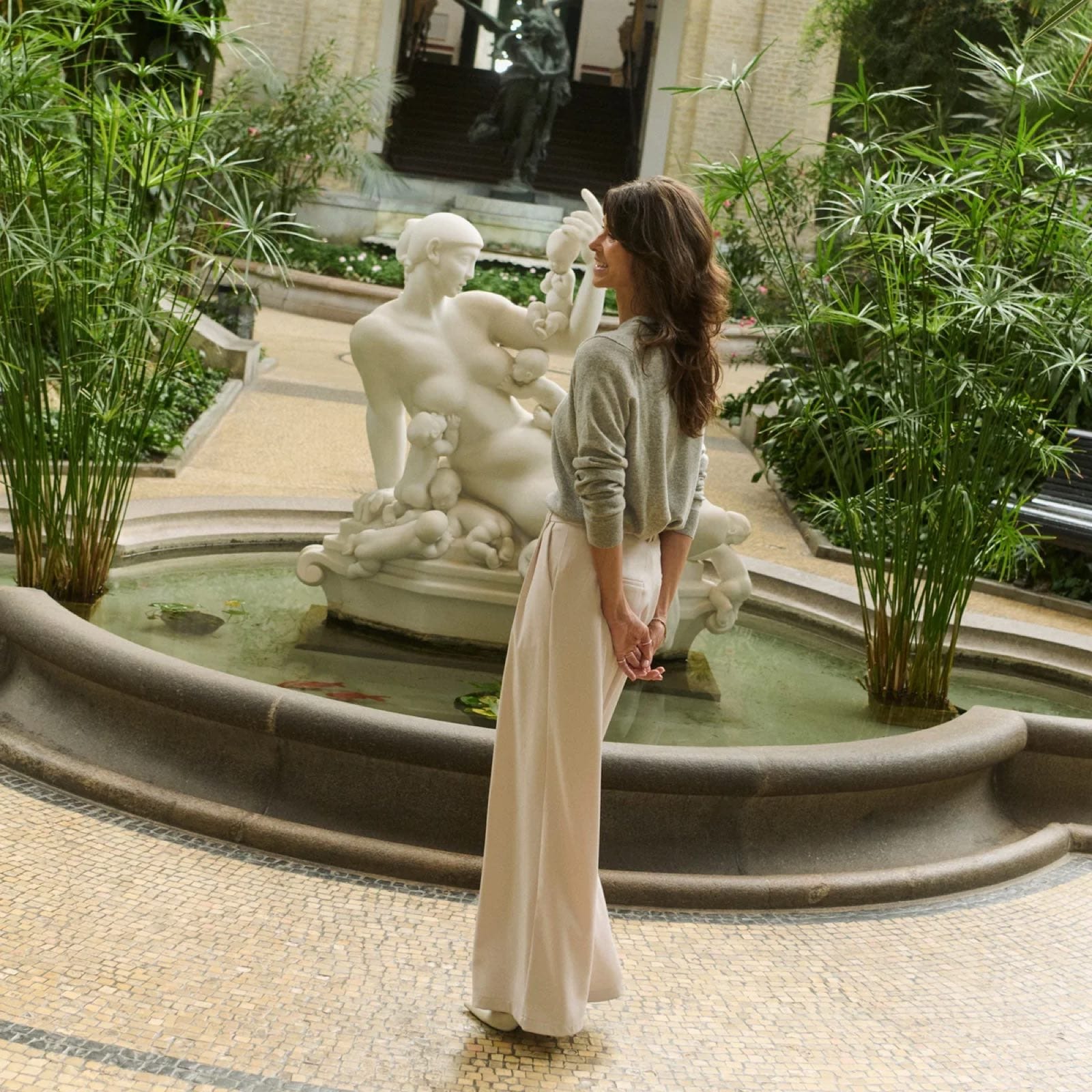
The Roman evidence also extends beyond skin. A 2025 archaeological study by a Glyptotek researcher argues from ancient evidence that some Greek and Roman sculptures were scented as well as coloured and adorned. Within an exhibition about clothing and representation, that possibility makes scent part of how a crafted public image could be encountered.
What the visitor can take away
Karmameju’s three products make the exhibition’s historical research tangible in different ways: an oil for the body, a rose mist and a sachet for a space or wardrobe. Their names and ingredients provide a modern route into ancient aromatic materials.
The most secure picture joins texts, objects and careful interpretation. Ancient writing describes aromatic plants and oil-based techniques; a sealed vessel from Carmona provides unusually specific chemical evidence; and the Glyptotek has designed four stations to let visitors consider scent in Roman social life. Each source answers a different question. Together they explain why perfume belongs beside the exhibition’s portraits, garments and grooming objects.
The Power of Fashion in the Roman Empire opened on 1 October 2026 and is scheduled to run until 29 March 2027. The scent stations are part of the Glyptotek exhibition; the three Karmameju products are sold separately by the company and in the museum shop. The museum’s public information and the company interview are the best guides to what the collaboration claims, while the ancient and archaeological evidence sets the limits of any recreation.
Ny Carlsberg Glyptotek, The Power of Fashion in the Roman Empire, exhibition page, accessed 6 October 2026.
Karmameju, Karmameju x Glyptoteket, collaboration and product overview, accessed 6 October 2026.
Karmameju, interview with Mette Skjærbæk on ancient fragrance culture and modern skincare, accessed 6 October 2026.
Theophrastus, Concerning Odours, sections 7–20 and 37–45, translated by Sir Arthur Hort in Enquiry into Plants, vol. II, Loeb Classical Library, 1926.
Daniel Cosano, Juan Manuel Román, Fernando Lafont and José Rafael Ruiz Arrebola, “Archaeometric Identification of a Perfume from Roman Times”, Heritage 6, no. 6 (2023), pp. 4472–4491.
Cecilie Brøns, “The Scent of Ancient Greco-Roman Sculpture”, Oxford Journal of Archaeology 44, no. 2 (2025), pp. 182–201; published summary inspected.

About the Roman Empire Times
See all the latest news for the Roman Empire, ancient Roman historical facts, anecdotes from Roman Times and stories from the Empire at romanempiretimes.com. Contact our newsroom to report an update or send your story, photos and videos. Follow RET on Google News, Flipboard and subscribe here to our daily email.
Follow the Roman Empire Times on social media: