
Alice Roberts’ Lost Scrolls Film Follows Herculaneum’s Buried Library
A November repeat follows the effort to read Herculaneum’s carbonised books. The library’s history explains why opening them became a conservation problem.

Alice Roberts’ documentary The Lost Scrolls of Pompeii: New Revelations returned to British television listings on Friday, 13 November 2026, with a repeat examining the effort to read ancient books without pulling them apart. Its subject is the carbonised papyrus library from Herculaneum, buried during the eruption of Vesuvius in AD 79.
The programme follows the work of computer scientist Brent Seales, whose research combines scans of the fragile objects with software designed to recover writing from their tightly packed layers. The central problem is physical as well as linguistic: the books survived as blackened rolls and fragments that can easily lose their contents when opened.
Although Pompeii appears in the title, the scrolls came from the Villa of the Papyri at neighbouring Herculaneum. They preserve Greek philosophical works within the material setting of a Roman residence, making the project an investigation of ancient intellectual life as well as an exercise in imaging technology.
A repeat of a 2024 programme
TVGuide listed the documentary on 5 HD from 8 p.m. to 9 p.m. on Friday, 13 November, and on 5 +1 from 9 p.m. to 10 p.m. Both entries identify the broadcast as a repeat and list subtitles.
The listings credit Adam Luria as series producer and Jonathan Drake and Steve Maher as executive producers. Their synopsis follows Roberts as she examines the work of reading the scrolls through scanning and software, while keeping the fragile objects closed. Both channel entries describe that same programme.
Apple TV’s UK programme record released the show on 12 May 2024, with a one-hour running time. Viewers checking subsequent availability should use the broadcaster’s current programme page.
A Roman villa preserved books that stopped being copied
The papyri were first discovered in 1752, during the exploration of Herculaneum. Further finds revealed a library within a large villa, with rolls stored on shelves in a small room. The collection consisted principally of Epicurean philosophical writing, a body of material that considerably enlarged the surviving literature of that school.
Many of these texts had dropped out of the copying traditions through which ancient literature reached later readers. Their preservation in the buried residence supplied physical manuscripts of works otherwise lost. The archaeological collection consequently preserves both writing and evidence of how books were gathered and kept together in antiquity.
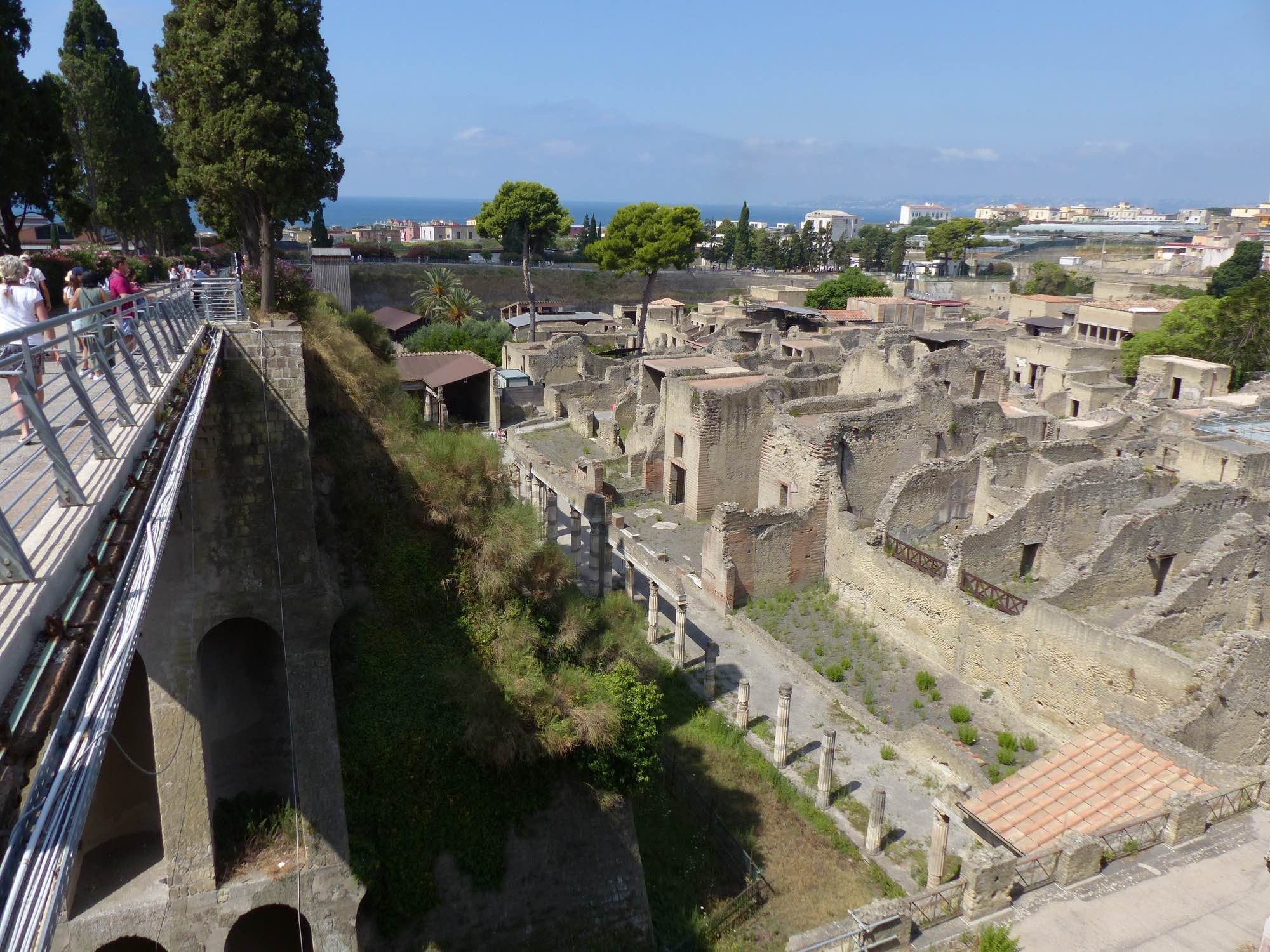
The scrolls belong to the wider archaeological setting of Herculaneum, whose surviving remains also include the city’s ancient shoreline. The villa’s library gives this buried Roman landscape a distinctive literary dimension: its contents include works that can be recovered from the objects themselves, even after the manuscripts ceased to circulate.
Unrolling the books could destroy the writing
Carbonisation helped the papyri survive, but left them brittle and difficult to handle. Pressure and deformation compressed their layers into irregular shapes. Early attempts to investigate the finds included splitting rolls lengthways; some objects were discarded because they were mistaken for pieces of charcoal. The losses began before suitable conservation methods were available.
In the eighteenth century, Antonio Piaggio devised a machine that gradually opened rolls with the aid of an attached supporting membrane. It recovered readable columns from some manuscripts, while the process also caused substantial damage. Later efforts to separate layers continued to expose writing at the cost of losing parts of the original object.
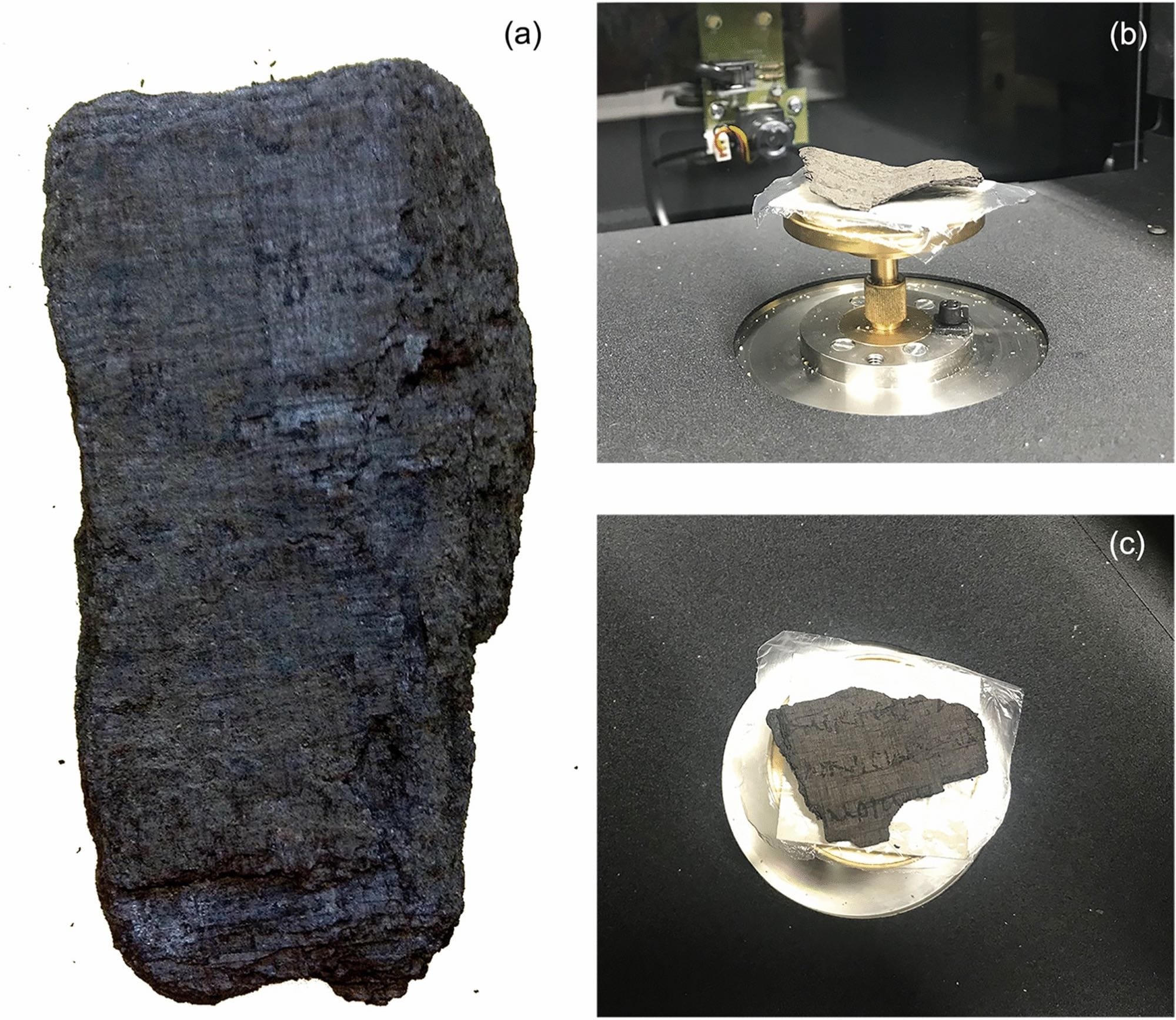
Fragments removed during these operations remain important research material. A 2021 study examined PHerc. 110, detached from a roll partially opened in 1867, and PHerc. 1103, from the damaged outer portion of another roll. Both contained compressed sheets that were stuck together, with only their external surfaces visible to ordinary inspection.
X-rays revealed the layers, then software flattened them
Virtual unfolding begins with a three-dimensional reconstruction from X-ray measurements. Researchers identify an individual papyrus sheet within that volume, trace its surface, and turn its distorted shape into a flat digital image. The original material remains rolled or compressed while the computer produces a surface on which writing can be studied.
This is a demanding geometric task. The 2021 investigation used a partly manual procedure to distinguish individual sheets and compared two mathematical methods for flattening them. The researchers checked their results against the papyrus fibres: a successful reconstruction should recover the crossing pattern created when plant strips were laid in perpendicular layers.
The choice of method depended on the fragment’s shape. One approach worked better for PHerc. 110, while both gave useful results for PHerc. 1103. Digital cuts helped reduce distortion in particularly complex surfaces. These operations explain why producing a readable page requires careful reconstruction of each object, beyond obtaining an X-ray image of its interior.
The ink posed a second problem
The predominant black ink was carbon-based, while the eruption had also carbonised its papyrus support. Their similar properties made the writing difficult to separate from the material beneath it in conventional X-ray images.
A study published in 2015 demonstrated that X-ray phase-contrast imaging could reveal Greek letters inside a rolled Herculaneum papyrus. The experiment exploited subtle differences that conventional absorption imaging struggled to show. Its results included small sequences of letters, providing an early demonstration of reading inside a roll while preserving its physical integrity.
Subsequent work combined improved imaging, surface reconstruction and machine learning to recover the ink signal. The manuscripts offer another route into ancient philosophy alongside the transmission described in our account of how Marcus Aurelius’ Meditations survived. At Herculaneum, the work begins with the physical remains of ancient books and the challenge of making their surfaces readable again.
The scroll research has advanced since the film
On 25 June 2026, the Vesuvius Challenge team announced that it had virtually unwrapped and read the surviving text of PHerc. 1667 continuously from beginning to end. The preserved object is the inner remnant of a larger roll damaged during earlier opening attempts. The announcement concerns that surviving portion, including the lower parts of about twenty-two columns.
The team interpreted its ethical discussion as belonging to a Stoic work, citing its language, themes and a reference to Aristocreon, the nephew and disciple of Chrysippus. The announcement also reported an author and title recovered from a different roll, PHerc. 139: Philodemus’ On Gods, Book 8. Those identifications show the range of philosophical material being investigated.
The film centres on recovering writing while preserving the carbonised books, a problem that continues to shape the project. The latest work extends that effort from isolated patches of text towards sustained readings of individual manuscripts, hoping to shed more light on these finds.


About the Roman Empire Times
See all the latest news for the Roman Empire, ancient Roman historical facts, anecdotes from Roman Times and stories from the Empire at romanempiretimes.com. Contact our newsroom to report an update or send your story, photos and videos. Follow RET on Google News, Flipboard and subscribe here to our daily email.
Follow the Roman Empire Times on social media: