
Annion and the Family Tombs of Roman-Era Chersonesus
A young woman’s probable identification connects human remains with a named family memorial in the cemetery outside Chersonesus.

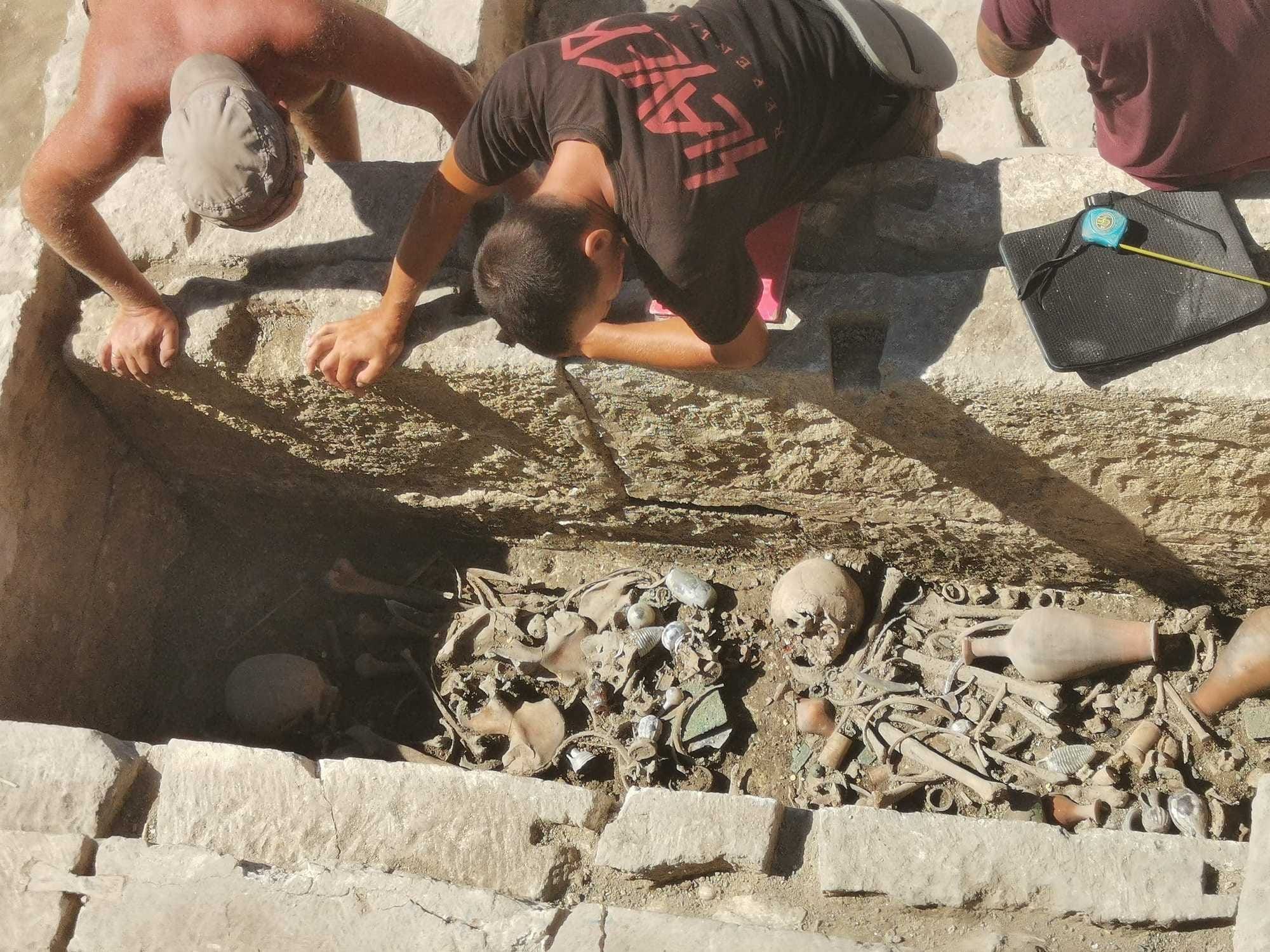
An inscribed grave marker names Annion, who died at eighteen, among the people commemorated in a Roman-era burial complex at Chersonesus. Researchers now associate her with a young woman whose remains were recovered from a substantial stone tomb in the settlement’s southern suburb.
The Institute for the History of Material Culture of the Russian Academy of Sciences announced its interpretation on 11 September 2026. The investigation combines the inscriptions, the human remains and objects deposited in the tomb, including jewellery, cosmetic containers and small figures.
The excavation campaign ran from 2021 to 2023. Annion’s monument had already appeared in a July 2022 report, beside one bearing the name Ariston, and in a published study of the cemetery in 2024. The September announcement presents further study of this excavated burial complex.
A Greek City in the Roman World
Chersonesus stood on the Heraclean Peninsula in south-western Crimea, on the northern shore of the Black Sea. Founded by Dorian Greeks in the fifth century BC, it became a trading city with an extensive agricultural hinterland. Its long history connected Greek, Roman and Byzantine communities with populations farther north.
The city’s surrounding territory, known as its chora, preserves the divisions of an agricultural landscape. Stone walls marked plots where vineyards supplied wine for export. UNESCO’s description treats the urban settlement and this countryside together, reflecting the relationship between the trading centre and the land supporting its economy.
Within the city, the archaeological remains include a regular street grid, houses, public buildings, fortifications and water systems from different periods. The Roman-era cemetery lay outside the defensive walls. Annion’s tomb belongs to this funerary landscape beyond the urban core, where monuments stood beside an approach to the city gates.
The Cemetery at the City Gates
The southern suburb contained an organized cemetery during the first centuries AD. Its most prestigious plots occupied positions close to the gates, alongside the road passing through the burial ground. Monumental structures in this area included the tombs identified with Ariston and Annion, as well as buildings associated with other prominent citizens.
A columbarium provided space for a wealthy family, while a round funerary building contained a sarcophagus and a lead urn. Another structure, an exedra, combined stone benches with burial chambers below. These buildings belonged to a cemetery in which both cremation and burial of the body were practised.
Farther south, excavators recorded simpler graves dug as pits or constructed as stone boxes. The 2024 study distinguishes these areas from the monumental plots nearer the entrance to the city. The differences concern the arrangement and construction of the cemetery as a whole; the neighbouring buildings were separate from Annion’s own tomb.
The Names on the Grave Markers
Four inscribed stelae provided the names used in the institute’s reconstruction of the memorial. Annion is identified as the daughter of Aeschines and granddaughter of Heroides, with her age at death given as eighteen. The other names are Ariston, son of Attina; Ariston, son of Ariston; and Boiscus, son of Ariston.
The repetition of names and the stated family relationships led researchers to propose a shared family or clan memorial area. Other evidence connects an Ariston with civic office, possibly as secretary of the city council. The institute presents the monuments as evidence for a family connected with the public life of Chersonesus.
The earlier report from July 2022 described the monument of Ariston as comprising a stele, base and pedestal, with Annion’s grave marker nearby. It also described the columbarium and its surviving burial niches. The names were therefore part of the excavation’s published record several years before the latest announcement about the young woman’s remains.
A Tomb Used More Than Once
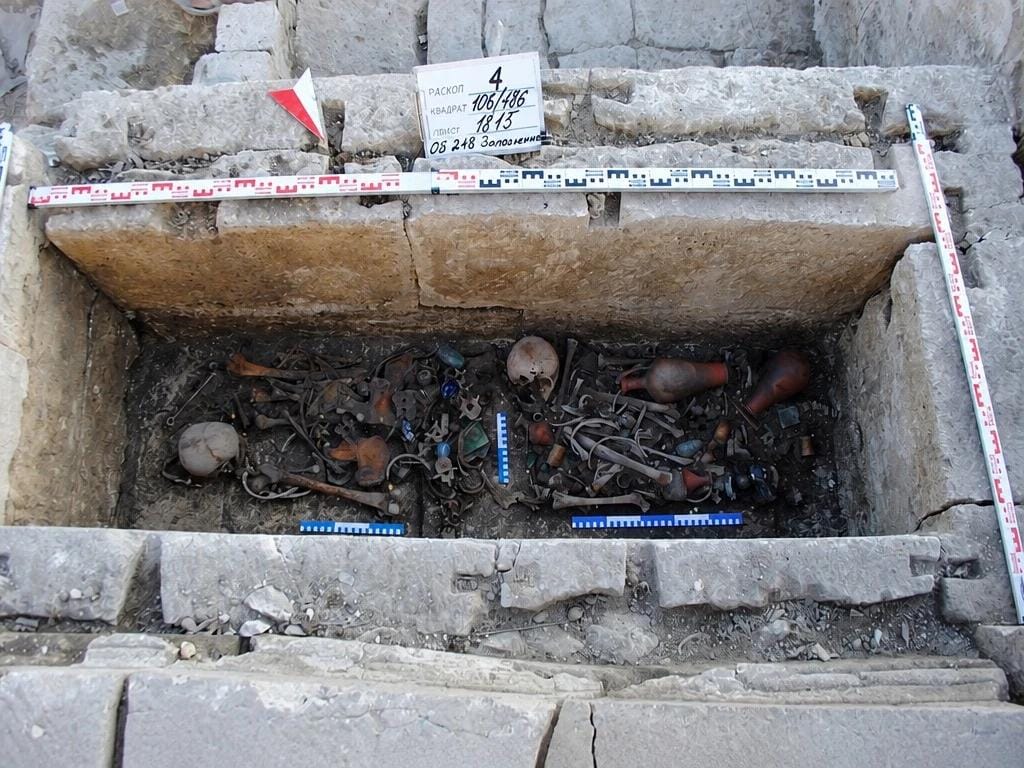
The stone-built tomb contained the remains of a young woman and a child estimated to have been six or seven years old. Researchers regard the woman’s identification as Annion as highly probable because her sex and young age agree with the inscription, and because of the grave marker’s position.
The institute reports that both sets of remains had been moved into the tomb after decomposition. The burial arrangement therefore involved the transfer of remains from an earlier resting place. The account does not identify a family relationship between the woman and child or establish the circumstances in which either died.
A stone-blocked opening in the front of the structure may have allowed further remains to be placed inside. Together with the transferred burials, this feature forms part of the researchers’ interpretation of a tomb used on more than one occasion. The identification of Annion remains a reconstruction from the archaeological and inscribed evidence.
Cosmetics and Jewellery Among the Burial Goods
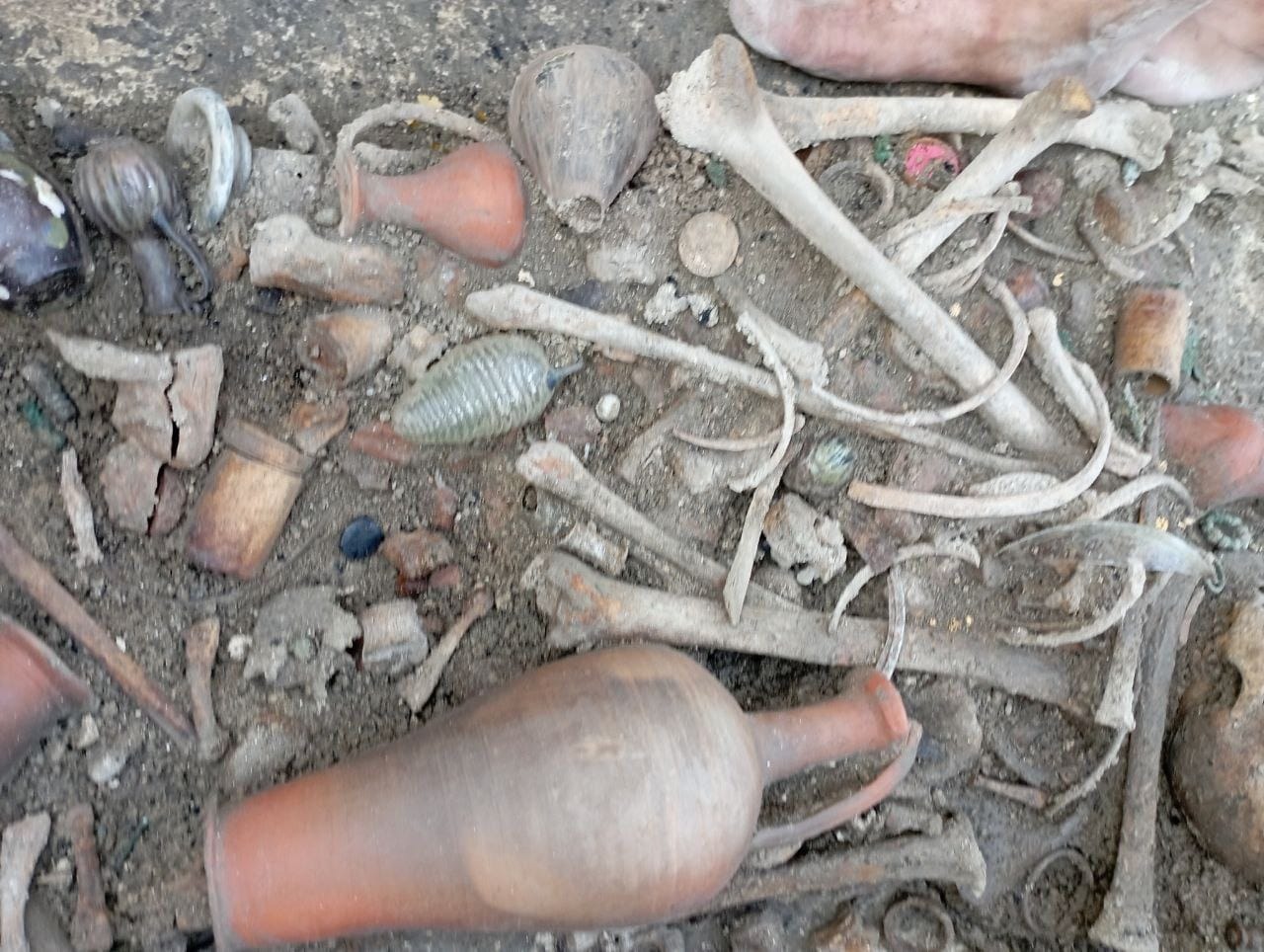
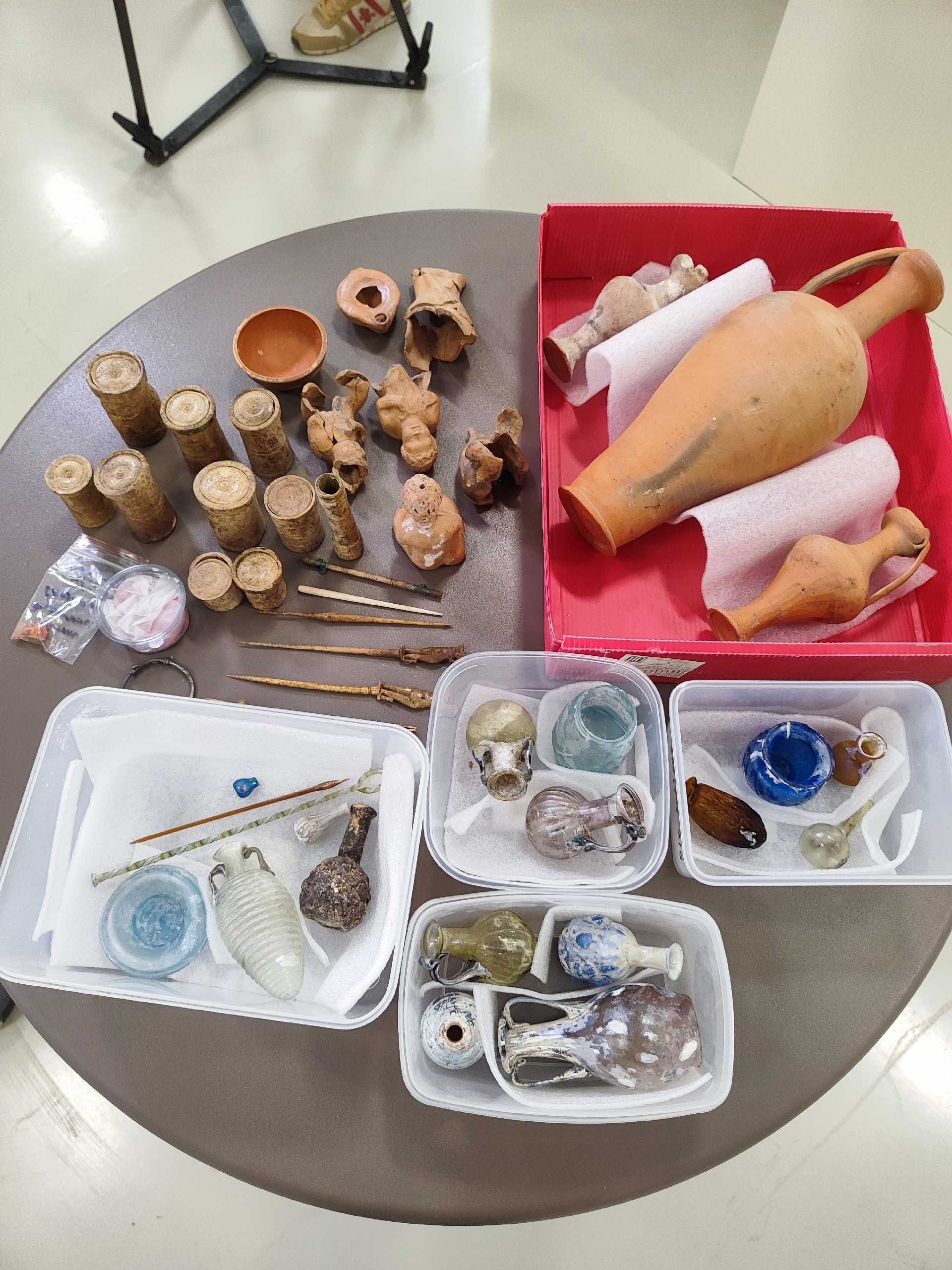
The burial goods included gold jewellery and clothing ornaments, a silver bracelet, glass vessels for oils and cosmetics, bone hairpins and the remains of a wooden box. Two small bone containers retained red and pink pigment, described in the report as rouge. The hairpins included representations of Aphrodite.
A terracotta figure showed a boy holding a dove. Beads and pendants were made from jet, carnelian, rock crystal, glass and faience, while a scarab, a miniature axe-shaped pendant and bronze bells belonged to a group interpreted as potentially protective objects. These finds accompanied the human remains in the tomb.
The assemblage is dated to the last third of the first century AD or the beginning of the second century. The memorial may have continued in use until the middle of the second century. These dates place the burial material earlier than a literal reading of the “1,800-year-old” description used in the recent news headline.
From Excavation to Museum Display
The 2024 study describes persistent difficulties caused by groundwater in the excavated area, including structures exposed below sea level. Its authors explain that funerary buildings were dismantled for later reassembly through anastylosis, the reconstruction of monuments using surviving architectural elements. This account concerns the treatment of the excavated cemetery’s structures.
According to the September report, Annion’s tomb has since been relocated near the entrance to the Museum of Antiquities and Byzantine Art. Its present display location is therefore separate from the original burial setting documented during excavation. The published plans and photographs record the relationship between the monuments in that setting.
The institute says the detailed findings are to appear in Materials on Archaeology and History of the Ancient and Medieval Black Sea Region. That planned publication is distinct from the broader cemetery study issued in 2024. For now, the announcement sets out the proposed identification, the transferred burials and the objects on which the interpretation rests.
Institute for the History of Material Culture, Russian Academy of Sciences. “Статуэтки, косметика и эпитафия помогли ученым ИИМК РАН раскрыть историю 18-летней жительницы древнего Херсонеса.” 11 September 2026
Natalia Solovyova, Sergey Solovyev, Viktor Vakhoneev, Anna Pokrovskaya and Yan Nizov. “The Southern Suburb of Tauric Chersonesos.” Hyperboreus 30.1 (2024), 20–44. DOI: 10.25990/hyperboreus.8108-1579
UNESCO World Heritage Centre. “Ancient City of Tauric Chersonese and its Chora.” Site description and Statement of Outstanding Universal Value
Valeria Chernykh. “Уникальные артефакты Южного пригорода Херсонеса.” Komsomolskaya Pravda, 15 July 2022
Dario Radley. “1,800-year-old Roman tomb at Chersonesus linked to an elite family memorial.” Archaeology News Online Magazine, 15 September 2026
About the Roman Empire Times
See all the latest news for the Roman Empire, ancient Roman historical facts, anecdotes from Roman Times and stories from the Empire at romanempiretimes.com. Contact our newsroom to report an update or send your story, photos and videos. Follow RET on Google News, Flipboard and subscribe here to our daily email.
Follow the Roman Empire Times on social media: