
Roman Nanotechnology: The Case of the Lycurgus Cup
The Lycurgus Cup combines myth, glass, and light into a single object whose colour changes with its environment. Through material behaviour rather than theory, it reveals how Roman craft exploited visual effects long before their physical causes were understood.

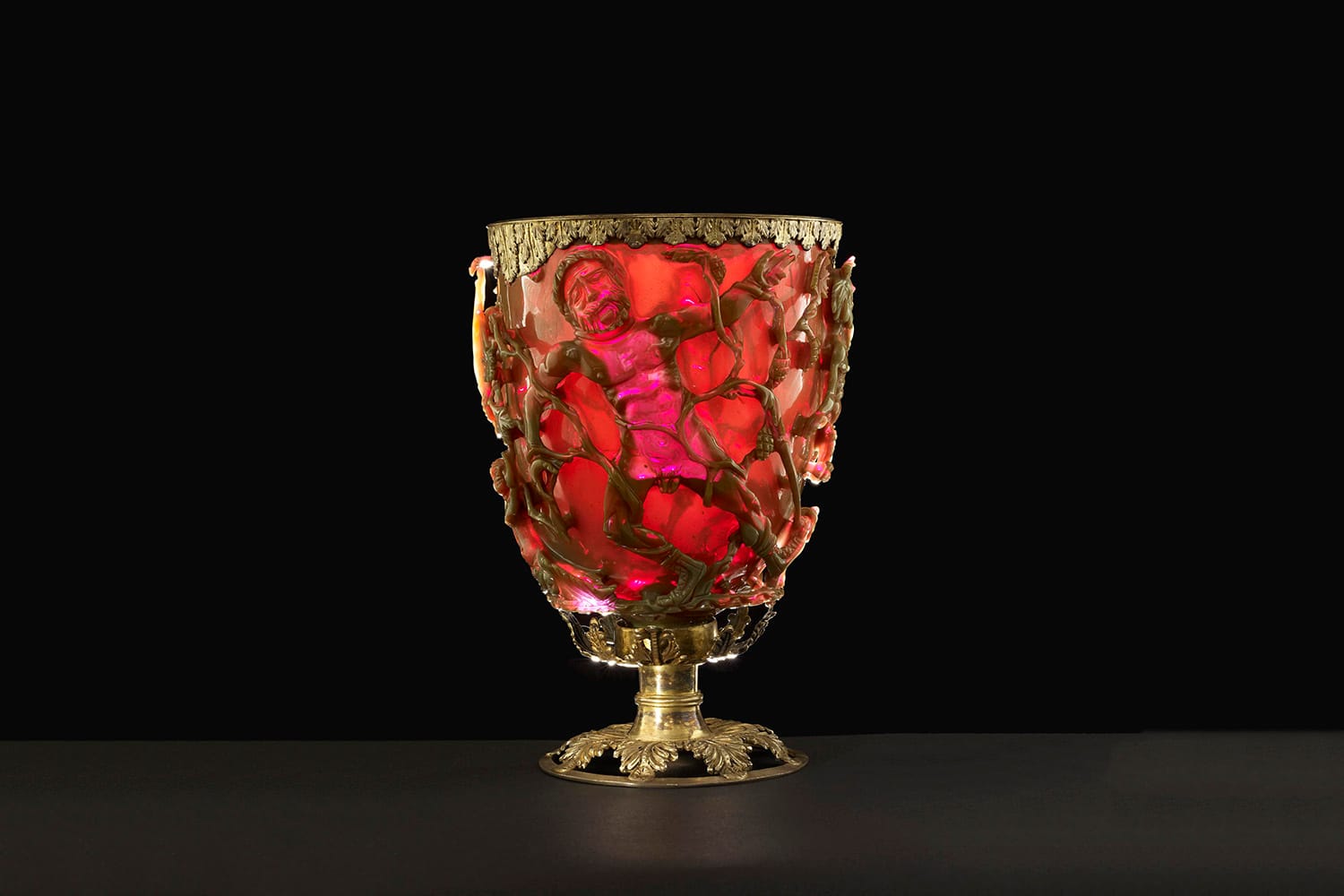
Objects from antiquity rarely unsettle modern categories. Most fit comfortably within what we think we know about ancient craft, technology, and intention. Occasionally, however, a single artefact resists easy classification. Preserved in glass, colour, and light, it invites questions that seem to belong as much to the present as to the past – about materials, knowledge, and the limits of ancient experimentation. The Lycurgus Cup is one such object.
A Glass Vessel with Unusual Optical Behaviour
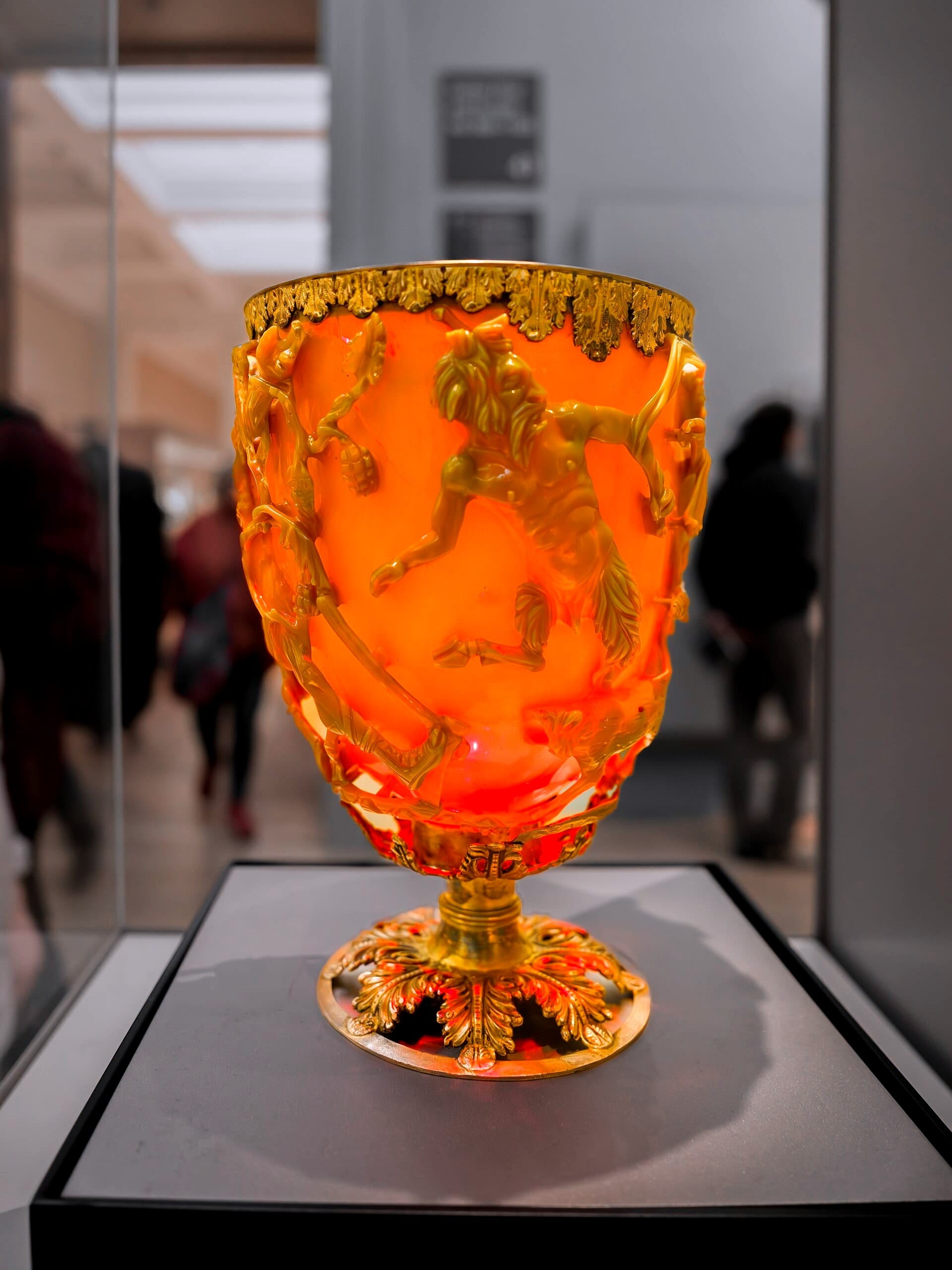
The Lycurgus Cup, generally dated to the fourth century CE, is the most elaborate surviving example of a Roman cage cup. It is made from standard Roman soda–lime–silica glass, but with the deliberate addition of trace amounts of gold and silver, alongside manganese compounds. These inclusions formed sub-microscopic metallic particles within the glass, producing an unusual optical effect. In reflected light the vessel appears opaque green, while in transmitted light it turns a translucent red.
This visual transformation is not a surface treatment but an intrinsic property of the material itself. The effect depends on the direction and intensity of light rather than on any applied colouring, making the cup one of the most technically complex glass objects known from antiquity.
Cutting, Relief, and the Manipulation of Light
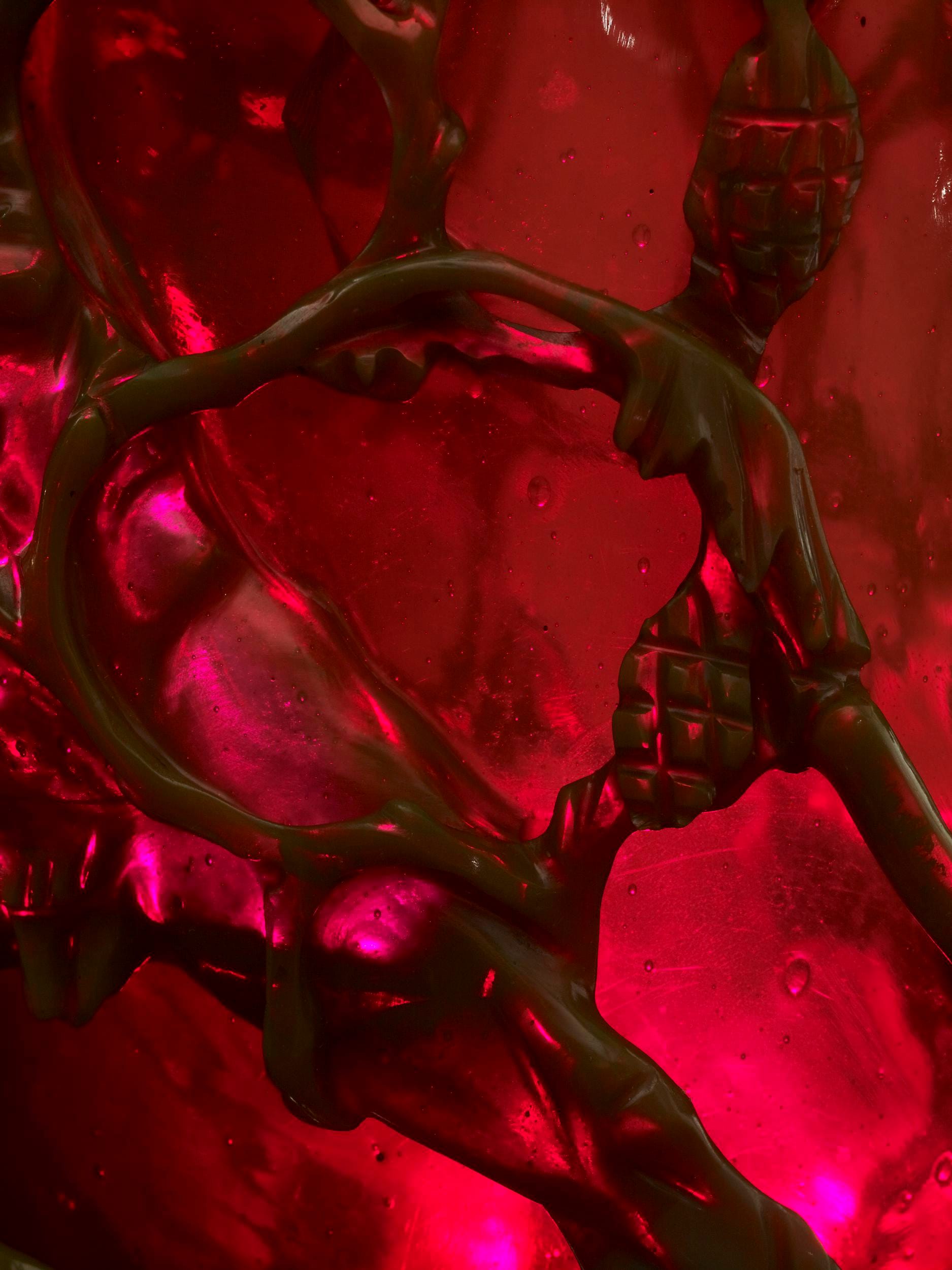
The cup was produced through a demanding multi-stage process. A thick blank was first cast and then extensively cut back to create a high-relief figural frieze, with deep undercutting typical of luxury diatreta glass. The figures were not only carved on the exterior but also hollowed and lightly polished on the interior. This thinning enhanced their luminosity when light passed through the vessel, allowing the sculpted forms to glow rather than simply reflect light.
The exceptional state of preservation reveals deliberate attention to how light would interact with depth, surface, and translucency. The visual effect was not incidental but carefully engineered.
Lycurgus and the Dionysiac Narrative
The imagery depicts the myth of Lycurgus, the Thracian king who opposed Dionysus. According to the version followed here, Lycurgus attacked the god’s followers and was punished when the nymph Ambrosia transformed into a vine that bound and trapped him. On the cup, Lycurgus appears entangled in vine shoots, flanked by figures from Dionysus’ retinue. Ambrosia lies at his side, Pan stands nearby with a panther, and Dionysus himself appears opposite the king.
The composition unfolds continuously around the vessel, encouraging the viewer to rotate the cup to follow the narrative. The choice of subject aligns closely with themes of wine, restraint, punishment, and divine power.
Contexts of Use: Banquet, Cult, or Display
The original context in which the Lycurgus Cup was used is unknown. Its Dionysiac imagery strongly suggests a sympotic setting, where mythological scenes related to wine often functioned as visual commentary on drinking itself. Other possibilities have been proposed, including ritual or cult use, but none can be demonstrated with certainty.
The form of the cup and the remains of its base support its identification as a drinking vessel rather than a lamp, though the play of transmitted light would also have made it visually striking in a dimly lit interior. It may have been passed around or displayed during elite gatherings rather than used routinely.
Colour, Wine, and Visual Play
The cup’s colour change invites interpretation within a banqueting context. In reflected light, its green tone evokes unripe grapes or white wine; in transmitted light, the red suggests mature grapes or red wine. This duality mirrors the Dionysiac themes of transformation and excess represented in the imagery.
The object thus combines material behaviour and narrative content into a single visual experience, one that responds dynamically to its environment rather than remaining visually static.
Although modern analysis identifies the cup as glass, its optical properties would have made its material ambiguous in antiquity. Ancient texts describe precious stones and vessels whose appearance altered under different lighting conditions, and glass with unusual visual effects could be perceived as comparable to rare minerals or crystal.
Before scientific testing was possible, the Lycurgus Cup was variously described as an object of uncertain material. Its colour shifts, translucency, and carved depth place it within a broader ancient fascination with luminous substances rather than within a simple hierarchy of materials.
Light Effects and Ancient Aesthetic Knowledge
Ancient literary descriptions of gems and luxury objects repeatedly emphasise changes in appearance caused by light, moisture, or movement. These accounts show a sustained interest in objects whose visual qualities were unstable and responsive. The Lycurgus Cup fits squarely within this aesthetic tradition.
Its behaviour under reflected and transmitted light corresponds closely to effects described for engraved gems and crystal vessels in sympotic and courtly contexts, where visual surprise and material ambiguity were prized.
Glass as an Experimental Medium
Roman glassmakers had long exploited the medium’s capacity for imitation and illusion. Earlier cameo glasses and luxury vessels demonstrate sustained experimentation with colour layering, relief, and translucency. The Lycurgus Cup extends this tradition by combining sculptural depth with material transformation.
Rather than representing a sudden technological anomaly, the cup reflects a long trajectory of Roman interest in pushing glass beyond utility into the realm of visual and conceptual play.
The Lycurgus Cup was not meant to be understood at a glance. Its imagery unfolds through movement, and its colour depends on light and position. Whether used actively or displayed, it demanded attention and rewarded close viewing.
In this sense, the cup exemplifies a broader Late Antique tendency for luxury objects to comment on their own use, material, and setting. Its technical sophistication serves not to announce innovation but to deepen the viewer’s engagement with myth, light, and substance. ("The Lycurgus Cup" by Jaś Elsner)
The Narrative Moment Chosen
The frieze on the Lycurgus Cup depicts a precise and unusual moment in the myth: not the attack on Dionysus, nor the outbreak of violence, but the onset of divine punishment already in motion. Lycurgus is shown disarmed, entangled, and overwhelmed, his resistance rendered futile. This choice distinguishes the cup from most earlier representations, which typically emphasise Lycurgus as an active aggressor.
Here, the narrative has already turned against him. The god’s revenge is no longer impending; it is unfolding.
This temporal positioning matters. The cup does not illustrate moral choice but moral consequence. Lycurgus’ fate is sealed, and the surrounding figures act not as participants in a struggle, but as agents or witnesses of divine justice.
Lycurgus as the Central Figure
At the centre of the composition stands Lycurgus himself, naked except for high-laced boots, stripped of weapons and authority. He is bound by living vines that coil around his body, immobilising him. His facial expression conveys fear rather than rage, and his raised hand forms a gesture associated with Roman imperial authority. Whether intentional or coincidental, this gesture complicates his role: Lycurgus is both tyrant and victim, ruler and condemned man.
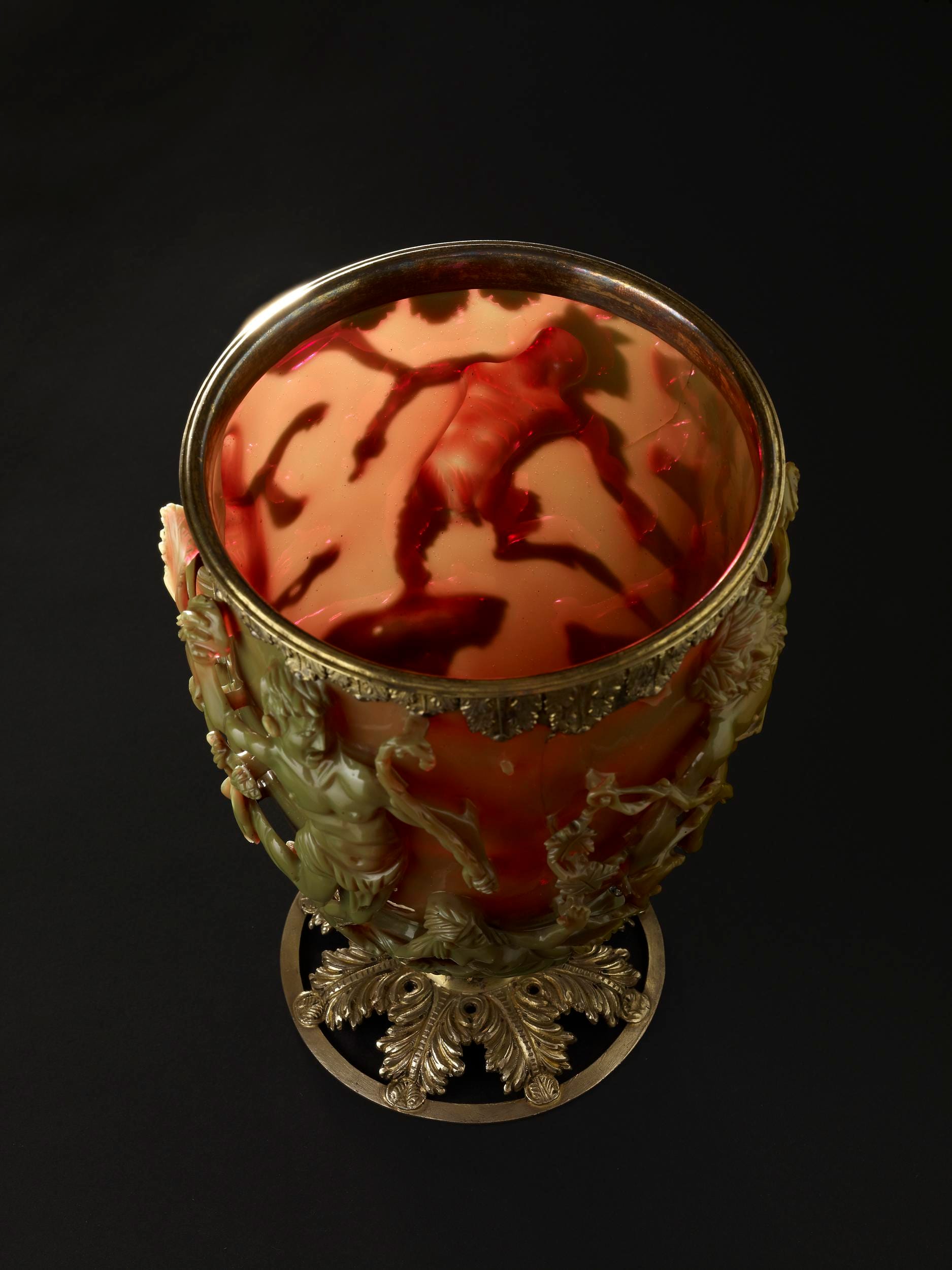
The imagery transforms the king into a visual warning. His power has failed him, and his former violence is rendered meaningless by the god he sought to destroy. The vine – the very source of wine – becomes the instrument of punishment.
Ambrosia and the Appeal to Earth
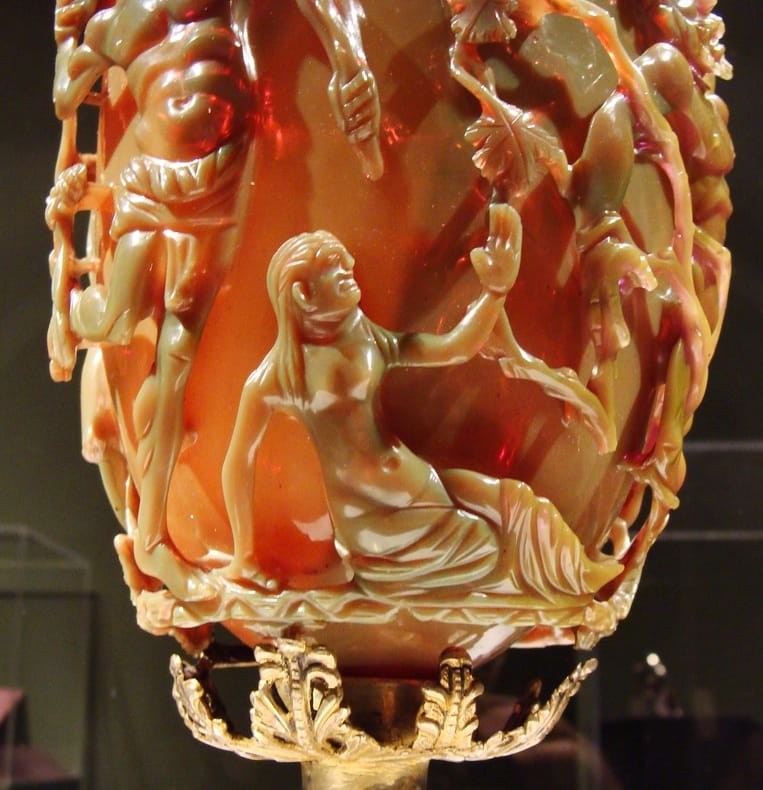
Ambrosia appears at Lycurgus’ side at the moment before her transformation. Her posture is low, her hand touching the ground, her other arm raised in supplication. She invokes Mother Earth as a protective force, a gesture well attested in Greek visual and literary traditions. In mythic terms, this appeal initiates the miracle: Ambrosia disappears into the earth and re-emerges as a grapevine.
Her role is crucial symbolically. Her name evokes immortality, nourishment, and divine sustenance. Through her transformation, the vine becomes not merely a plant but a vehicle of divine justice and eternal life, binding Lycurgus while affirming Dionysus’ creative power.
Dionysus and the Act of Judgment
Dionysus stands opposite Lycurgus, calm and composed. He wears a tunic, cloak, boots, and a mitra ribbon in his hair, and holds the thyrsus – an object associated with initiation into Dionysiac mysteries. His raised hand issues punishment rather than physical force. The god does not struggle; he commands.
This visual restraint reinforces Dionysus’ authority. The violence inflicted upon Lycurgus is not chaotic but ordered, sanctioned, and inevitable. The god’s role is judicial rather than emotional, underscoring the moral clarity of the scene.
The Supporting Figures: Satyr, Pan, and Panther
The Satyr and Pan mirror one another in pose and placement, creating visual rhythm across the frieze. Both raise a leg and arm, suggesting motion and tension, while remaining secondary to the central action. The Satyr’s stone and Pan’s association with wild nature reinforce the theme of Dionysian disorder unleashed against transgression.
The panther, a traditional companion of Dionysus, confronts Lycurgus directly. In Roman iconography, the panther often signifies divine punishment and ecstatic violence. Its presence near Dionysus strengthens the association between the god’s power and animal ferocity, reinforcing the inevitability of Lycurgus’ fate.
The frieze is carefully balanced. Figures are arranged in opposing groups, creating a symmetrical composition that contrasts order and chaos. Lycurgus stands between Ambrosia and the panther, caught between divine mercy and divine violence. Dionysus visually balances the combined figures of Lycurgus, Ambrosia, and the Satyr, while Pan mirrors the panther.
This symmetry is reinforced technically. The profiles of the four standing figures were hollowed and polished from the interior of the cup, making their faces and torsos more translucent under transmitted light. Ambrosia and the panther, smaller and lower in the composition, were hollowed only externally. The result is a hierarchy of luminosity that mirrors the narrative hierarchy of power.
In a banqueting context, the myth carries a dual warning. Lycurgus’ crime is not merely violence but rejection of Dionysus and his gift of wine. The frieze warns against both impiety and excess. Wine is a divine gift that brings joy, ecstasy, and community, but when rejected or abused, it leads to madness and destruction.
This moral ambivalence aligns with ancient sympotic ideology. Literary sources repeatedly frame wine as a force that must be approached with respect. The image of Lycurgus entangled by the vine makes the symbolism explicit: wine is both nourishment and danger, liberation and bondage.
Colour Change and Dionysiac Symbolism
The cup’s shift from green in reflected light to red in transmitted light reinforces the myth’s meaning. Green evokes unripe grapes, water, and restraint; red suggests ripeness, wine, blood, and intoxication. Ancient authors consistently linked these colours to Dionysian power, life, death, and rebirth.
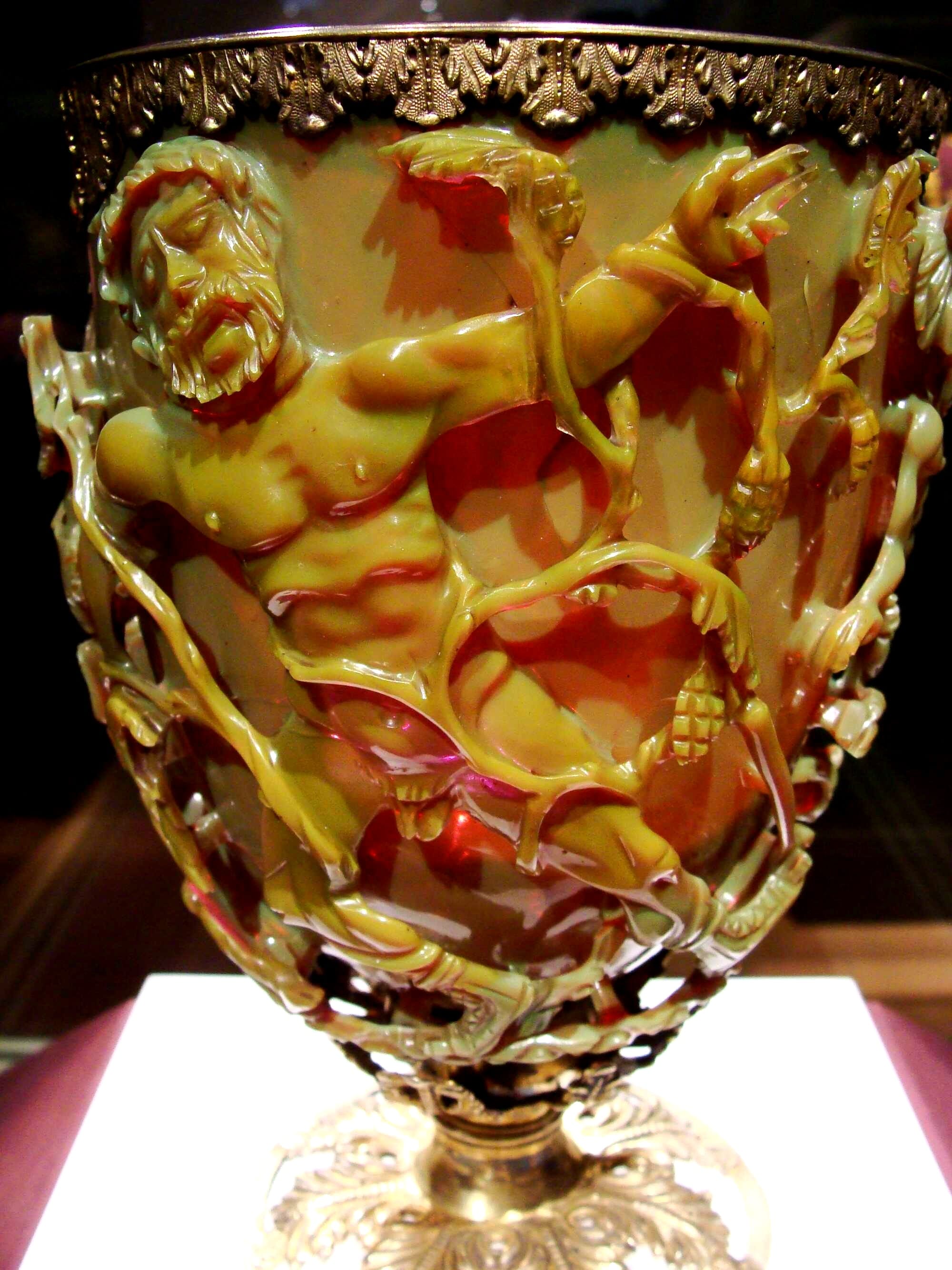
The transformation of colour parallels the transformation of Ambrosia and the fate of Lycurgus. It also reflects broader late antique ideas of renewal, aeternitas, and divine transformation. Whether filled with wine or illuminated by a lamp, the cup would have enacted the myth visually through light itself.
Meaning Made Visible
The decoration of the Lycurgus Cup is not illustrative but interpretative. It selects a charged narrative moment, organises it through symmetry and light, and embeds it within the physical behaviour of the material itself. Myth, ritual, and sensory experience converge.
The cup does not merely depict the punishment of Lycurgus. It performs it, repeatedly, whenever light passes through glass and wine fills the vessel. ("The symbolism of the Lycurgus Cup" by Maja Miziur-Moździoch. Institute of Archaeology and Ethnology Polish Academy of Sciences)
The Science Behind the Colour Change
The striking colour shift of the Lycurgus Cup is not the result of paint, staining, or surface treatment, but of the glass itself. Embedded within its matrix are minute particles of gold and silver, so small that they are measured in nanometres. These metallic nanoparticles are invisible individually, yet together they profoundly alter how the glass interacts with light.
When light strikes the surface of the cup and is reflected back to the eye, the nanoparticles scatter shorter wavelengths more strongly, giving the vessel its opaque green appearance. When light passes through the glass instead, different wavelengths dominate, and the cup appears translucent red. The colour change therefore depends entirely on lighting conditions rather than on any applied pigment.
This behaviour is explained by a physical phenomenon known as surface plasmon resonance. At very small scales, electrons on the surface of metallic particles oscillate in response to light. The precise colour produced depends on the size, shape, and composition of the particles, as well as their distribution within the glass. In the case of the Lycurgus Cup, the specific mixture of gold and silver nanoparticles produces two distinct optical responses, making the vessel dichroic.
One important consequence of this mechanism is durability. Unlike organic dyes or painted surfaces, which fade or degrade over time, colours produced by metallic nanoparticles are exceptionally stable. The optical effect is a property of the material itself and does not diminish with age. This explains why the Lycurgus Cup still displays its dramatic colour shift more than sixteen centuries after it was made, while many ancient painted objects have long since lost their original appearance.
Although the underlying chemistry was unknown in antiquity, Roman glassmakers were clearly capable of controlling the process with remarkable precision. The consistent colour behaviour of the cup suggests deliberate experimentation rather than accident. Trace amounts of precious metals were introduced into the molten glass, producing effects that could only be fully appreciated once the vessel was complete and exposed to changing light.
From a modern perspective, the Lycurgus Cup stands as one of the earliest known examples of functional nanostructured material. Its makers did not work from theoretical models, but from empirical knowledge acquired through practice. The result is an object in which artistic ambition, technical skill, and material behaviour are inseparably intertwined – a luxury vessel whose visual impact depends as much on physics as on myth.
The Lycurgus Cup does not reveal a lost scientific theory, nor does it anticipate modern physics in any direct sense. What it demonstrates instead is the depth of Roman engagement with material behaviour through practice, observation, and skilled manipulation. Glass, myth, light, and ritual are fused into a single object whose effects unfold only in use. Its power lies not in innovation declared, but in phenomena made visible – an artefact that continues to reward attention precisely because it resists simple explanation.
About the Roman Empire Times
See all the latest news for the Roman Empire, ancient Roman historical facts, anecdotes from Roman Times and stories from the Empire at romanempiretimes.com. Contact our newsroom to report an update or send your story, photos and videos. Follow RET on Google News, Flipboard and subscribe here to our daily email.
Follow the Roman Empire Times on social media: